
MEC-250 · Lesson 2 of 12 · 30 min
Crystal structures and X-ray diffraction
The gears in Kestrel's heavy-duty gearboxes are carburized: their surfaces are enriched with carbon, quenched and tempered to make a hard, wear-resistant case over a tough core. One of Jonah's routine checks on each furnace load is a measurement of retained austenite, the fraction of the case that failed to transform to martensite during the quench. Too much retained austenite and the case is soft and dimensionally unstable; it can transform later in service and cause the gear to grow and crack. The measurement is made with an X-ray diffractometer, and it works because austenite and martensite have different crystal structures that scatter X-rays at different angles. To understand the measurement, and much else in this course, we need the language of crystal structures.
Crystalline and amorphous solids
In a crystalline solid, the atoms are arranged in a pattern that repeats in three dimensions over long distances. Metals, most ceramics and some regions of many polymers are crystalline. In an amorphous or non-crystalline solid, such as window glass or an amorphous polymer, the atoms have only short-range order: each atom has roughly the same number of neighbors at roughly the same distance, but there is no repeating pattern beyond a few atoms. Whether a material crystallizes depends on how complex its structure is and how fast it is cooled. Silica cooled slowly from the melt can crystallize, but it usually forms glass because its network is hard to organize. Some metal alloys can be made amorphous by cooling them at a million degrees per second.
To describe a crystal, we use a lattice, an infinite array of points each with identical surroundings, and a basis, the group of atoms attached to each lattice point. The smallest repeating unit that shows the full symmetry of the structure is the unit cell. For most metals the unit cell is a cube or a hexagonal prism, and the basis is one atom per lattice point. In the hard-sphere model, atoms are treated as solid spheres that touch their nearest neighbors. It is a simplification, but it gives remarkably good predictions of densities and lattice dimensions.
The three common metallic structures
Because metallic bonding is non-directional, metal atoms tend to pack as tightly as possible, with many nearest neighbors. Most engineering metals adopt one of three structures.
In the face-centered cubic (FCC) structure, atoms sit at the eight corners of a cube and at the center of each of its six faces. Each corner atom is shared by eight cells and each face atom by two, so the cell contains \(8 \times \tfrac{1}{8} + 6 \times \tfrac{1}{2} = 4\) atoms. Atoms touch along the face diagonals, so \(4R = a\sqrt{2}\), or \(a = 2R\sqrt{2}\). Each atom has 12 nearest neighbors, the coordination number. Aluminum, copper, nickel, silver, gold, lead and austenitic stainless steel are FCC.
In the body-centered cubic (BCC) structure, atoms sit at the corners and one at the center of the cube, giving \(8 \times \tfrac{1}{8} + 1 = 2\) atoms per cell. Atoms touch along the body diagonal, so \(4R = a\sqrt{3}\). The coordination number is 8. Iron at room temperature, chromium, tungsten, molybdenum and vanadium are BCC.
In the hexagonal close-packed (HCP) structure, the unit cell is a hexagonal prism with atoms at the corners and centers of the top and bottom faces and three atoms in a plane halfway up. The cell contains 6 atoms and each has 12 nearest neighbors. For ideal packing the ratio of cell height to base edge is \(c/a = 1.633\); real HCP metals depart a little from this. Titanium at room temperature, magnesium, zinc and cobalt are HCP.
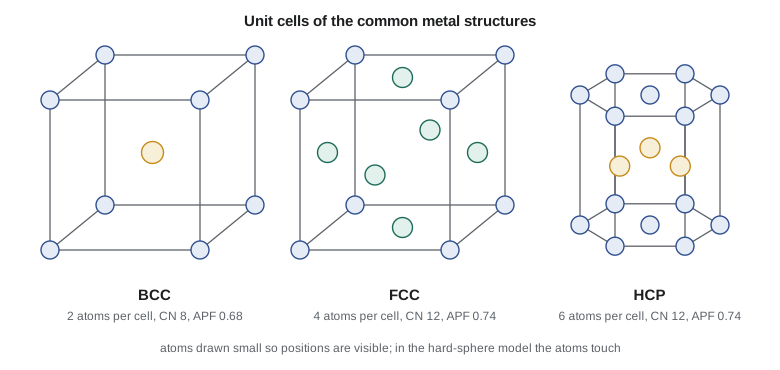
The atomic packing factor (APF) is the fraction of the cell volume occupied by the hard spheres. For FCC it is 0.74, the highest possible for spheres of one size, and HCP has the same value; both are close-packed structures, differing only in how the close-packed layers are stacked. BCC is less densely packed, with an APF of 0.68. This difference matters later: close-packed structures have more slip systems and different diffusion rates, and the change in packing when iron transforms between BCC and FCC causes a measurable change in volume.
Worked problem
Packing factor of BCC
Show that the atomic packing factor of the BCC structure is 0.68.
Show solution
- There are 2 atoms per cell, each of volume \(\tfrac{4}{3}\pi R^3\). The cell edge is \(a = 4R/\sqrt{3}\), so the cell volume is \(a^3 = 64R^3/(3\sqrt{3})\).
- \[\text{APF} = \frac{2 \times \tfrac{4}{3}\pi R^3}{64R^3/(3\sqrt{3})} = \frac{\sqrt{3}\,\pi}{8} = 0.680\]
Answer: About a third of the BCC cell is empty space. Small atoms such as carbon and nitrogen fit into some of that space as interstitial atoms, which is central to the behavior of steel.
Calculating density from crystal structure
If we know the crystal structure, the atomic radius and the atomic mass, we can calculate the theoretical density. The mass in one cell is the number of atoms \(n\) times the mass of one atom, \(A/N_A\), and the volume is \(V_C\):
Worked problem
Density of iron and aluminum
Calculate the densities of BCC iron (\(R = 0.1241\ \text{nm}\), \(A = 55.85\ \text{g/mol}\)) and FCC aluminum (\(R = 0.1431\ \text{nm}\), \(A = 26.98\ \text{g/mol}\)), and express them in pounds per cubic inch.
Show solution
- Iron: \(a = 4(0.1241)/\sqrt{3} = 0.2866\ \text{nm} = 2.866 \times 10^{-8}\ \text{cm}\), so \(V_C = 2.354 \times 10^{-23}\ \text{cm}^3\).
- \[\rho_{\text{Fe}} = \frac{2 \times 55.85}{(2.354 \times 10^{-23})(6.022 \times 10^{23})} = 7.88\ \text{g/cm}^3\]
- Aluminum: \(a = 2\sqrt{2}(0.1431) = 0.4047\ \text{nm}\), so \(V_C = 6.630 \times 10^{-23}\ \text{cm}^3\) and \(\rho_{\text{Al}} = 4(26.98)/(6.630 \times 10^{-23} \times 6.022 \times 10^{23}) = 2.70\ \text{g/cm}^3\).
Answer: The measured values are 7.87 and 2.70 g/cm³. Multiplying by 0.03613 converts g/cm³ to lb/in³: iron is 0.284 lb/in³ and aluminum 0.0975 lb/in³, the familiar values in US design handbooks. Aluminum has about a third of the density of iron even though its cell holds twice as many atoms, because each aluminum atom has less than half the mass of an iron atom.
Polymorphism: iron's change of structure
Some elements and compounds have more than one crystal structure, depending on temperature and pressure. This is called polymorphism, or allotropy for pure elements. Iron is the most important example in engineering. Below 912 °C it is BCC, called ferrite or alpha iron. Between 912 °C and 1394 °C it is FCC, called austenite or gamma iron. From 1394 °C to the melting point at 1538 °C it is BCC again, called delta iron. The change from FCC to BCC on cooling makes almost all the heat treatment of steel possible, as Lesson 8 will show, because the two structures dissolve very different amounts of carbon.
Polymorphic changes also change volume. Using lattice parameters near 912 °C, the volume per atom in BCC iron is about 1.4 percent larger than in FCC iron, so iron expands slightly as it cools through the transformation, against the general trend of thermal contraction. In a quenched steel part, where the outside transforms before the inside, these volume changes produce internal stresses that can distort or crack the part. Ceramics show the same effect: pure zirconia changes from a tetragonal to a monoclinic structure on cooling with a volume increase of several percent, enough to shatter it, which is why zirconia for engineering use is stabilized with additions such as yttria.
Crystallographic directions and planes
Many properties depend on direction within a crystal, so we need a way to name directions and planes. For a direction, place a vector through the origin of the unit cell, write the coordinates of a point on it in units of the cell edges, clear fractions to the smallest integers, and enclose them in square brackets, such as \([100]\), \([110]\) or \([111]\). A negative index is written with a bar over it, shown here as \([\bar{1}10]\). A family of equivalent directions, related by the symmetry of the crystal, is written in angle brackets, such as \(\langle 111 \rangle\).
For a plane, use Miller indices. Find where the plane cuts the three axes in units of the cell edges, take the reciprocals of these intercepts (a plane parallel to an axis has an intercept at infinity and a reciprocal of zero), clear fractions, and enclose the result in parentheses, such as \((100)\), \((110)\) or \((111)\). If the plane passes through the origin, move the origin to a neighboring corner first. A family of equivalent planes is written in braces, such as \(\{111\}\). In cubic crystals, the direction \([hkl]\) is perpendicular to the plane \((hkl)\), a convenient fact that does not hold for other crystal systems.
Planes and directions differ in how densely they are packed with atoms. The linear density of a direction is the number of atoms per unit length whose centers lie on it; the planar density of a plane is the number of atoms per unit area. In FCC crystals, the \(\{111\}\) planes and \(\langle 110 \rangle\) directions are close-packed. In BCC, the most densely packed planes are \(\{110\}\) and the close-packed directions are \(\langle 111 \rangle\). These close-packed planes and directions are where slip happens most easily, which is the subject of Lesson 5.
Worked problem
Planar density of the FCC (111) plane
Calculate the planar density of the (111) plane in FCC nickel, with \(R = 0.1246\ \text{nm}\).
Show solution
- The (111) plane within the cell is an equilateral triangle with sides equal to the face diagonal, \(4R\). Its corner atoms contribute \(3 \times \tfrac{1}{6} = \tfrac{1}{2}\) atom and its edge-center atoms \(3 \times \tfrac{1}{2} = 1.5\) atoms, so it contains 2 atoms.
- The area of an equilateral triangle of side \(4R\) is \(\tfrac{\sqrt{3}}{4}(4R)^2 = 4\sqrt{3}R^2\).
- \[\text{PD}_{111} = \frac{2}{4\sqrt{3}R^2} = \frac{1}{2\sqrt{3}\,(0.1246)^2} = 18.6\ \text{atoms/nm}^2\]
Answer: For comparison, the (100) plane of the same crystal has \(2/a^2 = 2/(8R^2) = 16.1\ \text{atoms/nm}^2\). The (111) plane is the densest plane in FCC, which is why it is the slip plane.
Single crystals, polycrystals and anisotropy
A single crystal has one continuous lattice throughout. Single crystals are used where grain boundaries would be harmful: turbine blades in jet engines are cast as single crystals of nickel superalloy so that there are no boundaries for creep to act on, and silicon wafers for electronics are single crystals. Most engineering metals, however, are polycrystalline, made of many grains with different orientations, separated by grain boundaries where the lattice orientation changes over a few atomic distances.
Because atomic packing varies with direction, many single-crystal properties are anisotropic. The elastic modulus of iron, for example, is about 125 GPa along a \(\langle 100 \rangle\) direction and about 273 GPa along \(\langle 111 \rangle\). In a polycrystal with randomly oriented grains, these directional differences average out, and the material behaves isotropically, with a modulus of about 210 GPa for steel. If processing aligns the grains in a preferred orientation, called texture or crystallographic texture, the material becomes anisotropic again. Rolled aluminum sheet for beverage cans has a controlled texture, because an uncontrolled one produces wavy edges called earing when the cans are drawn.
X-ray diffraction
X-rays have wavelengths of about 0.05 to 0.25 nm, comparable to the spacing of atomic planes. When an X-ray beam strikes a crystal, each plane of atoms scatters a small part of it. The scattered waves reinforce one another only in particular directions, where the path difference between waves reflected from neighboring planes is a whole number of wavelengths. This is Bragg's law:
Here \(\lambda\) is the X-ray wavelength, \(d_{hkl}\) the spacing between adjacent \((hkl)\) planes, \(\theta\) the angle between the incident beam and the planes, and \(n\) the order of reflection, usually taken as 1. For cubic crystals the plane spacing follows from the lattice parameter:
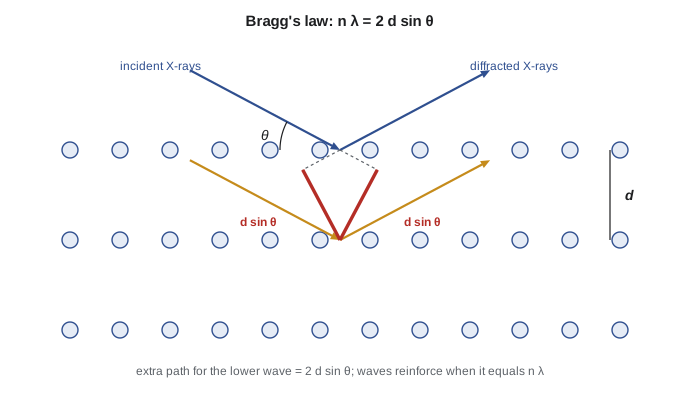
Not every plane produces a peak. In BCC and FCC cells, atoms at the body or face centers scatter waves that cancel those from the corners for certain planes. The rules are simple: in BCC, reflections occur only when \(h + k + l\) is even; in FCC, only when \(h\), \(k\) and \(l\) are all odd or all even. A diffractometer measures intensity against the angle \(2\theta\), producing a pattern of peaks that acts as a fingerprint of the crystal structure and lattice parameter.
Worked problem
First diffraction peak of ferrite
Copper K-alpha radiation (\(\lambda = 0.1541\ \text{nm}\)) is used on BCC iron with \(a = 0.2866\ \text{nm}\). At what angle \(2\theta\) does the (110) peak appear?
Show solution
- \(d_{110} = 0.2866/\sqrt{2} = 0.2027\ \text{nm}\).
- \[\sin\theta = \frac{\lambda}{2d} = \frac{0.1541}{2(0.2027)} = 0.3801 \quad\Rightarrow\quad \theta = 22.34^\circ,\ 2\theta = 44.7^\circ\]
Answer: The (110) peak of ferrite, and of martensite, which has a slightly distorted version of the same structure, appears near 44.7°. The strongest austenite peak, (111) of an FCC lattice with \(a \approx 0.36\ \text{nm}\), appears near 43.5°, close but separate. Comparing the integrated intensities of several austenite and martensite peaks gives the retained austenite fraction, which is how Jonah's lab checks each gear load.
# Cubic crystals: lattice parameter, density and X-ray diffraction peak positions
import math

NA = 6.022e23
metals = {   # name: (structure, atomic radius nm, atomic mass g/mol)
    'Fe (alpha)': ('BCC', 0.1241, 55.85),
    'Al':         ('FCC', 0.1431, 26.98),
    'Cu':         ('FCC', 0.1278, 63.55),
    'Ni':         ('FCC', 0.1246, 58.69),
    'Cr':         ('BCC', 0.1249, 52.00),
}
info = {'BCC': (2, lambda R: 4 * R / math.sqrt(3), 0.68),
        'FCC': (4, lambda R: 2 * math.sqrt(2) * R, 0.74)}

print("metal       cell  a (nm)   density (g/cm3)  (lb/in3)")
for name, (st, R, A) in metals.items():
    n, a_of_R, apf = info[st]
    a = a_of_R(R)
    rho = n * A / ((a * 1e-7) ** 3 * NA)          # nm -> cm
    print(f"{name:11s} {st}  {a:.4f}   {rho:6.2f}           {rho * 0.036127:.4f}")

def allowed(st, h, k, l):
    if st == 'BCC':
        return (h + k + l) % 2 == 0
    if st == 'FCC':
        return len({h % 2, k % 2, l % 2}) == 1
    return True

def peaks(st, a, lam=0.15406, smax=12):
    seen = {}
    for h in range(0, 5):
        for k in range(0, h + 1):
            for l in range(0, k + 1):
                s = h * h + k * k + l * l
                if s == 0 or s > smax or s in seen or not allowed(st, h, k, l):
                    continue
                d = a / math.sqrt(s)
                x = lam / (2 * d)
                if x <= 1:
                    seen[s] = (f"({h}{k}{l})", d, 2 * math.degrees(math.asin(x)))
    return [seen[s] for s in sorted(seen)]

for name in ('Fe (alpha)', 'Al'):
    st, R, A = metals[name]
    a = info[st][1](R)
    print(f"\n{name}, {st}, a = {a:.4f} nm, copper K-alpha radiation (0.15406 nm)")
    print("  plane    d (nm)   2-theta (deg)")
    for hkl, d, tt in peaks(st, a):
        print(f"  {hkl:7s} {d:.4f}   {tt:6.2f}")

# Volume change when iron transforms from FCC (gamma) to BCC (alpha) on cooling
aF, aB = 0.3591, 0.2863        # approximate lattice parameters near 912 C (nm)
vF, vB = aF ** 3 / 4, aB ** 3 / 2   # volume per atom
print(f"\nvolume per atom: FCC {vF * 1000:.4f}, BCC {vB * 1000:.4f} (x 1e-3 nm3); change {100 * (vB - vF) / vF:+.1f} %")metal cell a (nm) density (g/cm3) (lb/in3) Fe (alpha) BCC 0.2866 7.88 0.2847 Al FCC 0.4047 2.70 0.0976 Cu FCC 0.3615 8.94 0.3229 Ni FCC 0.3524 8.91 0.3218 Cr BCC 0.2884 7.20 0.2600 Fe (alpha), BCC, a = 0.2866 nm, copper K-alpha radiation (0.15406 nm) plane d (nm) 2-theta (deg) (110) 0.2027 44.68 (200) 0.1433 65.03 (211) 0.1170 82.35 (220) 0.1013 98.97 (310) 0.0906 116.41 (222) 0.0827 137.20 Al, FCC, a = 0.4047 nm, copper K-alpha radiation (0.15406 nm) plane d (nm) 2-theta (deg) (111) 0.2337 38.49 (200) 0.2024 44.75 (220) 0.1431 65.14 (311) 0.1220 78.28 (222) 0.1168 82.49 volume per atom: FCC 11.5767, BCC 11.7337 (x 1e-3 nm3); change +1.4 %
Diffraction is used for much more than identifying phases. Shifts in peak position measure residual stress, because stress changes the plane spacing; shot-peened springs and gears are checked this way. Peak broadening reveals very fine grain sizes and severe cold work. And the pattern from an unknown corrosion product or inclusion can be matched against databases of known compounds, a common step in failure analysis.
Common mistakes
MistakeCounting every atom drawn in a unit cell as belonging wholly to it.
InsteadCorner atoms count 1/8, edge atoms 1/4 and face atoms 1/2.
MistakeUsing a = 4R/√3 for FCC.
InsteadFor FCC, atoms touch along the face diagonal: a = 2R√2. The body diagonal applies to BCC.
MistakeWriting Miller indices from the intercepts rather than their reciprocals.
InsteadTake reciprocals of the intercepts, then clear fractions.
MistakeExpecting a (100) peak in the diffraction pattern of an FCC or BCC metal.
InsteadIt is forbidden in both; the first BCC peak is (110) and the first FCC peak is (111).
MistakeAssuming polycrystalline metals are always isotropic.
InsteadRolling, drawing and other processes can create texture and directional properties.
Summary and key terms
- Crystalline solids have long-range order; amorphous solids have only short-range order.
- FCC (4 atoms, CN 12, APF 0.74), BCC (2 atoms, CN 8, APF 0.68) and HCP (6 atoms, CN 12, APF 0.74) cover most metals.
- Theoretical density is ρ = nA/(V_C N_A).
- Iron is BCC below 912 °C, FCC from 912 °C to 1394 °C, and BCC again up to melting.
- Directions use [uvw] and planes use Miller indices (hkl); in cubic crystals [hkl] is normal to (hkl).
- Close-packed planes and directions are where slip occurs most easily.
- Bragg's law, nλ = 2d sin θ, with structure-dependent selection rules, identifies phases and measures lattice parameters and stresses.
- Unit cell
- The smallest repeating unit that shows the full symmetry of a crystal.
- Coordination number
- The number of nearest neighbors of an atom.
- Atomic packing factor
- The fraction of cell volume occupied by atoms in the hard-sphere model.
- Polymorphism
- The existence of more than one crystal structure for the same material.
- Miller indices
- Integers (hkl) naming a crystal plane, from the reciprocals of its intercepts.
- Anisotropy
- Dependence of a property on direction.
- Texture
- A preferred orientation of the grains in a polycrystal.
- Bragg's law
- The condition nλ = 2d sin θ for constructive interference of X-rays scattered by crystal planes.
Practice problems
Work each problem on paper first, then reveal the answer to check.
Calculate the lattice parameter and density of FCC copper (R = 0.1278 nm, A = 63.55 g/mol).
Show answer
a = 0.3615 nm; ρ = 8.94 g/cm³.
How many atoms per unit cell, and what coordination number, does HCP have?
Show answer
6 atoms; coordination number 12.
Give the Miller indices of a plane with intercepts 1, 1/2 and ∞ on the x, y and z axes.
Show answer
Reciprocals 1, 2, 0: the (120) plane.
Which of these planes give peaks for a BCC metal: (100), (110), (111), (200), (211)?
Show answer
(110), (200) and (211).
For BCC iron with copper radiation (0.1541 nm), find 2θ for the (200) peak.
Show answer
d = 0.1433 nm, sin θ = 0.5377, 2θ ≈ 65.0°.
Why does a steel part expand slightly as it cools through about 912 °C?
Show answer
FCC austenite changes to less densely packed BCC ferrite, which has about 1.4 % more volume per atom.
Lesson quiz · 5 questions
Score 60% or more to complete this lesson.
Create a free account to save your progress, take quizzes and earn a certificate.