
MEC-250 · Lesson 1 of 12 · 28 min
Materials, structure and atomic bonding
Amira Haddad started her co-op term at Kestrel Drive Systems in Peoria, Illinois, on a Monday. By Wednesday she was holding a broken tractor power take-off shaft. Kestrel designs and builds gearboxes, shafts and hydraulic cylinders for farm and forestry machines, and the shaft had come back from a dealer with a clean, flat fracture across one end. Jonah Mercer, the plant's materials and process engineer, handed it to her with a question rather than an answer: why did this steel part break, when a hundred thousand others like it did not? Answering that question takes the whole of this course. The answer depends on how the atoms in the steel are bonded, how they are arranged, what defects the arrangement contains, how the part was heat treated and how it was loaded. Materials science is the study of those links between structure, processing, properties and performance.
Why mechanical engineers study materials
Every design decision a mechanical engineer makes ends in a material. A shaft diameter is chosen from an allowable stress, and the allowable stress comes from the material's yield strength and fatigue limit. A housing wall thickness depends on stiffness, which comes from the elastic modulus. A seal works only if its polymer stays flexible at the lowest temperature the machine will see. Choosing the material, and the process that gives it its final structure, is often the decision with the largest effect on cost, weight, reliability and environmental footprint. Engineers who treat material properties as fixed numbers from a handbook miss the most useful fact in the subject: properties are not fixed. They are set by structure, and structure is set by processing.
The same steel bar can be soft enough to bend by hand or hard enough to cut glass, depending only on how it was heated and cooled. The same polymer can be clear and brittle or tough and cloudy, depending on how fast it cooled in the mold. This lesson builds the foundation for those ideas: the classes of engineering materials, the levels of structure that control their behavior, and the atomic bonding that sets their most basic properties.
The structure–processing–properties–performance chain
Materials engineers often draw the field as four linked ideas. Processing (casting, forging, machining, heat treatment, molding, sintering) produces a structure. The structure determines properties: strength, stiffness, toughness, conductivity, corrosion resistance. Properties, together with the loads and environment, determine performance in service: whether the shaft lasts twenty years or fails in two. When a part fails, as Kestrel's shaft did, investigators work backward along the chain. They look at the fracture to understand the performance, test the properties, examine the structure under a microscope, and check the processing records.
Structure itself exists at several scales. At the smallest, there are the electrons and the bonds between atoms, at around 0.1 nm. Next comes the arrangement of atoms: crystalline, with a repeating pattern, or amorphous, without one. Most metals are polycrystalline, made of many small crystals called grains, typically 1 to 100 micrometers across, visible under an optical microscope after polishing and etching. Within and between the grains there may be different phases, regions with different composition or crystal structure. Finally there is the macrostructure that you can see with your eye: porosity in a casting, flow lines in a forging, the hardened case on a gear tooth. Each scale controls different properties, and a good materials engineer moves between them easily.
The classes of engineering materials
Solid materials are conventionally grouped into metals, ceramics, polymers and composites, with semiconductors and biomaterials sometimes listed separately. The grouping follows bonding and structure, and it predicts a great deal about properties.
- Metals (steels, cast irons, aluminum, copper, titanium and nickel alloys) have metallic bonding. They are dense, stiff, strong, ductile, tough and good conductors of heat and electricity. Most are crystalline.
- Ceramics (alumina, silicon carbide, silicon nitride, zirconia, glass, concrete) are compounds of metals with non-metals, held by ionic and covalent bonds. They are hard, stiff, heat resistant and chemically stable, but brittle, and usually poor conductors.
- Polymers (polyethylene, nylon, PEEK, epoxy, rubbers) are long chain molecules built mostly of carbon and hydrogen, with covalent bonds along the chain and weaker secondary bonds between chains. They are light and easy to shape, but have low stiffness and low maximum service temperatures.
- Composites (glass-fiber and carbon-fiber reinforced polymers, metal matrix composites, concrete reinforced with steel) combine two or more materials to obtain properties neither has alone, usually stiff, strong fibers in a tougher matrix.
| Class | Density (Mg/m³) | Young's modulus (GPa) | Typical strength (MPa) | Fracture behavior |
|---|---|---|---|---|
| Steels | 7.8–7.9 | 190–210 | 250–2000 | Ductile; tough unless very hard or cold |
| Aluminum alloys | 2.6–2.9 | 68–80 | 30–600 | Ductile; no sharp low-temperature transition |
| Engineering ceramics | 2.5–6 | 200–450 | 200–1000 (bend) | Brittle; strength set by flaws |
| Thermoplastics | 0.9–1.4 | 0.2–4 | 10–100 | Ductile or brittle; depends on temperature and rate |
| Carbon-fiber composite | 1.5–1.6 | 50–150 (in-plane) | 500–1500 (fiber direction) | Directional; can split between layers |
These differences explain many design rules of thumb. A polymer gear can replace a steel gear in a light-duty mechanism because polymers are cheap to mold and run quietly, but its modulus is about a hundredth of steel's, so it deflects far more. A ceramic bearing ball is stiffer and harder than a steel ball and survives poor lubrication, but a single crack can destroy it. Lesson 12 returns to these trade-offs with the charts engineers use to compare materials quantitatively.
Atomic structure, briefly
Bonding depends on the outer electrons of atoms, so a short review is useful. An atom has a small dense nucleus of protons and neutrons surrounded by electrons in shells and subshells. The atomic number \(Z\) is the number of protons. The atomic mass, in atomic mass units or in grams per mole, is close to the total number of protons and neutrons. One mole contains Avogadro's number of atoms, \(N_A = 6.022 \times 10^{23}\). Iron, for example, has \(Z = 26\) and an atomic mass of 55.85 g/mol, so 55.85 g of iron contains \(6.022 \times 10^{23}\) atoms.
Electrons fill energy levels in a definite order, and the electrons in the outermost occupied shell, the valence electrons, take part in bonding. Atoms with a full outer shell, the noble gases, are chemically inert. Atoms with one or two valence electrons, like sodium and magnesium, give them up easily and become positive ions; these are the metals on the left of the periodic table. Atoms one or two electrons short of a full shell, like chlorine and oxygen, readily accept electrons and become negative ions. Carbon and silicon, in the middle, share electrons instead.
The tendency of an atom to attract shared electrons is measured by its electronegativity, usually on the Pauling scale, which runs from about 0.7 for caesium to about 4.0 for fluorine. Metals have low electronegativities; non-metals have high ones. The difference in electronegativity between two bonded atoms is the most useful single number for predicting the type of bond they form.
Primary bonds: ionic, covalent and metallic
In an ionic bond, one atom transfers electrons to another, and the resulting positive and negative ions are held together by electrostatic attraction. The attraction acts equally in all directions, so ions pack together as tightly as their sizes and the need for electrical neutrality allow. Ionic solids such as sodium chloride and magnesium oxide are hard and brittle, have high melting points, and are electrical insulators because the electrons are bound to the ions. Brittleness follows from the bonding: sliding one plane of ions over another brings like charges next to each other, and the crystal splits rather than deforming.
In a covalent bond, neighboring atoms share pairs of electrons. Covalent bonds are directional: they form at definite angles determined by the electron orbitals, such as the 109.5° tetrahedral angle in diamond and silicon. Covalent solids can be extremely hard and stiff, with very high melting points; diamond is the extreme case. Silicon carbide and silicon nitride, both used for wear parts and bearings, are mostly covalent. Within polymer chains, the carbon–carbon and carbon–hydrogen bonds are covalent too.
In metallic bonding, the valence electrons are not tied to any particular atom. They form a sea of electrons that moves freely through a lattice of positive ion cores and holds it together. Metallic bonds are not directional, so planes of atoms can slide over one another without breaking the solid apart; the electron sea simply rearranges. This is why metals are ductile and can be rolled, drawn and forged. The free electrons also explain why metals conduct electricity and heat so well, and why they are opaque and shiny.
Real bonds are often mixtures. A useful estimate of the ionic share comes from Linus Pauling's empirical relation between the percent ionic character and the electronegativity difference \(\Delta X\):
Worked problem
Ionic character of two ceramics
Estimate the percent ionic character of the bonds in magnesium oxide (MgO) and silicon carbide (SiC). Pauling electronegativities: Mg 1.31, O 3.44, Si 1.90, C 2.55.
Show solution
- For MgO, \(\Delta X = 3.44 - 1.31 = 2.13\), so \((\Delta X)^2 = 4.537\) and \(0.25 \times 4.537 = 1.134\).
- \[\%\,\text{IC} = (1 - e^{-1.134}) \times 100 = (1 - 0.322) \times 100 = 67.8\,\%\]
- For SiC, \(\Delta X = 2.55 - 1.90 = 0.65\), so \(0.25 \times 0.4225 = 0.106\) and \(\%\,\text{IC} = (1 - e^{-0.106}) \times 100 = 10.0\,\%\).
Answer: MgO bonds are about two-thirds ionic, which fits its use as a refractory and its brittleness. SiC is about 90 percent covalent, which fits its very high hardness and its use as an abrasive and in seal faces. Both values are estimates; the relation is empirical, but it ranks compounds sensibly.
Secondary bonds
Secondary or van der Waals bonds are much weaker than primary bonds, typically a few tenths of an electron volt per bond or less, compared with several electron volts for primary bonds. They arise from electric dipoles. A permanent dipole exists in molecules such as water, where the electrons are drawn toward the oxygen. Fluctuating dipoles occur in all atoms and molecules as their electron clouds momentarily shift. The strongest secondary bond is the hydrogen bond, formed when hydrogen bonded to oxygen, nitrogen or fluorine is attracted to a neighboring electronegative atom.
Secondary bonds matter enormously for polymers. The chains are held together along their length by covalent bonds, but neighboring chains are held to one another mainly by secondary bonds. Heating a thermoplastic breaks the secondary bonds first, so the chains can slide past each other and the material softens and flows, while the chains themselves remain intact. Nylon, which forms hydrogen bonds between chains, is stiffer and melts at a higher temperature than polyethylene, which has only the weaker fluctuating-dipole bonds. Hydrogen bonding also explains why nylon absorbs water and changes dimensions in humid air, a fact that has caught out more than one gear designer.
Bond energy curves
Many properties can be read directly from a plot of the energy of two atoms against the distance between them. At large separation there is no interaction. As the atoms approach, attraction lowers the energy. At very small separation, the electron clouds overlap and a strong repulsion takes over. A simple model writes the net potential energy as an attractive term plus a repulsive term:
For an ion pair the attractive term is the Coulomb energy, and \(n\) is typically 7 to 12. The force between the atoms is \(F = -dE/dr\). The equilibrium spacing \(r_0\) is where the net force is zero, at the bottom of the energy well, and the depth of the well \(E_0\) is the bond energy, the energy needed to separate the atoms completely.
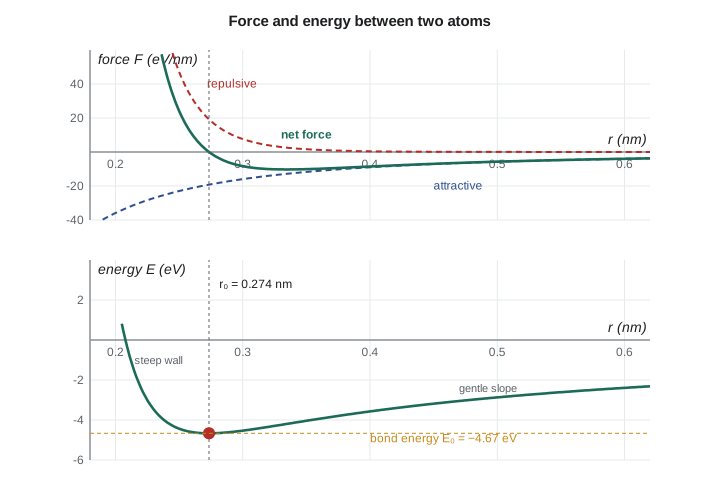
Three properties follow from the shape of the curve. The bond energy correlates with the melting temperature: materials with deep wells, like tungsten and alumina, melt at high temperatures, while those with shallow wells, like lead and polyethylene, melt low. The curvature of the well at \(r_0\), which is the slope of the force curve there, measures how stiff the bond is, and so correlates with Young's modulus: a narrow, deep well means a stiff material. And the asymmetry of the well, steeper on the compressive side than on the tensile side, means that as atoms vibrate more strongly at higher temperatures their average spacing grows. That is the origin of thermal expansion, and it explains why materials with deep, symmetric wells, such as ceramics, expand less than materials with shallow wells, such as polymers.
Worked problem
Equilibrium spacing and bond energy
For an ion pair, take \(A = 1.436\ \text{eV·nm}\), \(B = 5.0 \times 10^{-6}\ \text{eV·nm}^9\) and \(n = 9\). Find \(r_0\) and \(E_0\).
Show solution
- Set \(dE/dr = A/r^2 - nB/r^{n+1} = 0\), which gives \(r_0^{\,n-1} = nB/A\).
- \[r_0 = \Big(\frac{9 \times 5.0 \times 10^{-6}}{1.436}\Big)^{1/8} = (3.134 \times 10^{-5})^{0.125} = 0.2735\ \text{nm}\]
- Substitute back. Because \(B/r_0^{\,n} = A/(n\,r_0)\) at equilibrium, the energy simplifies to \(E_0 = -\dfrac{A}{r_0}\Big(1 - \dfrac{1}{n}\Big)\).
- \[E_0 = -\frac{1.436}{0.2735}\times\frac{8}{9} = -4.67\ \text{eV}\]
Answer: The ions sit 0.27 nm apart and about 4.7 eV is needed to pull them apart. Both are typical of ionic solids. The repulsive term contributes only one-ninth of the bond energy, because it falls off so steeply.
The program below evaluates the same model. It finds \(r_0\), \(E_0\) and the curvature at the minimum, prints the energy and force at several spacings, shows the asymmetry of the well, and applies Pauling's relation to a list of compounds that appear later in the course.
# Bond energy curve E(r) = -A/r + B/r^n for an ion pair, and percent ionic character
import math

A, B, n = 1.436, 5.0e-6, 9          # A in eV*nm, B in eV*nm^9 (illustrative ion pair)

def E(r):
    return -A / r + B / r ** n

def F(r):                            # force = -dE/dr (positive = repulsive)
    return -A / r ** 2 + n * B / r ** (n + 1)

r0 = (n * B / A) ** (1 / (n - 1))    # where dE/dr = 0
E0 = E(r0)
k = -2 * A / r0 ** 3 + n * (n + 1) * B / r0 ** (n + 2)   # curvature d2E/dr2 at r0
print(f"equilibrium spacing r0 = {r0:.4f} nm")
print(f"bond energy        E0 = {E0:.3f} eV")
print(f"curvature at r0       = {k:.0f} eV/nm^2 (bond stiffness)")

print("\n  r (nm)   E (eV)   F (eV/nm)")
for r in (0.22, 0.25, r0, 0.30, 0.35, 0.45, 0.60):
    print(f"  {r:6.3f}  {E(r):7.3f}  {(0.0 if abs(F(r)) < 1e-6 else F(r)):9.3f}")

# Asymmetry: the well is steeper on the compressive side, which is why solids expand on heating
dr = 0.02
print(f"\nrise in E for -{dr} nm: {E(r0 - dr) - E0:.3f} eV; for +{dr} nm: {E(r0 + dr) - E0:.3f} eV")

# Pauling estimate of percent ionic character from electronegativity difference
X = {'Na': 0.93, 'Mg': 1.31, 'Al': 1.61, 'Ti': 1.54, 'Si': 1.90, 'Fe': 1.83,
     'C': 2.55, 'N': 3.04, 'O': 3.44, 'Cl': 3.16}
print("\ncompound  dX    % ionic")
for name, a, b in (('NaCl', 'Na', 'Cl'), ('MgO', 'Mg', 'O'), ('Al2O3', 'Al', 'O'), ('TiO2', 'Ti', 'O'),
                   ('AlN', 'Al', 'N'), ('SiC', 'Si', 'C'), ('Fe', 'Fe', 'Fe')):
    d = abs(X[b] - X[a])
    ic = 100 * (1 - math.exp(-0.25 * d * d))
print(f"{name:9s} {d:4.2f} {ic:6.1f}")equilibrium spacing r0 = 0.2735 nm bond energy E0 = -4.667 eV curvature at r0 = 561 eV/nm^2 (bond stiffness) r (nm) E (eV) F (eV/nm) 0.220 -2.386 139.759 0.250 -4.433 24.210 0.274 -4.667 0.000 0.300 -4.533 -8.335 0.350 -4.039 -10.091 0.450 -3.185 -6.959 0.600 -2.393 -3.981 rise in E for -0.02 nm: 0.158 eV; for +0.02 nm: 0.083 eV compound dX % ionic NaCl 2.23 71.2 MgO 2.13 67.8 Al2O3 1.83 56.7 TiO2 1.90 59.4 AlN 1.43 40.0 SiC 0.65 10.0 Fe 0.00 0.0
Back to the broken shaft
Amira's shaft is a medium-carbon alloy steel, mostly iron with about 0.4 percent carbon and small additions of chromium and molybdenum. Its atoms are held by metallic bonds, which is why the shaft could be forged and machined and why it should be ductile and tough. A flat, brittle-looking fracture in a steel shaft therefore says that something has interfered with the material's normal behavior: a defect, an unsuitable microstructure, a stress concentration, repeated loading, or a combination. Jonah's first instructions to Amira were simple: do not touch the fracture surfaces, photograph everything, and record the part number and heat lot. Over the next eleven lessons, each new idea will add a piece to the explanation.
Common mistakes
MistakeTreating a material's properties as fixed values that cannot change.
InsteadMost properties depend on structure, which processing can change dramatically.
MistakeAssuming all ceramics are ionic and all polymers are covalent throughout.
InsteadMany ceramics are largely covalent, and polymers rely on secondary bonds between chains.
MistakeConfusing bond energy with bond stiffness.
InsteadBond energy is the depth of the well and relates to melting point; stiffness is its curvature and relates to modulus.
MistakeThinking secondary bonds are unimportant because they are weak.
InsteadThey control the softening, creep and moisture uptake of polymers.
MistakeReading Pauling's relation as an exact law.
InsteadIt is an empirical estimate, useful for ranking compounds.
Summary and key terms
- Materials engineering links processing, structure, properties and performance.
- Structure exists at the scales of bonds, crystal arrangement, microstructure and macrostructure.
- Metals, ceramics, polymers and composites differ in bonding and therefore in properties.
- Ionic bonds are non-directional and brittle; covalent bonds are directional and hard; metallic bonds allow slip and conduction.
- Secondary bonds hold polymer chains together and control softening and moisture uptake.
- The bond energy curve gives melting point (depth), modulus (curvature) and thermal expansion (asymmetry).
- Pauling's relation estimates the ionic share of a bond from the electronegativity difference.
- Valence electrons
- Electrons in the outermost occupied shell, which take part in bonding.
- Electronegativity
- The tendency of an atom to attract shared electrons.
- Ionic bond
- A bond formed by electron transfer and electrostatic attraction between ions.
- Covalent bond
- A directional bond formed by sharing pairs of electrons.
- Metallic bond
- Bonding by a sea of shared valence electrons around positive ion cores.
- Secondary bond
- A weak dipole bond, including hydrogen bonds and van der Waals bonds.
- Equilibrium spacing
- The interatomic distance at which the net force is zero.
- Bond energy
- The energy required to separate two bonded atoms completely.
- Grain
- A single crystal within a polycrystalline material.
Practice problems
Work each problem on paper first, then reveal the answer to check.
Estimate the percent ionic character of Al₂O₃ (Al 1.61, O 3.44).
Show answer
ΔX = 1.83; about 57 %.
Why are metals ductile while ionic solids are brittle?
Show answer
Metallic bonds are non-directional and the electron sea rearranges during slip; slip in an ionic crystal brings like charges together.
Material X has a deeper and narrower bond energy well than material Y. Which has the higher melting point and modulus?
Show answer
X, for both.
Using the model in the example, show that the repulsive term contributes 1/n of the attractive energy at r₀.
Show answer
At r₀, B/r₀ⁿ = A/(n r₀), so the repulsive energy is 1/n of A/r₀.
Why does nylon change dimensions in humid conditions while polyethylene hardly does?
Show answer
Nylon's amide groups form hydrogen bonds with water molecules, which it absorbs.
Run the program with B = 4.0 × 10⁻⁶ eV·nm⁹. How do r₀ and E₀ change?
Show answer
r₀ falls to about 0.266 nm and the well deepens to about −4.80 eV: weaker repulsion lets the ions come closer.
Lesson quiz · 5 questions
Score 60% or more to complete this lesson.
Create a free account to save your progress, take quizzes and earn a certificate.