
MEC-200 · Lesson 9 of 12 · 27 min
Thin-walled pressure vessels and strain measurement
Pressure vessels hold fluids or gases at a pressure different from the surroundings. Civil engineers meet them as water storage tanks, penstocks and pressure pipelines, wastewater digesters, compressed-air receivers and the pipes of water distribution systems. Their analysis is a direct and satisfying application of equilibrium, and it produces a biaxial state of stress that makes good use of lesson 8. The second half of this lesson turns to measurement: how strain gauges let engineers find the stresses in a real structure, and how a three-gauge rosette gives the full plane strain state at a point.
When is a vessel thin-walled?
A vessel is treated as thin-walled when its wall thickness \(t\) is small compared with its radius \(r\), usually when \(r/t \ge 10\). Under that condition the normal stress through the thickness is nearly uniform, and simple equilibrium of a cut section gives accurate results. Thick-walled cylinders, such as hydraulic rams and gun barrels, have stresses that vary strongly through the wall and need the Lamé equations from a more advanced course.
Stresses in a cylindrical vessel
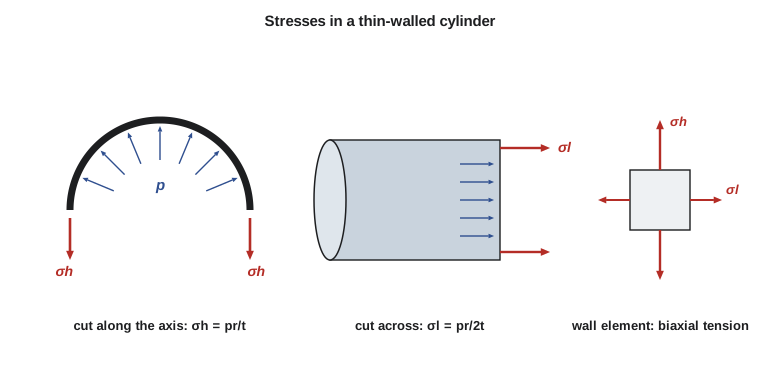
Cut a cylinder of internal pressure \(p\), radius \(r\) and wall thickness \(t\) with a plane through its axis, and consider a length \(L\) of one half. The pressure pushes on the projected area \(2r \times L\), giving a force \(2prL\). It is resisted by the circumferential (hoop) stress \(\sigma_h\) acting on the two cut wall strips, of total area \(2tL\). Equilibrium gives the hoop stress:
Now cut the cylinder across its axis. The pressure acts on the circular end area \(\pi r^2\) and is resisted by the longitudinal stress \(\sigma_l\) acting on the ring of wall, of area approximately \(2\pi r t\):
The hoop stress is twice the longitudinal stress. That is why an overpressurized pipe or a frozen water pipe splits lengthwise, along a line parallel to its axis: the crack opens against the larger hoop stress. It is also why longitudinal welded seams are more critical than circumferential ones, and why design codes apply joint efficiency factors to them.
Use the inner radius for \(r\) for a slightly conservative result; some codes use the mean radius. With \(r/t\) of 10, the two choices differ by about 5 %, and the difference shrinks for thinner walls.
Spherical vessels
A sphere is the same in every direction, so any cut through the center gives the same result as the longitudinal cut of a cylinder:
in every tangential direction. For the same pressure, radius and allowable stress, a sphere needs only half the wall thickness of a cylinder. That is why large gas storage tanks and some digesters are spherical or egg-shaped, even though they are harder to fabricate.
The state of stress in the wall
At a point on the outer surface of a cylinder, the hoop and longitudinal directions are principal directions: there is no shear stress on those planes, by symmetry. So \(\sigma_1 = pr/t\) and \(\sigma_2 = pr/(2t)\), both tensile. The maximum in-plane shear stress is \((\sigma_1 - \sigma_2)/2 = pr/(4t)\). But because both principal stresses have the same sign, the absolute maximum shear involves the third, radial direction, where the stress is zero on the outside surface: \(\tau_{\text{abs}} = \sigma_1/2 = pr/(2t)\), twice the in-plane value. This is exactly the case flagged in lesson 8.
On the inner surface the radial stress equals \(-p\). For thin walls this is small compared with the hoop stress, because \(p\) is much smaller than \(pr/t\), and it is usually neglected.
Worked problem
A steel penstock
A steel penstock with an inside diameter of 1.8 m carries water at an internal pressure of 1.2 MPa. The steel has a yield strength of 300 MPa, and the designer uses an allowable hoop stress of 125 MPa (a simplified value for this exercise). Find the required wall thickness and the resulting longitudinal stress.
Show solution
- \[t = \frac{p\,r}{\sigma_{\text{allow}}} = \frac{1.2 \times 900}{125} = 8.64\ \text{mm}\]
- Use \(t = 10\ \text{mm}\) (a standard plate thickness, which also leaves an allowance for corrosion). Check \(r/t = 90 \ge 10\): thin-walled.
- With \(t = 10\ \text{mm}\): \(\sigma_h = 1.2 \times 900/10 = 108\ \text{MPa}\), and \(\sigma_l = 54\ \text{MPa}\).
- Absolute maximum shear on the outer surface: \(\sigma_h/2 = 54\ \text{MPa}\).
Answer: A 10 mm wall gives 108 MPa hoop stress and 54 MPa longitudinal stress. A real penstock would also be checked for water hammer surges, external pressure when emptied, handling stresses and the supports' bending effects.
In the United States, boilers and pressure vessels are designed to the ASME Boiler and Pressure Vessel Code (Section VIII for most unfired vessels), with registration through the National Board and state or local jurisdictions. Large water pipelines and penstocks are usually designed to AWWA manuals and the owner's standards. Codes add joint efficiencies, corrosion allowances, minimum thicknesses and rules for heads, nozzles and supports that go well beyond the membrane formulas here.
Stress on an inclined weld
Large pipes are often made from steel strip wound in a helix and welded along a spiral seam. The stress normal to the seam, and the shear stress along it, follow from the transformation equations of lesson 8 with \(\sigma_x = \sigma_l\), \(\sigma_y = \sigma_h\) and \(\tau_{xy} = 0\).
Worked problem
A spiral-welded pipe
A spiral-welded steel pipe has an inside radius of 600 mm and a wall thickness of 8 mm, and carries water at 1.0 MPa. The weld seam makes an angle of 55° with the pipe's axis. Find the normal and shear stresses on the weld.
Show solution
- \(\sigma_h = 1.0 \times 600/8 = 75\ \text{MPa}\); \(\sigma_l = 37.5\ \text{MPa}\). Take \(x\) along the axis, \(y\) around the circumference.
- The normal to the seam is at \(55° + 90° = 145°\) from the axis, so \(\theta = 145°\) and \(2\theta = 290°\).
- \[\sigma_n = \frac{37.5 + 75}{2} + \frac{37.5 - 75}{2}\cos 290° = 56.25 - 18.75(0.342) = 49.8\ \text{MPa}\]
- \[\tau = -\frac{37.5 - 75}{2}\sin 290° = 18.75(-0.940) = -17.6\ \text{MPa}\]
Answer: The weld carries a normal (tensile) stress of about 49.8 MPa and a shear stress of about 17.6 MPa in magnitude, both well below the hoop stress of 75 MPa. A spiral seam is less critical than a longitudinal one.
Worked problem
A propane tank in US customary units
A cylindrical propane tank has an inside diameter of 41 in. and a design pressure of 250 psi. Using an allowable stress of 20,000 psi and a joint efficiency of 0.85 for the longitudinal seam, estimate the required shell thickness from the membrane formula.
Show solution
- The longitudinal seam carries the hoop stress, so require \(p\,r/(E_j\,t) \le \sigma_{\text{allow}}\).
- \[t = \frac{p\,r}{E_j\,\sigma_{\text{allow}}} = \frac{250 \times 20.5}{0.85 \times 20\,000} = 0.301\ \text{in.}\]
Answer: About 0.30 in. before any corrosion allowance. ASME Section VIII uses a slightly different formula that accounts for the thickness more exactly, giving a nearly identical result for thin shells.
Generalized Hooke's law and the change in size
In a biaxial stress state, each stress causes strain in its own direction and Poisson contraction in the other. For an isotropic material in plane stress:
For the penstock example, the hoop strain is \(\varepsilon_h = (108 - 0.3 \times 54)/200\,000 = 4.59 \times 10^{-4}\), so the diameter grows by \(4.59 \times 10^{-4} \times 1800 = 0.83\ \text{mm}\). The longitudinal strain is \((54 - 0.3 \times 108)/200\,000 = 1.08 \times 10^{-4}\). See how Poisson's effect reduces the longitudinal strain to less than a quarter of the hoop strain even though the longitudinal stress is half the hoop stress.
Measuring strain
Stress cannot be measured directly; strain can. The electrical resistance strain gauge, a fine metal foil grid bonded to the surface, changes resistance in proportion to the strain along its grid. Connected in a Wheatstone bridge, it can resolve strains of a few microstrain. Engineers use strain gauges to verify designs, monitor bridges and dams, load-test structures and find the stresses in components too complex to analyze by hand. Vibrating-wire gauges, which measure the change in frequency of a tensioned wire, are preferred for long-term monitoring of concrete and soil structures because they are very stable over years.
A single gauge measures strain in only one direction. At a point where the principal directions are unknown, three gauges at different angles are needed, because plane strain has three unknowns: \(\varepsilon_x\), \(\varepsilon_y\) and \(\gamma_{xy}\). Such a group is called a strain rosette.
Normal strain transforms with angle in the same way as normal stress, with \(\gamma_{xy}/2\) playing the role of \(\tau_{xy}\):
For a rectangular rosette with gauges a, b and c at 0°, 45° and 90°, this gives \(\varepsilon_x = \varepsilon_a\), \(\varepsilon_y = \varepsilon_c\) and
The principal strains then follow from the same formulas as principal stresses, with \(\gamma_{xy}/2\) in place of \(\tau_{xy}\). Finally, the principal stresses come from the generalized Hooke's law solved for stress:
Worked problem
Reducing rosette data
A rectangular rosette on a steel bridge girder web reads \(\varepsilon_a = 420\), \(\varepsilon_b = -60\) and \(\varepsilon_c = -180\) microstrain. With \(E = 200\ \text{GPa}\) and \(\nu = 0.3\), find the principal strains and stresses.
Show solution
- \(\varepsilon_x = 420\), \(\varepsilon_y = -180\), \(\gamma_{xy} = 2(-60) - 420 - (-180) = -360\ \mu\varepsilon\).
- Center \(= (420 - 180)/2 = 120\); radius \(= \sqrt{300^2 + 180^2} = 349.9\ \mu\varepsilon\).
- \(\varepsilon_1 = 469.9\ \mu\varepsilon\), \(\varepsilon_2 = -229.9\ \mu\varepsilon\).
- \(E/(1 - \nu^2) = 200\,000/0.91 = 219\,780\ \text{MPa}\).
- \[\sigma_1 = 219\,780\,(469.9 - 0.3 \times 229.9) \times 10^{-6} = 88.1\ \text{MPa}\]
- \[\sigma_2 = 219\,780\,(-229.9 + 0.3 \times 469.9) \times 10^{-6} = -19.5\ \text{MPa}\]
Answer: Principal stresses of about 88 MPa tension and 20 MPa compression. These can be compared with the values predicted by the design model to validate it.
Rosette reduction by code
Monitoring systems log thousands of rosette readings, so the reduction is always automated. The function below does the full chain, from three gauge readings to principal stresses, their direction and the von Mises stress.
# Rectangular (0-45-90) strain rosette reduction
import math

def rosette(ea, eb, ec, E=200000.0, nu=0.3):
    """Gauge readings in microstrain; E in MPa. Returns principal stresses in MPa."""
    ex, ey = ea * 1e-6, ec * 1e-6
    gxy = (2 * eb - ea - ec) * 1e-6
    C = (ex + ey) / 2
    R = math.hypot((ex - ey) / 2, gxy / 2)
    e1, e2 = C + R, C - R
    th = 0.5 * math.degrees(math.atan2(gxy, ex - ey))       # from gauge a to the e1 direction
    k = E / (1 - nu**2)
    s1, s2 = k * (e1 + nu * e2), k * (e2 + nu * e1)
    vm = math.sqrt(s1**2 - s1 * s2 + s2**2)
    return e1 * 1e6, e2 * 1e6, th, s1, s2, vm

for name, r in [("girder web", (420, -60, -180)),
                ("pipe wall", (110, 300, 460)),
                ("pure shear", (0, 250, 0))]:
    e1, e2, th, s1, s2, vm = rosette(*r)
    print(f"{name:11s}: e1 = {e1:6.1f}, e2 = {e2:6.1f} microstrain at {th:6.1f} deg; "
f"s1 = {s1:6.1f}, s2 = {s2:6.1f} MPa; von Mises = {vm:5.1f} MPa")girder web : e1 = 469.9, e2 = -229.9 microstrain at -15.5 deg; s1 = 88.1, s2 = -19.5 MPa; von Mises = 99.3 MPa pipe wall : e1 = 460.6, e2 = 109.4 microstrain at 87.6 deg; s1 = 108.5, s2 = 54.4 MPa; von Mises = 93.9 MPa pure shear : e1 = 250.0, e2 = -250.0 microstrain at 45.0 deg; s1 = 38.5, s2 = -38.5 MPa; von Mises = 66.6 MPa
The pipe-wall case is close to the 2:1 hoop-to-longitudinal pattern of a pressurized cylinder (gauge c along the hoop direction), and the pure-shear case gives equal and opposite principal stresses at 45°, both just as theory predicts.
Common mistakes
MistakeUsing the hoop stress formula for the longitudinal stress, or the reverse.
InsteadHoop \(pr/t\), longitudinal \(pr/(2t)\). The hoop stress is the larger, so longitudinal seams and lengthwise cracks are critical.
MistakeTaking the in-plane maximum shear as the absolute maximum in a pressure vessel wall.
InsteadBoth principal stresses are tensile, so the absolute maximum shear is \(\sigma_h/2\), using the zero radial stress at the outer surface.
MistakeApplying the thin-wall formulas when \(r/t\) is small.
InsteadUse them only when \(r/t \ge 10\); thicker walls need thick-cylinder theory.
MistakeConverting principal strains to stresses with \(\sigma = E\varepsilon\).
InsteadIn a biaxial state use \(\sigma_1 = E(\varepsilon_1 + \nu\varepsilon_2)/(1 - \nu^2)\), which accounts for Poisson coupling.
Summary and key terms
- Thin-walled vessels (\(r/t \ge 10\)) have nearly uniform stress through the wall.
- Cylinders: hoop stress \(pr/t\), longitudinal stress \(pr/(2t)\). Spheres: \(pr/(2t)\) in every direction.
- The wall is in biaxial tension; the absolute maximum shear is half the hoop stress.
- Stresses on inclined seams follow from the transformation equations.
- Generalized Hooke's law links biaxial stresses and strains through \(E\) and \(\nu\).
- Strain gauges measure surface strain; a three-gauge rosette gives the full plane strain state and hence the principal stresses.
- Thin-walled vessel
- A vessel whose radius is at least about ten times its wall thickness.
- Hoop stress
- The circumferential stress in the wall of a pressurized cylinder.
- Longitudinal stress
- The axial stress in the wall of a closed pressurized cylinder.
- Joint efficiency
- A factor that reduces the allowable stress at a welded seam.
- Generalized Hooke's law
- Equations giving strains from stresses in more than one direction, including Poisson effects.
- Strain gauge
- A sensor whose output changes in proportion to the strain of the surface it is bonded to.
- Strain rosette
- Three strain gauges at known angles at one point, used to find the plane strain state.
Practice problems
Work each problem on paper first, then reveal the answer to check.
A cylinder with \(r = 500\ \text{mm}\), \(t = 10\ \text{mm}\) holds 2 MPa. Find the hoop and longitudinal stresses.
Show answer
\(\sigma_h = 100\ \text{MPa}\), \(\sigma_l = 50\ \text{MPa}\).
A sphere of radius 4 m holds gas at 0.8 MPa with an allowable stress of 160 MPa. Find the thickness.
Show answer
\(t = pr/(2\sigma) = 0.8 \times 4000/320 = 10\ \text{mm}\).
Why do frozen water pipes split lengthwise?
Show answer
The hoop stress, which opens a lengthwise crack, is twice the longitudinal stress.
For the cylinder in the first problem, find the absolute maximum shear stress.
Show answer
\(\sigma_h/2 = 50\ \text{MPa}\).
Rosette readings are \(\varepsilon_a = 200\), \(\varepsilon_b = 200\), \(\varepsilon_c = 200\) microstrain. What is the strain state?
Show answer
\(\gamma_{xy} = 400 - 400 = 0\): equal strain in all directions, so \(\varepsilon_1 = \varepsilon_2 = 200\ \mu\varepsilon\).
Why are vibrating-wire gauges preferred for long-term monitoring of dams?
Show answer
They are very stable over long periods and insensitive to cable length and moisture, unlike foil gauges.
Lesson quiz · 5 questions
Score 60% or more to complete this lesson.
Create a free account to save your progress, take quizzes and earn a certificate.