
MEC-200 · Lesson 11 of 12 · 30 min
Superposition, indeterminate beams and energy methods
Integrating the elastic curve works, but it is slow for complicated loadings. This lesson offers two faster tools. Superposition builds deflections from a table of standard cases, and it turns statically indeterminate beams, such as propped cantilevers, fixed-end beams and continuous beams, into simple problems of compatibility. Energy methods compute deflections from the strain energy stored in a structure, and they apply just as easily to trusses, frames and curved members as to beams. Both ideas are foundations of the structural analysis courses that follow.
Deflection by superposition
Because \(EIv'' = M\) is linear, the deflection caused by several loads acting together is the sum of the deflections caused by each load alone. Engineers keep tables of slopes and deflections for standard cases, such as the one in lesson 10, and combine them. The skill lies in breaking a loading into cases that appear in the table, and in remembering that a deflection somewhere other than the loaded point may need the slope as well.
For example, a cantilever loaded at a point partway along its length, a distance \(a\) from the fixed end, deflects like a cantilever of length \(a\) up to the load. Beyond the load, the beam carries no moment, so it stays straight, continuing at the slope it had under the load. The tip deflection is therefore the deflection at the load plus the slope at the load times the remaining length:
Worked problem
A cantilever with two loads
A steel cantilever of length 3.0 m (\(EI = 12\,000\ \text{kN·m}^2\)) carries a uniform load of 4 kN/m over its full length and a point load of 6 kN at 2.0 m from the fixed end. Find the tip deflection.
Show solution
- Uniform load over the full length: \(v_1 = wL^4/(8EI) = 4(81)/(8 \times 12\,000) = 3.375 \times 10^{-3}\ \text{m}\).
- Point load at \(a = 2.0\ \text{m}\): deflection at the load \(Pa^3/(3EI) = 6(8)/36\,000 = 1.333 \times 10^{-3}\ \text{m}\); slope there \(Pa^2/(2EI) = 6(4)/24\,000 = 1.0 \times 10^{-3}\ \text{rad}\).
- Tip deflection from the point load: \(1.333 + 1.0 \times 1.0 = 2.333 \times 10^{-3}\ \text{m}\).
- Total: \(3.375 + 2.333 = 5.71 \times 10^{-3}\ \text{m}\).
Answer: The tip deflects about 5.7 mm downward. Each part came straight from a table, with no integration.
Statically indeterminate beams
A beam is statically indeterminate when it has more support reactions than equilibrium can determine. A propped cantilever (fixed at one end, simply supported at the other) has four reaction components (one horizontal, two vertical, one moment) and only three equilibrium equations, so it is indeterminate to the first degree. A beam fixed at both ends, or a beam continuous over three supports, has extra unknowns too.
Indeterminate beams are common because they are efficient: the extra restraint reduces moments and deflections, and it provides alternative load paths if one part is damaged. They come at a price. Their internal forces depend on the relative stiffness of their parts, and they develop stresses from support settlement and temperature changes that a determinate beam would simply accommodate.
The method of superposition for indeterminate beams follows the same pattern as the indeterminate axial and torsion problems of lessons 2 and 3.
- Choose redundant reactions: as many as the degree of indeterminacy. Remove them to leave a stable, determinate primary structure.
- Compute the displacement of the primary structure at each redundant due to the applied loads.
- Compute the displacement at each redundant due to the redundant itself, acting alone.
- Write compatibility: the total displacement at each support must match what the real support allows, usually zero. Solve for the redundants, then use equilibrium for everything else.
Worked problem
The propped cantilever
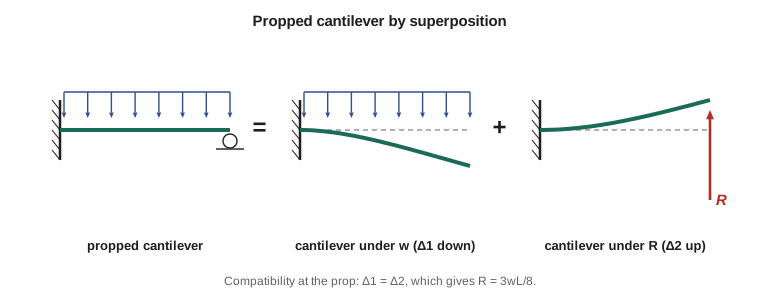
A beam of span \(L\) is fixed at A and simply supported at B, and carries a uniform load \(w\). Find the reaction at B, the fixed-end moment at A and the maximum positive moment.
Show solution
- Take \(R_B\) as the redundant. Removing the prop leaves a cantilever fixed at A.
- Tip deflection of the cantilever under \(w\): \(wL^4/(8EI)\) downward. Tip deflection from \(R_B\) acting upward: \(R_BL^3/(3EI)\) upward.
- \[\frac{R_B\,L^3}{3\,EI} = \frac{w\,L^4}{8\,EI} \quad\Rightarrow\quad R_B = \frac{3wL}{8}\]
- Equilibrium: \(R_A = wL - 3wL/8 = 5wL/8\), and the moment at A is \(M_A = R_BL - wL^2/2 = -wL^2/8\) (hogging).
- Zero shear at \(3L/8\) from B, where \(M_{\max} = (3wL/8)(3L/8) - w(3L/8)^2/2 = 9wL^2/128\).
Answer: \(R_B = 3wL/8\), \(M_A = -wL^2/8\), and the largest sagging moment is \(9wL^2/128 \approx 0.070\,wL^2\), compared with \(0.125\,wL^2\) for a simply supported beam.
Two more standard results follow the same way. A beam fixed at both ends under a uniform load has end moments of \(-wL^2/12\) and a midspan moment of \(+wL^2/24\), with a midspan deflection of \(wL^4/(384EI)\), one fifth of the simply supported value. A beam continuous over two equal spans with a uniform load on both has a central reaction of \(5wL/4\), end reactions of \(3wL/8\), and a hogging moment of \(-wL^2/8\) over the central support. These fixed-end moments are the starting values for the moment distribution and stiffness methods taught in structural analysis.
Worked problem
A two-span continuous beam
A continuous steel beam runs over three supports A, B and C, with two equal spans of 7.0 m, and carries a uniform load of 25 kN/m. Find the reactions and the moment over B.
Show solution
- Remove the middle support B. The primary structure is a simple beam of span 14 m. Its midspan deflection under the load is \(5w(14)^4/(384EI)\).
- A central upward force \(R_B\) on the 14 m span deflects it by \(R_B(14)^3/(48EI)\).
- \[\frac{R_B (14)^3}{48\,EI} = \frac{5 w (14)^4}{384\,EI} \quad\Rightarrow\quad R_B = \frac{5 w (14)}{8} = 218.75\ \text{kN}\]
- End reactions: \(R_A = R_C = (25 \times 14 - 218.75)/2 = 65.63\ \text{kN}\).
- Moment over B, taking span AB: \(M_B = 65.63(7) - 25(7)^2/2 = 459.4 - 612.5 = -153.1\ \text{kN·m}\).
Answer: \(R_B = 218.75\ \text{kN} = 5wL/4\) with \(L = 7\ \text{m}\), end reactions 65.6 kN, and \(M_B = -wL^2/8 = -153.1\ \text{kN·m}\). The middle support carries 62.5 % of the total load.
Worked problem
A continuous joist in US customary units
A wood joist runs continuously over two equal 12 ft spans and carries 50 lb/ft. Find the reaction at the middle support and the hogging moment there, and compare the end reaction with that of two separate simple spans.
Show solution
- \(R_B = 5wL/4 = 5(50)(12)/4 = 750\ \text{lb}\).
- \(M_B = -wL^2/8 = -50(144)/8 = -900\ \text{lb·ft}\).
- End reactions: \(3wL/8 = 225\ \text{lb}\), compared with \(wL/2 = 300\ \text{lb}\) for separate simple spans.
Answer: The middle support carries 750 lb (rather than 600 lb for two simple spans), and the joist must resist a 900 lb·ft hogging moment over it, with tension at the top. Continuity shifts load toward the interior support.
Strain energy
A loaded elastic member stores energy, just as a stretched spring does, and gives it back when unloaded. That stored energy, the strain energy \(U\), provides another route to deflections. For a linear elastic bar, the work done by a load \(P\) that rises gradually from zero while the bar stretches by \(\delta\) is \(P\delta/2\), so
For members where the force or moment varies, the energy is integrated or summed along the length. In a truss, the total strain energy is the sum of \(N_i^2L_i/(2A_iE_i)\) over all the members.
When a single load \(P\) acts on a structure, conservation of energy says the external work equals the strain energy: \(P\Delta/2 = U\), where \(\Delta\) is the deflection under the load in its own direction. For a cantilever with a tip load, \(M = -Px\) measured from the tip, so \(U = \int_0^L P^2x^2/(2EI)\,dx = P^2L^3/(6EI)\). Setting \(P\Delta/2 = P^2L^3/(6EI)\) gives \(\Delta = PL^3/(3EI)\), the same answer as lesson 10 with almost no effort.
Castigliano's theorem
The work–energy method handles only one load and the deflection under it. Castigliano's second theorem removes that limitation: in a linear elastic structure, the deflection at the point of application of a load \(P_i\), in the direction of that load, is the partial derivative of the total strain energy with respect to that load:
For beams and trusses it is easiest to differentiate inside the integral or sum before integrating:
To find a deflection where no load acts, apply an imaginary (dummy) load \(Q\) at that point, carry out the differentiation, and then set \(Q = 0\). To find a rotation, use a dummy couple instead. The same idea, expressed as virtual work with a unit load, is how structural analysis courses compute truss and frame deflections.
Worked problem
Truss deflection by Castigliano
A simple two-bar bracket has a horizontal steel bar AB, 2.0 m long, and an inclined bar CB from a support 1.5 m below A, meeting at B where a 30 kN load hangs. Both bars have \(A = 800\ \text{mm}^2\) and \(E = 200\ \text{GPa}\). Find the vertical deflection of B.
Show solution
- Geometry: CB has length \(\sqrt{2.0^2 + 1.5^2} = 2.5\ \text{m}\). Equilibrium at B for a load \(P\): \(N_{CB} = -5P/3\) (compression), \(N_{AB} = +4P/3\) (tension).
- So \(\partial N_{AB}/\partial P = 4/3\) and \(\partial N_{CB}/\partial P = -5/3\).
- \[\Delta_B = \frac{1}{AE}\Big[\Big(\frac{4P}{3}\Big)\Big(\frac{4}{3}\Big)(2000) + \Big(-\frac{5P}{3}\Big)\Big(-\frac{5}{3}\Big)(2500)\Big]\]
- \[\Delta_B = \frac{P}{AE}\,(3\,556 + 6\,944) = \frac{30\,000 \times 10\,500}{800 \times 200\,000} = 1.97\ \text{mm}\]
Answer: B moves about 1.97 mm downward. The compression member contributes about two thirds of the deflection because it is longer and carries a larger force.
Superposition and energy by code
Both methods lend themselves to short programs. The first part of the code below solves the propped cantilever and the two-span beam by compatibility, using the standard deflection formulas. The second part checks the truss result by summing \(N\,\partial N/\partial P\,L/(AE)\), then confirms Castigliano's theorem by differentiating the strain energy numerically.
# Indeterminate beams by superposition, and truss deflection by Castigliano
w, L = 25.0, 7.0                                # kN/m, m

# Propped cantilever: tip deflections of the cantilever under w and under R must cancel
RB_prop = (w * L**4 / 8) / (L**3 / 3)            # EI cancels
print(f"Propped cantilever: R_B = {RB_prop:.2f} kN  (3wL/8 = {3 * w * L / 8:.2f})")

# Two equal spans: remove the middle support of a 2L simple span
RB_cont = (5 * w * (2 * L)**4 / 384) / ((2 * L)**3 / 48)
RA = (w * 2 * L - RB_cont) / 2
MB = RA * L - w * L**2 / 2
print(f"Two spans: R_B = {RB_cont:.2f} kN, R_A = R_C = {RA:.2f} kN, M_B = {MB:.1f} kN*m")

# Truss: members (length mm, force per unit P, area mm^2, E MPa)
P = 30e3
members = {"AB": (2000, 4 / 3, 800, 200e3), "CB": (2500, -5 / 3, 800, 200e3)}
delta = sum((n * P) * n * Lm / (A * E) for Lm, n, A, E in members.values())
print(f"Truss deflection by Castigliano: {delta:.3f} mm")

def U(load):                                      # strain energy in N*mm
    return sum((n * load) ** 2 * Lm / (2 * A * E) for Lm, n, A, E in members.values())
h = 1.0
print(f"Numerical dU/dP: {(U(P + h) - U(P - h)) / (2 * h):.3f} mm")Propped cantilever: R_B = 65.62 kN (3wL/8 = 65.62) Two spans: R_B = 218.75 kN, R_A = R_C = 65.62 kN, M_B = -153.1 kN*m Truss deflection by Castigliano: 1.969 mm Numerical dU/dP: 1.969 mm
The numerical derivative of the strain energy matches the hand result, a direct check of Castigliano's theorem. Structural analysis software generalizes exactly these steps into the stiffness method, which handles any number of redundants at once.
Common mistakes
MistakeAdding tip deflections from a table without the slope contribution when the load is not at the tip.
InsteadBeyond a point load a cantilever is straight; add slope at the load times the remaining length.
MistakeChoosing redundants that leave an unstable primary structure.
InsteadThe released structure must still be stable and determinate, for example a cantilever or a simple beam.
MistakeForgetting that indeterminate beams develop forces from settlement and temperature.
InsteadIf a support settles, compatibility changes from zero to the settlement, and the redundants change.
MistakeApplying Castigliano's theorem to a nonlinear material or with large deflections.
InsteadIt holds for linear elastic structures with small displacements.
Summary and key terms
- Superposition builds slopes and deflections from standard cases.
- Indeterminate beams are solved by releasing redundants and enforcing compatibility at the released supports.
- Propped cantilever under \(w\): \(R_B = 3wL/8\), \(M_A = -wL^2/8\). Fixed–fixed: end moments \(-wL^2/12\).
- Two equal continuous spans under \(w\): central reaction \(5wL/4\), moment \(-wL^2/8\) over the support.
- Strain energy: \(N^2L/(2AE)\), \(T^2L/(2GJ)\), \(\int M^2/(2EI)\,dx\).
- Castigliano: \(\Delta_i = \partial U/\partial P_i\); use a dummy load to find deflections where no load acts.
- Superposition
- Combining the effects of separate loads by adding them, valid for linear elastic behavior.
- Redundant
- A reaction or internal force beyond those needed for static equilibrium.
- Primary structure
- The determinate structure left after removing the redundants.
- Propped cantilever
- A beam fixed at one end and simply supported at the other.
- Continuous beam
- A beam that runs unbroken over more than two supports.
- Strain energy
- Energy stored in a body by elastic deformation.
- Castigliano's second theorem
- The deflection at a load equals the partial derivative of the strain energy with respect to that load.
- Dummy load
- An imaginary load added at a point to find its deflection, then set to zero.
Practice problems
Work each problem on paper first, then reveal the answer to check.
A cantilever of length \(L\) carries \(P\) at midlength. Find the tip deflection.
Show answer
\(P(L/2)^3/(3EI) + P(L/2)^2/(2EI) \times L/2 = 5PL^3/(48EI)\).
What is the degree of indeterminacy of a beam fixed at both ends under vertical loads only?
Show answer
Two (four vertical and moment reactions, two useful equilibrium equations).
A propped cantilever spans 6 m with \(w = 10\ \text{kN/m}\). Find the prop reaction and the fixed-end moment.
Show answer
\(R_B = 22.5\ \text{kN}\); \(M_A = -45\ \text{kN·m}\).
Find the strain energy in a 2 m steel bar (\(A = 500\ \text{mm}^2\)) carrying 50 kN.
Show answer
\(U = (50\,000)^2(2000)/(2 \times 500 \times 200\,000) = 25\,000\ \text{N·mm} = 25\ \text{J}\).
Use the work–energy method to find the midspan deflection of a simple beam with a central load \(P\).
Show answer
\(U = 2\int_0^{L/2}(Px/2)^2/(2EI)\,dx = P^2L^3/(96EI)\); \(P\Delta/2 = U\) gives \(\Delta = PL^3/(48EI)\).
Why must a dummy load be set to zero at the end of a Castigliano calculation?
Show answer
It is not a real load; it is only there so the energy can be differentiated with respect to a load at that point.
Lesson quiz · 5 questions
Score 60% or more to complete this lesson.
Create a free account to save your progress, take quizzes and earn a certificate.