
MEC-200 · Lesson 8 of 12 · 26 min
Stress transformation and Mohr's circle
So far, stresses have been computed on cross-sections: planes perpendicular to the member's axis. But materials do not know which way the cross-section faces. A material fails on whatever plane is most severely stressed, and that plane is often inclined. Chalk twisted in torsion breaks on a 45° helix; concrete beams crack diagonally near their supports; ductile steel yields along slip planes at an angle to the load. This lesson shows how the stresses at a point change as the plane through it rotates, how to find the maximum normal and shear stresses, and how to judge whether a combination of stresses will cause yielding.
The state of stress at a point
Picture a tiny square element cut from a member, with faces parallel to the \(x\) and \(y\) axes. In general each face carries a normal stress and a shear stress. When all the stresses lie in the \(x\)–\(y\) plane, the element is in plane stress, described by three numbers: \(\sigma_x\), \(\sigma_y\) and \(\tau_{xy}\). Plane stress is the usual condition at the surface of a member, where nothing acts on the free face, and in thin plates and webs.
Shear stresses on adjacent faces must be equal, or the element would spin, so one value \(\tau_{xy}\) describes them all. The sign convention used here: normal stress positive in tension; \(\tau_{xy}\) positive when it acts in the positive \(y\) direction on the positive \(x\) face.
Lesson 7 produced exactly this kind of state. At the base of the sign post, the critical surface element had a normal stress \(\sigma_x\) from bending, \(\sigma_y = 0\), and a shear stress \(\tau_{xy}\) from torsion. The question now is what those stresses look like on other planes.
Transformation equations
Rotate the element counterclockwise by an angle \(\theta\), giving new axes \(x'\) and \(y'\). Equilibrium of a wedge-shaped free body cut at that angle gives the stresses on the rotated faces:
The stress on the perpendicular face, \(\sigma_{y'}\), follows from replacing \(\theta\) with \(\theta + 90°\). A useful check is that the sum of the normal stresses on any two perpendicular faces is constant: \(\sigma_{x'} + \sigma_{y'} = \sigma_x + \sigma_y\). Note also that every term depends on \(2\theta\), not \(\theta\). A rotation of 90° on the element is a rotation of 180° in the equations, which is why perpendicular faces have equal and opposite shear stress.
Principal stresses and maximum shear
As \(\theta\) varies, \(\sigma_{x'}\) reaches a maximum and a minimum on two perpendicular planes, called the principal planes. On those planes the shear stress is zero. Setting \(d\sigma_{x'}/d\theta = 0\) gives the principal angle and the principal stresses:
The shear stress is greatest on planes at 45° to the principal planes. Its magnitude, the maximum in-plane shear stress, is the radius term:
On the planes of maximum shear the normal stress is not zero; it equals the average \((\sigma_x + \sigma_y)/2\).
Two familiar cases make these results concrete. In a bar under simple tension \(\sigma\), the principal stresses are \(\sigma\) and 0, and the maximum shear, \(\sigma/2\), acts on 45° planes. That is why ductile steel specimens show slip lines (Lüders bands) at roughly 45° when they yield. In pure shear, as on the surface of a twisted shaft, \(\sigma_x = \sigma_y = 0\) and the principal stresses are \(\pm\tau\) on 45° planes. Chalk is weak in tension, so it fractures on the 45° helix where the principal tension acts.
Mohr's circle
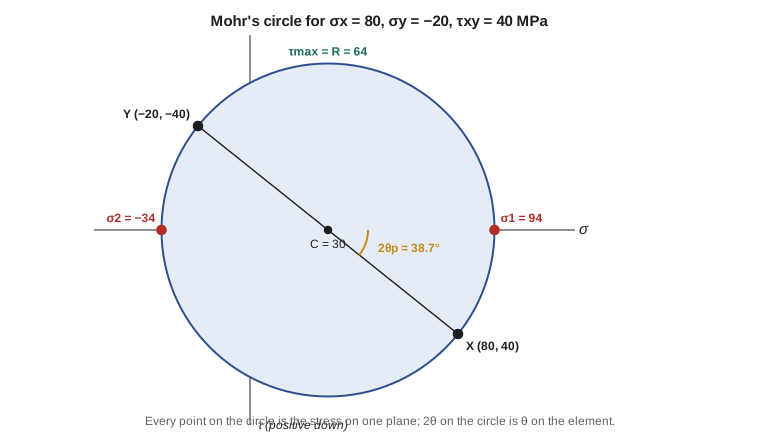
The transformation equations describe a circle. If you plot each plane's stresses as a point with the normal stress \(\sigma\) on the horizontal axis and the shear stress \(\tau\) on the vertical axis, all the points for all orientations lie on a circle, Mohr's circle, with
Constructing the circle is a fast, visual way to see every result at once.
- Plot point X at \((\sigma_x, \tau_{xy})\), representing the \(x\) face, and point Y at \((\sigma_y, -\tau_{xy})\), representing the \(y\) face. This course plots positive shear downward, a common convention that makes rotations on the circle go in the same direction as on the element.
- Join X and Y. The line crosses the \(\sigma\) axis at the center C. Draw the circle through X and Y.
- The circle crosses the \(\sigma\) axis at the principal stresses \(\sigma_1 = C + R\) and \(\sigma_2 = C - R\). The top and bottom of the circle give the maximum shear \(\pm R\).
- An angle of \(2\theta\) on the circle corresponds to a rotation of \(\theta\) on the element, in the same direction.
Worked problem
Principal stresses from Mohr's circle
At a point in a steel plate, \(\sigma_x = 80\ \text{MPa}\), \(\sigma_y = -20\ \text{MPa}\) and \(\tau_{xy} = 40\ \text{MPa}\). Find the principal stresses, their orientation and the maximum in-plane shear stress.
Show solution
- \[C = \frac{80 + (-20)}{2} = 30\ \text{MPa} \qquad R = \sqrt{50^2 + 40^2} = 64.0\ \text{MPa}\]
- Principal stresses: \(\sigma_1 = 30 + 64.0 = 94.0\ \text{MPa}\) and \(\sigma_2 = 30 - 64.0 = -34.0\ \text{MPa}\).
- \[\tan 2\theta_p = \frac{2(40)}{80 - (-20)} = 0.8 \quad\Rightarrow\quad 2\theta_p = 38.7°,\ \theta_p = 19.3°\]
- Check which plane carries \(\sigma_1\): substituting \(\theta = 19.3°\) in the transformation equation gives \(\sigma_{x'} = 30 + 50\cos 38.7° + 40\sin 38.7° = 94.0\ \text{MPa}\), so \(\sigma_1\) acts on the plane rotated 19.3° counterclockwise from \(x\).
- Maximum in-plane shear \(\tau_{\max} = R = 64.0\ \text{MPa}\), on planes at \(19.3° + 45° = 64.3°\) and \(-25.7°\), with a normal stress of 30 MPa.
Answer: \(\sigma_1 = 94.0\ \text{MPa}\) at 19.3° counterclockwise from \(x\), \(\sigma_2 = -34.0\ \text{MPa}\) at 109.3°, and \(\tau_{\max} = 64.0\ \text{MPa}\).
Absolute maximum shear stress
Plane stress is really a three-dimensional state in which the third principal stress, perpendicular to the plane, is zero. There are three Mohr's circles, one for each pair of principal stresses, and the absolute maximum shear stress is the radius of the largest. If \(\sigma_1\) and \(\sigma_2\) have opposite signs, the in-plane circle is the largest and \(\tau_{\text{abs}} = (\sigma_1 - \sigma_2)/2\). If they have the same sign, the largest circle runs from zero to the larger principal stress, and \(\tau_{\text{abs}} = \sigma_{\max}/2\), which can exceed the in-plane maximum. Thin-walled pressure vessels (lesson 9), where both principal stresses are tensile, are the standard example where this matters.
Failure criteria
A tension test tells you when a material yields under one stress. A member, though, may have two or three principal stresses at once. A failure criterion predicts when a combined state will cause yielding or fracture, using only the uniaxial test data.
For ductile metals, two criteria are used.
- The maximum shear stress criterion (Tresca) says yielding begins when the absolute maximum shear stress reaches the value it has at yield in a tension test, \(\sigma_y/2\). In plane stress with principal stresses of opposite sign, that means \(\sigma_1 - \sigma_2 = \sigma_y\).
- The distortion energy criterion (von Mises) says yielding begins when the energy of shape change reaches its value at yield in a tension test. In plane stress it gives an equivalent stress
and yielding when \(\sigma_{\text{vM}} = \sigma_y\). Experiments on ductile metals agree closely with von Mises, while Tresca is slightly conservative (by at most about 15 %) and simpler to apply by hand. In pure shear, von Mises predicts yield at \(\tau = \sigma_y/\sqrt{3} \approx 0.577\,\sigma_y\), which is why steel design codes base the shear yield strength of webs on about 0.6 times the tensile yield strength.
For brittle materials such as cast iron, concrete in tension and glass, the maximum normal stress criterion is the simple choice: fracture occurs when the largest principal tensile stress reaches the tensile strength. More refined criteria, such as Mohr–Coulomb, account for these materials being much stronger in compression; they are central to soil mechanics, where the same Mohr's circle reappears.
Worked problem
Checking the sign post
The sign post from lesson 7 had \(\sigma_x = 86.6\ \text{MPa}\), \(\sigma_y = 0\) and \(\tau_{xy} = 9.7\ \text{MPa}\) at its critical point. The pipe steel has a yield strength of 240 MPa. Find the principal stresses, the von Mises stress and the factor of safety against yield.
Show solution
- \[C = 43.3\ \text{MPa} \qquad R = \sqrt{43.3^2 + 9.7^2} = 44.4\ \text{MPa}\]
- \(\sigma_1 = 87.7\ \text{MPa}\), \(\sigma_2 = -1.1\ \text{MPa}\).
- \[\sigma_{\text{vM}} = \sqrt{86.6^2 + 3(9.7)^2} = \sqrt{7\,500 + 282} = 88.2\ \text{MPa}\]
- Factor of safety \(= 240/88.2 = 2.7\).
Answer: The torsion adds only about 2 % to the equivalent stress here, because the shear is small compared with the bending stress. The post has a factor of safety of about 2.7 against first yield under this wind load; a code design would use factored loads and resistance factors instead.
Worked problem
Principal stresses in US customary units
At a point on the web of a steel girder, \(\sigma_x = -12\ \text{ksi}\) (compression from bending), \(\sigma_y = 0\) and \(\tau_{xy} = 15\ \text{ksi}\). Find the principal stresses and the von Mises stress, and compare with \(F_y = 50\ \text{ksi}\).
Show solution
- \[C = -6\ \text{ksi} \qquad R = \sqrt{6^2 + 15^2} = 16.2\ \text{ksi}\]
- \(\sigma_1 = -6 + 16.2 = 10.2\ \text{ksi}\); \(\sigma_2 = -6 - 16.2 = -22.2\ \text{ksi}\).
- \[\sigma_{\text{vM}} = \sqrt{(-12)^2 + 3(15)^2} = \sqrt{144 + 675} = 28.6\ \text{ksi}\]
Answer: About 28.6 ksi, or 57 % of yield. Note the principal tension of 10.2 ksi even though the bending stress is compressive: in a concrete girder, that diagonal tension is what causes inclined shear cracks.
Transformations by code
The formulas are simple to program, and a function that returns principal stresses, their angle and the von Mises stress is a handy tool. The code below checks the worked example and then scans orientations every 15° to show the stress on each plane, so you can see the maximum and minimum appear.
# Plane stress transformation, principal stresses and von Mises stress (MPa)
import math

def principal(sx, sy, txy):
    C = (sx + sy) / 2
    R = math.hypot((sx - sy) / 2, txy)
    thp = 0.5 * math.degrees(math.atan2(2 * txy, sx - sy))   # angle to the sigma_1 plane
    vm = math.sqrt(sx**2 - sx * sy + sy**2 + 3 * txy**2)
    return C + R, C - R, thp, R, vm

def on_plane(sx, sy, txy, th_deg):
    t = math.radians(2 * th_deg)
    s = (sx + sy) / 2 + (sx - sy) / 2 * math.cos(t) + txy * math.sin(t)
    tau = -(sx - sy) / 2 * math.sin(t) + txy * math.cos(t)
    return s, tau

s1, s2, thp, tmax, vm = principal(80, -20, 40)
print(f"sigma1 = {s1:.1f}, sigma2 = {s2:.1f} MPa at theta_p = {thp:.1f} deg; "
      f"tau_max = {tmax:.1f} MPa; von Mises = {vm:.1f} MPa")
for th in range(0, 181, 15):
    s, tau = on_plane(80, -20, 40, th)
print(f"theta = {th:3d} deg sigma = {s:7.1f} tau = {tau:7.1f}")sigma1 = 94.0, sigma2 = -34.0 MPa at theta_p = 19.3 deg; tau_max = 64.0 MPa; von Mises = 114.9 MPa theta = 0 deg sigma = 80.0 tau = 40.0 theta = 15 deg sigma = 93.3 tau = 9.6 theta = 30 deg sigma = 89.6 tau = -23.3 theta = 45 deg sigma = 70.0 tau = -50.0 theta = 60 deg sigma = 39.6 tau = -63.3 theta = 75 deg sigma = 6.7 tau = -59.6 theta = 90 deg sigma = -20.0 tau = -40.0 theta = 105 deg sigma = -33.3 tau = -9.6 theta = 120 deg sigma = -29.6 tau = 23.3 theta = 135 deg sigma = -10.0 tau = 50.0 theta = 150 deg sigma = 20.4 tau = 63.3 theta = 165 deg sigma = 53.3 tau = 59.6 theta = 180 deg sigma = 80.0 tau = 40.0
The scan shows the normal stress peaking near 19° and bottoming out near 109°, the shear passing through zero at those angles, and everything repeating after 180°, just as Mohr's circle predicts.
Common mistakes
MistakeUsing \(\theta\) instead of \(2\theta\) when reading angles from Mohr's circle.
InsteadAn angle of \(2\theta\) on the circle is a rotation of \(\theta\) on the element.
MistakeAssuming \(\theta_p\) from \(\tan 2\theta_p\) always gives the plane of \(\sigma_1\).
InsteadThe equation has two solutions 90° apart. Substitute one angle back into the transformation equation to see which principal stress it gives.
MistakeTaking the in-plane maximum shear as the absolute maximum when both principal stresses have the same sign.
InsteadInclude the zero third principal stress; the absolute maximum may be half the larger principal stress.
MistakeUsing the maximum normal stress criterion for ductile steel.
InsteadDuctile metals yield according to shear or distortion energy; use von Mises or Tresca.
Summary and key terms
- Stresses at a point depend on the orientation of the plane; the physical state does not.
- The transformation equations give \(\sigma_{x'}\) and \(\tau_{x'y'}\) for any rotation \(\theta\), in terms of \(2\theta\).
- Principal stresses act on planes with zero shear; \(\sigma_{1,2} = C \pm R\).
- The maximum in-plane shear equals the radius \(R\) and acts at 45° to the principal planes.
- Mohr's circle displays every orientation at once; \(2\theta\) on the circle is \(\theta\) on the element.
- Ductile materials are checked with von Mises (or Tresca); brittle materials with the maximum normal stress.
- Plane stress
- A state in which all stresses act in one plane.
- Principal stresses
- The maximum and minimum normal stresses at a point, acting on planes with zero shear stress.
- Principal planes
- The planes on which the principal stresses act.
- Maximum in-plane shear stress
- Half the difference of the in-plane principal stresses.
- Mohr's circle
- A graphical representation of the stresses on all planes through a point.
- Tresca criterion
- Yielding begins when the maximum shear stress reaches half the uniaxial yield strength.
- Von Mises stress
- An equivalent stress based on distortion energy, compared directly with the yield strength.
Practice problems
Work each problem on paper first, then reveal the answer to check.
Find the principal stresses for \(\sigma_x = 60\), \(\sigma_y = 20\), \(\tau_{xy} = 15\) MPa.
Show answer
\(C = 40\), \(R = 25\); \(\sigma_1 = 65\), \(\sigma_2 = 15\ \text{MPa}\).
In pure shear \(\tau = 50\ \text{MPa}\), what are the principal stresses?
Show answer
\(\pm 50\ \text{MPa}\), on planes at 45°.
For the first problem, what is the absolute maximum shear stress?
Show answer
Both principal stresses are positive, so \(\tau_{\text{abs}} = 65/2 = 32.5\ \text{MPa}\), larger than the in-plane value of 25 MPa.
A point has \(\sigma_x = 150\ \text{MPa}\), \(\tau_{xy} = 60\ \text{MPa}\). Find the von Mises stress.
Show answer
\(\sqrt{150^2 + 3(60)^2} = \sqrt{33\,300} = 182.5\ \text{MPa}\).
According to von Mises, at what shear stress does a 350 MPa steel yield in pure shear?
Show answer
\(350/\sqrt{3} = 202\ \text{MPa}\).
Why do concrete beams crack diagonally near their supports?
Show answer
Shear and bending combine into a principal tensile stress on inclined planes, and concrete is weak in tension.
Lesson quiz · 5 questions
Score 60% or more to complete this lesson.
Create a free account to save your progress, take quizzes and earn a certificate.