
MCAT-140 · Lesson 7 of 12 · 22 min
Reasoning within the text: assumptions and inference
▶ Video coming soon A video version of this lesson is on the way.
Devika, who rarely missed a CARS question, missed two in a row on inference. Both times she chose an answer that was reasonable, sensible and, in her words, “basically what the author meant.” Thandiwe asked her to find the line that proved each one. She could not. “That’s the difference between a good guess about the author and an inference,” Thandiwe said. “An inference is something the passage forces you to accept. ‘Basically what the author meant’ is still you, filling a gap.”
This lesson covers the two most demanding skills in Reasoning Within the Text: drawing inferences that the passage supports, and identifying assumptions the author relies on without stating them. Both questions ask you to go just beyond the literal words of the passage, and both punish going too far.
What an inference is
In everyday speech, “infer” means to guess sensibly. In CARS, an inference is a statement that must be true, or is very strongly supported, given what the passage says. If a passage states that every member of a committee voted against a proposal, and that Dr. Ames was on the committee, you may infer that Dr. Ames voted against it. You may not infer that she disliked the proposal (she might have voted for procedural reasons) or that the proposal was bad.
Stems that ask for inferences take several forms: “It can be inferred from the passage that…”; “The passage suggests that…”; “The author would most likely agree with which statement?”; “Which of the following is implied by the passage?” All of them want the choice with the strongest support in the text, which is usually a modest, carefully limited statement.
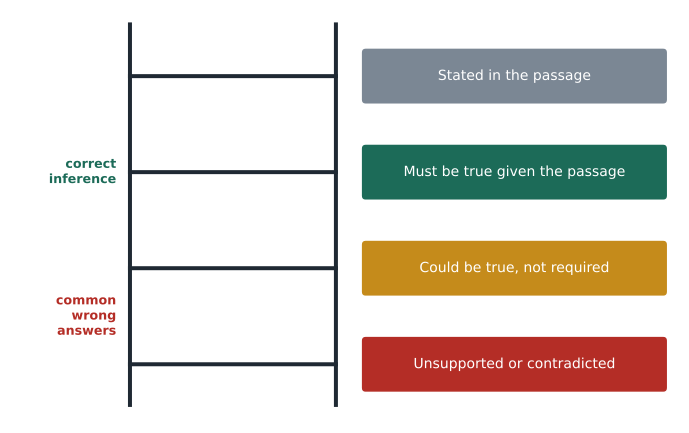
Wrong answers to inference questions cluster on the third rung: statements that could be true, fit the author’s general outlook, and might even be things the author believes, but that the passage does not require. Others go too far, turning a qualified claim into an absolute one, or extend the author’s view to a subject the passage never addresses. The strongest correct answers often sound almost too obvious. That is because a statement the passage forces you to accept usually stays close to the text.
Assumptions
An assumption is an unstated premise that the argument needs. If the assumption were false, the argument would fail or be seriously weakened. Authors leave assumptions unstated because they think them obvious, but those are exactly the points a careful reader, or a test writer, can probe.
Finding an assumption means looking for a gap between the evidence and the conclusion. Suppose an author argues: “Students in schools without letter grades read more books for pleasure. Therefore removing grades increases students’ love of reading.” The gap is between “read more books” and “love of reading,” and also between correlation and cause. The argument assumes that reading more books reflects a greater love of reading, and that the schools without grades did not differ in other ways that explain the difference.
The negation test
To check whether a choice is a necessary assumption, negate it and ask whether the argument collapses. If “the schools without grades did not differ in other important ways” is negated to “the schools without grades differed in other important ways that could explain the reading difference,” the argument is badly damaged. That shows the original statement was an assumption the argument needed. If negating a choice leaves the argument standing, the choice was not a necessary assumption, however reasonable it sounds.
Worked problem
Applying the negation test
Argument: “The city’s new bicycle lanes have reduced traffic injuries, since injuries fell by a third in the year after they opened.” Which is an assumption? A. Bicycling is good exercise. B. Nothing else that happened that year accounts for the fall. C. The lanes were expensive. D. Most residents own bicycles.
Show solution
- Locate the gap: the evidence is a fall after the lanes opened; the conclusion is that the lanes caused it.
- Negate B: “Something else that happened that year accounts for the fall.” The argument collapses; B is required.
- Negate A: “Bicycling is not good exercise.” The argument about injuries is untouched.
- Negate C and D: neither affects whether the lanes reduced injuries.
Answer: B. Only its negation breaks the argument.
Practice passage: the trouble with grades
Passage
Few features of schooling seem as permanent as the letter grade. Yet grading in its familiar form is surprisingly recent. For much of the history of education, teachers reported on students in words, through letters to parents or oral examinations, and the reduction of a term’s learning to a single symbol spread widely only as schools grew large enough that teachers could no longer know every family. Grades, in other words, began as a solution to a problem of scale.
They have since acquired other jobs. Grades sort students for selective programs, signal achievement to universities and employers, and serve, in many classrooms, as the main way students learn what the teacher values. This last function is the one most often neglected in debates about grading, and it is the one that matters most. Students are not foolish. If a teacher says that understanding is the goal but awards marks chiefly for completing worksheets on time, students will learn that completing worksheets on time is the goal.
Critics of grading frequently argue that grades reduce students’ interest in learning for its own sake. The research on this question is more mixed than either critics or defenders tend to admit. Some studies find that students who receive only written comments engage more deeply with feedback than those who receive a grade alone, or a grade with comments. Others find small or no differences. What the studies agree on, broadly, is that the effect of a grade depends on what it is attached to. A grade that reflects a clear, demanding standard can motivate; a grade that rewards compliance teaches compliance.
This suggests that the usual framing of the debate, whether to keep grades or abolish them, misses the point. Abolishing grades in a school that keeps rewarding the same behaviors by other means, through praise, prizes or access to advanced classes, changes little. Keeping grades while aligning them with the understanding teachers say they want could change a great deal. The more useful question is not whether a symbol appears on a report card but what that symbol teaches students to pursue.
None of this will satisfy those who regard any ranking of students as harmful in itself, and their objection deserves a hearing. But it rests on a claim about the value of ranking, not on the evidence about motivation, and should be argued on those grounds.
Questions
Question 1. It can be inferred from the passage that the author believes the effect of grades on motivation:
- A. is always negative.
- B. depends largely on what the grades reward.
- C. has been proven to be negligible.
- D. is greater in large schools than in small ones.
Answer: B. Paragraph 3: “the effect of a grade depends on what it is attached to.” A is contradicted by “can motivate.” C overstates “small or no differences” in some studies. D is never addressed.
Question 2. The author’s argument in paragraph 4 assumes that:
- A. students respond to what is actually rewarded, whatever form the reward takes.
- B. most schools have already abolished grades.
- C. teachers do not know what they value.
- D. written comments are always better than grades.
Answer: A. The claim that abolishing grades “changes little” if other rewards remain depends on students tracking rewards in any form. Negate A, “students respond only to grades, not to praise or prizes,” and abolishing grades would change a lot; the argument fails. B is false and irrelevant; C contradicts paragraph 2; D contradicts the mixed research.
Question 3. The author would most likely agree with which statement?
- A. Grades should be abolished in all schools.
- B. A school that abolishes grades but keeps rewarding compliance through prizes will see little change in what students pursue.
- C. Research has shown that written comments always increase interest in learning.
- D. The objection to ranking students is without merit.
Answer: B, which follows directly from paragraph 4. A contradicts the author’s reframing; C overstates the research; D contradicts “their objection deserves a hearing.”
Question 4. Which of the following is implied by the first paragraph?
- A. Letter grades were adopted partly because teachers in large schools could not report on each student in detail.
- B. Oral examinations are more accurate than letter grades.
- C. Teachers in the past did not evaluate students.
- D. Letter grades were invented by universities.
Answer: A. The paragraph links the spread of grades to schools growing too large for teachers to know every family, calling grades “a solution to a problem of scale.” B makes a comparison the passage does not make. C contradicts the paragraph. D is never stated.
| Type of wrong answer | What it looks like | Example from the grades passage |
|---|---|---|
| Could be true | Plausible and in the spirit of the passage, but not required | “The author has taught in a school without grades.” |
| Extreme | Turns a qualified claim into an absolute one | “Grades always reduce motivation.” |
| Out of scope | Extends the argument to a subject the passage does not address | “Universities should stop requiring transcripts.” |
| Reversed | States the opposite of what the passage supports | “Abolishing grades is sufficient to change student behavior.” |
| Wrong voice | States a view the author reports but does not hold | “Grades reduce interest in learning for its own sake.” (the critics’ claim) |
Assumptions you can spot while reading
Assumptions often hide in the move from evidence to conclusion, and you can catch many of them during your first read by asking one question at each conclusion: “what would have to be true for this to follow?” In the grades passage, the claim in paragraph 2 that students “will learn that completing worksheets on time is the goal” assumes that students infer goals from rewards rather than from what teachers say. That assumption is reasonable, and the author treats it as obvious (“Students are not foolish”), but a question could still ask about it.
Some assumptions are about cause. An argument that moves from “A happened, then B happened” to “A caused B” assumes that nothing else caused B. Some are about representativeness: an argument from a few cases to a general claim assumes the cases are typical. Some are about definitions: an argument that a policy “increases learning” assumes a particular measure of learning. Having these three families in mind makes assumption questions faster.
Inferences about what the author rejects
Some inference questions are phrased negatively: “The author would be least likely to agree with which statement?” or “Which of the following is inconsistent with the passage?” These are often easier than they look, because one choice will directly contradict a line in the passage while the others are either supported or simply not addressed. Be careful with the second group. A statement the passage does not address is not one the author would reject; it is one the author has no stated view on. The answer to a “least likely to agree” question is the choice that clashes with something the author actually says.
In the grades passage, a statement such as “Removing grades is the most effective reform a school can make” clashes with paragraph 4, where the author argues that removing grades while keeping other rewards changes little. A statement such as “Teachers should write longer report card comments” is not addressed, so it is a weaker candidate even though the author never endorses it. Sorting choices into supported, contradicted and not addressed takes a few seconds and turns these questions into simple matching.
Devika’s line test
After the session, Devika added a rule to her error log: “For every inference answer, put my finger on the line. If I can’t, it’s a guess.” On her next set she still answered inference questions quickly, because she usually could find the line at once, but she slowed down on the rare questions where she could not. Elliot copied the rule and added his own: “If it sounds like something I’d say at the clinic, cross it out.” Ezequiel, who liked the negation test, used it so enthusiastically that he began negating choices on questions that were not about assumptions at all. Thandiwe told him that was fine for now. “Over-applying a good tool is how you learn where it belongs.”
Common mistakes
MistakeAn inference is a reasonable guess about what the author thinks.
InsteadIn CARS, an inference must be required or very strongly supported by the passage.
MistakeThe boldest, most interesting choice is the best inference.
InsteadCorrect inferences are usually modest and stay close to the text.
MistakeAn assumption is any statement the author would accept.
InsteadAn assumption is a premise the argument needs; negating it should break the argument.
MistakeIf a choice is true in the real world, it is a valid inference.
InsteadOutside truths are not inferences from the passage.
Mistake“The author would agree” questions ask for the author’s general outlook.
InsteadThey ask for the statement the passage most strongly supports.
Summary and key terms
- A CARS inference must be required or very strongly supported by the passage; correct answers tend to be modest.
- Wrong inferences are often could-be-true, extreme, out of scope, reversed or in the wrong voice.
- An assumption is an unstated premise the argument needs; find it in the gap between evidence and conclusion.
- The negation test: negate the choice; if the argument collapses, it was a necessary assumption.
- Common hidden assumptions concern cause, representativeness and definitions.
- For every inference answer, be able to point to the line that requires it.
- Inference
- A statement required or very strongly supported by what the passage says.
- Assumption
- An unstated premise an argument depends on.
- Negation test
- Negating a candidate assumption to see whether the argument fails without it.
- Out of scope
- Concerning a subject or claim the passage does not address.
- Correlation
- Two things occurring together, which does not by itself show that one causes the other.
- Representativeness
- Whether the cases used as evidence are typical of the group a conclusion is about.
Practice problems
Work each problem on paper first, then reveal the answer to check.
In the grades passage, what can be inferred about the author’s view of the critics’ objection to ranking?
Show answer
The author thinks it deserves consideration but is a separate question from the evidence on motivation.
What does the claim that abolishing grades “changes little” assume?
Show answer
That students respond to rewards in any form, such as praise, prizes or access to classes, not only to grades.
Apply the negation test to: “Students infer what teachers value from what teachers reward.”
Show answer
Negated, students would ignore rewards and follow teachers’ stated goals; paragraph 2’s argument would collapse, so it is an assumption.
A choice says, “The author believes report cards should be eliminated.” Classify the error.
Show answer
Reversed or out of scope: the author argues the symbol matters less than what it rewards.
Name the three families of hidden assumption described in this lesson.
Show answer
Assumptions about cause, about representativeness and about definitions.
Lesson quiz · 5 questions
Score 60% or more to complete this lesson.
Create a free account to save your progress, take quizzes and earn a certificate.