
MCAT-140 · Lesson 2 of 12 · 21 min
Reading for structure: active reading and passage mapping
▶ Video coming soon A video version of this lesson is on the way.
Devika reads novels on the bus, essays at lunch and the occasional economics blog when she cannot sleep. Her diagnostic CARS score, 127, was her best section. Elliot, whose CARS score was 122, wanted to know her secret. “I don’t think I have one,” she said. Thandiwe asked her to read a paragraph aloud and say, after each sentence, what it was doing. Devika did it without thinking: “Setting up the old view. Still the old view. Here’s the turn. Now the author’s view. This is evidence for it.” Thandiwe turned to Elliot. “That is the secret. She is not reading for facts. She is reading for moves.”
This lesson builds the reading method that the rest of the course relies on. It explains why CARS passages are best read as arguments, how to track the author’s voice against other voices, which words signal the structure of an argument, how to build a short passage map, and how to use the on-screen highlighter without drowning in it. The method is deliberately simple. Under time pressure, simple methods survive and elaborate ones collapse.
Read for the argument, not the facts
A science passage is built around information: an experiment, a table, a mechanism. You read it to extract details. A CARS passage is built around a position. Even when it seems descriptive, a history of a building style, an account of a ritual, the author is usually arguing for an interpretation and against another. Most CARS questions, including many that look like detail questions, ask about that position: what the author thinks, why, how strongly, and against whom.
This is why reading every sentence carefully for content can still go wrong. A reader who has memorized the dates and names in a passage but cannot say what the author is arguing has learned the wrong thing. You will be able to look details up again in seconds, because the passage stays on screen. You will not have time to reconstruct the argument from scratch for each question.
Whose voice is this?
CARS authors constantly report views they do not hold. They summarize critics, describe the conventional wisdom, quote earlier scholars, and imagine objections. Many wrong answers are statements that appear in the passage but belong to someone other than the author. Keeping voices straight is the single most valuable reading habit for CARS.
Voices are usually signaled. Phrases such as “some historians argue,” “it is often said,” “according to the standard account” and “critics have claimed” introduce views the author is about to examine, and often reject. Phrases such as “I would argue,” “in fact,” “the more likely explanation” and “what this account misses” mark the author’s own view. When an author reports a view without comment, be cautious: the author may agree, disagree, or simply be describing the field.
Signal words
A small set of words carries most of the structure of an argument. Train yourself to notice them, and to ask what each one tells you about the sentence that follows.
| Signal | Examples | What it tells you |
|---|---|---|
| Contrast or turn | but, however, yet, although, nevertheless, on the other hand, in fact | The next idea pushes against the previous one; the author’s view often follows a turn. |
| Continuation | also, moreover, furthermore, similarly, in addition | More of the same point; usually safe to read faster. |
| Cause and effect | because, since, therefore, thus, so, as a result, consequently | A reason or a conclusion; often the key link in the argument. |
| Example | for instance, for example, consider, such as | Support for a general claim; the example matters only as far as it supports that claim. |
| Emphasis and evaluation | crucially, above all, unfortunately, admittedly, surprisingly | The author’s attitude; tone questions often hinge on these. |
| Concession | admittedly, granted, to be sure, it is true that | The author grants a point to the other side before continuing with their own view. |
| Limitation | only, rarely, in some cases, at least, perhaps | The claim is narrower than it might first seem; extreme answer choices often ignore this. |
Limitation words deserve special attention. An author who says a policy “sometimes” helps is making a much weaker claim than one who says it “always” helps. Answer choices that drop or exaggerate these qualifiers are among the most common traps on the test.
Building a passage map
A passage map is a very short summary of the passage written while you read: one line per paragraph, saying what that paragraph does, plus a line for the author’s main point and a word or two for tone. On test day you can keep it on the noteboard provided at the test center, or in your head once you are practiced. Writing it makes you decide what each paragraph is for, which is the whole point.
A good map line describes a paragraph’s function, not its content. “P2: example of a Dutch guild” is less useful than “P2: example supporting P1’s claim that guilds controlled quality.” Function lines answer the question most CARS items ask: what is this part doing in the argument?
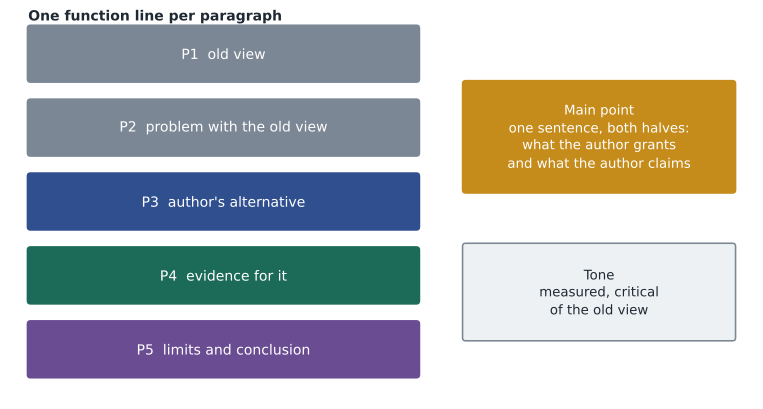
Mapping should take seconds per paragraph, not minutes. Write in fragments and abbreviations. Some students use symbols: an arrow for a cause, a minus sign for criticism, a plus sign for support, “A” for the author’s view and “O” for others. Whatever you use, keep it consistent so you can read it back quickly.
The reading loop
Active reading is a loop you run on each paragraph. First, read the paragraph straight through, at a steady pace, without stopping to reread individual sentences. Second, label it: what is its job, and whose voice is it in? Third, predict: given what you have read, where is the argument going next? The prediction does not have to be right. Its value is that it keeps you looking for the argument, and when the next paragraph surprises you, the surprise itself tells you something important has happened.
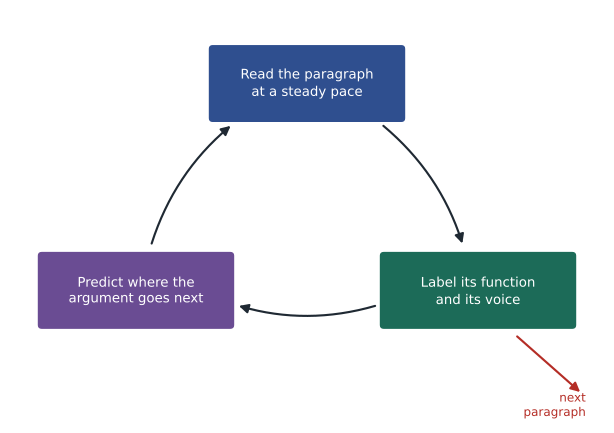
Rereading is the most common time sink in CARS. If a sentence is dense, read to the end of the paragraph before going back. The rest of the paragraph usually explains it. If you still do not understand it after the paragraph, mark it and move on; if a question needs it, you will come back with a clearer purpose.
How much to highlight
Highlight sparingly: the thesis when you find it, the turn where the author’s view begins, and the conclusion. Perhaps one or two words in a paragraph that carry a crucial qualifier. If you find yourself highlighting more than a line per paragraph, stop and ask what the highlighting is for. Highlights help you find things again; they do not help you understand them.
A worked example
Read the following passage, written for this course, and build a map as you go. Then compare your map with the one below.
Practice passage: the invention of standard time
Until the second half of the nineteenth century, time was a local matter. Each town set its clocks by the sun, so that noon came when the sun stood highest over that particular place. A traveler moving west found the clocks of each new town a few minutes behind the last. For most people this hardly mattered. Journeys were slow, and the difference between one town’s noon and the next was smaller than the uncertainty of arrival.
The usual story of what changed is a story about machines. Railways, the account goes, made local time unworkable. A single line might pass through dozens of towns each keeping its own noon, and timetables that listed every local time became bewildering. Railway companies therefore adopted standard times for their operations, and governments eventually followed, dividing continents into zones a full hour apart. On this view, standard time was simply the clock catching up with the locomotive.
This account is not wrong, but it leaves out most of what made the change difficult. The technical problem was easy to state and fairly easy to solve: agree on zones and synchronize clocks by telegraph. The harder problem was persuading people that the time on their own church tower was less authoritative than a time chosen far away by companies they did not control. In many places, the adoption of standard time was resisted for years. Some towns kept two sets of clocks, one for the railway and one for everything else. Newspapers mocked “railway time” as an imposition, and local officials argued that the sun, not a company, was the proper judge of noon.
What eventually settled the matter was less the railway timetable than the slow spread of activities that depended on many people acting at the same moment across distance: telegraph offices, stock exchanges, factory shifts that began before dawn, and later radio broadcasts. Each of these made a shared, abstract time useful in daily life rather than merely in transport. Standard time succeeded when it stopped feeling like the railway’s time and started feeling like everyone’s.
If this is right, the history of standard time is less a story about a machine than about a change in what counted as authority. The locomotive created the occasion for the change, but the change itself was social: a gradual agreement that coordination with distant strangers mattered more than fidelity to the local sun.
A good map of this passage might read:
- P1: background, time was local and this was workable.
- P2: the usual account (not the author’s): railways forced standard time.
- P3: turn, author says the usual account leaves out the social difficulty; evidence of resistance.
- P4: what actually settled it: many activities needing shared time.
- P5: conclusion, standard time was a social change in authority, not just technical.
- Main point: railways prompted standard time, but its adoption depended on a social shift toward valuing coordination with distant others.
- Tone: measured, revisionist; respectful of the usual account but finds it incomplete.
Several features of this map are worth pointing out. Paragraph 2 is marked as someone else’s view, because the author signals it with “the usual story” and “the account goes.” Paragraph 3 begins with a concession (“This account is not wrong”) followed by a turn (“but”). The main point is stated with both halves, what the author grants and what the author adds, because a main-idea question will reward exactly that balance.
Worked problem
Using the map to answer a structure question
Which statement best describes the function of paragraph 2? A. It presents the author’s thesis. B. It describes a widely held explanation that the author goes on to qualify. C. It provides evidence that local time was unworkable. D. It argues that railways were unimportant.
Show solution
- Check the map: P2 is “the usual account (not the author’s).”
- The author says the account “is not wrong, but it leaves out” much, so the author qualifies it rather than rejecting it.
- A is wrong: the thesis comes in P3 to P5. C confuses the account’s claim with the author’s evidence. D overstates; the author grants that railways created the occasion.
Answer: B. The map answers the question before you read the choices.
How the map pays off
With a map in hand, many questions become a matter of matching. A main-idea question asks you to find the choice that matches your main-point line. A function question asks you to find the choice that matches a paragraph line. Even application questions, which go beyond the text, become easier when you have already stated the author’s principle in a sentence. The map turns reading time into answering time.
Elliot tried the method on two passages in the session. On the first, he wrote too much, nearly a sentence per line, and finished late. On the second, he limited himself to six words per line and found his answers came faster. “I’m reading less carefully,” he complained. “No,” said Thandiwe. “You are reading more carefully for the right thing.”
Common mistakes
MistakeA passage map should summarize the facts in each paragraph.
InsteadMap lines should state each paragraph’s function in the argument and whose voice it is in.
MistakeEvery view stated in the passage is the author’s view.
InsteadAuthors often report views they reject; track signals such as “some argue” and “the usual account.”
MistakeReread a confusing sentence until you understand it.
InsteadFinish the paragraph first; the rest usually explains it. Return only if a question needs it.
MistakeMore highlighting means more careful reading.
InsteadHighlight only the thesis, the turn, the conclusion and key qualifiers.
MistakeQualifiers such as “sometimes” and “in part” are minor details.
InsteadQualifiers set the strength of a claim; answers that drop them are often wrong.
Summary and key terms
- CARS passages are arguments; read for the author’s position and how it is built, not for facts.
- Track voices: the author’s view versus views the author reports, concedes or rejects.
- Signal words for contrast, cause, example, concession, emphasis and limitation reveal structure.
- A passage map has one function line per paragraph, plus the main point and the tone.
- Run a read, label and predict loop on each paragraph; avoid rereading mid-paragraph.
- Highlight sparingly; the map, not the highlighting, does the work.
- Passage map
- A brief note of each paragraph’s function, the main point and the tone, made while reading.
- Voice
- Whose view a sentence expresses: the author’s or someone the author is reporting.
- Turn
- A point where the passage shifts direction, often signaled by but, however or yet.
- Concession
- A point the author grants to an opposing view before continuing their own argument.
- Qualifier
- A word that limits the strength or scope of a claim, such as some, often or in part.
- Active reading
- Reading with a purpose: labeling each part of the argument and predicting where it goes next.
Practice problems
Work each problem on paper first, then reveal the answer to check.
In the standard time passage, which phrase signals that paragraph 2 is not the author’s own view?
Show answer
“The usual story of what changed” and “the account goes” mark it as a reported, conventional view.
What two signals open paragraph 3, and what do they tell you?
Show answer
“This account is not wrong” is a concession and “but” is a turn; the author grants part of the usual view and then adds their own.
Rewrite this map line as a function line: “P4: telegraphs, stock exchanges, factories, radio.”
Show answer
For example: “P4: the author’s explanation of what actually settled the change: activities needing shared time.”
A choice says the author believes railways had nothing to do with standard time. Why is it wrong?
Show answer
The author grants that the locomotive “created the occasion” and calls the usual account “not wrong”; the choice exaggerates the author’s view.
What is the purpose of predicting where an argument goes next?
Show answer
It keeps you reading for the argument, and a surprising next paragraph alerts you to an important turn.
Lesson quiz · 5 questions
Score 60% or more to complete this lesson.
Create a free account to save your progress, take quizzes and earn a certificate.