
MCAT-140 · Lesson 1 of 12 · 24 min
How CARS works: format, skills and timing
▶ Video coming soon A video version of this lesson is on the way.
Elliot opened the first CARS session with a confession. “I read the passage, I understand every word, and then I get half the questions wrong,” he said. “It feels like the test is grading my opinions.” Thandiwe Tolliver nodded. “It is grading something, but not your opinions,” she said. “It is grading whether you can tell the difference between what an author said, what the author would accept, and what you happen to believe. That is a skill, and skills can be trained. Today we look at the machine before we learn to drive it.”
This course is about the second section of the MCAT, Critical Analysis and Reasoning Skills, usually called CARS. It is the only section with no science content, and the only one where outside knowledge is not needed and can actually hurt you. Every answer is supported, or ruled out, by the passage in front of you. This first lesson covers the format of the section, the three skill areas the AAMC uses to describe its questions, how the section is scored, and how to plan your time. Later lessons take each skill area in turn, then the two families of passages, humanities and social sciences, and finish with a timed capstone set written for this course.
The section at a glance
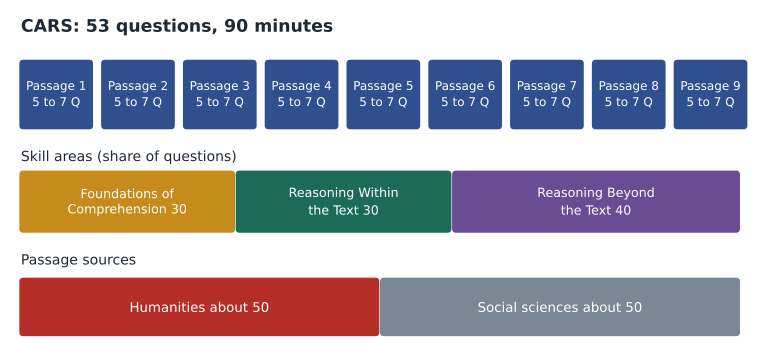
CARS gives you 90 minutes for 53 questions. The questions come in nine passage sets. Each passage is roughly 500 to 600 words and is followed by five to seven questions. There are no independent questions in CARS, unlike the science sections, so every question belongs to a passage. The section sits second on test day, after Chem/Phys and a short optional break, and before the 30-minute mid-exam break.
| Feature | CARS | Science sections (for comparison) |
|---|---|---|
| Questions | 53 | 59 |
| Time | 90 minutes | 95 minutes |
| Passages | 9, each with 5 to 7 questions | 10, each with 4 to 6 questions |
| Independent questions | None | 15 |
| Passage length | About 500 to 600 words | Varies; often shorter, with figures and tables |
| Outside knowledge needed | None | Yes: the content outline |
| Scaled score range | 118 to 132 | 118 to 132 each |
The passages come from two broad areas in roughly equal measure. Humanities passages draw on architecture, art, dance, ethics, literature, music, philosophy, popular culture, religion, theater and studies of diverse cultures. Social science passages draw on anthropology, archaeology, economics, education, geography, history, linguistics, political science, population health, psychology, sociology and studies of diverse cultures. You do not need to know anything about these fields. A passage on Baroque music does not assume you can read a score, and a passage on monetary policy does not assume you have taken economics. What the passages do assume is that you can follow a long, carefully built argument written for an educated general reader.
That last phrase matters. CARS passages are usually adapted from books and articles written by scholars for other thoughtful readers. They are often abstract, sometimes dry, occasionally playful, and almost always argumentative. The author is trying to persuade you of something, even when the topic is the history of a dance form. Reading CARS well means reading for that argument rather than for facts.
The three skill areas
The AAMC describes every CARS question as testing one of three skill areas. The names are worth learning, because they tell you what kind of thinking a question wants, and this course is organized around them.
| Skill area | Share of questions | What it asks | Typical question wording |
|---|---|---|---|
| Foundations of Comprehension | About 30 percent | What does the passage say and mean? Main idea, the meaning of a word or phrase in context, the purpose of a sentence or paragraph, the author’s tone. | “The central thesis of the passage is that…”; “As used in paragraph 3, the word ‘economy’ most nearly means…” |
| Reasoning Within the Text | About 30 percent | How do the parts of the passage fit together? How claims are supported, what the author assumes, what follows from the text, how strong the evidence is. | “The author’s claim that X is supported by…”; “Which assumption underlies the author’s argument?” |
| Reasoning Beyond the Text | About 40 percent | How do the passage’s ideas extend to new situations? Applying a principle to a new case, or judging how new information would affect a claim. | “Which situation would the author most likely consider an example of X?”; “Which finding, if true, would most weaken…” |
The largest share, about 40 percent, goes to Reasoning Beyond the Text. Students are often surprised by this, because those questions feel the strangest. They introduce a scenario the passage never mentions, a new study, a hypothetical artist, a policy in another country, and ask how the author would see it. These questions are not invitations to speculate. They are tests of whether you understood the author’s principles well enough to apply them. Lessons 8 and 9 deal with them in detail.
Comprehension questions are not a warm-up, either. A question asking for the main idea of a passage can be the hardest in a set, because several answers will be true statements from the passage and only one captures its point. Lessons 3, 4 and 5 cover them. Reasoning Within the Text questions, covered in lessons 6 and 7, reward readers who noticed how the argument was built while they read.
What “no outside knowledge” really means
The AAMC states plainly that CARS questions can be answered from the passage alone. In practice this rule cuts in two directions. First, you never need to know the topic, so an unfamiliar subject is not a reason to panic. Second, and more important, knowledge or opinions you bring to the passage are a trap. If a passage argues that a famous novel is overrated and you love that novel, the correct answer will still reflect the author’s view. If a passage makes a claim about history that you believe is false, the correct answer will still be the one the passage supports.
Elliot recognized himself in this immediately. On his diagnostic in September, he had chosen answers that were true, sensible and, as Thandiwe put it, “written by Elliot rather than by the author.” The fix is a habit you will practice throughout the course: for every answer you choose, be able to point to the words in the passage that support it.
Scoring
CARS is scored on the same scale as each science section: 118 to 132, with a midpoint of 125. Your scaled score comes from the number of questions you answer correctly; there is no penalty for wrong answers, so you should never leave a question blank. The four section scores add up to the total score of 472 to 528. Some medical schools look closely at the CARS score on its own, because it is the section least affected by how much content a student has memorized.
Because there are only 53 questions, small changes in raw score move the scaled score noticeably. Getting three or four more questions right can be the difference between two scaled points. That is encouraging. It means steady improvement in accuracy shows up in the score.
The tools on screen
The MCAT is taken on a computer. In CARS, the passage appears on the left of the screen and one question at a time appears on the right. The testing software lets you highlight text in the passage, strike out answer choices you have eliminated, flag questions for review, and move back and forth between questions within the section. A review screen at the end lists questions you have flagged or left incomplete. You cannot take the passage or your highlights into another section, and you cannot return to CARS once its time ends.
These tools are useful in moderation. Highlighting every sentence is the same as highlighting nothing. Lesson 2 shows a lean method: highlight the few words that carry the argument (a thesis, a turn, a conclusion) and keep a short mental or written map of the paragraphs. Strikeout is excellent for CARS, because most questions are solved by eliminating three choices rather than spotting one.
Planning your time
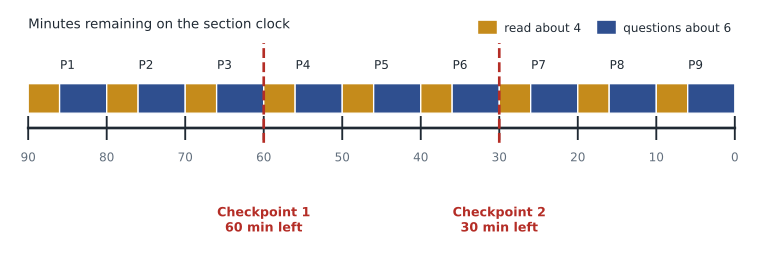
Ninety minutes for nine passages gives you ten minutes per passage, including the questions. A common split is about four minutes reading and mapping, and about six minutes on the five to seven questions, roughly one minute each. These are averages, not rules. A short, clear passage with five questions may take eight minutes; a dense one with seven questions may take twelve.
The simplest way to stay on pace is to use checkpoints rather than watching the clock on every question. The section timer counts down, so the checkpoints are stated as time remaining.
| After finishing | Time used | Time remaining on the clock (target) |
|---|---|---|
| Passage 3 | 30 minutes | About 60 minutes |
| Passage 6 | 60 minutes | About 30 minutes |
| Passage 9 | 90 minutes | 0, ideally with a minute or two to spare for flagged questions |
If you reach a checkpoint behind schedule, do not panic and do not start skimming. Look for one passage later in the section that seems hardest and plan to move through it more quickly, guessing on its hardest questions. Losing one or two questions on a brutal passage is far better than rushing three good passages.
Worked problem
Recovering from a slow start
Ezequiel finishes passage 3 with 55 minutes remaining. How far behind is he, and what is a sensible plan for the rest of the section?
Show solution
- The checkpoint target after passage 3 is about 60 minutes remaining, so he is about 5 minutes behind.
- Six passages remain, so he needs to average about 55 divided by 6, a little over 9 minutes each.
- Rather than speeding up on every passage, he can aim for 9 minutes on each, which saves about a minute per passage.
- If passage 7 or 8 is unusually dense, he can spend 8 minutes on it, answer the questions he can support quickly, and guess on the one or two hardest, flagging them.
Answer: He is about 5 minutes behind. Saving roughly a minute on each remaining passage, and accepting a guess or two on the hardest one, gets him back on schedule without rushing every passage.
Some students change the order in which they attempt passages, skipping a passage that looks miserable and returning to it at the end. This can work, but it has costs: you lose time judging difficulty, and it is easy to run out of time before returning. Thandiwe’s advice was to work in order by default and to skip only when a passage’s first paragraph is truly impenetrable. If you skip, flag the first question of the skipped passage so the review screen reminds you.
A first look at a passage
Here is a short passage written for this course, about half the length of a real CARS passage, followed by one question from each skill area. Read it as you normally would, then try the questions.
Practice passage: the museum of ordinary things
For most of their history, museums collected the extraordinary: the jeweled crown, the painting by a master, the skeleton of a creature no one alive had seen. Their authority rested on rarity. A visitor came to see what could not be seen anywhere else, and left with the sense that culture was something made by a few exceptional people and kept behind glass for the rest.
In the last half century, a different kind of museum has gained ground. It displays a factory worker’s lunch pail, a school timetable, a set of kitchen scales. Its curators argue that these objects tell us more about how most people lived than any crown could. The argument is persuasive, but it carries a risk its defenders rarely admit. An ordinary object becomes extraordinary the moment it is placed in a case and lit. The lunch pail, removed from the hands that carried it, acquires the same aura of rarity the old museums cultivated. The visitor still looks through glass at something set apart.
None of this means the museum of ordinary things has failed. It means that its success depends less on what it collects than on what it lets visitors do. Where people can handle replicas, add their own objects, or hear the voices of those who used the originals, the glass begins to dissolve.
Question 1 (Foundations of Comprehension). The author’s main point is that museums of ordinary objects:
- A. tell us more about the past than traditional museums do.
- B. risk recreating the distance they set out to remove, unless they change how visitors engage.
- C. have failed because ordinary objects cannot be displayed.
- D. should collect crowns and paintings alongside everyday objects.
The answer is B. Choice A is the curators’ argument, which the author calls persuasive but does not make the main point. Choice C contradicts the last paragraph (“None of this means… has failed”). Choice D is never suggested.
Question 2 (Reasoning Within the Text). The claim that “an ordinary object becomes extraordinary the moment it is placed in a case and lit” serves mainly to:
- A. support the curators’ argument about how most people lived.
- B. identify the risk the author believes defenders of these museums overlook.
- C. explain why traditional museums valued rarity.
- D. show that lunch pails are now rare objects.
The answer is B: the sentence introduces the “risk its defenders rarely admit.” Choice D takes the metaphor too literally.
Question 3 (Reasoning Beyond the Text). Which exhibit would the author most likely regard as closest to the ideal described in the passage?
- A. A sealed case of antique tools with detailed labels
- B. A gallery of factory photographs printed at very large scale
- C. A room where visitors use replica tools and listen to recorded interviews with former workers
- D. A display of a single famous inventor’s workshop
The answer is C, which matches the conditions in the final paragraph: handling replicas and hearing the voices of users. Choices A and B keep visitors at a distance, and D returns to the exceptional individual.
Look closely at the pattern in these explanations, because it will recur throughout the course. Every correct answer is tied to specific words in the passage. Every wrong answer has a specific reason it fails: it states someone else’s view, goes too far, contradicts the text, or brings in something the passage never says.
How the rest of the course is built
Each lesson that follows takes one part of the CARS skill set, explains the reasoning behind it, and gives you original passages to practice on. The passages and questions in this course were written for it and imitate the style of the test, not any real test item. Lesson 2 builds the reading method you will use everywhere. Lessons 3 to 5 cover comprehension; lessons 6 and 7 cover reasoning within the text; lessons 8 and 9 cover reasoning beyond the text; lessons 10 and 11 look at the habits of humanities and social science passages; and lesson 12 is a timed set with a full debrief. The official AAMC practice materials remain the best source of real CARS passages, and Thandiwe’s group uses them alongside this course.
Common mistakes
MistakeCARS rewards knowing a lot about history, philosophy and the arts.
InsteadEvery answer comes from the passage; outside knowledge is not needed and often misleads.
MistakeComprehension questions are the easy ones.
InsteadMain-idea and tone questions often have several true-sounding choices; only one matches the author’s point exactly.
MistakeYou should check the clock after every question.
InsteadUse checkpoints every three passages; constant clock-watching wastes time and attention.
MistakeLeave a question blank if you are unsure.
InsteadThere is no penalty for wrong answers; eliminate what you can and always answer.
MistakeHighlight everything that seems important.
InsteadHighlight only the words that carry the argument: thesis, turns and conclusions.
Summary and key terms
- CARS has 53 questions in 90 minutes, in nine passages of about 500 to 600 words with five to seven questions each, and no independent questions.
- Passages are split about equally between humanities and social sciences; no knowledge of the topic is needed.
- The AAMC’s three skill areas are Foundations of Comprehension (about 30 percent), Reasoning Within the Text (about 30 percent) and Reasoning Beyond the Text (about 40 percent).
- The section is scored from 118 to 132, with no penalty for wrong answers.
- Budget about ten minutes per passage and check pace after passages 3 and 6.
- Every correct answer can be tied to words in the passage; every wrong answer has a specific flaw.
- CARS
- Critical Analysis and Reasoning Skills, the second section of the MCAT.
- Passage set
- A passage and the five to seven questions that go with it.
- Foundations of Comprehension
- The skill area covering what a passage says and means: main idea, word meaning in context, purpose and tone.
- Reasoning Within the Text
- The skill area covering how a passage’s claims, evidence and assumptions fit together.
- Reasoning Beyond the Text
- The skill area covering how a passage’s ideas apply to new situations or are affected by new information.
- Checkpoint
- A planned moment to compare elapsed time with your target pace.
- Strikeout
- The on-screen tool for crossing out answer choices you have eliminated.
Practice problems
Work each problem on paper first, then reveal the answer to check.
How many minutes per passage does CARS allow on average, and how many questions does each passage carry?
Show answer
About 10 minutes per passage (90 minutes for 9 passages), each with 5 to 7 questions.
Which CARS skill area carries the largest share of questions?
Show answer
Reasoning Beyond the Text, at about 40 percent.
A question asks how the author would respond to a new study not mentioned in the passage. Which skill area is it?
Show answer
Reasoning Beyond the Text, because it asks how the passage’s ideas extend to new information.
You finish passage 6 with 24 minutes remaining. Are you on pace?
Show answer
You are about 6 minutes behind the target of about 30 minutes remaining; save a little time on each of the last three passages and guess on the hardest question if needed.
Why can outside knowledge hurt your CARS score?
Show answer
It tempts you to choose answers that are true or agreeable to you rather than answers the passage supports.
Lesson quiz · 5 questions
Score 60% or more to complete this lesson.
Create a free account to save your progress, take quizzes and earn a certificate.