
MCAT-140 · Lesson 6 of 12 · 21 min
Reasoning within the text: argument structure and evidence
▶ Video coming soon A video version of this lesson is on the way.
Elliot, a neuroscience major, had no trouble with evidence in a lab report. Give him a figure and he would tell you whether the control was adequate and the sample large enough. What he found strange was that CARS passages asked the same questions about arguments made in words. “There’s no data,” he said. “How am I supposed to judge whether it’s supported?” Thandiwe pulled up a passage about savings clubs. “There is plenty of data,” she said. “It just isn’t in a table. An anecdote is a sample size of one. A historical example is an observation. A quotation from an expert is a citation. You already know how to judge all of these. You just have to recognize them in prose.”
This lesson opens the second skill area, Reasoning Within the Text. These questions ask how the parts of a passage fit together: which claims support which, what kind of evidence the author offers, how strong it is, and which claims are left without support. The skills are close to those of evaluating a scientific study, applied to an argument written in prose.
The parts of an argument
An argument has a conclusion, the claim the author wants you to accept, and premises, the reasons offered for it. Premises may be supported by evidence: facts, examples, data, testimony. Many passages contain several small arguments nested inside a larger one, so that the conclusion of one paragraph becomes a premise for the next.
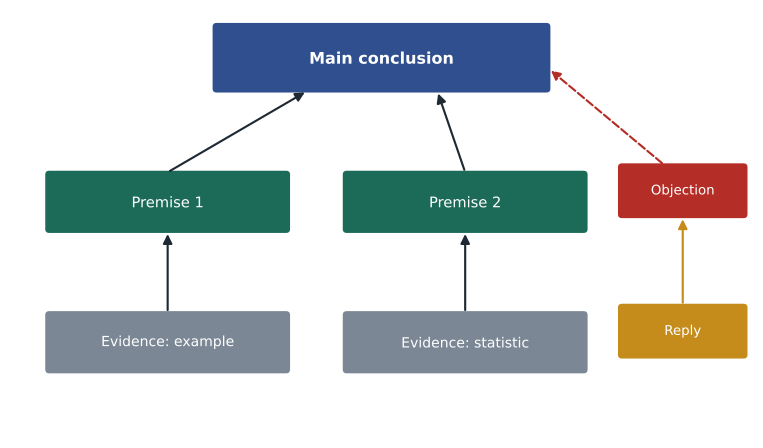
Finding the conclusion is the job of your passage map. Finding the premises means asking, for each major claim, “why does the author say so?” The answer may be a reason stated in the same sentence (“because…”), an example in the next sentence, or a whole paragraph of evidence. Claims for which you cannot find any answer to that question are unsupported, and questions often ask about them.
Kinds of evidence and their strength
CARS passages use many kinds of support, and they differ in strength. The test does not expect you to apply formal rules, but it does expect the judgment a careful reader would bring.
| Kind of support | Example in a passage | Strengths | Weaknesses |
|---|---|---|---|
| Statistical or survey data | “In a survey of 2,000 households, most…” | Covers many cases | May not show cause; depends on who was sampled |
| Historical example | “In the 1890s, the same thing happened in…” | Real, concrete | One case may not generalize |
| Anecdote | “One woman told the researchers…” | Vivid, illustrates mechanisms | Very small sample; may be unusual |
| Expert testimony | “As the historian X argued…” | Brings authority | Experts can disagree or be wrong; authority is not proof |
| Analogy | “Just as a river finds the lowest path…” | Clarifies an idea | Depends on how similar the two cases really are |
| Logical reasoning | “If X were true, we would expect Y; we do not see Y” | Can be decisive when premises are sound | Only as strong as its premises |
| Author’s assertion | “It is clear that…” | None as evidence | A claim stated firmly is not thereby supported |
Questions in this area take several forms. Some ask how a claim is supported (“The author supports the claim that X primarily by…”). Some ask which claim is least supported (“Which of the following claims is supported by the least evidence in the passage?”). Some ask whether a piece of evidence actually supports the conclusion it is offered for. All of them require you to keep claims and their support connected in your mind.
Least-supported claims
A question asking which claim is least supported can be solved by elimination. For each choice, find the claim in the passage, then look for its support. A claim followed by data, an example or a reasoned explanation is supported, even if the support is not perfect. A claim stated once and never defended, or defended only by the author’s confidence (“surely,” “obviously”), is the likely answer. Be careful: the least-supported claim is often a minor one, tucked into a sentence on the way to something else.
Practice passage: the savings club
Passage
In many parts of the world, people who cannot easily borrow from banks save and lend through an arrangement that economists call a rotating savings and credit association. A group of neighbors, coworkers or relatives agrees to contribute a fixed sum at regular meetings. At each meeting, the whole pot goes to one member, and the order rotates until everyone has received it once. Then the cycle may begin again. The arrangement has many local names and is found on every inhabited continent.
To an economist trained to expect rational individuals to maximize returns, these clubs once looked like a puzzle. Every member except the last receives the pot before having paid in full, so the early recipients effectively borrow interest-free from the later ones, while the last member receives no more than they would have saved alone, and later. Why would anyone accept the last place? Early explanations suggested that members were simply unfamiliar with better options, and that the clubs would vanish as banks arrived.
They have not vanished. Studies in several countries have found the clubs flourishing alongside banks, including among members who hold bank accounts. A more persuasive explanation begins with the difficulty of saving. A person who keeps money at home is under constant pressure to spend it, on emergencies, on relatives who ask, and on small temptations. A savings club turns a private intention into a public commitment. Missing a contribution means letting down people one sees every week. In interviews, members frequently describe the club as a way of protecting their savings from themselves and from others’ requests, and some say this is precisely why they prefer it to a bank account they could empty at any time.
The social pressure that makes the clubs work also explains their limits. Because enforcement rests on reputation rather than law, the clubs function best among people who know each other well and expect to keep knowing each other. They are vulnerable when members move away, and a single default can end a group. Larger and more anonymous clubs, which some organizers have attempted, tend to fail more often.
The persistence of these associations is therefore not a sign of ignorance but of a sophisticated solution to a problem that formal finance handles poorly. It suggests that policies aimed at people who save little would do better to make commitment easier than to lecture people about interest rates. A bank account that could not be emptied before a chosen date, or a savings plan with a group element, might borrow what the clubs already understand.
Mapping the argument
P1: background; what the clubs are. P2: the old puzzle and old explanation (ignorance; not the author’s). P3: turn: clubs persist; author’s explanation: commitment against spending pressure; supported by studies and interviews. P4: same mechanism explains limits; supported by reasoning and a general claim about larger clubs. P5: conclusion: clubs are a sophisticated solution; policy suggestion. Main point: savings clubs persist because they solve a commitment problem, which policy should learn from.
Questions
Question 1. The author supports the claim that savings clubs help members resist pressure to spend primarily by citing:
- A. statistical evidence on interest rates.
- B. members’ own descriptions of why they use the clubs.
- C. the opinions of early economists.
- D. the failure of larger clubs.
Answer: B. Paragraph 3 says “members frequently describe the club as a way of protecting their savings,” which is the direct support. C is the view the author rejects. D supports a different claim, about limits.
Question 2. Which claim in the passage receives the least support?
- A. The clubs persist where banks are available.
- B. Members value the clubs as a commitment device.
- C. Larger, more anonymous clubs tend to fail more often.
- D. Early recipients effectively borrow interest-free from later members.
Answer: C. It is stated in one sentence with no study, example or data. A is supported by studies in several countries; B by interviews; D by the reasoning about the payment order in paragraph 2.
Question 3. The reasoning in paragraph 2 that the last member gains nothing financially serves mainly to:
- A. explain why economists once found the clubs puzzling.
- B. show that savings clubs are financially irrational.
- C. support the author’s policy proposal.
- D. demonstrate that the clubs are disappearing.
Answer: A. The paragraph sets up the puzzle that the author then resolves. B states the conclusion the old view drew, which the author rejects.
Question 4. Which finding, if reported in the passage, would most strengthen the author’s explanation in paragraph 3?
- A. Members who leave a club typically save less afterward, even when they open bank accounts.
- B. Savings clubs were first recorded several centuries ago.
- C. Some clubs meet weekly and others monthly.
- D. Banks in some regions charge high fees.
Answer: A. If leaving the club, and so losing the commitment, lowers saving even with a bank account available, the commitment explanation gains support. D would support an alternative, that the clubs persist because banks are costly. This question looks ahead to the new-information skills of lesson 9.
Worked problem
Testing whether evidence fits the claim
Suppose the author had supported the commitment explanation with this sentence: “Bank fees in some countries are high.” Would that be good support?
Show solution
- State the claim: clubs persist because they create a commitment that protects savings from spending pressure.
- Ask what the evidence shows: banks are costly in some places.
- That fact supports a different explanation, that people avoid banks because of cost, and says nothing about commitment.
Answer: No. The evidence is relevant to the topic but not to the claim. Always match the evidence to the specific claim it is offered for.
Evidence that supports a different claim
The example above shows the most frequent reasoning error in passages and in answer choices: evidence that bears on the topic but not on the claim. Wrong choices in CARS often cite something true from the passage that supports the wrong conclusion. The habit that guards against this is to restate the claim in a few words before evaluating any support for it.
A related error concerns counterevidence. Authors often mention facts that seem to cut against their view and then explain them away. In the savings club passage, the limits of the clubs in paragraph 4 might look like a weakness, but the author turns them into further support: the same social mechanism explains both success and failure. Questions may ask how the author handles such facts, and the answer is usually “by showing they fit the author’s explanation.”
Questions about method
Some questions ask not what the author argues but how. “The author’s method in the passage is best described as…” wants a description of the overall strategy: presenting a puzzle and resolving it, testing rival explanations against evidence, tracing a concept through history, or arguing from a single extended case. The savings club passage presents a puzzle, rejects an early explanation using evidence that contradicts it, offers a better explanation supported by interviews, extends that explanation to account for the clubs’ limits, and draws a policy lesson. A choice that says “resolving an apparent anomaly by offering and supporting an alternative explanation” fits that sequence.
Method questions share the traps of purpose questions from lesson 3. A choice may describe a method the author uses in one paragraph only, or name a method the passage never uses, such as “presenting new experimental results” for a passage that reports others’ findings in a sentence or two. As with purpose questions, the verbs carry most of the meaning. Compare each verb with what the author actually does, paragraph by paragraph, and check that the choice describes the whole passage rather than one part of it.
Ezequiel’s field notes
Ezequiel said the savings club passage reminded him of his grandmother, who had belonged to such a club in Albuquerque for decades. Thandiwe let him tell the story, then asked him to answer the questions without using it. “Your grandmother is an anecdote,” she said, smiling. “The passage has its own anecdotes. Use those.” He wrote a new rule on his error log: “Personal knowledge = evidence from outside the passage. Not allowed.” Devika added that she found it useful to label each paragraph of support with the kind of evidence it used, so that “least supported” questions became a matter of looking for the paragraph with no label.
Common mistakes
MistakeA claim stated confidently is supported.
InsteadConfidence is not evidence; look for reasons, examples or data attached to the claim.
MistakeAny fact on the same topic supports the author’s conclusion.
InsteadEvidence must bear on the specific claim; relevant-sounding facts can support a different one.
MistakeAn expert’s opinion settles the matter.
InsteadExpert testimony adds weight but can be challenged, and authors often argue against experts.
MistakeFacts that seem to cut against the author weaken the argument.
InsteadCheck whether the author explains them; often they are turned into further support.
MistakeYour own experience can confirm or refute a passage’s claim.
InsteadOnly the passage counts; personal knowledge is outside evidence.
Summary and key terms
- Arguments have conclusions, premises and evidence; claims in one paragraph often support the next.
- Kinds of support include data, historical examples, anecdotes, expert testimony, analogy and logical reasoning, each with strengths and weaknesses.
- To find the least-supported claim, locate each choice and look for its support; unsupported claims are often minor.
- Match evidence to the specific claim it is offered for.
- Authors often absorb apparent counterevidence by showing it fits their explanation.
- Personal knowledge is never evidence in CARS.
- Conclusion
- The claim an argument tries to establish.
- Premise
- A reason offered in support of a conclusion.
- Evidence
- Facts, examples, data or testimony offered to support a premise or conclusion.
- Anecdote
- A single story or case used as evidence.
- Commitment device
- An arrangement that makes it harder to abandon a plan, such as saving.
- Rotating savings and credit association
- A group whose members contribute regularly and take turns receiving the whole pot.
- Least-supported claim
- A claim in the passage given little or no evidence.
Practice problems
Work each problem on paper first, then reveal the answer to check.
What kind of evidence supports the claim that clubs persist alongside banks?
Show answer
Studies in several countries, a form of empirical observation.
How does the author handle the clubs’ limits in paragraph 4?
Show answer
By showing that the same reliance on social pressure that makes them work also explains their failures, so the limits support the explanation.
Which view of the clubs does the author reject, and where?
Show answer
The early view that members joined out of unfamiliarity with better options, set out in paragraph 2 and rejected from paragraph 3 on.
Why would “bank fees are high” be weak support for the commitment explanation?
Show answer
It supports a cost-based explanation instead; it says nothing about commitment or spending pressure.
What policy does the author suggest, and on what reasoning?
Show answer
Savings products that make commitment easier, because the clubs show that commitment, not information about interest, drives saving.
Lesson quiz · 5 questions
Score 60% or more to complete this lesson.
Create a free account to save your progress, take quizzes and earn a certificate.