
MCAT-140 · Lesson 11 of 12 · 21 min
Social science passages
▶ Video coming soon A video version of this lesson is on the way.
Ezequiel’s Psych/Soc score had been his best section in 2025, and social science CARS passages felt like home. That was the problem. On a passage about rural hospitals he chose an answer that matched what he had seen on ambulance runs in northern New Mexico, and it was wrong. “You know too much about this one,” Thandiwe said. “The more familiar the subject, the more carefully you have to separate the passage from your own experience.”
The other half of CARS passages come from the social sciences: anthropology, archaeology, economics, education, geography, history, linguistics, political science, population health, psychology and sociology. This lesson describes their habits, shows how to read the causal arguments and studies they contain, and works through a full passage on a population health question. It ends with a daily practice routine and an error log designed for CARS, which Thandiwe’s group used for the rest of their preparation.
What makes social science passages different
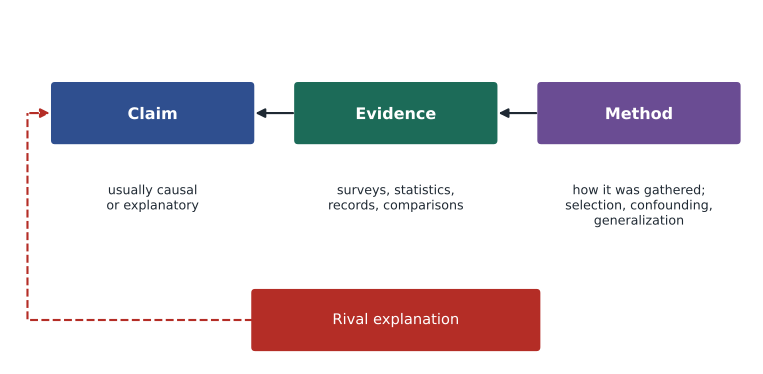
Social science passages usually argue about causes and explanations: why a city declined, why people save, what a policy did, how a language changed. Their evidence looks more like science: surveys, statistics, historical records, field observations and comparisons between groups. That familiarity helps science students, but it also brings two risks. The first is outside knowledge: you may know, or think you know, something about the topic. The second is overconfidence about method: social science passages often discuss the limits of their own evidence, and questions test whether you noticed.
Causal claims and their problems
Most arguments in social science passages move from an association to a cause. Three problems recur, and authors frequently raise them themselves.
| Problem | What it means | Example |
|---|---|---|
| Confounding | A third factor causes both things that are associated | Neighborhoods with more parks also have higher incomes, and income affects health |
| Selection | The groups compared differ because of who chose to join them | People who already like walking choose to live where walking is easy |
| Reverse causation | The supposed effect actually causes the supposed cause | Healthier people may be better able to move to more desirable neighborhoods |
| Generalization | Findings from one place or group may not hold elsewhere | A study in one city may not apply to rural areas |
These are the same issues you meet in research design in Psych/Soc and in experimental passages on the science sections. In CARS they appear in prose, and questions ask whether the author has addressed them, which one an objection raises, or which finding would rule one out.
Practice passage: does walkability make people healthier?
Passage
Over the past few decades, urban planners and public health researchers have converged on an appealing idea: that the design of neighborhoods shapes the health of the people who live in them. In places where shops, schools and parks are within walking distance, the argument goes, people walk more, drive less and are less likely to develop the chronic conditions associated with inactivity. Many studies support at least the first link. Residents of more walkable neighborhoods do, on average, walk more than residents of car-dependent ones, and they tend to have lower average body weights.
But the evidence for a causal effect of design on health is weaker than its popularity suggests. The central difficulty is that people are not assigned to neighborhoods at random. Those who enjoy walking, or who cannot afford a car, may choose walkable areas, and those who prefer driving may choose suburbs designed for it. If so, the differences between residents reflect who moves where, not what the neighborhood does to them. Researchers call this self-selection, and it is notoriously hard to rule out. Walkable neighborhoods also tend to differ from others in income, age structure and access to healthy food, each of which affects health in its own right.
Some studies have tried to get around the problem by following people who move. If walkability itself matters, then people who move from a car-dependent area to a walkable one should begin to walk more, and those who move the other way should walk less. Several such studies have found changes in the expected direction, though generally modest ones. Others have taken advantage of events that change a neighborhood’s design without anyone choosing to move, such as the opening of a new transit line or the conversion of a road into a pedestrian street, and have found small increases in walking among existing residents.
These findings suggest that design has some effect, but they also suggest it is smaller than the raw comparisons imply. Much of the gap between walkable and car-dependent neighborhoods appears to reflect the people who choose them. This matters for policy. A city that rebuilds a district to encourage walking may see real gains, but it should not expect its residents to come to resemble those of the walkable neighborhoods it admires, at least not quickly, and not by design alone.
None of this argues against walkable neighborhoods. They have many virtues besides health, and modest effects summed across a whole city can be meaningful. It argues only for honesty about what the evidence shows, and for designing studies that can tell the effect of a place apart from the choices of the people in it.
Map
P1: popular claim (design shapes health); association is real. P2: author’s challenge: self-selection and confounding. P3: better designs: movers and natural experiments, which find modest effects. P4: conclusion: design matters but less than raw comparisons suggest; policy implication. P5: limit: not against walkability; call for honesty and better studies. Main point: walkable design probably has a real but modest effect on activity, smaller than raw comparisons imply because of self-selection and confounding. Tone: measured, skeptical of overclaiming, supportive of walkability itself.
Questions
Question 1. The author’s main point is that:
- A. walkable neighborhoods have no effect on health.
- B. walkable design likely has a real but modest effect, smaller than simple comparisons suggest.
- C. cities should stop building walkable neighborhoods.
- D. residents of walkable neighborhoods walk more than others.
Answer: B. A and C contradict paragraphs 4 and 5. D is a true detail from paragraph 1 that both sides accept.
Question 2. The author’s discussion of people who move between neighborhoods serves mainly to:
- A. describe a research design that addresses self-selection.
- B. show that moving is bad for health.
- C. prove that walkability has a large effect.
- D. illustrate the popular argument in paragraph 1.
Answer: A. Following movers lets researchers see whether the same people change their behavior when their neighborhood changes. C overstates the “modest” effects found.
Question 3. Which finding would most weaken the author’s claim that self-selection explains much of the gap?
- A. People who moved to walkable neighborhoods increased their walking until they matched long-term residents.
- B. Residents of walkable neighborhoods have higher average incomes.
- C. Many people who move to walkable neighborhoods say they did so because they enjoy walking.
- D. Transit lines are expensive to build.
Answer: A. If movers came to match residents fully, the gap would reflect the neighborhood rather than who chose it. B supports the confounding concern; C supports self-selection; D is irrelevant.
Question 4. A city converts a busy road into a pedestrian street and finds that existing residents walk slightly more afterward. The author would most likely regard this as:
- A. evidence of a modest causal effect of design, less affected by self-selection.
- B. proof that design is the main cause of health differences.
- C. irrelevant, since the residents did not move.
- D. evidence that self-selection is the only explanation.
Answer: A. Paragraph 3 describes exactly this kind of event and its small effects; since residents did not choose the change, self-selection is reduced.
Question 5. The author’s attitude toward walkable neighborhoods themselves is best described as:
- A. supportive, while skeptical of exaggerated health claims.
- B. hostile.
- C. enthusiastic and uncritical.
- D. indifferent.
Answer: A. Paragraph 5: “None of this argues against walkable neighborhoods. They have many virtues.”
Worked problem
Spotting which problem an objection raises
A critic responds to the passage: “Walkable neighborhoods in this study were mostly in wealthier districts.” Which problem from the table does this raise?
Show solution
- The critic points to a third factor, income, that differs between neighborhood types.
- Income independently affects health, so it could explain part of the health difference.
- That is confounding, not selection: the critic is not talking about who chose to move, but about a feature that travels with walkability.
Answer: Confounding. The author already mentions it in paragraph 2, so the objection is consistent with the passage.
Economics, linguistics and political science
Economics passages on CARS rarely use equations. They argue about behavior, incentives and institutions in ordinary language, as the savings club passage in lesson 6 did, and they often set a simple model of rational choice against evidence that people behave differently. Linguistics passages ask how languages change, how words acquire meanings, or how speakers signal identity, and they rely on examples of usage that the passage supplies. Political science passages discuss how institutions distribute power, why voters or governments behave as they do, and what a reform would change. Across all of these, the questions are the same as in the walkability passage: what is the claim, what is the evidence, what might explain the evidence instead, and how strongly does the author commit to the conclusion. When a passage reports a model or a theory, keep its predictions separate from the author’s evaluation of it; authors frequently describe a model in order to show where it fails.
History passages
History is a social science on CARS, and history passages combine the habits of both families. They often argue about cause, like other social science passages, but their evidence is usually documents, records and the interpretation of events rather than studies. The Site K passage in lesson 9 and the standard time passage in lesson 2 are typical. Track the old account, the new account and the evidence the author uses to move from one to the other, and watch for qualifications about what the records can and cannot show.
A daily CARS routine
CARS improves through steady practice, not cramming. Thandiwe’s routine for the group had three parts. Each day: two timed passages (about 20 minutes), followed by a review of every question, right or wrong, that takes at least as long as the passages did. Each week: one longer set of five or more passages under timing, to build stamina. And throughout: wide reading of serious nonfiction outside test materials, about twenty minutes a day, from a mix of humanities and social science sources.
Review matters more than volume. For each question, the review asks three things: what the correct answer’s support in the passage is, why each wrong answer is wrong, and, for any miss, which kind of error it was.
An error log for CARS
The group’s error log for CARS uses the categories from this course rather than the content categories used for science sections.
| Category | What it looks like | Typical fix |
|---|---|---|
| Reading | Misread or missed a sentence, a qualifier or a voice | Slow the first read of turns and conclusions |
| Scope | Chose too broad, too narrow or too extreme | Compare choices on strength and coverage |
| Outside knowledge | Chose what was true or agreeable rather than supported | Point to the line before choosing |
| Reasoning | Wrong inference, assumption or effect of new information | Use the negation test and the discrimination check |
| Structure | Matched surface rather than structure on an application question | State the principle with its conditions first |
| Timing | Rushed or guessed because time ran short | Use checkpoints after passages 3 and 6 |
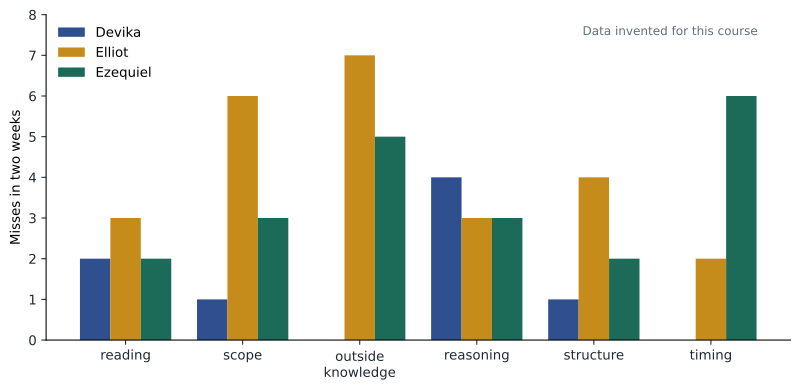
After two weeks, the pattern in the group’s logs was clear. Elliot’s misses were mostly outside knowledge and scope; he was choosing answers he agreed with, and answers that went further than the author. Ezequiel’s were mostly timing and outside knowledge, the latter concentrated on population health and history passages close to his own experience. Devika had few misses, most of them in reasoning, especially on assumption questions. Each of them took one fix from the table and made it a habit for the following two weeks.
Common mistakes
MistakeSocial science passages are easier because they look like science.
InsteadFamiliarity invites outside knowledge; the passage’s claims still govern.
MistakeAn association reported in a passage shows that one thing causes the other.
InsteadCheck for confounding, selection and reverse causation, which authors often raise themselves.
MistakeIf an author doubts a causal claim, they reject the policy it supports.
InsteadAuthors often support a practice while doubting exaggerated claims for it, as in the walkability passage.
MistakeMore practice passages always mean faster improvement.
InsteadCareful review of every question, right or wrong, improves CARS more than volume.
MistakeHistory passages are about memorizing events.
InsteadThey argue about interpretations and causes using documents and records.
Summary and key terms
- Social science passages usually argue about causes, using surveys, statistics, records and comparisons.
- Watch for confounding, self-selection, reverse causation and limits on generalization; authors often raise these themselves.
- Better designs, such as following movers or using natural experiments, address self-selection.
- Familiar topics invite outside knowledge; separate the passage from your experience.
- History passages combine causal argument with interpretation of documents.
- Practice daily with timed passages and full review, and log errors by CARS category.
- Confounding
- When a third factor causes both of two associated things.
- Self-selection
- When the groups compared differ because of who chose to join them.
- Reverse causation
- When the supposed effect actually causes the supposed cause.
- Natural experiment
- An event that changes conditions for people who did not choose the change, allowing comparison.
- Walkability
- How easily daily destinations can be reached on foot from a place.
- Generalization
- Extending a finding from the studied group or place to others.
Practice problems
Work each problem on paper first, then reveal the answer to check.
Why are studies of people who move between neighborhoods useful to the walkability author?
Show answer
They track the same people before and after a change, which reduces the effect of self-selection.
What does the author conclude about the size of design’s effect?
Show answer
It is real but modest, smaller than raw comparisons between neighborhoods suggest.
A critic says walkable neighborhoods have younger residents. Which problem does this raise?
Show answer
Confounding: age differs between neighborhood types and affects health.
What would show reverse causation in the walkability case?
Show answer
Evidence that healthier people are better able to move to walkable neighborhoods, so health causes location rather than the reverse.
What three questions should a CARS review ask about each question?
Show answer
What supports the correct answer, why each wrong answer is wrong, and what kind of error any miss was.
Lesson quiz · 5 questions
Score 60% or more to complete this lesson.
Create a free account to save your progress, take quizzes and earn a certificate.