
MCAT-122 · Lesson 8 of 12 · 26 min
Carbonyl chemistry: aldehydes and ketones
▶ Video coming soon A video version of this lesson is on the way.
Thandiwe opened with a single drawing: a carbon double-bonded to oxygen, with a delta-plus on the carbon and a delta-minus on the oxygen. 'If you remember one picture from organic chemistry, make it this one,' she said. 'Half the reactions on the MCAT are a nucleophile finding that delta-plus. Sugars forming rings, imines in enzymes, aldol reactions in glycolysis, all of it.' Elliot pointed at the glycolysis poster above his desk. 'Aldolase,' he said. 'Exactly,' she said.
This lesson covers aldehydes and ketones: their structure and naming, why the carbonyl carbon is electrophilic, nucleophilic addition (hydrates, hemiacetals and acetals, imines and enamines, cyanohydrins, hydride reduction and Grignard addition), oxidation of aldehydes, and the chemistry of the alpha carbon (keto-enol tautomerism, enolates, the aldol reaction and kinetic and thermodynamic enolates). The AAMC outline lists all of these under aldehydes and ketones in content category 5D: description, nomenclature and physical properties; nucleophilic addition at the C=O bond (acetal and hemiacetal, imine and enamine, hydride reagents, cyanohydrin); oxidation of aldehydes; reactions at adjacent positions (keto-enol tautomerism and alpha-racemization, aldol condensation and retro-aldol, kinetic versus thermodynamic enolate); and general principles (the effect of substituents on C=O reactivity, steric hindrance, acidity of alpha-H and carbanions).
Structure, naming and properties
In aldehydes the carbonyl carbon is bonded to at least one hydrogen; in ketones it is bonded to two carbons. The carbonyl carbon is sp2 and trigonal planar, with bond angles near 120 degrees. Aldehydes take the suffix -al, with the carbonyl carbon numbered 1 (butanal, CH3CH2CH2CHO). Ketones take the suffix -one with a locant (butan-2-one, CH3COCH2CH3, also called methyl ethyl ketone). When a higher-priority group is present, the carbonyl oxygen is named with the prefix oxo-, and an aldehyde group as formyl-.
The C=O bond is strongly polar, so aldehydes and ketones have dipole-dipole attractions and boil higher than alkanes of similar mass, but lower than alcohols, because they cannot donate hydrogen bonds. They can accept hydrogen bonds from water, so small members such as acetone and acetaldehyde mix with water. Formaldehyde, the smallest aldehyde, is a gas usually sold as an aqueous solution (formalin), where it exists mostly as its hydrate.
Why the carbonyl carbon is electrophilic
Oxygen is more electronegative than carbon, and resonance adds a minor contributor with a positive charge on carbon and a negative charge on oxygen. Both effects leave the carbonyl carbon electron-poor. Nucleophiles attack it from above or below the plane of the carbonyl, at an angle of roughly 107 degrees to the C=O bond. The pi bond breaks, the electrons move onto oxygen, and the carbon becomes sp3 and tetrahedral. This tetrahedral intermediate is the hub of carbonyl chemistry.
Aldehydes are more reactive than ketones for two reasons. Sterically, a hydrogen is smaller than an alkyl group, so nucleophiles reach an aldehyde carbon more easily, and the tetrahedral product is less crowded. Electronically, alkyl groups donate electron density to the carbonyl carbon, reducing its partial positive charge; ketones have two such donors and aldehydes only one. Electron-withdrawing groups make a carbonyl more reactive: trichloroacetaldehyde (chloral) is so electrophilic that it exists almost entirely as its hydrate in water.
Acid and base catalysis speed up nucleophilic addition in different ways. Under acidic conditions, protonating the carbonyl oxygen makes the carbon more electrophilic, so even weak nucleophiles such as water and alcohols can add. Under basic conditions, a strong nucleophile such as hydroxide or an alkoxide attacks the neutral carbonyl directly.
Hydrates, hemiacetals and acetals
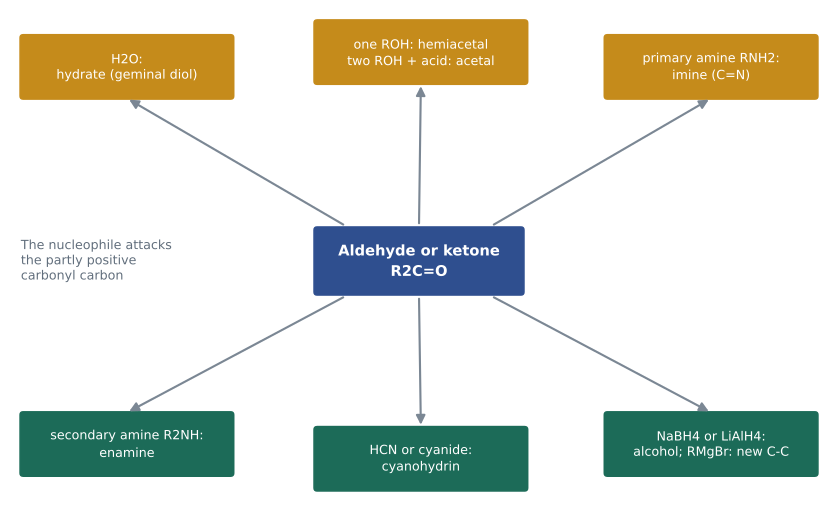
Water adds reversibly to aldehydes and ketones to form hydrates, also called geminal diols, with two OH groups on one carbon. For most ketones the equilibrium lies far toward the carbonyl; for formaldehyde and aldehydes with electron-withdrawing groups it lies toward the hydrate. Hydrates matter because they explain why chromic acid in water oxidizes primary alcohols all the way to carboxylic acids (lesson 7): the aldehyde formed first adds water, and the hydrate is oxidized again.
One molecule of alcohol adds to an aldehyde or ketone to form a hemiacetal, a carbon bearing one OH and one OR group (older texts call the ketone version a hemiketal). Hemiacetals are usually unstable and revert to the carbonyl, except when the OH and carbonyl are in the same molecule and can close a five- or six-membered ring. That is exactly what sugars do. Glucose exists mostly as a six-membered cyclic hemiacetal, formed when the OH on carbon 5 attacks the aldehyde carbon. The new stereocenter at carbon 1, the anomeric carbon, can have its OH below the ring (alpha) or above it (beta) in the standard drawing. In water the two anomers interconvert through the open-chain form, a process called mutarotation, and at equilibrium about two thirds of glucose is beta.
With acid catalysis and a second molecule of alcohol, a hemiacetal loses water and forms an acetal (or ketal), a carbon bearing two OR groups. The mechanism is worth knowing in outline: protonate the hemiacetal OH, lose water to form a resonance-stabilized oxocarbenium ion, add the second alcohol, and lose a proton. Every step is reversible. Removing water drives acetal formation forward, and adding excess water with acid reverses it, hydrolyzing the acetal back to the carbonyl and alcohol.
Worked problem
Using an acetal as a protecting group
A chemist wants to reduce the ester group of a molecule that also contains a ketone, using LiAlH4, which would reduce both. How can the ketone be kept intact?
Show solution
- Treat the compound with ethylene glycol (ethane-1,2-diol) and an acid catalyst, removing water. The ketone becomes a cyclic acetal.
- Acetals are stable to bases, nucleophiles and hydride reagents, so LiAlH4 now reduces only the ester, to a primary alcohol.
- Treat the product with aqueous acid to hydrolyze the acetal and restore the ketone.
Answer: Protect the ketone as a cyclic acetal, reduce, then deprotect with aqueous acid. Acetals are stable in base but labile in acid.
Acetals connect directly to biochemistry. A glycosidic bond, which links sugars into disaccharides and polysaccharides, is an acetal formed between the anomeric carbon of one sugar and an OH of another. Glycosidic bonds are stable in base but hydrolyzed by acid or by enzymes (glycosidases), which is why digestion of starch and the acid hydrolysis of sucrose both work. A sugar whose anomeric carbon is part of a glycosidic bond cannot open to the aldehyde form, so it is a nonreducing sugar; sucrose is the classic example, because both anomeric carbons are tied up.
Imines and enamines
Primary amines (RNH2) add to aldehydes and ketones to form a carbinolamine, which loses water to give an imine, a compound with a C=N double bond (also called a Schiff base). The reaction is fastest near pH 4 to 5. At lower pH the amine is protonated and no longer nucleophilic; at higher pH there is too little acid to help water leave. Like acetal formation, imine formation is reversible, and excess water hydrolyzes imines back to the carbonyl and amine.
Secondary amines (R2NH) cannot form a neutral imine, because the nitrogen has no second hydrogen to lose. Instead, after water leaves, a proton is removed from the alpha carbon, giving an enamine, a compound with a C=C bond attached to nitrogen. Enamines are nucleophilic at the alpha carbon and behave somewhat like enolates.
Imines are everywhere in enzymes. Aldolase in glycolysis forms an imine between a lysine side chain and the ketone of fructose 1,6-bisphosphate before cleaving it. Pyridoxal phosphate (vitamin B6), the cofactor of transaminases, forms an imine with amino acids during amino acid metabolism. And the visual pigment rhodopsin contains retinal attached to a lysine of the protein opsin as a protonated imine; absorption of light isomerizes the retinal from cis to trans, starting the signal of vision.
Cyanohydrins, hydride reduction and Grignard reagents
Hydrogen cyanide adds to aldehydes and ketones to form cyanohydrins, compounds with an OH and a CN on the same carbon. The reaction is catalyzed by base, which generates the cyanide ion, the actual nucleophile. Cyanohydrins are useful because the nitrile can later be hydrolyzed to a carboxylic acid or reduced to an amine, adding one carbon to the chain. The Strecker synthesis of amino acids (lesson 10) uses the same addition of cyanide, but to an imine.
Hydride reagents reduce aldehydes and ketones to alcohols by delivering H- to the carbonyl carbon, followed by protonation of the oxygen. Sodium borohydride (NaBH4) is mild and can be used in alcohol or water; it reduces aldehydes and ketones but not esters, carboxylic acids or amides. Lithium aluminum hydride (LiAlH4) is much stronger and must be used in dry ether, because it reacts violently with water. It reduces aldehydes, ketones, esters, carboxylic acids and amides. Aldehydes give primary alcohols and ketones give secondary alcohols. In cells, NADH and NADPH play the same role, transferring a hydride to a carbonyl carbon under enzyme control.
Grignard reagents (RMgBr) and organolithium reagents (RLi) are sources of carbanion-like carbon nucleophiles. They add to aldehydes and ketones to form new carbon-carbon bonds. Formaldehyde gives a primary alcohol with one more carbon, other aldehydes give secondary alcohols, and ketones give tertiary alcohols. Grignard reagents are also very strong bases, so they must be kept away from water, alcohols, carboxylic acids and any other acidic O-H or N-H, which would simply protonate them, as the passage in lesson 7 showed.
Oxidation of aldehydes
Aldehydes are easily oxidized to carboxylic acids, because they still have a hydrogen on the carbonyl carbon; ketones are not, because oxidation would require breaking a carbon-carbon bond. Strong oxidants such as chromic acid and potassium permanganate oxidize aldehydes readily, and so do mild reagents. Tollens' reagent, a silver-ammonia complex, oxidizes aldehydes and is reduced to metallic silver, forming a silver mirror on the glass. Benedict's and Fehling's reagents use copper(II), which is reduced to red copper(I) oxide. These are the classic tests for reducing sugars: any sugar that can open to an aldehyde form, such as glucose, gives a positive result.
The alpha carbon: tautomerism and enolates
The carbon next to a carbonyl is the alpha carbon, and its hydrogens are alpha hydrogens. They are unusually acidic for C-H bonds, with pKa values near 19 to 20 for ketones and about 17 for aldehydes, compared with about 50 for an alkane. The reason is resonance: removing an alpha hydrogen gives an enolate ion, whose negative charge is shared between the alpha carbon and the oxygen. Hydrogens on a carbon between two carbonyls, as in a beta-diketone or a beta-keto ester, are much more acidic still (pKa about 9 to 11), because the charge spreads over both carbonyls.
Aldehydes and ketones exist in equilibrium with their enol tautomers, isomers in which a hydrogen has moved from the alpha carbon to the oxygen, giving a C=C-OH. Tautomers are constitutional isomers that interconvert rapidly; they are not resonance structures, because an atom (the hydrogen) actually moves. For simple ketones the keto form is strongly favored. Tautomerism is catalyzed by both acid and base, and it has a stereochemical consequence: if the alpha carbon is a stereocenter, passing through the planar enol or enolate scrambles it, so an optically pure alpha-substituted ketone racemizes in acid or base. This is the alpha-racemization named on the AAMC outline. Keto-enol tautomerism also interconverts sugars: glucose 6-phosphate and fructose 6-phosphate interconvert through an enediol intermediate in glycolysis.
The aldol reaction
An enolate is a carbon nucleophile, and it can attack the carbonyl carbon of another aldehyde or ketone. This is the aldol addition. With acetaldehyde and dilute base, the enolate of one molecule adds to a second molecule to give 3-hydroxybutanal, a beta-hydroxy aldehyde (the name aldol comes from aldehyde plus alcohol). With heat, the beta-hydroxy carbonyl loses water to form an alpha,beta-unsaturated carbonyl, here but-2-enal. Addition followed by dehydration is called aldol condensation, because a small molecule, water, is lost.
Worked problem
Predicting an aldol product
What is the aldol addition product of two molecules of propanal (CH3CH2CHO) with dilute NaOH, and what forms on heating?
Show solution
- Base removes an alpha hydrogen from C2 of one propanal, forming an enolate with the nucleophilic carbon at C2.
- That carbon attacks the carbonyl carbon (C1) of a second propanal.
- Protonation of the oxygen gives CH3CH2CH(OH)-CH(CH3)-CHO.
- Heating removes the OH and an alpha hydrogen, forming a C=C between the old carbonyl carbon and the alpha carbon.
Answer: Addition: 3-hydroxy-2-methylpentanal. Condensation: 2-methylpent-2-enal.
The aldol reaction is reversible, and its reverse, the retro-aldol reaction, cleaves a beta-hydroxy carbonyl into two smaller carbonyl compounds. Aldolase in glycolysis catalyzes a retro-aldol reaction, splitting fructose 1,6-bisphosphate (a six-carbon sugar) into dihydroxyacetone phosphate and glyceraldehyde 3-phosphate (two three-carbon sugars). In gluconeogenesis the same enzyme runs the reaction forward. Elliot tapped his poster again.
Kinetic and thermodynamic enolates
An unsymmetrical ketone such as 2-methylcyclohexanone has two different alpha carbons, so it can form two enolates. Removing a proton from the less substituted alpha carbon is faster, because those protons are more numerous and less hindered; this gives the kinetic enolate. Removing a proton from the more substituted alpha carbon gives the more substituted, more stable C=C; this is the thermodynamic enolate. Conditions decide which forms. A strong, bulky base such as lithium diisopropylamide (LDA), at low temperature (often minus 78 degrees Celsius) and with a short reaction time, removes the most accessible proton quickly and irreversibly, giving the kinetic enolate. A weaker base such as an alkoxide, at room temperature or above and with longer times, allows proton exchange back and forth, so the system settles into the more stable thermodynamic enolate. The same kinetic-versus-thermodynamic logic appears again in lesson 11.
Passage practice: a sugar that closes a ring
Data invented for this course. A researcher dissolved crystalline alpha-D-glucose in water and recorded its specific rotation over time. It began at +112 degrees and fell over several hours to a constant +52.7 degrees. A solution of crystalline beta-D-glucose began at +18.7 degrees and rose to the same +52.7 degrees. When glucose was treated with methanol and dry HCl, the product, methyl glucoside, gave a negative Tollens test and no longer changed its rotation in water. Glucose itself gave a positive Tollens test.
Question 1. The change in rotation over time is best explained by: (A) hydrolysis of glucose. (B) interconversion of the alpha and beta anomers through the open-chain aldehyde. (C) racemization of every stereocenter. (D) oxidation of glucose by water.
Question 2. At equilibrium the specific rotation is +52.7 degrees. Approximately what fraction of the cyclic glucose is beta? (A) About one third. (B) About one half. (C) About two thirds. (D) Nearly all.
Question 3. Methyl glucoside gives a negative Tollens test because: (A) it has no OH groups. (B) its anomeric carbon is an acetal, which cannot open to the aldehyde. (C) it is a ketone. (D) methanol oxidizes silver ions.
Question 4. Which functional group links the ring oxygen and carbon 1 in cyclic glucose? (A) An ether only. (B) A hemiacetal. (C) An ester. (D) An imine.
Answers. 1: B (skill 2). This is mutarotation; both solutions reach the same equilibrium mixture. 2: C (skill 2). Let x be the beta fraction: 112(1 - x) + 18.7x = 52.7, so 93.3x = 59.3 and x is about 0.64. Estimation works too: 52.7 lies about two thirds of the way from 112 toward 18.7. 3: B (skill 1). The glycoside is an acetal and is locked closed. 4: B (skill 1). Carbon 1 carries the ring O and an OH: a hemiacetal. Ezequiel, who had guessed on a reducing-sugar question in 2025, answered question 3 first and grinned.
Common mistakes
MistakeKetones are more reactive than aldehydes toward nucleophiles.
InsteadAldehydes are more reactive: less steric hindrance and less electron donation to the carbonyl carbon.
MistakeAcetals hydrolyze in base.
InsteadAcetals are stable in base and hydrolyze in aqueous acid, which is why they work as protecting groups.
MistakeSecondary amines form imines with ketones.
InsteadPrimary amines form imines; secondary amines form enamines.
MistakeTautomers are resonance structures.
InsteadTautomers are real isomers in which a hydrogen atom moves; resonance structures differ only in electron placement.
MistakeNaBH4 reduces esters to alcohols.
InsteadNaBH4 reduces aldehydes and ketones; LiAlH4 is needed for esters, acids and amides.
Summary and key terms
- The carbonyl carbon is electrophilic; nucleophiles add to form a tetrahedral intermediate.
- Aldehydes are more reactive than ketones for steric and electronic reasons.
- One alcohol gives a hemiacetal; a second alcohol with acid gives an acetal, stable in base and hydrolyzed by aqueous acid.
- Primary amines give imines; secondary amines give enamines; cyanide gives cyanohydrins.
- NaBH4 and LiAlH4 reduce carbonyls to alcohols; Grignard reagents add carbon to give alcohols.
- Alpha hydrogens are acidic (pKa about 17 to 20); enolates drive tautomerism, alpha-racemization and the aldol reaction; LDA at low temperature gives the kinetic enolate.
- Hemiacetal
- A carbon bonded to one OH and one OR, formed from a carbonyl and one alcohol.
- Acetal
- A carbon bonded to two OR groups, formed from a hemiacetal and a second alcohol.
- Anomeric carbon
- The carbon that was the carbonyl carbon in a sugar's open-chain form.
- Imine
- A compound with a C=N bond, formed from a carbonyl and a primary amine.
- Enolate
- The resonance-stabilized anion formed by removing an alpha hydrogen.
- Tautomers
- Constitutional isomers that interconvert by moving a hydrogen and a double bond.
- Aldol reaction
- Addition of an enolate to a carbonyl, forming a beta-hydroxy carbonyl compound.
Practice problems
Work each problem on paper first, then reveal the answer to check.
What product forms when cyclohexanone reacts with NaBH4, then water?
Show answer
Cyclohexanol, a secondary alcohol.
What forms when acetone reacts with methylamine (CH3NH2) at pH 5?
Show answer
An imine, (CH3)2C=NCH3, plus water.
Which gives a positive Tollens test: acetone or acetaldehyde?
Show answer
Acetaldehyde, because aldehydes are oxidized; ketones are not.
What reagent forms the kinetic enolate of 2-methylcyclohexanone?
Show answer
LDA at minus 78 degrees Celsius.
What alcohol forms when phenylmagnesium bromide reacts with acetone, then aqueous acid?
Show answer
2-Phenylpropan-2-ol, a tertiary alcohol.
Lesson quiz · 5 questions
Score 60% or more to complete this lesson.
Create a free account to save your progress, take quizzes and earn a certificate.