
MCAT-122 · Lesson 10 of 12 · 23 min
Nitrogen-containing compounds and amino acid chemistry
▶ Video coming soon A video version of this lesson is on the way.
Elliot had a story from the free clinic. 'A patient asked why his antihistamine label says "hydrochloride". I said it was a salt and moved on. Then I wondered why you would turn a drug into a salt at all.' Thandiwe nodded. 'Because the drug is an amine. Amines are bases, and protonating them turns an oily, water-insoluble molecule into a crystalline, water-soluble one. That one fact explains drug labels, extractions and a good share of amino acid chemistry.'
This lesson covers amines (structure, naming, basicity and reactions), amides from the nitrogen side, nitriles and other nitrogen groups in brief, and the organic chemistry of amino acids: their configuration, their behavior as dipolar ions, titration curves and isoelectric points, the Strecker and Gabriel syntheses, the peptide bond and disulfide bonds. On the AAMC outline, amino acids appear in content category 5D (absolute configuration at the alpha position, dipolar ions, classification as acidic or basic and hydrophilic or hydrophobic, synthesis of alpha-amino acids by the Strecker and Gabriel syntheses, the sulfur linkage of cysteine and cystine, the peptide linkage, hydrolysis and the isoelectric point). The Biochemistry Review course covered the side chains and protein structure in depth; this lesson focuses on the reactions and acid-base chemistry.
Amines: structure and naming
Amines are derivatives of ammonia in which one or more hydrogens are replaced by carbon groups. Recall from lesson 1 that primary (RNH2), secondary (R2NH) and tertiary (R3N) amines have one, two and three carbon groups on nitrogen, and quaternary ammonium ions (R4N+) have four. Alkyl amines are named with the suffix -amine (ethanamine, or ethylamine) or with the prefix amino- when a higher-priority group is present (2-aminoethanol). Groups on nitrogen are given the locant N, as in N,N-dimethylaniline. Aniline is aminobenzene, and many drugs and dyes are aniline derivatives.
The nitrogen of an alkyl amine is sp3, with three bonds and a lone pair in a trigonal pyramidal arrangement. An amine with three different groups is technically chiral at nitrogen, but it usually cannot be resolved into enantiomers, because the nitrogen rapidly inverts through a planar transition state, like an umbrella flipping, at room temperature. Quaternary ammonium ions, which have no lone pair, do not invert and can be chiral.
Primary and secondary amines hydrogen bond with each other, though less strongly than alcohols, because N is less electronegative than O. Their boiling points therefore lie between those of alkanes and alcohols of similar mass. Tertiary amines cannot donate hydrogen bonds and boil lower. All amines accept hydrogen bonds from water, so small amines are water soluble. Low-molar-mass amines have strong, unpleasant fishy odors; putrescine and cadaverine, diamines formed when proteins decay, are named for their smell.
Basicity of amines
The lone pair on nitrogen makes amines bases. Basicity is usually described by the pKa of the conjugate acid, the ammonium ion (written pKaH): the higher the pKaH, the stronger the base. Alkyl ammonium ions have pKaH values of about 10 to 11, so alkyl amines are moderately strong bases, much stronger than water and about a million times stronger than aniline. At physiological pH (7.4), most alkyl amines are therefore present mainly as ammonium ions.
| Compound | Approximate pKa of the conjugate acid | Reason |
|---|---|---|
| Ammonia | 9.2 | Reference |
| Methylamine | 10.6 | Alkyl group donates electron density |
| Triethylamine | 10.8 | Alkyl donation, partly offset by poorer solvation |
| Pyridine | 5.2 | Lone pair in an sp2 orbital, held more tightly |
| Aniline | 4.6 | Lone pair delocalized into the ring |
| Acetamide | about -0.5 | Lone pair delocalized into the carbonyl; not basic |
| Pyrrole | about -4 | Lone pair is part of the aromatic sextet |
The table shows the same principles as earlier lessons. Electron-donating alkyl groups increase basicity. Delocalizing the lone pair decreases it: aniline's lone pair is shared with the benzene ring, amides share theirs with the carbonyl, and pyrrole's lone pair is needed for aromaticity. Hybridization matters too: a lone pair in an sp2 orbital, as in pyridine, has more s character and is held closer to the nucleus, so it is less available. These trends let you predict which nitrogen in a drug molecule will be protonated at a given pH.
The Henderson-Hasselbalch relationship works for bases too. For an amine with pKaH 10.6, at pH 7.4 the ratio of ammonium ion to free amine is 10 to the power (10.6 - 7.4), about 1,600 to 1. Drugs that are amines are often sold as hydrochloride salts, made by reacting the free amine with HCl. The salts are solid, stable and water soluble, which makes them easier to formulate and absorb. Acid-base extraction (lesson 4) uses the same chemistry: dilute HCl pulls amines out of an organic layer as ammonium salts, and adding NaOH frees the amine again.
Reactions of amines
Amines are good nucleophiles. They react with alkyl halides by SN2, but the reaction is hard to control, because the product amine is often more nucleophilic than the starting amine and reacts again. Treating ammonia with methyl iodide can give a mixture of methylamine, dimethylamine, trimethylamine and tetramethylammonium iodide. This overalkylation problem is exactly why the Gabriel synthesis, described below, was developed for making clean primary amines.
Amines react with acid chlorides and anhydrides to form amides (lesson 9), and with aldehydes and ketones to form imines or enamines (lesson 8). Primary and secondary amines can be acylated, but tertiary amines cannot, because they have no N-H to lose. In biology, the amine groups of lysine side chains and protein N-termini react with aldehydes and ketones to form imines, and sugars react nonenzymatically with protein amines in the same way. This glycation is the chemistry behind the hemoglobin A1c test, which measures how much glucose has attached to hemoglobin over the previous months.
Nitriles and other nitrogen groups
Nitriles (R-C triple bond N) contain an sp-hybridized carbon and nitrogen. They are polar, with a characteristic IR stretch near 2250 per centimeter (lesson 5). Nitriles are made by SN2 reactions of cyanide with alkyl halides (lesson 6) or by adding cyanide to carbonyls and imines. Their value is as intermediates: acid or base hydrolysis converts a nitrile first to an amide and then to a carboxylic acid, and LiAlH4 reduces nitriles to primary amines. Both routes add one carbon to the starting chain. Other nitrogen groups that may appear in passages include nitro groups (-NO2), which are strongly electron-withdrawing and can be reduced to amines; azides (-N3); and the nitrogen heterocycles of the nucleic acid bases, histidine and tryptophan.
Amino acids: structure and configuration
The 20 standard amino acids have an amino group, a carboxyl group, a hydrogen and a side chain (R group) on a central alpha carbon. Except for glycine, whose side chain is a hydrogen, the alpha carbon is a stereocenter. Amino acids in proteins are L amino acids. In the CIP system almost all of them are S, as lesson 3 showed for alanine; cysteine is R, because the sulfur in its CH2SH side chain outranks the oxygens of the carboxyl. Two amino acids, isoleucine and threonine, have a second stereocenter in the side chain.
Amino acids are classified by their side chains. Nonpolar (hydrophobic) side chains include those of glycine, alanine, valine, leucine, isoleucine, methionine, proline, phenylalanine and tryptophan. Polar, uncharged side chains include serine, threonine, cysteine, tyrosine, asparagine and glutamine. Acidic side chains (aspartate and glutamate) carry a carboxyl, and basic side chains (lysine, arginine and histidine) carry a nitrogen that can be protonated. The Biochemistry Review covers these in detail; for organic chemistry, what matters is that the side chains are functional groups you already know: alcohols, thiols, amides, carboxylic acids, amines, a guanidine and an imidazole.
Dipolar ions and titration
An amino acid contains both an acid (the carboxyl, pKa about 2) and a base (the amino group, pKaH about 9 to 10). At neutral pH, the carboxyl is deprotonated and the amino group is protonated, so the molecule is a zwitterion (dipolar ion): +H3N-CHR-COO-. Its net charge is zero, but it carries two charges. Zwitterions explain why amino acids are crystalline solids that melt (and usually decompose) above 200 degrees Celsius and dissolve well in water but poorly in nonpolar solvents.
As pH changes, the charge changes. At very low pH both groups are protonated and the amino acid is a cation, +H3N-CHR-COOH (net charge +1). As base is added, the carboxyl loses its proton first, near pH 2, giving the zwitterion. Then, near pH 9 to 10, the ammonium group loses its proton, giving the anion H2N-CHR-COO- (net charge -1). A titration curve shows two flat buffering regions centered at each pKa, and a steep jump between them.
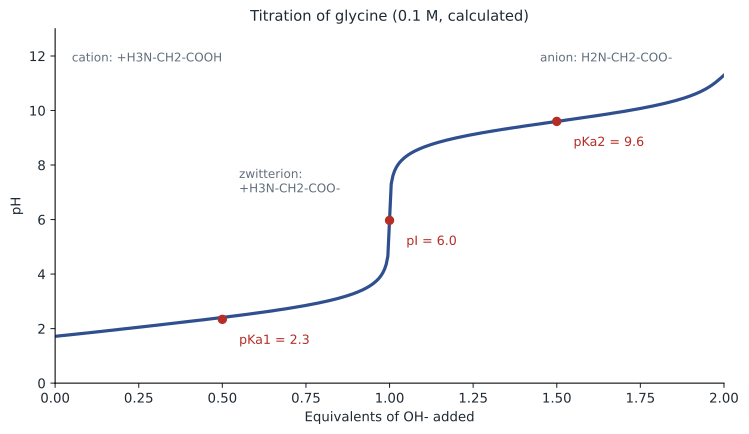
The isoelectric point (pI) is the pH at which an amino acid has no net charge. For amino acids with nonionizable side chains, the pI is the average of the two pKa values. For glycine, (2.3 + 9.6) / 2 is about 6.0. For acidic amino acids, the pI is the average of the two lowest pKa values (the alpha carboxyl and the side chain carboxyl), so aspartate's pI is near 3. For basic amino acids, it is the average of the two highest (the alpha amino and the side chain), so lysine's pI is near 9.7. At a pH below the pI an amino acid or protein carries a net positive charge, and above it a net negative charge. Electrophoresis and ion-exchange chromatography (lesson 4) separate molecules by exactly this property.
Worked problem
Net charge at a given pH
Glutamate has pKa values of about 2.2 (alpha carboxyl), 4.3 (side-chain carboxyl) and 9.7 (alpha amino). What is its pI, and what is its approximate net charge at pH 7.4?
Show solution
- It is an acidic amino acid, so pI = (2.2 + 4.3) / 2, about 3.2.
- At pH 7.4, both carboxyls are well above their pKa values, so both are deprotonated: charge -2 from them.
- The amino group (pKa 9.7) is still mostly protonated at 7.4: charge +1.
- Net charge is about -1.
Answer: pI about 3.2; net charge about -1 at pH 7.4.
Synthesizing amino acids in the laboratory
The AAMC outline names two laboratory syntheses of alpha-amino acids. Both produce racemic products, because they create the alpha stereocenter without any chiral influence. Resolving the product (lesson 4) or using enzymes is needed to obtain a single L enantiomer.
In the Strecker synthesis, an aldehyde reacts with ammonia (often supplied as ammonium chloride) to form an imine. Cyanide (from sodium or potassium cyanide) adds to the imine carbon, exactly as it adds to carbonyls in cyanohydrin formation, giving an alpha-aminonitrile. Acid hydrolysis of the nitrile then converts it to a carboxylic acid, producing the amino acid. The aldehyde supplies the side chain: acetaldehyde gives alanine, and 2-methylpropanal gives valine. The new carboxyl carbon comes from the cyanide.
The Gabriel synthesis makes primary amines without overalkylation by using phthalimide, a nitrogen compound flanked by two carbonyls. The N-H of phthalimide is acidic (pKa about 8) because the negative charge of its conjugate base is shared by both carbonyls, so phthalimide is easily deprotonated to a nitrogen nucleophile, and once alkylated it cannot react again. In the simplest form, potassium phthalimide reacts with a primary alkyl halide by SN2, and hydrolysis (or reaction with hydrazine) releases the primary amine. To make amino acids, the halide is diethyl bromomalonate. The resulting phthalimidomalonic ester is deprotonated at its acidic central carbon and alkylated with a second alkyl halide, which becomes the side chain. Heating with aqueous acid then hydrolyzes the phthalimide and both esters, and the resulting malonic acid decarboxylates (lesson 9), leaving an alpha-amino acid.
The peptide bond and disulfides
A peptide bond is an amide formed between the carboxyl of one amino acid and the amino group of the next, with loss of water. Peptide bonds have the properties of amides from lessons 2 and 9: the C-N bond has partial double-bond character, the six atoms of the peptide group lie in a plane, the bond is almost always trans, and the nitrogen is not basic. Hydrolysis is thermodynamically favorable but very slow at neutral pH without a catalyst. Strong acid and heat (in the laboratory) or proteases (in the body) break peptide bonds. Sequencing methods that cleave one residue at a time from the N-terminus, and enzymes such as trypsin that cut after lysine and arginine, rely on this chemistry.
Cysteine's thiol side chain undergoes the redox chemistry described in lesson 7. Two cysteines can be oxidized to form a disulfide bond, producing the linked dimer called cystine. In proteins, disulfide bonds cross-link distant parts of the chain or join separate chains, as in insulin, which has two chains joined by two disulfides. Reducing agents such as 2-mercaptoethanol or dithiothreitol break disulfides back into thiols, which is why they are added before SDS-PAGE when a passage wants separate chains to be resolved.
Passage practice: an amine drug and the stomach
Data invented for this course. A drug candidate, compound N, is a tertiary amine with conjugate-acid pKa 9.4 and no other ionizable groups. In a partition experiment between octanol and buffered water, the fraction of N in octanol was 0.95 at pH 11, 0.50 at pH 9.4 and below 0.01 at pH 2. The team also measured absorption from the stomach (pH about 2) and the small intestine (pH about 6 to 7.5) in an animal model and found that most absorption took place in the intestine.
Question 1. At pH 2, compound N exists mainly as: (A) the neutral amine. (B) the ammonium ion. (C) a zwitterion. (D) an amide.
Question 2. Why is the octanol fraction 0.50 at pH 9.4? (A) The drug decomposes at that pH. (B) At pH = pKa, the neutral and protonated forms are equal, and the neutral form partitions into octanol. (C) Octanol is protonated at pH 9.4. (D) The drug is a zwitterion at its pKa.
Question 3. Which best explains absorption mainly in the intestine? (A) A larger fraction of N is neutral at intestinal pH than at stomach pH, and neutral molecules cross membranes more easily. (B) Amines are destroyed by stomach acid. (C) N forms disulfide bonds in the intestine. (D) The intestine is more acidic.
Question 4. The company sells N as its hydrochloride salt mainly because the salt: (A) is more lipophilic. (B) is a crystalline solid that dissolves readily in water. (C) cannot be absorbed. (D) is a stronger base.
Answers. 1: B (skill 2). Seven units below the pKa, the amine is essentially fully protonated. 2: B (skill 4). Henderson-Hasselbalch gives a 1 to 1 ratio at pH = pKa. 3: A (skill 3). At pH 7, about 0.4 percent of N is neutral, roughly 100,000 times more than at pH 2; even a small neutral fraction is continuously replenished as it is absorbed. 4: B (skill 1). Elliot answered all four, then said, 'That is my antihistamine question. Hydrochloride means it is an amine that was protonated on purpose.'
Common mistakes
MistakeAmides are basic because they contain nitrogen.
InsteadThe amide lone pair is delocalized into the carbonyl; amides are essentially neutral.
MistakeAniline is a stronger base than methylamine.
InsteadAniline's lone pair is delocalized into the ring, making it about a million times weaker as a base.
MistakeThe pI of every amino acid is the average of all its pKa values.
InsteadAverage the two pKa values that bracket the neutral species: the two lowest for acidic amino acids, the two highest for basic ones.
MistakeThe Strecker synthesis gives pure L amino acids.
InsteadIt forms the stereocenter without chiral control, so the product is racemic.
MistakeDirect alkylation of ammonia is a clean way to make primary amines.
InsteadOveralkylation gives mixtures; the Gabriel synthesis avoids this.
Summary and key terms
- Amines are bases; alkyl ammonium ions have pKa near 10 to 11, so alkyl amines are protonated at pH 7.4.
- Delocalization (aniline, amides, pyrrole) and sp2 lone pairs (pyridine) weaken basicity.
- Amino acids are zwitterions at neutral pH; titration shows buffering near each pKa.
- pI is the average of the two pKa values bracketing the neutral form; below pI the net charge is positive.
- Strecker: aldehyde + NH3 + cyanide, then hydrolysis. Gabriel: phthalimide alkylation, then hydrolysis (and decarboxylation for amino acids). Both give racemates.
- Peptide bonds are planar, trans amides; cysteines oxidize to disulfides (cystine).
- Amine
- A compound with nitrogen bonded to one, two or three carbon groups and a lone pair.
- pKaH
- The pKa of a base's conjugate acid; a higher value means a stronger base.
- Zwitterion
- A neutral molecule with separate positive and negative charges.
- Isoelectric point
- The pH at which a molecule has no net charge.
- Strecker synthesis
- Synthesis of an amino acid from an aldehyde, ammonia and cyanide, followed by nitrile hydrolysis.
- Gabriel synthesis
- Synthesis of primary amines or amino acids by alkylating phthalimide and then releasing the amine.
- Cystine
- Two cysteine residues joined by a disulfide bond.
Practice problems
Work each problem on paper first, then reveal the answer to check.
Which is the strongest base: aniline, pyridine or methylamine?
Show answer
Methylamine (pKaH about 10.6).
What is the pI of alanine if its pKa values are 2.3 and 9.7?
Show answer
About 6.0.
Which aldehyde would you use in a Strecker synthesis of phenylalanine?
Show answer
Phenylacetaldehyde, C6H5CH2CHO; the CH2C6H5 becomes the side chain.
At pH 12, what is the net charge of glycine?
Show answer
About -1: the carboxyl is deprotonated and the amino group is neutral.
What reagent breaks disulfide bonds before SDS-PAGE?
Show answer
A reducing agent such as 2-mercaptoethanol or dithiothreitol.
Lesson quiz · 5 questions
Score 60% or more to complete this lesson.
Create a free account to save your progress, take quizzes and earn a certificate.