
MCAT-122 · Lesson 11 of 12 · 25 min
Reaction mechanisms and oxidation-reduction
▶ Video coming soon A video version of this lesson is on the way.
By the eleventh session, the group's error logs had a pattern. Elliot's organic misses were mostly "did not follow the electrons". Devika's were "could not tell oxidation from reduction". Ezequiel's were "too many reagents to remember". Thandiwe put the three phrases on the screen. 'Same root,' she said. 'You are trying to memorize reactions. Today we stop. You need three tools: curved arrows, oxidation states and a short list of reagent families. With those, you can work out most mechanisms you have never seen.'
This lesson pulls the course together around general principles. It covers how to read and draw curved-arrow mechanisms, the four basic electron movements behind all polar reactions, reaction energy diagrams with intermediates and transition states, kinetic and thermodynamic control, how to assign oxidation states to carbon and recognize oxidation and reduction, the main oxidizing and reducing agents, and how biological redox reactions with NAD+ and FAD fit the same rules. On the AAMC outline, energy changes in chemical reactions, kinetics, mechanisms and catalysis belong to content category 5E (principles of chemical thermodynamics and kinetics), and oxidation of alcohols and aldehydes, reduction by hydride reagents and phenol redox appear in category 5D.
Curved arrows: the grammar of mechanisms
A mechanism is a step-by-step account of which bonds break and form. Curved arrows show the movement of electron pairs. Every arrow starts at a source of electrons, a lone pair or a bond, and ends where the electrons go, either between two atoms (forming a new bond) or on one atom (becoming a lone pair). Arrows never start at a positive charge or at an atom with no electrons to give. A half-headed (fishhook) arrow shows one electron, used for radical reactions; the MCAT uses these rarely.
Three checks catch most errors. First, count charges: the total charge must be the same on both sides of every step. Second, check that no second-row atom ends up with more than eight electrons; if an arrow adds a bond to a carbon that already has four, another arrow must break one of its bonds. Third, check that arrows go from electron-rich to electron-poor: from nucleophiles to electrophiles, from bases to acidic protons.
Four basic electron movements
Almost every polar reaction in this course is built from four basic steps, used in different combinations. Recognizing them turns a long mechanism into a short sequence of familiar moves.
| Step | What happens | Examples in this course |
|---|---|---|
| Nucleophilic attack | A lone pair or pi bond forms a new bond to an electrophilic atom | SN2, addition to C=O, enolate attacking a carbonyl |
| Loss of a leaving group | A bond breaks and its electrons go to the departing group | SN1 ionization, collapse of a tetrahedral intermediate |
| Proton transfer | A base removes a proton; the electrons stay behind | Acid catalysis of esterification, tautomerism, E2 |
| Rearrangement | A group shifts with its electrons to a neighboring atom | 1,2-hydride and methyl shifts in carbocations |
Seen this way, an SN2 reaction is nucleophilic attack and loss of a leaving group in one step. SN1 is loss of a leaving group, sometimes rearrangement, then nucleophilic attack. E2 is a proton transfer and loss of a leaving group together. Nucleophilic acyl substitution under acid catalysis is a proton transfer to the carbonyl oxygen, nucleophilic attack, proton transfers, loss of a leaving group and a final proton transfer. Fischer esterification has six or seven arrows in total, but only three kinds of move.
Worked problem
Reading a new mechanism
A passage describes the acid-catalyzed hydrolysis of an acetal into an aldehyde and two alcohols. Without memorizing it, outline the steps.
Show solution
- Proton transfer: acid protonates one OR oxygen, turning it into a good leaving group (an alcohol).
- Loss of a leaving group: the alcohol departs. The neighboring oxygen's lone pair forms a C=O+ bond, giving a resonance-stabilized oxocarbenium ion.
- Nucleophilic attack: water attacks the electrophilic carbon.
- Proton transfer: loss of a proton gives a hemiacetal.
- Repeat: protonate the second OR, lose it, and lose a proton from the OH to form the C=O.
Answer: Proton transfer, loss of leaving group, nucleophilic attack, proton transfer, then the same sequence again. It is the exact reverse of acetal formation (lesson 8), as the principle of microscopic reversibility requires.
Energy diagrams, intermediates and transition states
A reaction energy diagram plots free energy against reaction progress. Peaks are transition states, fleeting arrangements at the highest energy along a step that cannot be isolated. Valleys between peaks are intermediates, such as carbocations, enolates and tetrahedral intermediates, which have real lifetimes and can sometimes be detected. The height of the highest barrier relative to the starting point (the activation energy) controls the overall rate; that step is the rate-determining step. The difference in free energy between reactants and products, delta G, controls the position of equilibrium, not the rate.
The Hammond postulate links the two. A transition state resembles the species closest to it in energy. In an endothermic step, such as the ionization that forms a carbocation, the transition state is late and looks like the carbocation, so anything that stabilizes the carbocation (more alkyl groups, resonance) also lowers the barrier. That is why carbocation stability predicts SN1 and E1 rates (lesson 6).
Catalysts lower the activation energy by providing a different pathway, often by stabilizing a transition state or by turning a poor leaving group into a good one. They speed up both the forward and reverse reactions equally and do not change delta G or the equilibrium constant. Acids catalyze carbonyl chemistry by protonating oxygen; enzymes catalyze reactions by holding substrates in place, stabilizing transition states and providing acidic, basic and nucleophilic side chains, exactly the mechanisms described in the Biochemistry Review.
Kinetic versus thermodynamic control
When a reaction can give two products, the product that forms faster (lower activation energy) is the kinetic product, and the more stable product (lower free energy) is the thermodynamic product. They are often different. At low temperature, with short reaction times and irreversible conditions, the kinetic product dominates, because molecules do not have enough energy to reverse and try again. At higher temperature, with longer times and reversible conditions, the system reaches equilibrium and the thermodynamic product dominates.
You have already met two examples. LDA at minus 78 degrees Celsius gives the kinetic enolate of an unsymmetrical ketone, while an alkoxide at room temperature gives the thermodynamic enolate (lesson 8). Bulky bases give the less substituted Hofmann alkene, while small bases and E1 conditions give the more stable Zaitsev alkene (lesson 6). A third classic example is the addition of HBr to 1,3-butadiene: at low temperature the 1,2-addition product dominates (kinetic), and at higher temperature the more substituted, more stable 1,4-addition product dominates (thermodynamic).
Oxidation states of carbon
Organic chemists describe oxidation and reduction at carbon by counting bonds. To find the oxidation state of a carbon, count -1 for each bond to hydrogen (or to a less electronegative atom such as a metal), +1 for each bond to a more electronegative atom such as O, N or a halogen (a double bond counts twice), and 0 for each bond to another carbon. Sum the values. Oxidation means the carbon's oxidation state increases; reduction means it decreases.
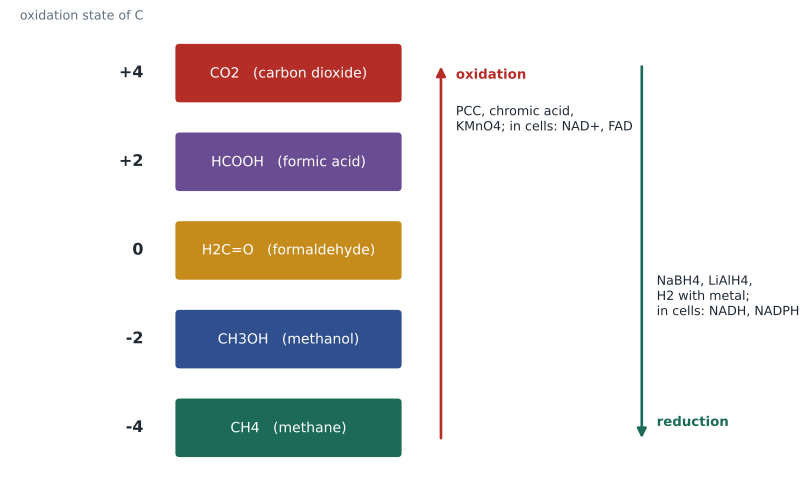
A practical shortcut is often enough: gaining bonds to oxygen (or other heteroatoms) or losing bonds to hydrogen is oxidation; gaining bonds to hydrogen or losing bonds to oxygen is reduction. Alcohols to aldehydes or ketones, aldehydes to carboxylic acids, and hydroquinones to quinones are oxidations. Ketones to alcohols, esters to alcohols, nitriles to amines and alkenes to alkanes (by adding H2) are reductions. Reactions that only exchange one heteroatom for another at the same level, such as hydrolyzing an ester to an acid or converting an acid chloride to an amide, are neither: the carbon keeps three bonds to heteroatoms.
Worked problem
Assigning oxidation states
In the conversion of ethanol to acetaldehyde to acetic acid, what happens to the oxidation state of carbon 1?
Show solution
- Ethanol, CH3CH2OH: C1 has two C-H bonds (-2), one C-O bond (+1) and one C-C bond (0). Oxidation state -1.
- Acetaldehyde, CH3CHO: C1 has one C-H (-1), a C=O (+2) and one C-C (0). Oxidation state +1.
- Acetic acid, CH3COOH: C1 has a C=O (+2), a C-O (+1) and one C-C (0). Oxidation state +3.
Answer: -1 to +1 to +3: two two-electron oxidations. In the body these are catalyzed by alcohol dehydrogenase and aldehyde dehydrogenase, each reducing one NAD+ to NADH.
Oxidizing and reducing agents
The MCAT expects you to recognize a short list of reagents by family rather than memorize every condition. Oxidizing agents usually contain metals in high oxidation states or oxygen-rich groups. Reducing agents usually deliver hydride (H-) or hydrogen atoms.
| Reagent | Type | Typical use |
|---|---|---|
| Chromic acid (Jones reagent), Na2Cr2O7 or CrO3 with H2SO4 | Strong oxidant | Primary alcohols to acids; secondary to ketones; aldehydes to acids |
| PCC (pyridinium chlorochromate) | Mild oxidant | Primary alcohols to aldehydes; secondary to ketones |
| KMnO4 | Strong oxidant | Alcohols and aldehydes to acids; cleaves C=C when hot |
| Tollens' reagent (silver-ammonia complex) | Mild, selective oxidant | Aldehydes to carboxylates; test for reducing sugars |
| O3 (ozone), then a reducing workup | Oxidative cleavage | Cleaves C=C into two carbonyl compounds |
| NaBH4 | Mild hydride donor | Aldehydes and ketones to alcohols |
| LiAlH4 | Strong hydride donor | Aldehydes, ketones, acids and esters to alcohols; amides and nitriles to amines |
| H2 with Pd, Pt or Ni | Catalytic hydrogenation | Alkenes and alkynes to alkanes; can also reduce other groups |
| NAD+ / NADH, FAD / FADH2 | Biological redox carriers | Two-electron oxidations and reductions in metabolism |
Catalytic hydrogenation adds H2 across a C=C double bond on the surface of a metal catalyst. Both hydrogens add to the same face of the alkene (syn addition), so a substituted cyclic alkene gives the cis product. Partial hydrogenation of vegetable oils, once used to make margarine, isomerized some cis double bonds to trans, producing trans fats; this is the connection between a simple organic reaction and a public health problem. Ozonolysis, the oxidative cleavage of alkenes, is useful in passages for locating a double bond: the positions of the two new carbonyls show where the C=C was.
Biological redox: NAD+ and FAD
Cells use the same oxidation-state logic with different reagents. NAD+ (nicotinamide adenine dinucleotide) accepts a hydride ion, two electrons and one proton, on its nicotinamide ring to become NADH; the second proton released by the substrate goes into solution. NAD+ oxidizes alcohols to carbonyls and aldehydes to acids, and NADH, or NADPH in biosynthesis, reduces carbonyls back to alcohols. FAD accepts two electrons and two protons to form FADH2 and typically oxidizes C-C single bonds to C=C double bonds, as succinate dehydrogenase does when it converts succinate to fumarate in the citric acid cycle.
Biological oxidations release energy because the carbon atoms of fuels are in low oxidation states. A fatty acid carbon (mostly CH2, oxidation state -2) has further to climb to CO2 (+4) than a sugar carbon (about 0), which is why fats store more than twice as much energy per gram as carbohydrates. The ladder in the figure is a map of metabolism: glycolysis, the citric acid cycle and beta-oxidation all move carbon upward, and the electrons they release flow through NADH, FADH2 and ubiquinone (lesson 7) to oxygen.
A strategy for unfamiliar reactions
When a passage presents a reaction you have never seen, work through five questions. What are the functional groups in the starting material? Which atoms are nucleophilic (lone pairs, pi bonds, negative charges) and which are electrophilic (partial positive carbons, protons on acids, carbons bearing leaving groups)? What do the reagents do: are they acids, bases, nucleophiles, oxidants or reductants? Which of the four basic moves connects the nucleophile to the electrophile? And does the product make sense: balanced charges, octets, and the right change in oxidation state? This approach turns most "new" reactions into combinations of the steps in this course.
Passage practice: a two-step synthesis
Data invented for this course. A chemist converted cyclohexanone into compound X in two steps. In step 1, cyclohexanone was treated with ethylmagnesium bromide in dry ether, followed by aqueous acid workup, giving compound W (C8H16O). W showed a broad IR peak at 3400 per centimeter and no peak near 1715. In step 2, W was heated with concentrated phosphoric acid, giving compound X (C8H14), which reacted rapidly with bromine and showed no O-H in its IR spectrum. Ozonolysis of X followed by a reducing workup gave a single product, C8H14O2, containing both a ketone and an aldehyde.
Question 1. What type of reaction occurred in step 1? (A) Oxidation of the ketone. (B) Nucleophilic addition of a carbanion-like ethyl group to the carbonyl. (C) SN2 substitution at the carbonyl oxygen. (D) Aldol condensation.
Question 2. Compound W is: (A) a primary alcohol. (B) a secondary alcohol. (C) a tertiary alcohol. (D) an ether.
Question 3. Step 2 is best described as: (A) E1 dehydration giving the more substituted alkene. (B) E2 elimination with a bulky base. (C) oxidation of the alcohol to a ketone. (D) SN1 substitution by phosphate.
Question 4. What happens to the oxidation state of the original carbonyl carbon across step 1? (A) It increases. (B) It decreases. (C) It stays the same. (D) It cannot be determined.
Answers. 1: B (skill 1). 2: C (skill 2). The carbonyl carbon ends up bonded to OH and three carbons: 1-ethylcyclohexanol. 3: A (skill 2). Hot acid protonates the OH, water leaves to give a tertiary carbocation, and loss of a ring proton gives 1-ethylcyclohexene, the more substituted (Zaitsev) alkene; ozonolysis then opens the ring to one product with a ketone and an aldehyde, confirming the double bond was in the ring. 4: B (skill 2). The carbon goes from two bonds to O (C=O, +2 contribution) plus two C-C bonds to one bond to O, so its oxidation state falls from +2 to +1: adding a carbon nucleophile is a reduction at that carbon. Devika got question 4 right and underlined it in her log: "Count bonds, do not guess."
Common mistakes
MistakeCurved arrows show the movement of atoms.
InsteadCurved arrows show electron pairs moving from a lone pair or bond to a new position; atoms follow the electrons.
MistakeA catalyst shifts the equilibrium toward products.
InsteadCatalysts lower activation energy for both directions; they change the rate, not the equilibrium constant.
MistakeThe thermodynamic product always forms faster.
InsteadThe kinetic product forms faster; the thermodynamic product is more stable and dominates under reversible conditions.
MistakeEster hydrolysis is a reduction because water adds.
InsteadExchanging one heteroatom for another at the same carbon is neither oxidation nor reduction.
MistakeNAD+ accepts two hydrogen atoms.
InsteadNAD+ accepts a hydride ion (two electrons, one proton); the second proton is released to solution.
Summary and key terms
- Curved arrows run from electron sources (lone pairs, bonds) to electron sinks; charges and octets must balance.
- Polar mechanisms combine four moves: nucleophilic attack, loss of a leaving group, proton transfer and rearrangement.
- The highest barrier sets the rate; delta G sets the equilibrium; catalysts change only the rate.
- Kinetic products form fastest (low temperature, irreversible); thermodynamic products are most stable (higher temperature, reversible).
- Oxidation at carbon adds bonds to heteroatoms or removes bonds to hydrogen; reduction does the reverse.
- PCC, chromic acid and permanganate oxidize; NaBH4, LiAlH4 and H2 with a metal reduce; NAD+ and FAD are the cell's oxidants.
- Mechanism
- A step-by-step description of bond making and breaking in a reaction.
- Transition state
- The highest-energy arrangement along a reaction step; cannot be isolated.
- Intermediate
- A species formed and consumed during a reaction, found in an energy valley.
- Hammond postulate
- A transition state resembles the species closest to it in energy.
- Kinetic product
- The product that forms fastest, through the lowest barrier.
- Thermodynamic product
- The most stable product, favored at equilibrium.
- Oxidation state of carbon
- A count of bonds to heteroatoms (+1 each) and to hydrogen (-1 each).
Practice problems
Work each problem on paper first, then reveal the answer to check.
What is the oxidation state of carbon in formaldehyde, H2C=O?
Show answer
0: two C-H bonds (-2) and a C=O (+2).
Is the conversion of an alkene to an alkane with H2 and Pd an oxidation or a reduction?
Show answer
A reduction: each carbon gains a bond to hydrogen.
Which hydride reagent reduces an ester to a primary alcohol?
Show answer
LiAlH4, which reduces esters to primary alcohols.
In an energy diagram, how do you identify the rate-determining step?
Show answer
It is the step with the highest transition state relative to the starting material.
What does FAD typically do in the citric acid cycle?
Show answer
It oxidizes a C-C single bond to a C=C (succinate to fumarate), becoming FADH2.
Lesson quiz · 5 questions
Score 60% or more to complete this lesson.
Create a free account to save your progress, take quizzes and earn a certificate.