
MCAT-122 · Lesson 3 of 12 · 27 min
Structure and isomers: isomerism and stereochemistry
▶ Video coming soon A video version of this lesson is on the way.
Elliot liked stereochemistry because it felt like geometry. Ezequiel did not. 'I can never tell if I rotated the molecule or reflected it,' he said. Thandiwe handed out a set of model kits by mail the week before, and asked everyone to build two copies of 2-butanol before the session. 'Today we use our hands. If you can hold the two molecules and try to stack them, you will never need to guess whether they are the same.'
This lesson classifies isomers, explains chirality and how to assign R and S configurations with the Cahn-Ingold-Prelog rules, covers E and Z alkenes, meso compounds, optical activity and racemic mixtures, and reviews conformations of chains and rings. On the AAMC outline these topics are in content category 5B under stereochemistry of covalently bonded molecules: isomers (structural isomers, stereoisomers including diastereomers, enantiomers and cis-trans isomers, and conformational isomers), polarization of light and specific rotation, absolute and relative configuration, the R and S convention, the E and Z convention, and racemic mixtures. Biology adds the stakes: enzymes and receptors are chiral, so the two enantiomers of a drug can behave very differently in the body.
A map of isomers
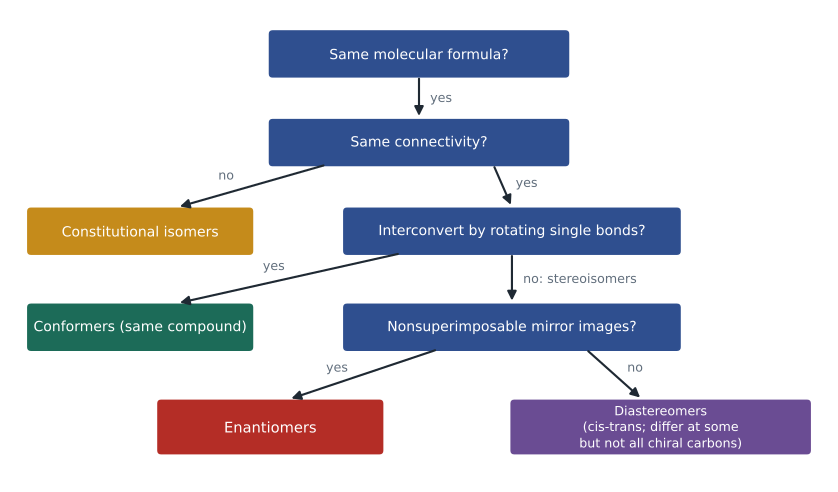
Isomers are compounds with the same molecular formula but different structures. The first question is whether the atoms are connected in the same order. If not, the compounds are constitutional (structural) isomers. If the connectivity is the same but the arrangement in space differs, they are stereoisomers. Stereoisomers divide again by whether they are mirror images.
| Type | Relationship | Physical properties | Example |
|---|---|---|---|
| Constitutional isomers | Different connectivity | Different | Butane and isobutane (C4H10); ethanol and dimethyl ether (C2H6O) |
| Conformers | Same molecule, rotation about single bonds | Same compound (interconvert) | Staggered and eclipsed ethane |
| Enantiomers | Nonsuperimposable mirror images | Identical except rotation of plane-polarized light and interactions with other chiral things | (R)- and (S)-2-butanol |
| Diastereomers | Stereoisomers that are not mirror images | Different | cis- and trans-2-butene; D-glucose and D-galactose |
| Meso compound | Has stereocenters but is achiral because of internal symmetry | Optically inactive | (2R,3S)-tartaric acid |
This table contains one of the most tested facts in MCAT organic chemistry: enantiomers have identical physical properties (boiling point, melting point, solubility in ordinary solvents, spectra) except for the direction in which they rotate plane-polarized light and how they interact with other chiral molecules. Diastereomers, by contrast, have different physical properties and can be separated by ordinary methods such as distillation, recrystallization or chromatography. Lesson 4 uses this to resolve racemic mixtures: converting enantiomers into diastereomers makes them separable.
Chirality and stereocenters
An object is chiral if it cannot be superimposed on its mirror image, like a left and a right hand. In organic molecules, chirality usually comes from a stereocenter (also called a chiral center): an sp3 carbon bonded to four different groups. 2-Butanol has a stereocenter at carbon 2, which carries H, OH, CH3 and CH2CH3. 2-Propanol does not, because carbon 2 carries two identical methyl groups.
A molecule with one stereocenter is always chiral. A molecule with several stereocenters is usually chiral, but not always: if it has an internal mirror plane, it is achiral and is called a meso compound. A molecule with n stereocenters has at most 2 to the n stereoisomers. Meso compounds reduce that number, because two of the "different" forms turn out to be the same compound.
Assigning R and S
The Cahn-Ingold-Prelog (CIP) rules give each stereocenter an absolute configuration, R (rectus, right) or S (sinister, left). The procedure has four steps.
First, rank the four groups on the stereocenter by the atomic number of the atom directly attached. Higher atomic number gets higher priority: I > Br > Cl > S > F > O > N > C > H. Second, if two attached atoms tie, move outward and compare the sets of atoms attached to each, looking for the first point of difference. A CH2OH outranks a CH2CH3 because at the first point of difference O beats C. Double bonds count as if each atom were duplicated, so a C=O carbon counts as carrying two oxygens. Third, orient the molecule so the lowest-priority group (often H) points away from you. Fourth, trace a path from priority 1 to 2 to 3. Clockwise is R; counterclockwise is S.
Worked problem
Assigning the configuration of an amino acid
L-alanine has its stereocenter bonded to NH2, COOH, CH3 and H. In a drawing with H on a dash (pointing away), the path from NH2 to COOH to CH3 runs counterclockwise. What is the configuration?
Show solution
- Rank by attached atom: NH2 (N, atomic number 7) is priority 1.
- COOH and CH3 both attach through carbon. Compare their substituents: COOH carbon carries (O, O, O) counting the double bond twice; CH3 carries (H, H, H). COOH is priority 2 and CH3 is priority 3.
- H is priority 4 and already points away.
- The 1 to 2 to 3 path is counterclockwise.
Answer: S. L-alanine is (S)-alanine. Almost all L-amino acids in proteins are S; cysteine is the exception (R), because its CH2SH group outranks COOH when sulfur is compared with oxygen.
Two shortcuts save time. If the lowest-priority group points toward you (on a wedge) instead of away, determine the direction as usual and then reverse the answer. And swapping any two groups on a stereocenter inverts its configuration; swapping twice restores it. Swapping is a quick way to compare two drawings: if one swap turns drawing A into drawing B, they are enantiomers at that center.
R and S describe geometry, not the direction of optical rotation. A compound's sign of rotation, (+) or (-), also called d or l, must be measured with a polarimeter and cannot be predicted from R or S. The older D and L labels used for sugars and amino acids are a third system, based on relationship to glyceraldehyde in a Fischer projection. Passages may use all three, so keep them apart.
Fischer projections
A Fischer projection draws a stereocenter as a cross. The horizontal lines point toward the viewer and the vertical lines point away. Sugars are traditionally drawn this way, with the most oxidized carbon (the aldehyde or ketone) at the top. To assign R or S in a Fischer projection, note that if the lowest-priority group is on a vertical line, the clockwise or counterclockwise direction gives the answer directly; if it is on a horizontal line, reverse the answer. Rotating a Fischer projection by 180 degrees in the plane keeps the configuration, but rotating it by 90 degrees inverts it.
For sugars, the D or L label depends on the stereocenter farthest from the carbonyl. If its OH points to the right in the Fischer projection, the sugar is D; to the left, L. Most natural sugars are D. Two sugars that differ at only one stereocenter are epimers (D-glucose and D-galactose differ at carbon 4), and the two cyclic forms that differ only at the new stereocenter created by ring closure are anomers (alpha and beta), a topic that connects to hemiacetals in lesson 8.
Cis-trans and E and Z
Because double bonds do not rotate, alkenes with two different groups on each double-bond carbon exist as stereoisomers. When each carbon has one hydrogen, cis (same side) and trans (opposite sides) work well. For more substituted alkenes, use the E and Z system. Rank the two groups on each carbon by CIP priority. If the two higher-priority groups are on the same side, the alkene is Z (zusammen, together); if on opposite sides, E (entgegen, opposite). Cis and trans isomers are diastereomers and have different physical properties. Cis isomers are usually more polar, with higher boiling points, and pack less well into solids, giving lower melting points.
Rings create the same kind of isomerism. In 1,2-dimethylcyclohexane, both methyls can be on the same face of the ring (cis) or on opposite faces (trans). These are diastereomers, and each may also be chiral or meso depending on symmetry.
Meso compounds and counting stereoisomers
Tartaric acid, HOOC-CH(OH)-CH(OH)-COOH, has two stereocenters, so up to four stereoisomers are possible: (R,R), (S,S), (R,S) and (S,R). The (R,R) and (S,S) forms are enantiomers of each other. The (R,S) and (S,R) forms have a mirror plane between the two central carbons, so they are the same achiral compound, meso-tartaric acid. Tartaric acid therefore has three stereoisomers. A quick test: a compound whose two halves are identical and whose stereocenters have opposite labels (R,S) is meso.
Worked problem
Counting stereoisomers
How many stereoisomers does 2,3-dibromobutane have, and how many does 2,3-dibromopentane have?
Show solution
- 2,3-Dibromobutane has two stereocenters (C2 and C3), and its two halves are identical (CH3-CHBr-).
- So it has (R,R), (S,S) and a meso (R,S) form: three stereoisomers.
- 2,3-Dibromopentane also has two stereocenters, but its halves differ (CH3 on one end, CH2CH3 on the other), so no meso form is possible.
- It has 2 squared = 4 stereoisomers: two pairs of enantiomers.
Answer: 2,3-Dibromobutane: 3. 2,3-Dibromopentane: 4.
Optical activity, racemic mixtures and enantiomeric excess
Chiral compounds are optically active: they rotate the plane of plane-polarized light. The observed rotation depends on concentration and path length, so it is normalized as specific rotation, [alpha] = alpha / (l x c), where alpha is the observed rotation in degrees, l is the path length in dm (tenths of a meter) and c is the concentration in grams per mL. Two enantiomers have specific rotations equal in size and opposite in sign.
A racemic mixture (racemate) contains equal amounts of two enantiomers. Its rotations cancel, so it is optically inactive. Reactions that pass through a planar intermediate, such as a carbocation in an SN1 reaction or an enol at an alpha carbon, often give racemic products, because the incoming group can attack either face equally. Enantiomeric excess (ee) measures how far a mixture is from racemic: ee equals the percent of the major enantiomer minus the percent of the minor one, which also equals the observed specific rotation divided by that of the pure enantiomer, times 100.
Worked problem
Enantiomeric excess from rotation
Suppose pure (S)-ibuprofen has a specific rotation of +57 degrees under the conditions used. A sample has a specific rotation of +38 degrees. What is its enantiomeric excess, and what is its composition?
Show solution
- ee = 38 / 57 x 100, which is two thirds of 100, about 67 percent.
- The sample is 67 percent "extra" S on top of a racemic portion of 33 percent.
- The racemic portion splits evenly: about 16.5 percent S and 16.5 percent R.
- Total S: 67 + 16.5, about 83 percent; R about 17 percent.
Answer: About 67 percent ee, roughly 83 percent (S) and 17 percent (R).
Drug chemistry makes this practical. Ibuprofen is sold as a racemate, and the body converts much of the inactive R enantiomer into the active S form. Other drugs are sold as single enantiomers, such as escitalopram, the S enantiomer of citalopram. Thalidomide is the classic cautionary case: its enantiomers interconvert in the body, so selling a single enantiomer would not have prevented its harm.
Conformations of chains
Conformers are different arrangements of one molecule produced by rotating about single bonds. They interconvert rapidly at room temperature and are not separate compounds. Newman projections show conformations by looking straight down a C-C bond: the front carbon is a point with three bonds, and the back carbon is a circle with three bonds.
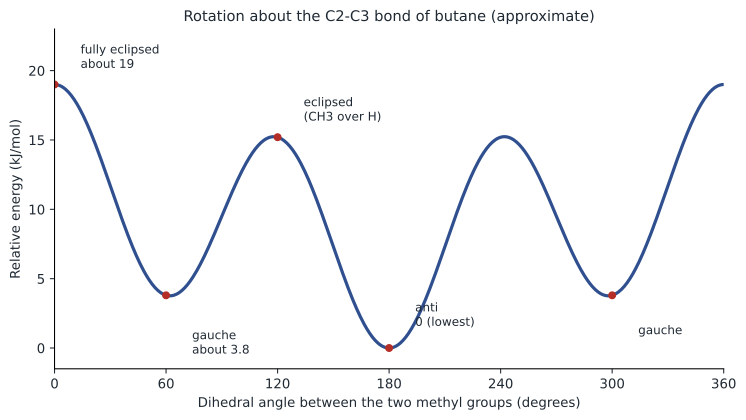
In ethane, the staggered conformation (back bonds between front bonds) is about 12 kJ/mol lower in energy than the eclipsed conformation, because eclipsed bonds repel (torsional strain). In butane, viewed down C2-C3, the lowest-energy conformation is anti, with the two methyl groups 180 degrees apart. Gauche conformations, with methyls 60 degrees apart, are about 3.8 kJ/mol higher because the methyls crowd each other (steric strain). The highest-energy conformation is fully eclipsed, with methyl directly in front of methyl.
Ring conformations
Small rings suffer angle strain because their bond angles are forced away from 109.5 degrees. Cyclopropane (60 degrees) is highly strained and reactive; cyclobutane is strained too. Cyclohexane avoids strain almost completely by adopting a chair conformation, in which every bond angle is near 109.5 degrees and every C-H bond is staggered. Each carbon in the chair has one axial position (pointing straight up or down) and one equatorial position (pointing outward around the ring's equator).
A chair can flip into another chair, and in the process every axial group becomes equatorial and every equatorial group becomes axial. Substituents prefer the equatorial position, because axial groups bump into the other axial hydrogens on the same face, two carbons away (1,3-diaxial interactions). The larger the group, the stronger the preference. A tert-butyl group is so bulky that it locks the ring into the chair in which it is equatorial. In disubstituted rings, the most stable chair puts as many large groups as possible in equatorial positions. Glucose is the most common hexose in nature partly because in beta-D-glucopyranose every bulky substituent can be equatorial.
The boat conformation of cyclohexane is higher in energy, about 30 kJ/mol above the chair, because of eclipsed bonds and a clash between the two "flagpole" hydrogens. Rings fused together, as in steroids such as cholesterol, are locked into rigid shapes that matter for how they fit into membranes and receptors.
Passage practice: two enantiomers, two effects
Data invented for this course. A drug candidate, compound E, has one stereocenter. The team separated its enantiomers and tested them. E1 had a specific rotation of +24 degrees and bound the target receptor 200 times more tightly than E2. E2 had a specific rotation of -24 degrees. A batch made by a new synthesis had an observed specific rotation of +12 degrees. Both enantiomers had the same melting point, 141 degrees Celsius, and the same IR spectrum.
Question 1. What is the enantiomeric excess of the new batch? (A) 12 percent. (B) 25 percent. (C) 50 percent. (D) 75 percent.
Question 2. Which property would most likely differ between E1 and E2? (A) Boiling point. (B) Solubility in hexane. (C) Rate of metabolism by a liver enzyme. (D) Molar mass.
Question 3. A chemist claims E1 is the R enantiomer because it rotates light clockwise. This reasoning is: (A) correct, because R always rotates clockwise. (B) correct, because dextrorotatory compounds are R. (C) flawed, because the sign of rotation cannot be predicted from R or S. (D) flawed, because enantiomers do not rotate light.
Question 4. What is the composition of the new batch? (A) 50 percent E1 and 50 percent E2. (B) 75 percent E1 and 25 percent E2. (C) 62.5 percent E1 and 37.5 percent E2. (D) 100 percent E1.
Answers. 1: C (skill 2). 12 / 24 = 0.5, so 50 percent ee. 2: C (skill 2). Enzymes are chiral, so they can distinguish enantiomers; the listed physical properties are identical. 3: C (skill 3). R and S describe geometry; the sign of rotation must be measured. 4: B (skill 2). 50 percent excess plus half of the remaining 50 percent: 75 percent E1, 25 percent E2. Ezequiel got the first and third right and the fourth wrong, choosing C. 'Same trap as the ibuprofen example,' he said, and wrote "ee + half of the rest" in his error log.
Common mistakes
MistakeR compounds rotate light clockwise.
InsteadR and S are geometric labels; the sign of rotation is measured experimentally and is unrelated.
MistakeEnantiomers have different boiling points and can be separated by distillation.
InsteadEnantiomers have identical physical properties in achiral environments; diastereomers can be separated.
MistakeA molecule with two stereocenters always has four stereoisomers.
InsteadIf a meso form exists, there are only three.
MistakeWhen the lowest-priority group is toward you, read the direction directly.
InsteadReverse the answer when the lowest-priority group points toward you.
MistakeSubstituents on cyclohexane prefer axial positions.
InsteadThey prefer equatorial positions to avoid 1,3-diaxial interactions.
Summary and key terms
- Constitutional isomers differ in connectivity; stereoisomers differ only in spatial arrangement.
- Enantiomers are nonsuperimposable mirror images with identical physical properties except optical rotation and chiral interactions.
- Diastereomers are stereoisomers that are not mirror images and have different properties.
- CIP rules: rank by atomic number, put priority 4 away, clockwise is R.
- Meso compounds have stereocenters and an internal mirror plane, so they are achiral.
- Staggered and anti conformations are lowest in energy; cyclohexane chairs put bulky groups equatorial.
- Stereocenter
- An atom, usually sp3 carbon, bonded to four different groups.
- Enantiomers
- Nonsuperimposable mirror-image stereoisomers.
- Diastereomers
- Stereoisomers that are not mirror images.
- Meso compound
- An achiral compound with stereocenters and an internal mirror plane.
- Racemic mixture
- An equal mixture of two enantiomers; optically inactive.
- Specific rotation
- Observed rotation divided by path length and concentration.
- Epimers
- Diastereomers that differ at only one stereocenter.
Practice problems
Work each problem on paper first, then reveal the answer to check.
Does 3-methylhexane have a stereocenter?
Show answer
Yes: C3 carries H, CH3, CH2CH3 and CH2CH2CH3, four different groups.
What is the relationship between (2R,3R)- and (2R,3S)-2,3-dihydroxypentanal?
Show answer
Diastereomers: they differ at one of two stereocenters and are not mirror images (they are epimers at C3).
A sample has 90 percent of one enantiomer and 10 percent of the other. What is its ee?
Show answer
80 percent.
Which is more stable: cis-1,4-di-tert-butylcyclohexane or trans-1,4-di-tert-butylcyclohexane?
Show answer
Trans, because both tert-butyl groups can be equatorial in one chair.
Swapping two groups on a stereocenter does what to its configuration?
Show answer
It inverts it (R becomes S).
Lesson quiz · 5 questions
Score 60% or more to complete this lesson.
Create a free account to save your progress, take quizzes and earn a certificate.