
MCAT-122 · Lesson 7 of 12 · 25 min
Alcohols, ethers and phenols
▶ Video coming soon A video version of this lesson is on the way.
Devika brought a question from the pharmacy. 'A customer asked why rubbing alcohol is isopropyl alcohol and not the kind you drink. I said they are both alcohols, then realized I did not know what that word means chemically, beyond "has an OH".' Thandiwe was delighted. 'That is exactly the right question. "Has an OH" is the start. Whether that OH is on a primary, secondary or tertiary carbon, or on a ring, decides almost everything it can do.'
This lesson covers alcohols, ethers and phenols: their naming and physical properties, their acidity, how alcohols are oxidized, how their OH groups are converted into good leaving groups as mesylates and tosylates, how alcohols are protected during multistep syntheses, how ethers form and react, and the redox chemistry of phenols and quinones that underlies ubiquinone in the electron transport chain. On the AAMC outline, alcohols (nomenclature, physical properties including acidity and hydrogen bonding, oxidation, SN1 and SN2 substitution, protection of alcohols, and preparation of mesylates and tosylates) and phenols (oxidation and reduction, such as hydroquinones and ubiquinones, as biological two-electron redox centers) are both listed in content category 5D.
Alcohols: structure and properties
An alcohol has an OH group bonded to an sp3 carbon. The oxygen is sp3 hybridized with two lone pairs, and the C-O-H angle is close to the tetrahedral value. Alcohols are named with the suffix -ol (ethanol, propan-2-ol) or, when a higher-priority group is present, with the prefix hydroxy-. Compounds with two OH groups are diols (ethylene glycol is ethane-1,2-diol), and with three, triols (glycerol is propane-1,2,3-triol). Diols with both OH groups on adjacent carbons are called vicinal diols; with both on the same carbon, geminal diols, which are usually unstable and lose water to form a carbonyl (lesson 8).
Alcohols both donate and accept hydrogen bonds, so they have much higher boiling points than alkanes or ethers of similar mass, and small alcohols mix with water in all proportions. Methanol, ethanol and the propanols are fully miscible; solubility falls steadily as the carbon chain grows, and 1-hexanol dissolves only slightly. Each additional OH raises the boiling point and water solubility further, which is why glycerol is a viscous, water-soluble liquid with a boiling point near 290 degrees Celsius.
Acidity of alcohols and phenols
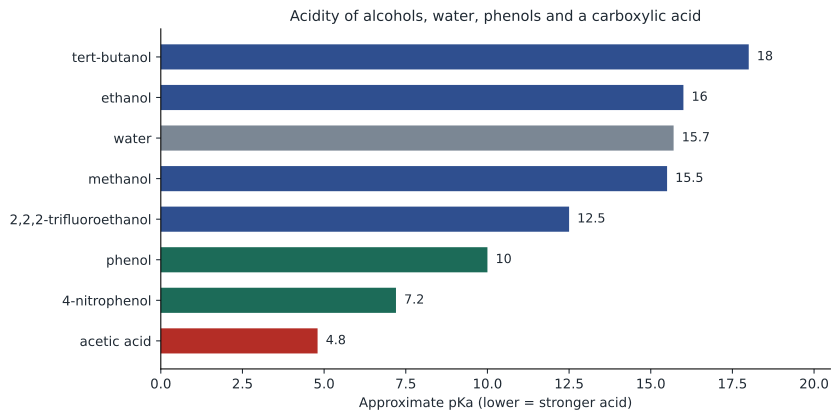
Alcohols are very weak acids, comparable to water. The pKa of methanol is about 15.5, ethanol about 16, and tert-butanol about 18. Two factors explain the trend. Alkyl groups donate electron density inductively, which destabilizes the negatively charged alkoxide ion. And larger alkoxides are harder for solvent molecules to surround and stabilize. Electron-withdrawing groups make alcohols more acidic: 2,2,2-trifluoroethanol has a pKa near 12.5, because the fluorines pull electron density away from the oxygen and stabilize the alkoxide.
Because alcohols are such weak acids, forming an alkoxide requires a very strong base, such as sodium hydride (NaH) or sodium metal. Sodium hydroxide is not strong enough to deprotonate most alcohols completely, because hydroxide and alkoxide are about equally basic. Alkoxides are strong bases and good nucleophiles, used in the Williamson ether synthesis below and in E2 eliminations in lesson 6.
Phenols are far more acidic than alcohols. Phenol has a pKa near 10, about a million times more acidic than ethanol, because the negative charge of the phenoxide ion is delocalized into the aromatic ring by resonance, onto the carbons ortho and para to the oxygen. Substituents change this. Electron-withdrawing groups such as nitro groups, especially in the ortho and para positions where they can share the charge by resonance, increase acidity: 4-nitrophenol has a pKa near 7.2, and 2,4,6-trinitrophenol (picric acid) is nearly as acidic as a strong mineral acid, with pKa near 0.4. Electron-donating groups such as methyl or methoxy decrease acidity slightly.
Worked problem
Predicting acid-base equilibria
Which way does the equilibrium lie when phenol is mixed with aqueous sodium hydroxide? What about ethanol with aqueous sodium bicarbonate?
Show solution
- An acid-base equilibrium favors the side with the weaker acid (higher pKa).
- Phenol (pKa 10) + hydroxide gives phenoxide + water (pKa 15.7). Water is the weaker acid, so the equilibrium lies far to the right.
- Ethanol (pKa 16) + bicarbonate gives ethoxide + carbonic acid (pKa about 6.4). Ethanol is the weaker acid, so the equilibrium lies far to the left.
Answer: NaOH deprotonates phenol almost completely; bicarbonate does not deprotonate ethanol. This is the basis of the acid-base extractions in lesson 4.
Oxidation of alcohols
Oxidation in organic chemistry usually means gaining bonds to oxygen or losing bonds to hydrogen at a carbon (lesson 11 makes this precise with oxidation states). When an alcohol is oxidized, the carbon bearing the OH loses a hydrogen and forms a C=O. What happens next depends on how many hydrogens that carbon has.
| Alcohol | H on the OH-bearing carbon | Mild oxidant (PCC, Swern, Dess-Martin) | Strong oxidant (chromic acid / Jones, KMnO4) |
|---|---|---|---|
| Primary (RCH2OH) | Two | Aldehyde (RCHO) | Carboxylic acid (RCOOH) |
| Secondary (R2CHOH) | One | Ketone (R2CO) | Ketone (R2CO) |
| Tertiary (R3COH) | None | No reaction | No reaction (no C-H to remove) |
Strong oxidants in water, such as chromic acid (made from sodium dichromate or chromium trioxide in aqueous sulfuric acid, the Jones reagent) or potassium permanganate, oxidize primary alcohols all the way to carboxylic acids. In water, the aldehyde formed first adds water to give a hydrate (a geminal diol), which is oxidized again. Pyridinium chlorochromate (PCC) in dichloromethane is a milder chromium reagent used without water, so oxidation stops at the aldehyde. Chromium(VI) reagents are toxic, and modern laboratories often use chromium-free alternatives such as Swern oxidation or Dess-Martin periodinane, which also stop at aldehydes. In the chromic acid reaction, orange chromium(VI) is reduced to green chromium(III), a color change once used in roadside breath tests for ethanol.
Cells oxidize alcohols too, with enzymes instead of chromium. Alcohol dehydrogenase uses NAD+ to oxidize ethanol to acetaldehyde, and aldehyde dehydrogenase oxidizes acetaldehyde to acetate, the same primary alcohol to aldehyde to carboxylic acid sequence. The reverse reaction, reduction of a carbonyl to an alcohol, is covered in lesson 8. Methanol poisoning is dangerous because the same enzymes convert methanol to formaldehyde and then formic acid, which damages the optic nerve. Ethanol is used as an antidote in some settings because it competes for alcohol dehydrogenase, and the drug fomepizole inhibits the enzyme directly.
Turning OH into a leaving group
Hydroxide is a poor leaving group, so alcohols do not react with nucleophiles in SN2 reactions. There are three standard ways around this. The first is to protonate the alcohol with strong acid. Water is a good leaving group, so primary alcohols with HBr or HI react by SN2 and tertiary alcohols react by SN1, often with rearrangement. The second is to use reagents that replace OH directly with a halogen, such as thionyl chloride (SOCl2), which gives an alkyl chloride, and phosphorus tribromide (PBr3), which gives an alkyl bromide. These work well for primary and secondary alcohols and avoid carbocation rearrangements.
The third method, specifically named on the AAMC outline, is to convert the alcohol into a sulfonate ester. Reacting an alcohol with methanesulfonyl chloride (mesyl chloride, MsCl) or p-toluenesulfonyl chloride (tosyl chloride, TsCl) in the presence of a base such as pyridine replaces the O-H hydrogen with a sulfonyl group, giving a mesylate (ROMs) or tosylate (ROTs). The C-O bond is not broken in this step, so the configuration at the carbon is unchanged. The sulfonate is an excellent leaving group, because its negative charge is delocalized over three oxygens. A nucleophile can then displace it by SN2, with inversion.
Worked problem
Inverting a stereocenter with a tosylate
(R)-2-Butanol is treated with TsCl and pyridine, then with sodium cyanide in DMSO. What is the product and its configuration?
Show solution
- Tosylation forms (R)-2-butyl tosylate. The C-O bond is untouched, so the configuration is retained.
- Cyanide attacks the secondary carbon by SN2 in a polar aprotic solvent, displacing tosylate with inversion of geometry.
- Assign priorities in the product: CN (C bonded to N, N, N) outranks CH2CH3 (C bonded to C, H, H), which outranks CH3, then H.
- Drawing the inverted product shows that the configuration label is S.
Answer: (S)-2-Methylbutanenitrile. The two-step sequence converts an alcohol into a substitution product with clean inversion and no carbocation rearrangement.
Protecting groups
In a molecule with several functional groups, a reagent meant for one group may attack another. A protecting group temporarily converts a reactive group into an unreactive form, survives the planned reaction, and is then removed. Alcohols are often protected as silyl ethers, made by reaction with a chlorosilane such as tert-butyldimethylsilyl chloride (TBSCl). Silyl ethers survive bases, nucleophiles, Grignard reagents and many oxidants, and they are removed with fluoride ion (from tetrabutylammonium fluoride), because the silicon-fluorine bond is exceptionally strong. Other common protecting groups for alcohols include benzyl ethers and acetals (lesson 8).
Protection is a strategy question on the MCAT. If a passage describes a synthesis in which a strong base or a Grignard reagent would destroy an OH group, the correct answer usually involves protecting the OH first and removing the protecting group last. Grignard reagents are strong bases that would simply deprotonate an unprotected alcohol, consuming the reagent.
Ethers
An ether has an oxygen bonded to two carbons (R-O-R'). Ethers are named either as alkoxy alkanes (methoxyethane) or by naming both groups followed by "ether" (ethyl methyl ether). Cyclic ethers include tetrahydrofuran (THF), a common solvent, and epoxides, three-membered rings containing oxygen. Ethers accept hydrogen bonds from water but cannot donate them, so they boil at about the same temperatures as alkanes of similar mass and much lower than isomeric alcohols. Diethyl ether boils near 35 degrees Celsius, while its isomer 1-butanol boils near 118. Ethers are fairly unreactive, which makes them good solvents for reactions with strong bases and Grignard reagents.
The Williamson ether synthesis makes ethers by SN2: an alkoxide ion attacks a primary alkyl halide or tosylate. The halide must be primary (or methyl), because alkoxides are strong bases and would cause E2 elimination with secondary or tertiary halides. To make tert-butyl methyl ether, the correct pairing is tert-butoxide with methyl iodide, not methoxide with tert-butyl bromide, which would give mostly isobutylene by elimination.
Ethers are cleaved by strong acids such as HBr and HI, which protonate the oxygen and allow halide to attack. Epoxides are much more reactive than ordinary ethers, because the three-membered ring is strained. They open with nucleophiles under basic conditions (attack at the less substituted carbon, SN2-like) or acidic conditions (attack at the more substituted carbon, which carries more partial positive charge). Epoxide opening gives trans products, because the nucleophile attacks from the face opposite the oxygen. In the body, cytochrome P450 enzymes oxidize some aromatic compounds to reactive epoxides, which is how benzo[a]pyrene in tobacco smoke becomes a DNA-damaging carcinogen.
Phenols, quinones and biological redox
Phenols undergo a distinctive two-electron redox reaction. A 1,4-dihydroxybenzene (a hydroquinone) can be oxidized by losing two electrons and two protons to form a 1,4-benzoquinone, a ring with two C=O groups. The reaction is reversible, so quinones and hydroquinones can shuttle electrons back and forth. The AAMC outline specifically names this as a biological two-electron redox center.
Ubiquinone (coenzyme Q) in the inner mitochondrial membrane is the best-known example. It accepts two electrons and two protons from complex I or complex II to become ubiquinol (QH2), diffuses through the membrane, and passes the electrons to complex III, regenerating ubiquinone. Its long hydrophobic isoprenoid tail keeps it dissolved in the membrane. Plastoquinone plays the same role in photosynthesis, and vitamin K is a naphthoquinone needed for blood-clotting factor activation. Phenols also act as antioxidants: vitamin E (tocopherol) and many plant polyphenols donate a hydrogen atom to stop radical chain reactions, forming a resonance-stabilized phenoxyl radical that is too stable to continue the chain.
Thiols, the sulfur analogues of alcohols, are worth a sentence here. Thiols (R-SH) are more acidic than alcohols (pKa near 10 for many thiols), and thiolates are excellent nucleophiles. Two thiols can be oxidized to a disulfide (R-S-S-R), and disulfides are reduced back to thiols. In proteins, disulfide bonds between cysteine residues (forming cystine) stabilize the tertiary structure of many secreted proteins, a topic listed under amino acids in content category 5D and covered in lesson 10.
Passage practice: a protected synthesis
Data invented for this course. A chemist needs to convert compound H, HO-CH2CH2CH2-CHO, into HO-CH2CH2CH2-CH(OH)CH3 using methylmagnesium bromide (a Grignard reagent, a source of CH3- that adds to aldehydes). Her first attempt, adding one equivalent of the Grignard reagent directly to compound H, gave mostly unreacted aldehyde and methane gas. In a second attempt she treated H with TBSCl and imidazole, then with the Grignard reagent, then with aqueous acid, and finally with tetrabutylammonium fluoride. The second route gave the desired diol in good yield.
Question 1. Why did the first attempt fail? (A) The aldehyde is too hindered. (B) The Grignard reagent deprotonated the alcohol, forming methane. (C) Grignard reagents do not react with aldehydes. (D) The alcohol oxidized the Grignard reagent.
Question 2. What is the purpose of the TBSCl step? (A) To oxidize the alcohol. (B) To protect the alcohol as a silyl ether. (C) To convert the aldehyde to an acetal. (D) To make a better leaving group for SN2.
Question 3. What does tetrabutylammonium fluoride do in the last step? (A) It reduces the aldehyde. (B) It removes the silyl protecting group. (C) It adds a methyl group. (D) It fluorinates the alcohol.
Question 4. The new alcohol formed from the aldehyde carbon is: (A) primary. (B) secondary. (C) tertiary. (D) a phenol.
Answers. 1: B (skill 2). Grignard reagents are strong bases (the conjugate acid, methane, has pKa near 50), so the alcohol O-H (pKa about 16) is deprotonated first. 2: B (skill 1). 3: B (skill 1). Fluoride has a very high affinity for silicon. 4: B (skill 1). The carbon now carries OH, H, CH3 and the chain. Devika had all four. 'And rubbing alcohol is secondary,' she said, 'which is why it oxidizes to acetone, not to an acid.'
Common mistakes
MistakeSodium hydroxide fully deprotonates ethanol.
InsteadEthanol (pKa about 16) and water (15.7) are similar, so hydroxide gives only a small amount of ethoxide; use NaH for complete deprotonation.
MistakeTertiary alcohols oxidize to ketones.
InsteadTertiary alcohols have no H on the carbinol carbon and resist oxidation.
MistakeTosylation inverts the stereocenter.
InsteadTosylation breaks the O-H bond, not the C-O bond, so the configuration is retained; inversion happens in the later SN2 step.
MistakeWilliamson synthesis works with any alkyl halide.
InsteadUse a primary or methyl halide; secondary and tertiary halides undergo E2 with alkoxides.
MistakePhenols are about as acidic as alcohols.
InsteadResonance makes phenols roughly a million times more acidic (pKa about 10 versus 16).
Summary and key terms
- Alcohols hydrogen bond, giving high boiling points and water solubility for small members.
- Alcohol pKa values are 15 to 18; phenols are near 10 because phenoxide is resonance stabilized.
- Primary alcohols oxidize to aldehydes (PCC) or acids (chromic acid); secondary alcohols give ketones; tertiary alcohols resist oxidation.
- Mesylates and tosylates convert OH into an excellent leaving group with retention; SN2 then inverts.
- Silyl ethers protect alcohols and are removed with fluoride.
- Williamson ether synthesis pairs an alkoxide with a primary halide; quinone-hydroquinone pairs act as two-electron redox centers.
- Alkoxide
- The conjugate base of an alcohol, RO-.
- PCC
- Pyridinium chlorochromate, a mild oxidant that converts primary alcohols to aldehydes.
- Tosylate
- A p-toluenesulfonate ester, ROTs, with an excellent leaving group.
- Protecting group
- A temporary modification that keeps a functional group from reacting.
- Williamson ether synthesis
- SN2 reaction of an alkoxide with a primary alkyl halide to form an ether.
- Epoxide
- A strained three-membered cyclic ether.
- Quinone
- A cyclic dione formed by two-electron oxidation of a hydroquinone.
Practice problems
Work each problem on paper first, then reveal the answer to check.
What is the product of oxidizing cyclohexanol with chromic acid?
Show answer
Cyclohexanone; cyclohexanol is a secondary alcohol.
Which is more acidic, 4-nitrophenol or 4-methylphenol?
Show answer
4-Nitrophenol, because the nitro group withdraws electrons and delocalizes the phenoxide charge.
How would you make ethyl propyl ether by Williamson synthesis?
Show answer
Either sodium ethoxide with 1-bromopropane or sodium propoxide with bromoethane; both halides are primary.
What happens to the configuration when (S)-2-pentanol is converted to its mesylate?
Show answer
It stays S, because the C-O bond is not broken.
In the electron transport chain, what does ubiquinone become after accepting two electrons and two protons?
Show answer
Ubiquinol (QH2), a hydroquinone.
Lesson quiz · 5 questions
Score 60% or more to complete this lesson.
Create a free account to save your progress, take quizzes and earn a certificate.