
MCAT-121 · Lesson 7 of 12 · 29 min
Waves, sound and optics: wave behavior and sound
▶ Video coming soon A video version of this lesson is on the way.
Thandiwe started the session by playing two notes through her laptop speaker, one after another, then both together. The combined sound wobbled in loudness, rising and falling a few times a second. 'Those are beats,' she said. 'Two waves, slightly different frequencies, adding up. Today is about what happens when waves add, travel, bounce and change pitch. You will meet every one of these ideas again in an ultrasound passage.' Devika, who had shadowed in an obstetrics clinic, said she had watched a sonographer measure blood flow in an umbilical cord and had wondered how the machine knew the speed.
This lesson covers the wave parts of content categories 4A and 4D: wave characteristics (amplitude, wavelength, frequency, period, speed and phase), transverse and longitudinal waves, superposition and interference, standing waves and resonance, and sound, including its production, speed in different media, intensity and the decibel scale, attenuation, the Doppler effect, pitch, ultrasound and shock waves. Light, which is also a wave, follows in lesson 8.
What a wave is
A mechanical wave is a disturbance that travels through a medium, carrying energy from place to place without carrying the medium along with it. When a wave passes through water, each bit of water bobs in place; when a sound passes through air, each air molecule jiggles back and forth around its average position. Electromagnetic waves such as light need no medium at all and travel through a vacuum.
In a transverse wave, the medium oscillates perpendicular to the direction the wave travels: a wave on a string, the ripples on a pond (approximately) and all electromagnetic waves are transverse. In a longitudinal wave, the medium oscillates parallel to the direction of travel, producing alternating regions of high pressure (compressions) and low pressure (rarefactions). Sound in air and in body tissues is longitudinal. Only transverse waves can be polarized, a fact that lesson 8 uses for light.
Describing a wave
The amplitude is the maximum displacement of the medium from equilibrium; for sound, it corresponds to the maximum pressure variation. The wavelength λ is the distance between successive identical points, such as crest to crest. The period T is the time for one complete oscillation at a point, and the frequency f, in hertz, is the number of oscillations per second, f equals 1 over T. The speed of the wave is the distance it travels per unit time. Because a wave advances one wavelength in one period, its speed equals frequency times wavelength.
The speed of a wave is set by the medium, not by the source. When a wave passes from one medium into another, its frequency stays the same, because each oscillation at the boundary drives one oscillation on the other side, but its speed and wavelength change together. Sound entering water from air speeds up by a factor of about four, so its wavelength also grows about fourfold while its frequency is unchanged. The energy a wave carries rises with the square of its amplitude.
Phase describes where in its cycle a point of a wave is. Two waves are in phase when their crests line up and out of phase by 180 degrees (half a cycle) when the crest of one lines up with the trough of the other. A phase difference can be expressed in degrees, in radians or as a fraction of a wavelength: a path difference of half a wavelength corresponds to a phase difference of 180 degrees.
Superposition and interference
When two waves overlap in the same place, the total displacement is the sum of the individual displacements. This superposition principle leads to interference. Waves in phase add to a larger amplitude, constructive interference; waves 180 degrees out of phase cancel partly or completely, destructive interference. Noise-canceling headphones produce a sound wave that is out of phase with incoming noise. After overlapping, waves continue on unchanged, as if they had never met.
Beats occur when two waves of slightly different frequencies interfere. The combined wave alternates between constructive and destructive interference, so its loudness rises and falls at a beat frequency equal to the difference of the two frequencies. Musicians tune instruments by adjusting a string until the beats with a reference tone disappear. In Thandiwe's demonstration, notes of 440 and 443 hertz produced 3 beats per second.
Standing waves and resonance
When waves reflect back and forth within a bounded medium, such as a string fixed at both ends or air in a pipe, the reflected waves interfere with the incoming ones. At certain frequencies the result is a standing wave, a pattern that oscillates in place without traveling. Points that never move are nodes; points of maximum oscillation are antinodes. Adjacent nodes are half a wavelength apart.
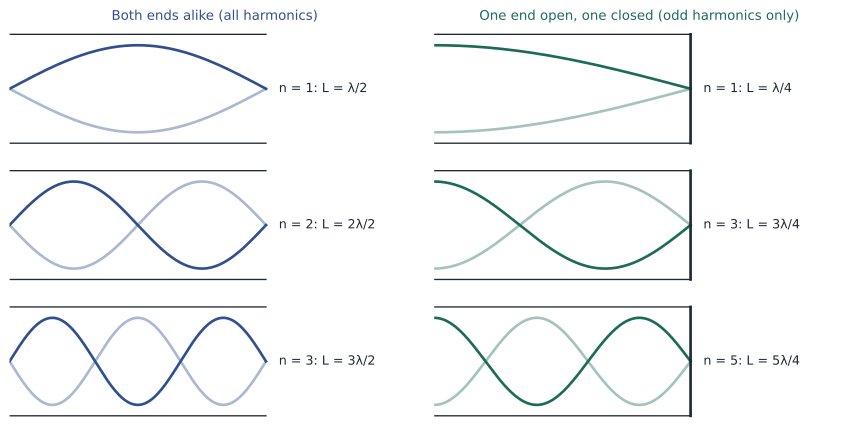
For a string fixed at both ends, both ends must be nodes, so the string length must be a whole number of half wavelengths: L equals n λ over 2, where n is 1, 2, 3 and so on. A pipe open at both ends has displacement antinodes at both ends, and the same lengths are allowed. The allowed frequencies are f equals n v over 2L, so every whole-number multiple of the lowest, or fundamental, frequency is present. A pipe closed at one end has a node at the closed end and an antinode at the open end, so its length must be an odd number of quarter wavelengths: L equals n λ over 4 with n odd, giving frequencies n v over 4L with n equals 1, 3, 5 and so on. Its fundamental is half that of an open pipe of the same length, and only odd harmonics occur.
Worked problem
The ear canal as a closed pipe
The ear canal is roughly a tube about 2.5 cm long, open at the outer end and closed by the eardrum. Taking the speed of sound in air as 340 m/s, estimate its fundamental resonant frequency.
Show solution
- A tube closed at one end has L = λ/4 at its fundamental, so λ = 4L = 0.10 m.
- f = v/λ = 340 / 0.10 = 3,400 Hz.
Answer: About 3,400 hertz. Human hearing is in fact most sensitive at roughly 2,000 to 5,000 hertz, partly because of this resonance.
Resonance is the large response of a system driven at one of its natural frequencies. A child on a swing pushed in time with the swing's natural period goes higher and higher; a wine glass can shatter when a singer holds a note at its natural frequency. In the inner ear, the basilar membrane varies in stiffness and width along its length, so different places resonate with different frequencies, high frequencies near the base of the cochlea and low ones near the apex. That place coding is how the ear separates the pitches of a sound.
Sound
Sound is a longitudinal pressure wave produced by a vibrating object, such as vocal folds, a guitar string or a loudspeaker cone. Humans hear frequencies from about 20 hertz to about 20,000 hertz, with the upper limit declining with age. Sound below that range is infrasound; above it is ultrasound. Pitch is the perceived highness or lowness of a sound and corresponds mainly to frequency. Loudness corresponds mainly to intensity. Timbre, or quality, which lets you tell a violin from a flute playing the same note, depends on which harmonics are present and how strong each is.
The speed of sound depends on the medium's resistance to compression and on its density: roughly, speed equals the square root of a stiffness term (the bulk modulus) divided by density. Stiffer media carry sound faster; denser media, other things equal, carry it more slowly. In practice the stiffness effect dominates, so sound is slowest in gases, faster in liquids and fastest in solids.
| Medium | Approximate speed of sound |
|---|---|
| Air at 20 °C | about 343 m/s |
| Water and most soft tissue | about 1,500 m/s (soft tissue is often taken as 1,540 m/s) |
| Bone | roughly 3,000 to 4,000 m/s |
| Steel | about 5,000 to 6,000 m/s |
In a gas, the speed of sound increases with temperature, roughly in proportion to the square root of the absolute temperature, because faster molecules pass the disturbance along more quickly. It does not depend on the pressure of the gas at a fixed temperature, and it does not depend on the frequency or amplitude of the sound.
Intensity and the decibel scale
Intensity is the power a wave carries per unit area perpendicular to its direction of travel, measured in watts per square meter. It is proportional to the square of the amplitude. Sound spreading out evenly from a small source covers the surface of an expanding sphere, so its intensity falls with the square of the distance: doubling your distance from a source quarters the intensity, in the absence of absorption.
The ear responds to an enormous range of intensities, from the threshold of hearing at about 10 to the minus 12th watts per square meter (I0) to the threshold of pain at roughly 1 watt per square meter, a factor of a trillion. To compress this range, sound level β is expressed in decibels using a logarithm. The threshold of hearing is 0 decibels. Every tenfold increase in intensity adds 10 decibels; every hundredfold increase adds 20. Normal conversation is roughly 60 decibels, heavy traffic around 80 to 90, and the pain threshold around 120. Doubling the intensity adds about 3 decibels, because the logarithm of 2 is about 0.3.
Worked problem
Decibels and distance
A machine produces a sound level of 90 dB at a distance of 1 m. What is the sound level at 10 m, assuming the sound spreads evenly with no absorption?
Show solution
- Moving from 1 m to 10 m multiplies the distance by 10.
- Intensity falls by 10² = 100, because I is proportional to 1/r².
- A factor of 100 in intensity is 20 dB.
Answer: 70 decibels.
Attenuation is the gradual loss of a wave's intensity as the medium absorbs and scatters its energy. In soft tissue, ultrasound attenuation rises with frequency: higher frequencies give sharper images but cannot penetrate as deeply. That trade-off is why scans of deep organs use lower frequencies than scans of structures near the skin.
The Doppler effect
When a source of waves and an observer move relative to each other, the observed frequency differs from the emitted frequency. As a source approaches, each wave crest is emitted from a position a little closer to the observer than the previous one, so the crests arrive bunched together and the observed frequency is higher. As a source recedes, the crests are spread out and the frequency is lower. The same shift occurs if the observer moves toward or away from a stationary source. The pitch of an ambulance siren drops as it passes you.
In the formula, v is the speed of the wave in the medium. Choose the signs so that motion toward the other party raises the observed frequency: use plus in the numerator if the observer moves toward the source, and minus in the denominator if the source moves toward the observer. For speeds much smaller than the wave speed, a simpler approximation is often enough: the fractional change in frequency, Δf over f, is about the relative speed divided by the wave speed.
Doppler ultrasound measures the speed of blood. A probe sends ultrasound into a vessel; red blood cells moving toward the probe reflect it at a slightly higher frequency, and cells moving away reflect it at a lower one. Because the reflection involves two shifts, one when the moving cells receive the wave and one when they re-emit it, the frequency shift is about twice the speed of the blood divided by the speed of sound in tissue, times the transmitted frequency, adjusted by the cosine of the angle between the beam and the vessel. Devika's question had its answer: the machine knows the speed of sound in tissue and the transmitted frequency, measures the shift, and calculates the blood's speed.
Worked problem
Estimating a Doppler shift
Ultrasound at 2.0 MHz is reflected by blood moving at 0.77 m/s directly toward the probe. Take the speed of sound in tissue as 1,540 m/s. Estimate the frequency shift.
Show solution
- For reflection from a moving target, Δf ≈ 2 v f / c.
- Δf ≈ 2 × 0.77 × 2.0 × 10⁶ / 1,540.
- 0.77/1,540 = 5 × 10⁻⁴, so Δf ≈ 2 × 5 × 10⁻⁴ × 2 × 10⁶ = 2,000 Hz.
Answer: About 2,000 hertz higher, a shift that falls in the audible range, which is why Doppler machines can play blood flow as sound.
If a source moves at or faster than the speed of sound in the medium, the wave crests pile up into a cone-shaped shock wave, heard as a sonic boom. Lithotripsy uses focused shock waves to break up kidney stones without surgery.
Ultrasound imaging
Medical ultrasound uses frequencies of a few megahertz to a few tens of megahertz, far above human hearing. A transducer, typically made of a piezoelectric crystal that vibrates when a voltage is applied and generates a voltage when it is vibrated, sends short pulses into the body and listens for echoes. Echoes arise where sound crosses a boundary between tissues with different acoustic impedance, a property equal to density times the speed of sound. The greater the mismatch, the stronger the reflection. Air and soft tissue differ enormously, so almost all ultrasound is reflected at an air gap; that is why gel is applied between the probe and the skin. Bone also reflects strongly, casting acoustic shadows.
The depth of each reflecting boundary comes from the echo's round-trip time. If an echo returns after time t, the boundary lies at a depth of v t over 2, where v is the speed of sound in tissue; the factor of 2 accounts for the trip down and back. Resolution improves with shorter wavelengths, which means higher frequencies, but penetration falls because attenuation rises with frequency. Ultrasound uses no ionizing radiation, which makes it the standard imaging method in pregnancy.
Worked problem
Locating a boundary
An ultrasound echo from the back wall of the heart returns 130 microseconds after the pulse is sent. How deep is the wall? Take v = 1,540 m/s.
Show solution
- Round trip: 1,540 m/s × 130 × 10⁻⁶ s ≈ 0.20 m.
- One way: half of that, 0.10 m.
Answer: About 10 centimeters.
Common mistakes
MistakeWhen sound enters a new medium, its frequency changes.
InsteadFrequency stays the same; speed and wavelength change together.
MistakeRaising the frequency of a sound increases its speed.
InsteadSpeed is set by the medium; higher frequency means shorter wavelength.
MistakeA 20 dB increase means the intensity doubled.
InsteadEach 10 dB is a tenfold change; 20 dB is a hundredfold increase. Doubling adds about 3 dB.
MistakeSound travels faster in denser media, so it is fastest in air.
InsteadSound is slowest in gases and fastest in solids, because stiffness matters more than density.
MistakeA pipe closed at one end has all harmonics.
InsteadOnly odd harmonics fit, with L = nλ/4 for n = 1, 3, 5.
Summary and key terms
- Waves carry energy, not matter; sound is longitudinal, light and waves on strings are transverse.
- v = fλ; the medium sets the speed, the source sets the frequency, and frequency is unchanged across boundaries.
- Superposition produces constructive and destructive interference; beats occur at the difference frequency.
- Standing waves: L = nλ/2 for strings and open pipes; L = nλ/4 with odd n for pipes closed at one end.
- Sound level β = 10 log(I/I0); every factor of 10 in intensity adds 10 dB, and intensity falls as 1/r².
- The Doppler effect raises observed frequency for approach and lowers it for recession; ultrasound images from echoes at impedance boundaries.
- Longitudinal wave
- A wave in which the medium oscillates parallel to the direction of travel, such as sound.
- Wavelength
- The distance between successive identical points on a wave.
- Node
- A point in a standing wave that does not oscillate.
- Resonance
- A large-amplitude response when a system is driven at one of its natural frequencies.
- Decibel
- A logarithmic unit of sound level: 10 log of the intensity ratio to 10⁻¹² W/m².
- Attenuation
- The loss of wave intensity through absorption and scattering in a medium.
- Doppler effect
- The change in observed frequency caused by relative motion of source and observer.
- Acoustic impedance
- The product of a medium's density and its speed of sound, which governs reflection at boundaries.
Practice problems
Work each problem on paper first, then reveal the answer to check.
What is the wavelength of a 500 Hz sound in air (v = 340 m/s)?
Show answer
λ = v/f = 0.68 m.
Two tuning forks of 256 Hz and 260 Hz sound together. What is the beat frequency?
Show answer
4 beats per second.
By how many decibels does the sound level rise if intensity increases 1,000-fold?
Show answer
30 dB.
What is the fundamental frequency of a 0.5 m pipe open at both ends (v = 340 m/s)?
Show answer
f = v/2L = 340 Hz.
Why must gel be used between an ultrasound probe and the skin?
Show answer
Any air gap has a huge impedance mismatch with tissue and would reflect nearly all the ultrasound.
Lesson quiz · 5 questions
Score 60% or more to complete this lesson.
Create a free account to save your progress, take quizzes and earn a certificate.