
MCAT-121 · Lesson 12 of 12 · 25 min
Capstone: a physics and math passage set
▶ Video coming soon A video version of this lesson is on the way.
For the last session of the physics block, Thandiwe wrote a timed set in the format of the Chem/Phys section: three passages with five questions each and five independent questions, twenty questions in 32 minutes, close to the pace of the real section (59 questions in 95 minutes). All three passages follow one imaginary patient through the hospital: a narrowed artery studied in a flow model, measured with Doppler ultrasound and imaged with a radioactive tracer. 'No calculators, no equation sheet, scratch paper only,' she said. 'Timed first, then blind review, then we talk.' The passages and questions below are original and written for this course; all data are invented.
Take the set under timed conditions before reading the explanations: about 9 minutes for each passage and 5 minutes for the independent questions. Mark any answer you are unsure of, then do a blind review, reconsidering marked questions without a time limit before you check the key. Each explanation names the reasoning skill involved, using the AAMC's four scientific inquiry and reasoning skills: knowledge of scientific concepts (skill 1), scientific reasoning and problem solving (skill 2), reasoning about research design (skill 3) and data-based and statistical reasoning (skill 4).
Passage 1: flow through a narrowed vessel
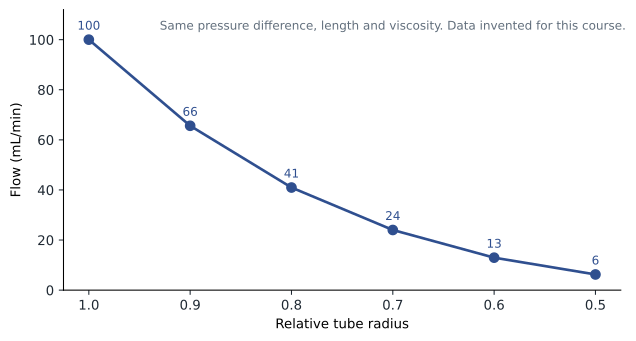
Atherosclerotic plaque narrows arteries and reduces blood flow. To study the relationship between vessel size and flow, researchers built a bench model: a rigid glass tube 10 cm long carrying a blood-like fluid driven by a pump that held the pressure difference between the two ends constant. In Experiment 1 they replaced the tube with tubes of smaller radius, keeping length, fluid and pressure difference unchanged, and measured the volume flow rate. The results appear in Figure 1, with radius expressed relative to the largest tube.
In Experiment 2, the researchers used the largest tube again but replaced the fluid with one of twice the viscosity. In Experiment 3, they returned to the original fluid and the largest tube but inserted a short rigid collar that reduced the radius to one half over a 1 cm segment in the middle of the tube. They measured the average fluid speed and the pressure at the wall in the wide section upstream and inside the collar. Throughout, flow remained laminar, except just downstream of the collar in Experiment 3, where eddies were observed.
Questions 1 to 5 refer to passage 1.
1. Which relationship between flow Q and radius r is most consistent with Figure 1? (A) Q is proportional to r. (B) Q is proportional to r squared. (C) Q is proportional to r to the fourth. (D) Q is proportional to 1/r.
2. In Experiment 2, the flow through the largest tube is most likely to be closest to: (A) 50 mL/min. (B) 25 mL/min. (C) 100 mL/min. (D) 200 mL/min.
3. In Experiment 3, how does the average speed of the fluid inside the collar compare with its speed in the wide section upstream? (A) It is one quarter as large. (B) It is the same. (C) It is twice as large. (D) It is four times as large.
4. How does the wall pressure inside the collar compare with the wall pressure in the wide section upstream, and why? (A) Higher, because the faster fluid pushes harder on the walls. (B) Lower, because the fluid's kinetic energy per unit volume increases. (C) The same, because the pump holds the pressure constant. (D) Higher, because the narrower tube has greater resistance.
5. The researchers want the tube of relative radius 0.5 to carry the same flow as the largest tube. By approximately what factor must they increase the pressure difference? (A) 16. (B) 4. (C) 2. (D) 8.
Passage 2: measuring the jet with Doppler ultrasound
In a patient with a narrowed carotid artery, physicians use Doppler ultrasound to measure blood speed. The probe emits ultrasound at 4.0 MHz. Sound reflected by moving red blood cells returns with a frequency shift Δf given by Equation 1, where v is the blood speed, c is the speed of sound in tissue (1,540 m/s), f is the transmitted frequency and θ is the angle between the ultrasound beam and the direction of flow.
Equation 1: Δf = 2 f v cos θ / c
With the beam aligned along the vessel (θ = 0), the measured shift in a normal segment of the artery was 2,600 Hz. Inside the narrowed segment, the shift was 10,400 Hz. Clinicians often estimate the pressure drop across a narrowing from the peak jet speed using the simplified Bernoulli relation in Equation 2, in which ΔP is in mm Hg and v in meters per second.
Equation 2: ΔP ≈ 4 v²
Questions 6 to 10 refer to passage 2.
6. What is the approximate speed of blood in the normal segment? (A) 0.25 m/s. (B) 0.5 m/s. (C) 1.0 m/s. (D) 2.0 m/s.
7. What is the approximate speed of blood in the narrowed segment? (A) 0.5 m/s. (B) 1.0 m/s. (C) 2.0 m/s. (D) 4.0 m/s.
8. Using Equation 2, what is the estimated pressure drop across the narrowing? (A) 4 mm Hg. (B) 8 mm Hg. (C) 32 mm Hg. (D) 16 mm Hg.
9. A technician accidentally holds the probe so the beam meets the flow at 60 degrees but calculates speed as if θ were 0. How will the reported blood speed compare with the true speed? (A) It will be half the true speed. (B) It will equal the true speed. (C) It will be twice the true speed. (D) It will be about 0.87 times the true speed.
10. What is the approximate wavelength of the 4.0 MHz ultrasound in tissue? (A) 0.04 mm. (B) 0.4 mm. (C) 4 mm. (D) 4 cm.
Passage 3: imaging with a positron-emitting tracer
To assess the metabolic activity of the artery wall, the patient receives a tracer labeled with a positron-emitting isotope, here called isotope Q, which has a physical half-life of 2 hours. Each positron travels about a millimeter in tissue before it annihilates with an electron, producing two photons of 511 keV each that travel in nearly opposite directions. A ring of detectors records pairs of photons that arrive within a few nanoseconds of each other.
The patient is injected with 400 MBq of tracer at 9:00 a.m. The tracer is also cleared from the body by the kidneys, with a biological half-life of 6 hours. When both processes act together, the effective half-life Te satisfies Equation 3, where Tp is the physical and Tb the biological half-life.
Equation 3: 1/Te = 1/Tp + 1/Tb
A nurse who prepares the injection stands 1 m from the syringe for 2 minutes. The hospital's radiation safety officer wants to reduce the nurse's exposure from this step by a factor of 4 without shortening the time.
Questions 11 to 15 refer to passage 3.
11. Considering only physical decay, what is the activity of the injected tracer at 3:00 p.m.? (A) 200 MBq. (B) 100 MBq. (C) 50 MBq. (D) 25 MBq.
12. Isotope Q decays by positron emission. Compared with isotope Q, the daughter nucleus has: (A) the same mass number and an atomic number one lower. (B) a mass number one lower and the same atomic number. (C) the same mass number and an atomic number one higher. (D) a mass number four lower and an atomic number two lower.
13. Why does the scanner count only photon pairs that arrive at opposite detectors within a few nanoseconds? (A) Each photon carries half of a positron's charge. (B) Photons from a single annihilation travel at the speed of light in nearly opposite directions, so a coincidence locates the annihilation along the line between the detectors. (C) Positrons travel through tissue at the speed of light. (D) Gamma rays are slowed by tissue and must be timed to correct their energy.
14. What is the effective half-life of the tracer in the patient? (A) 8 hours. (B) 4 hours. (C) 3 hours. (D) 1.5 hours.
15. Which change would achieve the safety officer's goal? (A) Halving the activity drawn into the syringe while keeping the distance at 1 m, with the scan delayed by one half-life. (B) Doubling the nurse's distance from the syringe to 2 m. (C) Increasing the distance to 4 m. (D) Doubling the distance to 2 m and doubling the time.
Independent questions
16. A 2 kg box slides 3 m down a frictionless ramp, dropping a vertical height of 1.25 m. Starting from rest, what is its speed at the bottom? (g = 10 m/s²) (A) 2.5 m/s. (B) 7.7 m/s. (C) 5 m/s. (D) 25 m/s.
17. An object is placed 15 cm from a converging lens of focal length 10 cm. Which describes the image? (A) Virtual, upright, 30 cm on the same side as the object. (B) Real, inverted, 6 cm from the lens. (C) Real, inverted, 30 cm from the lens and twice the object's size. (D) Virtual, upright, half the object's size.
18. Two 6-ohm resistors are connected in parallel across a 12-volt battery of negligible internal resistance. What current does the battery supply? (A) 1 A. (B) 2 A. (C) 3 A. (D) 4 A.
19. A hospital ventilator alarm is 60 dB at the nurses' station. A faulty alarm is 90 dB at the same place. By what factor does the faulty alarm's intensity exceed the normal one's? (A) 1,000. (B) 30. (C) 1.5. (D) 100.
20. A stone is dropped from rest from a bridge and hits the water 3 s later. Ignoring air resistance, how high is the bridge above the water? (g = 10 m/s²) (A) 15 m. (B) 30 m. (C) 90 m. (D) 45 m.
Answer key and explanations
| Question | Answer | Skill |
|---|---|---|
| 1 | C | 4 |
| 2 | A | 2 |
| 3 | D | 2 |
| 4 | B | 1 |
| 5 | A | 2 |
| 6 | B | 2 |
| 7 | C | 4 |
| 8 | D | 2 |
| 9 | A | 3 |
| 10 | B | 1 |
| 11 | C | 2 |
| 12 | A | 1 |
| 13 | B | 1 |
| 14 | D | 2 |
| 15 | B | 3 |
| 16 | C | 1 |
| 17 | C | 2 |
| 18 | D | 1 |
| 19 | A | 1 |
| 20 | D | 2 |
Question 1 (C, skill 4). Check the ratios rather than the shape. At relative radius 0.5, flow is 6 out of 100, close to 0.5 to the fourth (0.0625). At 0.8, flow is 41, close to 0.8 to the fourth (about 0.41). A linear relationship would give 50 at radius 0.5 and a square relationship 25. This is Poiseuille's law; the passage held pressure difference, length and viscosity constant, exactly the conditions under which flow depends on r to the fourth.
Question 2 (A, skill 2). Poiseuille's law puts viscosity in the denominator: doubling it halves the flow, from 100 to 50 mL/min. The common wrong answer, 25, comes from treating viscosity like radius and squaring the factor.
Question 3 (D, skill 2). Continuity: the same volume passes each cross section per second, so speed is inversely proportional to area. Halving the radius divides the area by 4, so the speed in the collar is four times the upstream speed. Choice A inverts the relationship.
Question 4 (B, skill 1). Bernoulli's equation at constant height: where the fluid speeds up, its kinetic energy per unit volume, one half ρ v squared, rises, so its pressure falls. Choice A is the intuitive trap. Choice C confuses the fixed pressure difference between the tube's ends with the local pressure at the wall, and choice D confuses resistance to flow with local pressure.
Question 5 (A, skill 2). At constant pressure difference, the 0.5 tube carries 1/16 of the flow. Because flow is proportional to the pressure difference for a given tube, restoring the original flow requires 16 times the pressure difference. That is a steep relationship: modest narrowing of an artery demands large increases in driving pressure, or else flow falls.
Question 6 (B, skill 2). Rearrange Equation 1 with cos 0 equal to 1: v equals Δf c over 2f. That is 2,600 times 1,540 divided by 8.0 times 10 to the 6th. Estimate: 2,600 times 1,540 is about 4.0 times 10 to the 6th, and 4.0 divided by 8.0 is 0.5. The blood moves at about 0.5 m/s.
Question 7 (C, skill 4). The shift in the narrowed segment, 10,400 Hz, is exactly four times the normal shift. Because Δf is proportional to v, the jet moves four times as fast, about 2.0 m/s. A ratio solves this without repeating the calculation, and it agrees with Passage 1: a narrowing to half the radius quadruples the speed.
Question 8 (D, skill 2). ΔP is about 4 times 2.0 squared, which is 4 times 4, or 16 mm Hg. Choice B forgets to square the speed; choice C squares the 4 as well.
Question 9 (A, skill 3). The real shift includes cos 60 degrees, which is 0.5, so the measured shift is half what it would be with the beam aligned. Calculating as if θ were 0 then gives a speed half the true value. This is a measurement-design question: the error is systematic, the same direction every time, and repeating the measurement would not fix it. Correct alignment, or correcting for the angle, would.
Question 10 (B, skill 1). Wavelength equals speed divided by frequency: 1,540 divided by 4.0 times 10 to the 6th, which is about 3.9 times 10 to the minus 4th meters, or 0.4 mm. Wavelengths shorter than a millimeter are why ultrasound can resolve fine structures such as vessel walls.
Question 11 (C, skill 2). From 9:00 a.m. to 3:00 p.m. is 6 hours, three half-lives of 2 hours: 400, 200, 100, 50 MBq. The question limits you to physical decay, so the biological half-life is irrelevant here.
Question 12 (A, skill 1). In positron emission, a proton becomes a neutron and a positron is emitted, so the atomic number falls by 1 and the mass number is unchanged. Choice C describes beta-minus decay and choice D alpha decay.
Question 13 (B, skill 1). Annihilation produces two photons traveling in nearly opposite directions at the speed of light, so they reach opposite detectors almost simultaneously. Recording only such coincidences places the annihilation somewhere on the line joining the two detectors; many such lines intersect at the tracer's location. Photons carry no charge, and positrons, which have mass, travel more slowly than light.
Question 14 (D, skill 2). Equation 3: 1/Te equals 1/2 plus 1/6, which is 3/6 plus 1/6, or 4/6. So Te equals 6/4, or 1.5 hours. The effective half-life is always shorter than either half-life alone, which rules out A, B and C immediately.
Question 15 (B, skill 3). Radiation from a small source falls off with the inverse square of distance, so doubling the distance from 1 m to 2 m cuts the exposure rate, and therefore the exposure in the same time, to one quarter. Choice C overshoots, giving one sixteenth; it meets the goal but is not the change that gives a factor of 4, and the question asks for the factor of 4. Choice D quarters the rate but doubles the time, halving exposure overall. Choice A changes the procedure itself, which the passage does not propose.
Question 16 (C, skill 1). Conservation of energy on a frictionless ramp: mgh equals one half m v squared, so v equals the square root of 2gh, the square root of 25, which is 5 m/s. The ramp's length and the box's mass do not matter.
Question 17 (C, skill 2). 1/i equals 1/10 minus 1/15, which is 3/30 minus 2/30, or 1/30, so i equals 30 cm, positive and therefore real. Magnification is minus 30/15, or minus 2: inverted and twice the size. An object between f and 2f always gives an enlarged real image beyond 2f.
Question 18 (D, skill 1). Two equal resistors in parallel give half the resistance of one: 3 ohms. Current equals 12 V over 3 Ω, which is 4 A. Choice A treats them as in series (12 ohms).
Question 19 (A, skill 1). Each 10 dB is a factor of 10 in intensity, so 30 dB is 10 cubed, a factor of 1,000. Choice B confuses decibels with intensity, and choice D uses only two factors of 10.
Question 20 (D, skill 2). Distance fallen from rest is one half g t squared: 0.5 times 10 times 9, which is 45 m. Choice A forgets to square the time; choice C forgets the one half.
The debrief
After blind review, the group compared notes. Elliot scored 17 out of 20 timed and 19 after blind review. He missed question 15 by choosing C, reading "reduce by a factor of 4" as "reduce by at least a factor of 4", and question 9, where he forgot the cosine. His fix: underline exactly what a question asks for before looking at the choices. His third timed miss was question 4, where he chose A under time pressure and changed it correctly in blind review. 'Your instinct said faster means more pressure,' Thandiwe said. 'Bernoulli says the opposite. Train the instinct.'
Devika scored 15 timed and 17 after blind review, matching her general chemistry capstone. In September, calculations had been her weakest area; tonight she lost only one point to arithmetic, question 6, where she divided by 4.0 times 10 to the 6th instead of 8.0 times 10 to the 6th, forgetting the factor of 2 in Equation 1. She ran out of time on questions 19 and 20 and guessed; in blind review she answered both correctly in under a minute each. Her other two misses, questions 4 and 14, she still got wrong in blind review, and both went into her error log as content gaps. Her plan: two timed independent-question sets a week, to build speed on questions she already knows how to do.
Ezequiel scored 14 timed and 16 after blind review. He solved all of Passage 1 correctly, including the ratio check on Figure 1, and said afterwards that this was the first graph he had read "the way you taught us, axes first". His misses clustered in Passage 2, where he spent four minutes on question 6 setting up Equation 1 symbolically before plugging in numbers, then rushed question 8 and forgot to square the speed. In Passage 3 he used Equation 3 correctly but chose 3 hours for question 14, averaging the half-lives instead of adding their reciprocals. Thandiwe told him that his reading of data had improved more than anyone's in the group since the diagnostic, and that his next target was arithmetic speed. He added a line to his error log: "when an equation is given, rearrange first, estimate second, check the units third."
| Student | Timed | After blind review | Main fix |
|---|---|---|---|
| Elliot | 17/20 | 19/20 | Underline exactly what the question asks for |
| Devika | 15/20 | 17/20 | Timed independent-question sets for speed |
| Ezequiel | 14/20 | 16/20 | Rearrange, estimate, check units; practice reciprocal sums |
Thandiwe closed the block with three general lessons. First, nearly every passage in this set could be solved with a ratio, a single conservation law or one rearranged equation; none required long calculation. Second, the passage told you what was held constant, and reading that sentence carefully decided questions 1, 2, 3 and 5. Third, the most expensive errors were not about physics at all: they came from misreading what the question asked. The next block of the Sunday Session moves on to organic chemistry, where the habits of reading what is held constant and checking each step carry straight over.
Using this set in your own preparation
If you scored well on the passage questions but lost time, practice passage sets under time pressure, aiming for about 9 minutes per passage. If you lost points on independent questions, review the underlying content in the relevant lesson of this course; independent questions are pure recall and application, and they are the fastest points on the test. If your misses came from reading the figure or the passage, use the four-step data routine from lesson 11 on every passage for two weeks. For each miss, record in your error log the reason (content, reading, reasoning, timing or careless) and a specific fix, then retest that type of question within a week.
Common mistakes
MistakeIn a narrowing, faster flow means higher pressure on the walls.
InsteadBernoulli: faster flow at the same height means lower pressure.
MistakeEffective half-life is the average of the physical and biological half-lives.
InsteadReciprocals add: 1/Te = 1/Tp + 1/Tb, so Te is shorter than either.
MistakeA Doppler measurement taken at an angle still gives the true speed.
InsteadThe shift includes cos θ; ignoring the angle underestimates the speed.
MistakeDoubling the distance from a source halves the radiation exposure.
InsteadIntensity follows an inverse-square law; doubling distance quarters it.
MistakeChecking a graph's overall shape is enough to identify a power law.
InsteadTest ratios at two or more points to distinguish r², r⁴ and other powers.
Summary and key terms
- Poiseuille's law (flow ∝ r⁴/η at constant pressure difference) and continuity (speed ∝ 1/area) answer most flow questions.
- Bernoulli's equation predicts lower pressure where fluid moves faster.
- Doppler shifts are proportional to speed and cos θ; ratios avoid repeated calculation.
- Count half-lives for decay; combine physical and biological half-lives by adding reciprocals.
- Inverse-square laws govern radiation and sound intensity with distance.
- Read exactly what each question asks; most errors in the set came from misreading, not from physics.
- Blind review
- Reconsidering uncertain answers without a time limit before checking the key.
- Coincidence detection
- Recording only photon pairs arriving at opposite detectors at nearly the same time, as in PET.
- Effective half-life
- The combined half-life of a tracer in the body, from physical decay and biological clearance.
- Stenosis
- An abnormal narrowing of a blood vessel or valve.
- Simplified Bernoulli relation
- A clinical estimate of the pressure drop across a narrowing, about 4v² in mm Hg with v in m/s.
- Systematic error
- An error that shifts every measurement in the same direction, such as an uncorrected beam angle.
Practice problems
Work each problem on paper first, then reveal the answer to check.
In Passage 1, what flow would you predict for a tube of relative radius 0.4?
Show answer
0.4⁴ = 0.0256, so about 2.6 mL/min.
In Passage 2, what shift would blood at 1.0 m/s produce with the beam aligned?
Show answer
Δf = 2 × 4.0 × 10⁶ × 1.0 / 1,540 ≈ 5,200 Hz.
In Passage 3, what activity remains in the patient at 12:00 p.m., using the effective half-life?
Show answer
3 hours is two effective half-lives: 400 → 200 → 100 MBq.
If Ezequiel's answer to question 14 had been right, what would that imply about the two processes?
Show answer
Averaging half-lives would imply the slower process slows clearance overall, which is wrong; adding processes always shortens the effective half-life.
Which questions in the set could be answered from a ratio alone, without any absolute numbers?
Show answer
Questions 2, 3, 5, 7, 9 and 15 among others: each depends only on how one quantity scales with another.
Lesson quiz · 5 questions
Score 60% or more to complete this lesson.
Create a free account to save your progress, take quizzes and earn a certificate.