
MCAT-121 · Lesson 5 of 12 · 27 min
Electricity and circuits: charge, fields, current and resistance
▶ Video coming soon A video version of this lesson is on the way.
Elliot came to the electricity session with a question from the clinic. A patient had asked him why the nurse rubbed gel on her skin before attaching the electrodes for an electrocardiogram. He had guessed "better contact" and wanted to know whether that was the real answer. 'It is,' Thandiwe said, 'and by the end of today you will be able to say it in physics: the gel lowers the resistance between the skin and the electrode, so the tiny voltages from the heart reach the machine instead of being lost.' Devika groaned that electricity was her least favorite topic. Thandiwe promised that it was built from about six ideas, and that most MCAT questions use two of them at a time.
This lesson covers the electrostatics and circuit parts of content category 4C: electric charge and its conservation, conductors and insulators, Coulomb's law, electric fields, electric potential energy and potential, current, electromotive force and voltage, resistance and resistivity, Ohm's law, series and parallel circuits, power in circuits and meters. Capacitors, magnetism and the body's own electricity follow in lesson 6; the electrochemistry part of category 4C (galvanic and electrolytic cells) is reviewed in MCAT-120.
Electric charge
Charge comes in two kinds, positive and negative. Like charges repel and unlike charges attract. Charge is measured in coulombs. It is quantized: every charge is a whole-number multiple of the elementary charge e, about 1.6 times 10 to the minus 19th coulombs, carried by a proton (plus e) or an electron (minus e). Charge is conserved: it can move from one object to another, but the total in an isolated system never changes. Rubbing a balloon on hair transfers electrons from the hair to the balloon; the balloon becomes negative and the hair equally positive.
In conductors, such as metals and ionic solutions, charges move freely. In metals the mobile charges are electrons; in body fluids and electrolyte solutions they are ions such as sodium, potassium and chloride. In insulators, such as rubber, glass, dry skin and the lipid core of a cell membrane, charges stay put. Excess charge placed on an isolated conductor spreads over its outer surface, and the electric field inside a conductor in equilibrium is zero. A charged object brought near a neutral conductor induces a separation of charge in it, with the opposite charge on the near side, which is why a charged balloon can stick to a neutral wall.
Coulomb's law
The force between two point charges q1 and q2 separated by distance r is given by Coulomb's law. The constant k is about 9 times 10 to the 9th N·m²/C². The force acts along the line joining the charges, repulsive for like charges and attractive for unlike charges.
Coulomb's law has the same inverse-square form as Newton's law of gravitation, but electric forces are enormously stronger; the electric repulsion between two protons is about 10 to the 36th times their gravitational attraction. Proportional reasoning answers most Coulomb questions. Doubling one charge doubles the force; doubling both quadruples it; doubling the distance divides the force by four; halving the distance multiplies it by four. When several charges act on one, find each force separately and add them as vectors.
Worked problem
Scaling a Coulomb force
Two small charged spheres repel with a force of 12 millinewtons. The charge on each sphere is doubled and the distance between them is tripled. What is the new force?
Show solution
- Doubling both charges multiplies the force by 2 × 2 = 4.
- Tripling the distance divides it by 3² = 9.
- New force: 12 mN × 4/9 ≈ 5.3 mN.
Answer: About 5.3 millinewtons, still repulsive.
In water, the force between ions is much weaker than in a vacuum because water molecules, being polar, orient around each ion and partly cancel its field. The reduction factor, the dielectric constant of water, is about 80. This is why salts dissolve in water, and why the interior of a protein or a membrane, where the dielectric constant is low, is a place where charges interact strongly.
Electric fields
An electric field describes the force a charge would feel at each point in space. The field E at a point is the force per unit positive test charge, so a charge q placed there feels a force F equals q E. Field units are newtons per coulomb, which are equivalent to volts per meter. The field of a point charge Q at distance r has magnitude k Q over r squared and points away from a positive charge and toward a negative one. A positive charge in a field is pushed along the field direction; a negative charge, such as an electron, is pushed opposite to it.
Field lines are a picture of the field. They begin on positive charges and end on negative charges, they never cross, their direction at any point gives the field direction, and their density shows the field strength. Between two large parallel plates with equal and opposite charges, the field is uniform: the same strength and direction everywhere between the plates, pointing from the positive plate to the negative plate, with a magnitude equal to the potential difference divided by the plate separation (E equals V over d). Parallel plates appear in passages about capacitors, gel electrophoresis, mass spectrometry and the cell membrane, which behaves like a pair of charged plates separated by a thin insulating layer.
Electric potential energy and potential
Because the electric force is conservative, a charge in a field has electric potential energy, just as a mass has gravitational potential energy. For two point charges, the potential energy is k q1 q2 over r. It is positive for like charges, which must be pushed together, and negative for unlike charges, which attract. Systems move spontaneously toward lower potential energy: unlike charges move together, like charges apart.
Electric potential, V, is potential energy per unit charge, measured in volts (joules per coulomb). The potential of a point charge Q at distance r is k Q over r, a scalar, so the potentials of several charges simply add without directions. What matters physically is the potential difference, or voltage, between two points. Moving a charge q through a potential difference ΔV changes its potential energy by q ΔV. Positive charges naturally move from high potential to low potential, and negative charges from low to high; in both cases the potential energy falls. An electron accelerated through 1 volt gains 1 electron volt of kinetic energy, 1.6 times 10 to the minus 19th joules.
Equipotential surfaces connect points at the same potential. They are always perpendicular to field lines, and no work is needed to move a charge along one. Around a point charge they are concentric spheres; between parallel plates they are flat planes parallel to the plates. The field points from high potential toward low potential, along the direction in which potential falls fastest.
Worked problem
The membrane as parallel plates
A neuron's resting membrane potential is about −70 millivolts (inside relative to outside), and the membrane is about 7 nanometers thick. Estimate the electric field in the membrane and its direction.
Show solution
- E = V/d = 0.070 V / (7 × 10⁻⁹ m) = 10⁷ V/m.
- The outside is at higher potential than the inside, and the field points from high to low potential.
Answer: About 10 million volts per meter, pointing inward. Fields that strong act on charged parts of the voltage-gated channels embedded in the membrane, which is how a change in membrane potential opens them.
Current
Electric current is the rate at which charge passes a point: I equals Δq over Δt, measured in amperes (coulombs per second). By convention, current flows in the direction positive charges would move, from higher to lower potential through an external circuit. In metal wires the moving charges are electrons, which drift the opposite way, but the convention is kept. In body fluids, current is carried by positive and negative ions moving in opposite directions. For a steady current to flow there must be a complete path, a closed circuit, and a source of potential difference to drive it.
A battery or other source provides an electromotive force (emf), the energy it supplies per unit charge, measured in volts. Despite its name, emf is not a force. A real battery has a small internal resistance, so the voltage across its terminals while delivering current is slightly less than its emf; the difference is the current times the internal resistance.
Resistance and Ohm's law
Resistance measures how much a component opposes current. For many materials, called ohmic, the current is proportional to the voltage across the component, and the constant of proportionality defines resistance: Ohm's law, V equals I R, with resistance in ohms. The resistance of a uniform wire depends on its material and shape: R equals ρ L over A, where ρ (here the resistivity, not density) is a property of the material, L the length and A the cross-sectional area. Longer and thinner wires have more resistance, which parallels Poiseuille's law for fluids, though resistance depends on area (radius squared) rather than radius to the fourth. The resistance of most metals increases with temperature.
Conductivity is the reciprocal of resistivity. Body tissues vary widely: blood and muscle conduct relatively well because of their electrolytes, fat and bone poorly, and dry skin very poorly. That explains the electrocardiogram gel: the outer layer of skin has high resistance, and the gel, an electrolyte, fills the gaps and lowers the contact resistance. Bioelectrical impedance devices estimate body fat from how readily a tiny current passes through the body, since lean tissue conducts better than fat.
Series and parallel circuits
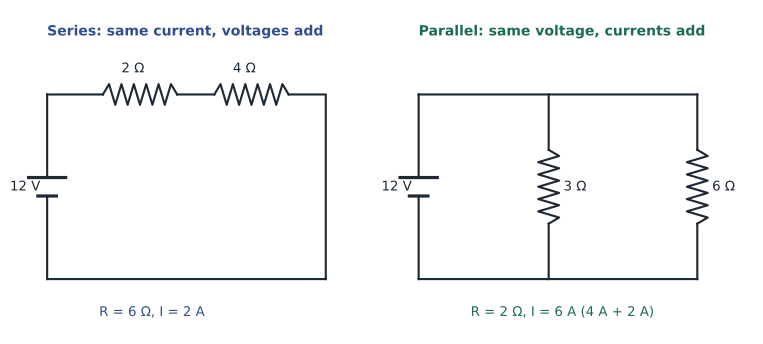
Components in series lie on a single path, so the same current passes through each. Their voltages add up to the total, and their resistances add: R total equals R1 plus R2 plus and so on. Adding a resistor in series always increases total resistance and reduces the current.
Components in parallel are connected across the same two points, so each has the same voltage across it. The currents through the branches add up to the total current, and the reciprocals of the resistances add: 1 over R total equals 1 over R1 plus 1 over R2 and so on. The total resistance of a parallel combination is always less than its smallest branch resistance. For two resistors, the shortcut is the product over the sum. Adding another branch in parallel lowers the total resistance and increases the total current drawn from the source, which is why plugging too many appliances into one circuit can trip a breaker.
Worked problem
Solving a combined circuit
A 12-volt battery is connected to a 2-ohm resistor in series with a parallel pair of 6-ohm and 3-ohm resistors. Find the total current, the voltage across the parallel pair and the current through the 6-ohm resistor.
Show solution
- Parallel pair: (6 × 3)/(6 + 3) = 18/9 = 2 Ω.
- Total resistance: 2 + 2 = 4 Ω. Total current: 12 V / 4 Ω = 3 A.
- Voltage across the 2-ohm series resistor: 3 A × 2 Ω = 6 V, leaving 6 V across the parallel pair.
- Current through the 6-ohm branch: 6 V / 6 Ω = 1 A (and 2 A through the 3-ohm branch).
Answer: 3 A total; 6 V across the pair; 1 A through the 6-ohm resistor.
Two conservation laws, Kirchhoff's rules, sit underneath every circuit calculation. The junction rule says that the current entering any junction equals the current leaving it, a statement of charge conservation. The loop rule says that the sum of the voltage changes around any closed loop is zero, a statement of energy conservation: a charge that goes around the loop returns to its starting potential.
Power in circuits
Power delivered to or used by a circuit element is the current times the voltage across it, P equals I V. For a resistor, Ohm's law gives two equivalent forms, I squared R and V squared over R. Resistors convert electrical energy into heat; this is how toasters, electric blankets and electrosurgical devices work. Choose the form that matches what the question holds constant. In a series circuit, all elements share the same current, so the largest resistor dissipates the most power (I squared R). In a parallel circuit, all branches share the same voltage, so the smallest resistor dissipates the most power (V squared over R).
Meters
An ammeter measures current and must be placed in series with the component, so the current passes through it. An ideal ammeter has zero resistance, so it does not change the current it measures. A voltmeter measures potential difference and is connected in parallel across the component. An ideal voltmeter has infinite resistance, so it draws no current. Real meters approximate these ideals. A passage that describes a meter with the wrong resistance for its role is usually asking how the measurement will be distorted: a voltmeter with low resistance draws current and lowers the voltage it is trying to measure.
Electrical safety and the body
The danger of an electric shock depends mainly on the current that passes through the body and the path it takes, especially whether it crosses the heart. Currents of a few milliamperes are felt; somewhere in the range of roughly 10 to 20 milliamperes, muscles may contract so strongly that a person cannot let go; currents of about 100 milliamperes across the chest can cause ventricular fibrillation. Because current equals voltage over resistance, wet skin, which has much lower resistance than dry skin, makes a given voltage far more dangerous. Grounding and ground-fault circuit interrupters protect people by providing a low-resistance path for stray current and by cutting the circuit when current leaks. MCAT passages may give a voltage and a body resistance and ask for the current, a direct application of Ohm's law.
Common mistakes
MistakeAdding a resistor in parallel increases the total resistance.
InsteadParallel branches lower total resistance below the smallest branch; series additions raise it.
MistakeElectric potential is a vector.
InsteadPotential is a scalar; potentials from several charges add without directions. The field is a vector.
MistakeCurrent flows in the direction electrons move.
InsteadConventional current is the direction positive charge would move, opposite to electron drift.
MistakeA voltmeter is placed in series with a resistor.
InsteadVoltmeters go in parallel (ideally infinite resistance); ammeters go in series (ideally zero resistance).
MistakeDoubling the distance between two charges halves the force.
InsteadCoulomb's law is inverse-square: doubling the distance divides the force by four.
Summary and key terms
- Charge is quantized (e = 1.6 × 10⁻¹⁹ C) and conserved; conductors let charges move, insulators do not.
- Coulomb's law: F = k|q1q2|/r²; the field E = F/q points away from positive charges.
- Potential is energy per charge; ΔPE = qΔV, and positive charges move toward lower potential.
- Between parallel plates, the field is uniform and E = V/d; equipotentials are perpendicular to field lines.
- Ohm's law V = IR; resistance R = ρL/A; series resistances add, parallel reciprocals add.
- Power P = IV = I²R = V²/R; ammeters go in series, voltmeters in parallel.
- Elementary charge
- The magnitude of the charge on a proton or electron, about 1.6 × 10⁻¹⁹ coulombs.
- Electric field
- The force per unit positive charge at a point in space, in newtons per coulomb or volts per meter.
- Electric potential
- Electric potential energy per unit charge, measured in volts.
- Equipotential surface
- A surface on which every point has the same electric potential.
- Current
- The rate of flow of charge, measured in amperes.
- Electromotive force
- The energy per unit charge supplied by a source such as a battery.
- Resistivity
- A material property that determines resistance together with a conductor's length and area.
- Kirchhoff's rules
- The junction rule (charge conservation) and loop rule (energy conservation) for circuits.
Practice problems
Work each problem on paper first, then reveal the answer to check.
How much charge passes through a wire carrying 2 A for 1 minute?
Show answer
q = It = 2 × 60 = 120 C.
What is the total resistance of three 6-ohm resistors in parallel?
Show answer
1/R = 3/6, so R = 2 Ω.
A proton moves from a point at 100 V to a point at 40 V. What happens to its potential energy?
Show answer
It falls by e × 60 V = 60 eV, about 9.6 × 10⁻¹⁸ J, and its kinetic energy rises by the same amount.
A wire is stretched to twice its length, halving its cross-sectional area. How does its resistance change?
Show answer
R = ρL/A, so it quadruples.
A 120 V source is applied across wet skin with a body resistance of 1,000 Ω. What current flows?
Show answer
I = V/R = 0.12 A, or 120 mA, a dangerous current.
Lesson quiz · 5 questions
Score 60% or more to complete this lesson.
Create a free account to save your progress, take quizzes and earn a certificate.