
MCAT-121 · Lesson 4 of 12 · 24 min
Energy and fluids: pressure, buoyancy and flow
▶ Video coming soon A video version of this lesson is on the way.
Fluids are where MCAT physics most obviously meets the body, and Thandiwe built the session around one patient. 'A 68-year-old man has a narrowed carotid artery,' she said. 'His physician listens with a stethoscope and hears a whooshing sound. Before this session ends, you will be able to explain why the blood speeds up in the narrow part, why the pressure there drops, why a modest narrowing cuts flow so sharply, and where the sound comes from.' Ezequiel said he had heard that whoosh, called a bruit, through his own stethoscope on the job and had never known what made it.
This lesson covers the physics half of content category 4B, fluids for blood circulation, gas movement and gas exchange: density and specific gravity, buoyancy and Archimedes' principle, hydrostatic pressure and Pascal's law, the continuity equation, Bernoulli's equation and the Venturi effect, viscosity and Poiseuille flow, turbulence and surface tension. The gas laws and partial pressures in the same content category belong to general chemistry and are reviewed in MCAT-120; the circulatory and respiratory biology is reviewed in MCAT-112.
Density and specific gravity
Density is mass per unit volume, ρ (the Greek letter rho) equals m over V, measured in kilograms per cubic meter or grams per cubic centimeter. Water has a density of about 1,000 kilograms per cubic meter, or 1 gram per cubic centimeter. Specific gravity is the ratio of a substance's density to that of water, a pure number. Blood has a specific gravity of about 1.05, bone about 1.9, fat about 0.9 and air about 0.0012 at sea level. Urine specific gravity, measured in clinical tests, usually falls between about 1.005 and 1.030 and reflects how concentrated the urine is.
Pressure in a fluid
Pressure is force per unit area, measured in pascals. A fluid at rest pushes perpendicular to every surface it touches, and at any point the pressure acts equally in all directions. In a fluid at rest, pressure increases with depth because each layer supports the weight of the fluid above it. The hydrostatic pressure at depth h below the surface of a fluid of density ρ is the pressure at the surface plus ρ g h.
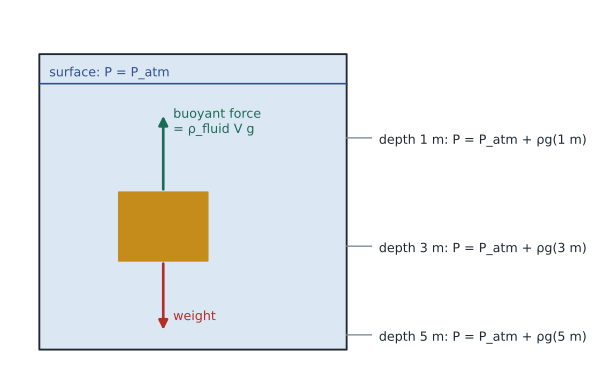
Pressure at a given depth depends only on the depth and the fluid density, not on the shape of the container. Every 10 meters of water adds about 1 atmosphere (ρ g h equals 1,000 times 10 times 10, which is 10 to the 5th pascals). A diver at 20 meters therefore experiences about 3 atmospheres absolute: 1 from the air above the water plus 2 from the water. That pressure compresses gas in the lungs and middle ear and increases the amount of nitrogen that dissolves in the blood, which is why divers must ascend slowly.
Absolute pressure is the total pressure; gauge pressure is the pressure above atmospheric. A tire gauge and a blood pressure cuff both read gauge pressure. A blood pressure of 120 over 80 mm Hg means the arterial pressure rises to 120 mm Hg above atmospheric during systole and falls to 80 mm Hg above atmospheric during diastole. In a standing person, hydrostatic pressure adds to the pressure produced by the heart in the feet and subtracts from it in the head. Using a column of blood about 1.3 meters from heart to feet, the extra pressure at the feet is roughly 1,050 times 10 times 1.3, about 14,000 pascals, or about 100 mm Hg. This is why blood pressure is measured at heart level, why ankles swell after long periods of standing, and why a person who stands up quickly may feel faint.
Barometers and manometers use the same equation. A mercury barometer balances the atmosphere against a column of mercury about 760 millimeters tall; mercury is used because it is dense (13.6 times as dense as water), so the column is short. A water barometer would need a column about 10 meters tall.
Pascal's principle
Pascal's principle states that a pressure change applied to an enclosed incompressible fluid is transmitted undiminished to every part of the fluid and to the walls of its container. In a hydraulic lift, a small force on a small piston creates a pressure that pushes on a large piston with a proportionally larger force: F1 over A1 equals F2 over A2. As with any machine, there is no free lunch; the small piston moves through a proportionally larger distance, so the work in and work out are equal. Hydraulic brakes, dental chairs and syringes rely on the same principle.
Buoyancy and Archimedes' principle
An object in a fluid experiences an upward buoyant force equal to the weight of the fluid it displaces. The force arises because the pressure on the bottom of the object, being deeper, exceeds the pressure on the top. For an object of volume V fully submerged in a fluid of density ρ_fluid, the buoyant force is ρ_fluid V g. Note that the density in the formula is the fluid's, not the object's.
Whether an object floats depends on its average density compared with the fluid. A denser object sinks; a less dense object floats with only part of its volume submerged, enough to displace its own weight. The fraction submerged equals the ratio of the object's density to the fluid's: ice, with a density about 0.92 times that of water, floats with about 92 percent of its volume below the surface. A floating object's buoyant force equals its weight, whatever the fluid. The body's average density is close to that of water, which is why people float more easily after inhaling and why body composition can be estimated by weighing a person under water: the apparent loss of weight gives the volume, and mass over volume gives average density.
Worked problem
Apparent weight under water
A metal sample weighs 30 newtons in air and 20 newtons when fully submerged in water. What is its density? (ρ_water = 1,000 kg/m³, g = 10 m/s²)
Show solution
- The buoyant force is the apparent weight loss: 30 − 20 = 10 N.
- Displaced water weighs 10 N, so its volume is 10 / (1,000 times 10) = 10⁻³ m³. That is also the sample's volume.
- Mass of the sample: 30 N / 10 m/s² = 3 kg.
- Density: 3 kg / 10⁻³ m³ = 3,000 kg/m³.
Answer: 3,000 kg/m³, a specific gravity of 3. A shortcut: specific gravity equals weight in air divided by weight lost, 30/10.
Fluids in motion: the continuity equation
For an incompressible fluid flowing steadily through a pipe, the same volume must pass every cross section each second; fluid cannot pile up or disappear. The volume flow rate Q, in cubic meters per second, equals the cross-sectional area A times the average speed v, and it is constant along the pipe.
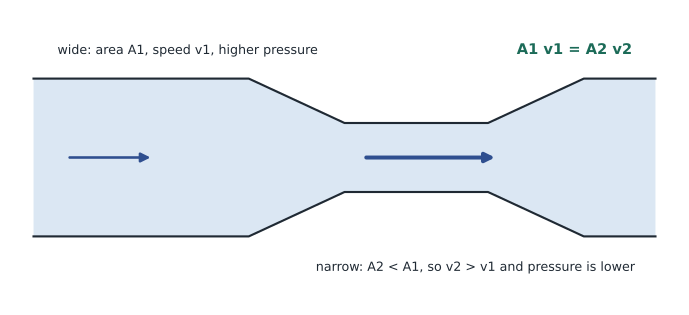
Speed is inversely proportional to area, and area is proportional to the radius squared. If a vessel narrows to half its radius, its area falls to one quarter and the blood must move four times as fast through it. The continuity principle also applies to branching systems, where the relevant area is the total area of all branches in parallel. Blood moves fastest in the aorta, which has the smallest total cross-sectional area, and slowest in the capillaries. Each capillary is tiny, but there are billions of them, so their combined area is hundreds of times that of the aorta. The slow flow gives time for gas and nutrient exchange.
Bernoulli's equation
Bernoulli's equation is conservation of energy for an ideal fluid: incompressible, nonviscous and flowing steadily without turbulence. Along a streamline, the sum of the pressure, the kinetic energy per unit volume and the gravitational potential energy per unit volume stays constant.
Each term has units of pressure, which is also energy per unit volume. In a horizontal pipe, the height term is the same everywhere, so where the fluid speeds up, its pressure must drop. This is the Venturi effect, and it is counterintuitive: the fast-moving fluid in a constriction pushes less on the walls, not more. A Venturi meter measures flow by comparing pressures in a wide and a narrow section. A pitot tube measures the speed of a moving fluid (aircraft airspeed, for example) by comparing the pressure where the flow is brought to rest with the pressure in the moving stream.
Worked problem
Pressure in a constriction
Water flows through a horizontal pipe at 1 m/s where the cross-sectional area is 4 cm². It then enters a section with an area of 1 cm². By how much does the pressure drop? Treat water as ideal, with ρ = 1,000 kg/m³.
Show solution
- Continuity: v2 = v1 × (A1/A2) = 1 × 4 = 4 m/s.
- Bernoulli, same height: P1 − P2 = one half ρ (v2² − v1²).
- P1 − P2 = 0.5 × 1,000 × (16 − 1) = 500 × 15 = 7,500 Pa.
Answer: The pressure falls by 7,500 pascals (about 56 mm Hg) in the narrow section.
Applied to a narrowed artery, the same reasoning explains part of the danger of severe stenosis: blood rushing through the narrow section has lower lateral pressure, which in extreme cases may let the vessel partly collapse, and the high-speed jet beyond the narrowing becomes turbulent. Bernoulli's equation also has a clinical form in echocardiography. Doppler ultrasound (lesson 7) measures the speed of blood through a narrowed heart valve, and the pressure difference across the valve is estimated from that speed. Real blood is viscous, so Bernoulli gives an idealized picture; the next section adds viscosity.
Viscosity and Poiseuille's law
Viscosity is a fluid's resistance to flow, its internal friction. Honey is more viscous than water; blood, with its cells and proteins, is roughly three to four times as viscous as water. In a viscous fluid flowing smoothly through a tube, the layer touching the wall is at rest and the fluid moves fastest along the center, in a pattern called laminar flow. Maintaining that flow requires a pressure difference to overcome viscous drag, so pressure falls steadily along the tube.
Poiseuille's law gives the volume flow rate of laminar flow through a cylindrical tube of radius r and length L, with a pressure difference ΔP across it and fluid viscosity η (eta).
The law has the same form as Ohm's law for circuits (lesson 5): flow equals pressure difference divided by resistance, where the resistance is 8 η L divided by π r to the fourth. Resistance rises with viscosity and length and falls steeply with radius. The fourth-power dependence on radius is the most tested idea in MCAT fluids. If the radius of a vessel halves, its resistance rises 16-fold, so with the same pressure difference the flow falls to one sixteenth. A 10 percent narrowing of the radius (to 0.9 of the original) cuts flow to 0.9 to the fourth, about 0.66 of the original, a one-third reduction. This is why arterioles, by contracting or relaxing the smooth muscle in their walls, are the main controllers of blood flow and blood pressure: small changes in radius make large changes in resistance.
| Change (others constant) | Effect on resistance | Effect on flow at constant ΔP |
|---|---|---|
| Radius doubles | ÷ 16 | × 16 |
| Radius halves | × 16 | ÷ 16 |
| Length doubles | × 2 | ÷ 2 |
| Viscosity doubles (for example, high hematocrit) | × 2 | ÷ 2 |
| Pressure difference doubles | No change | × 2 |
Vessels in series add their resistances; vessels in parallel combine like resistors in parallel, so adding parallel pathways lowers total resistance. That is why the capillary beds, despite tiny individual radii, do not dominate total resistance: so many capillaries run in parallel. Note the tension between continuity and Poiseuille in passages. Continuity says a narrowing speeds the fluid up if the flow rate is fixed; Poiseuille says a narrowing reduces the flow rate if the pressure difference is fixed. Read which quantity the passage holds constant.
Turbulence
At high speeds, in wide vessels or past obstructions, smooth laminar flow breaks up into chaotic eddies. Turbulent flow wastes energy, raises resistance and makes noise. Whether flow is laminar or turbulent is predicted by a dimensionless number, the Reynolds number, which rises with fluid density, speed and vessel diameter and falls with viscosity. Turbulence is more likely when blood moves fast, when vessels are wide, or when viscosity is low, as in anemia, where fewer red blood cells thin the blood. Turbulent flow produces the sounds of heart murmurs, of arterial bruits beyond a narrowing like the one in Thandiwe's patient, and the Korotkoff sounds heard when measuring blood pressure with a cuff. As the cuff deflates past systolic pressure, blood spurts through the partly compressed artery in turbulent jets, and the sounds begin; when the cuff pressure falls below diastolic, flow becomes continuous and laminar again, and the sounds stop.
Surface tension and the alveoli
At a liquid surface, molecules are pulled inward by their neighbors more strongly than outward, so the surface behaves like a stretched elastic sheet. Surface tension, measured in newtons per meter, lets insects walk on water and pulls droplets into spheres. For a small bubble of radius r, the pressure inside exceeds the pressure outside by an amount proportional to surface tension divided by r (2γ over r for a bubble with one surface, the law of Laplace). Smaller bubbles have higher internal pressure. In the lungs, alveoli are lined with a thin film of water, and without help their surface tension would make small alveoli collapse into larger ones. Pulmonary surfactant, a mixture of lipids and proteins secreted by alveolar cells, lowers surface tension and stabilizes the alveoli. Premature infants who lack enough surfactant can develop respiratory distress syndrome. Capillary action, the rise of liquid in a narrow tube, is another surface tension effect, relevant to blood collection in capillary tubes.
Common mistakes
MistakeThe buoyant force depends on the density of the submerged object.
InsteadIt depends on the density of the fluid and the volume displaced; the object's density decides whether it floats.
MistakeWhere a fluid moves faster in a horizontal pipe, its pressure is higher.
InsteadBy Bernoulli's equation, faster flow means lower pressure at the same height.
MistakeHalving a vessel's radius halves the blood flow.
InsteadFlow depends on r⁴; halving the radius divides flow by 16 at constant pressure difference.
MistakeBlood moves fastest in the capillaries because they are narrowest.
InsteadThe capillaries' total cross-sectional area is largest, so blood moves slowest there.
MistakePressure at the bottom of a container depends on its shape.
InsteadHydrostatic pressure depends only on depth, fluid density and g.
Summary and key terms
- Density is mass over volume; specific gravity compares a density with that of water.
- Hydrostatic pressure rises by ρgh with depth; every 10 m of water adds about 1 atmosphere.
- Pascal's principle transmits pressure through enclosed fluids; buoyant force equals the weight of fluid displaced.
- Continuity: Av is constant, so flow speeds up where the total area shrinks.
- Bernoulli's equation is energy conservation for ideal fluids: faster flow means lower pressure at the same height.
- Poiseuille's law makes flow proportional to r⁴; turbulence produces murmurs and bruits; surfactant lowers alveolar surface tension.
- Specific gravity
- The ratio of a substance's density to the density of water.
- Gauge pressure
- Pressure measured relative to atmospheric pressure.
- Archimedes' principle
- The buoyant force on an object equals the weight of the fluid it displaces.
- Continuity equation
- For steady incompressible flow, the product of cross-sectional area and speed is constant.
- Venturi effect
- The drop in fluid pressure where flow speeds up through a constriction.
- Viscosity
- A fluid's internal resistance to flow.
- Laminar flow
- Smooth flow in parallel layers, fastest at the center of a tube.
- Surfactant
- A substance that lowers surface tension, such as the lipoprotein film lining the alveoli.
Practice problems
Work each problem on paper first, then reveal the answer to check.
What is the gauge pressure 5 m below the surface of a lake? (ρ = 1,000 kg/m³, g = 10 m/s²)
Show answer
ρgh = 1,000 × 10 × 5 = 5 × 10⁴ Pa, about half an atmosphere.
A block of density 600 kg/m³ floats in water. What fraction of it is submerged?
Show answer
600/1,000 = 0.6, or 60 percent.
Blood flows at 0.3 m/s in a vessel. What is its speed where the radius is one third as large?
Show answer
Area falls to 1/9, so speed rises ninefold to 2.7 m/s.
An arteriole's radius increases by 20 percent. By roughly what factor does flow change at constant pressure?
Show answer
1.2⁴ ≈ 2.07, so flow roughly doubles.
Why does lowering blood viscosity, as in anemia, make murmurs more likely?
Show answer
Lower viscosity raises the Reynolds number, favoring turbulent flow.
Lesson quiz · 5 questions
Score 60% or more to complete this lesson.
Create a free account to save your progress, take quizzes and earn a certificate.