
MCAT-121 · Lesson 2 of 12 · 30 min
Kinematics and forces: motion, Newton's laws and equilibrium
▶ Video coming soon A video version of this lesson is on the way.
Thandiwe opened the second physics session with a video clip of a paramedic team carrying a stretcher down a slope. 'Name every force on that stretcher,' she said. Ezequiel, who had carried a few stretchers himself, answered first: gravity, the push of the two paramedics, and friction under their boots. 'Good,' she said. 'Now tell me which of those forces acts on the stretcher and which acts on the paramedics.' The group went quiet. That question, which object feels which force, is where most mechanics mistakes start, and it is where this lesson ends.
This lesson covers the first part of content category 4A: translational motion (displacement, velocity and acceleration, including motion in two dimensions), Newton's three laws of motion, the common forces (gravity, normal force, tension, friction and spring force), the center of mass, and equilibrium, including torque. The MCAT tests these ideas in settings such as a patient on a tilted bed, a falling object in a laboratory, blood cells in a centrifuge or the forces on a joint.
Describing motion
Position tells you where an object is; displacement is a change in position. Velocity is the rate of change of position, a vector with units of meters per second. Speed is the magnitude of velocity. Acceleration is the rate of change of velocity, also a vector, with units of meters per second squared. An object accelerates whenever its velocity changes in magnitude, in direction or in both, so a car going around a curve at constant speed is accelerating.
Average velocity is displacement divided by time. Average acceleration is change in velocity divided by time. For motion with constant acceleration, the MCAT expects you to know four kinematic equations. Here x is displacement, v0 is the initial velocity, v the final velocity, a the constant acceleration and t the elapsed time.
Each equation leaves out one of the five variables. Choose the equation that omits the variable you neither know nor need. If a question gives initial speed, acceleration and distance and asks for final speed, use the third equation, which has no time in it. If it gives time but not final speed, use the second.
Graphs of motion
Motion graphs are common on the test, and three rules cover nearly every question. On a position-versus-time graph, the slope is the velocity. On a velocity-versus-time graph, the slope is the acceleration and the area between the curve and the time axis is the displacement. On an acceleration-versus-time graph, the area is the change in velocity. A horizontal line on a velocity graph means constant velocity, not that the object is at rest; the object is at rest only where the velocity graph sits on zero. Area below the time axis on a velocity graph counts as negative displacement.
Worked problem
Displacement from a velocity graph
A wheelchair accelerates uniformly from rest to 2 meters per second in 4 seconds, moves at 2 meters per second for 6 seconds, then slows uniformly to rest in 2 seconds. How far does it travel?
Show solution
- Area of the first triangle: one half times 4 s times 2 m/s = 4 m.
- Area of the rectangle: 6 s times 2 m/s = 12 m.
- Area of the last triangle: one half times 2 s times 2 m/s = 2 m.
- Total: 4 + 12 + 2 = 18 m.
Answer: 18 meters. The acceleration during the first 4 seconds is 0.5 m/s², the slope of that segment.
Free fall
Near Earth's surface, an object moving under gravity alone accelerates downward at g, about 9.8 meters per second squared. The MCAT almost always lets you round g to 10 m/s², and the answer choices are set up so that the rounding does not matter. Free fall ignores air resistance, so a feather and a hammer dropped together in a vacuum land together. Objects thrown upward slow down at g, momentarily stop at the top, and then speed up at g on the way down; the acceleration is g downward the entire time, including the instant at the top when the velocity is zero.
Two quick results are worth having ready. An object dropped from rest falls a distance of one half g t squared, so in 1 second it falls about 5 meters and in 2 seconds about 20 meters. An object dropped from height h hits the ground at a speed equal to the square root of 2gh, so from 5 meters it lands at about 10 meters per second and from 20 meters at about 20 meters per second.
Projectile motion
A projectile moves in two dimensions under gravity alone. The key idea is that horizontal and vertical motion are independent. Horizontally, nothing pushes or pulls the projectile (ignoring air), so its horizontal velocity stays constant. Vertically, it accelerates downward at g, exactly as if it had been thrown straight up or dropped. The time of flight is set by the vertical motion alone.
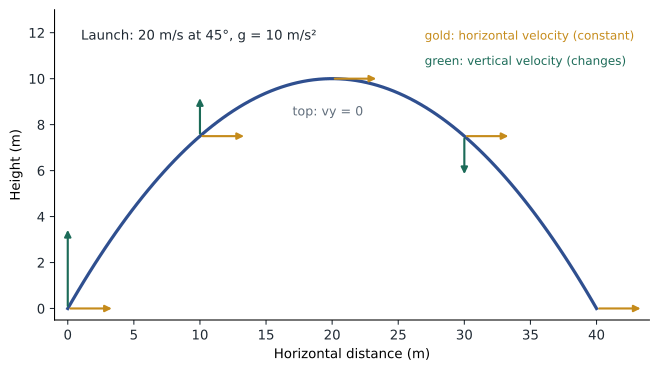
For a projectile launched at speed v0 and angle θ above the horizontal from level ground, the horizontal component is v0 cos θ and the vertical component is v0 sin θ. The time to reach the top is (v0 sin θ)/g, the total flight time is twice that, and the range is the horizontal velocity times the flight time. For a fixed launch speed on level ground, the range is greatest at 45 degrees, and complementary angles such as 30 and 60 degrees give the same range. A ball rolled off a table horizontally and a ball dropped from the same height at the same instant land at the same time, because both start with zero vertical velocity.
Worked problem
A projectile from level ground
A ball is kicked at 20 meters per second at 30 degrees above the horizontal. Using g = 10 m/s², how long is it in the air and how far does it travel?
Show solution
- Vertical component: 20 sin 30° = 10 m/s. Horizontal component: 20 cos 30° ≈ 17 m/s.
- Time to the top: 10/10 = 1 s. Total time: 2 s.
- Range: 17 m/s times 2 s ≈ 34 m.
Answer: About 2 seconds and about 35 meters.
Newton's three laws
Newton's first law says that an object stays at rest or moves at constant velocity unless a net external force acts on it. This tendency to resist changes in motion is inertia, and mass is its measure. The first law also defines an equilibrium: if the net force on an object is zero, its velocity does not change.
Newton's second law says that the net force on an object equals its mass times its acceleration: the sum of the forces, F net, equals m a. The law is a vector equation, so it holds separately in each direction. A useful habit is to write it once along the direction of motion and once perpendicular to it. Note that the law involves the net force. A large force can coexist with zero acceleration if another force cancels it.
Newton's third law says that when object A exerts a force on object B, B exerts a force of equal magnitude and opposite direction on A. The two forces in such a pair act on different objects, so they never cancel each other. A person standing on the floor pushes down on it, and the floor pushes up on the person. The person's weight and the floor's upward push on the person are equal in this case, but they are not a third-law pair; they both act on the person, and they are equal only because the person is not accelerating vertically. In an elevator accelerating upward, the floor pushes up with more force than the person's weight.
The common forces
| Force | Direction | Magnitude | Notes |
|---|---|---|---|
| Weight (gravity) | Toward the center of Earth (down) | mg | Acts on every mass; 1 kg weighs about 10 N |
| Normal force | Perpendicular to a surface, pushing away from it | Whatever the situation requires | Equals mg only on a level surface with no other vertical forces |
| Tension | Along a rope or cable, pulling | Same throughout an ideal massless rope | A rope can only pull |
| Static friction | Opposes the impending sliding | Up to μs N | Adjusts to prevent sliding, up to a maximum |
| Kinetic friction | Opposes the sliding motion | μk N | Usually less than maximum static friction |
| Spring force | Toward the spring's rest length | kx (Hooke's law) | x is the stretch or compression |
Friction deserves extra care. Static friction acts when surfaces are not sliding relative to each other, and it takes whatever value is needed to keep them from sliding, up to a maximum of μs times the normal force. Kinetic friction acts once sliding begins and has a magnitude of μk times the normal force, independent of speed in the simple model. The coefficients μs and μk are dimensionless and depend on the two surfaces; μk is usually smaller than μs, which is why it takes more force to start a heavy box moving than to keep it moving. Walking depends on static friction: your foot pushes backward on the ground, and static friction pushes you forward.
Weight, mass and gravitation
Mass is a property of an object, measured in kilograms, and does not change with location. Weight is the gravitational force on it, measured in newtons. Newton's law of universal gravitation gives the force between any two masses as G times the product of the masses divided by the square of the distance between their centers. G is tiny (about 6.7 times 10 to the minus 11th N·m²/kg²), so gravitational forces between ordinary objects are negligible; only planet-sized masses produce noticeable weights. The law is an inverse-square law: doubling the distance from Earth's center divides your weight by four.
Inclined planes
On a ramp tilted at angle θ, it is easiest to set up axes along and perpendicular to the slope. Gravity then splits into mg sin θ down the slope and mg cos θ into the slope. The normal force balances the perpendicular part, so N equals mg cos θ when nothing else pushes perpendicular to the ramp. Friction acts along the slope, opposing motion or impending motion.
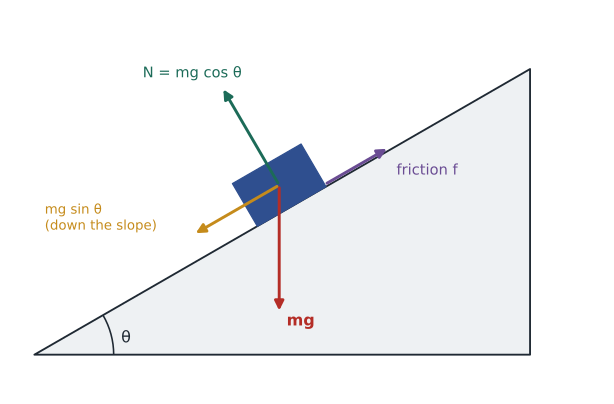
Several results follow. On a frictionless incline, the acceleration down the slope is g sin θ, independent of mass. A block rests on an incline with friction if mg sin θ is no larger than the maximum static friction, μs mg cos θ, which means tan θ must be no larger than μs. That gives a neat experimental method, used in some laboratory passages: tilt the ramp until the block just begins to slide, and the tangent of that angle equals μs. A block sliding down at constant speed has μk equal to tan θ.
Worked problem
A patient on a tilted bed
A 60-kilogram patient lies on a hospital bed tilted 30 degrees head-up. What friction force from the mattress keeps the patient from sliding, and what normal force does the mattress exert? (g = 10 m/s²)
Show solution
- Weight: 60 kg times 10 m/s² = 600 N.
- Along the slope: friction must balance mg sin 30° = 600 times 0.5 = 300 N.
- Perpendicular: N = mg cos 30° ≈ 600 times 0.87 ≈ 520 N.
Answer: Static friction of 300 N up the slope; a normal force of about 520 N.
Systems of objects and the free-body diagram
The single most useful habit in mechanics is drawing a free-body diagram: isolate one object, draw it as a dot or a box, and draw every force acting on that object, each starting at the object, with labels. Do not draw forces that the object exerts on other things, and do not draw "the force of motion"; there is no such thing. Then choose axes and apply Newton's second law in each direction. For connected objects, such as two masses joined by a string over a pulley, draw one diagram per object, note that they share the same magnitude of acceleration and that an ideal string has the same tension at both ends, and solve the equations together.
Back to the stretcher: gravity on the stretcher and patient, the upward and forward pushes of the paramedics' hands, and nothing else act on the stretcher. Friction under the paramedics' boots acts on the paramedics, not on the stretcher. The stretcher pushes back on the paramedics' hands with forces equal and opposite to theirs, by Newton's third law, but those forces belong on the paramedics' diagrams.
Circular motion
An object moving in a circle at constant speed v and radius r accelerates toward the center of the circle with a magnitude of v squared divided by r. This centripetal acceleration requires a net inward force, the centripetal force, of m v squared over r. Centripetal force is not a new kind of force; it is a role played by tension, friction, gravity or a normal force. A car turning on a flat road relies on static friction; a satellite relies on gravity. A centrifuge spins samples so fast that the required inward force on dense particles is huge, and particles that cannot be held in place drift outward relative to the fluid and sediment. Centrifuge speeds are often reported as multiples of g, the relative centrifugal force.
Center of mass, torque and equilibrium
The center of mass is the average position of an object's mass, weighted by mass. For a uniform object it sits at the geometric center. For two point masses on a line, it lies closer to the heavier mass, at x equal to (m1 x1 + m2 x2)/(m1 + m2). Gravity acts as if all the weight were concentrated at the center of mass.
Torque measures how effectively a force causes rotation about a pivot. Its magnitude is the force times the lever arm, which is the perpendicular distance from the pivot to the line of action of the force; equivalently, torque equals r F sin θ, where r is the distance from the pivot to the point where the force acts and θ the angle between r and F. A force directed through the pivot produces no torque. Torques are labeled clockwise or counterclockwise.
An object is in static equilibrium when two conditions hold: the net force is zero (no linear acceleration) and the net torque about any point is zero (no angular acceleration). In problems, choose the pivot at a point where an unknown force acts, so that force drops out of the torque equation.
Worked problem
The forearm as a lever
A person holds a 5-kilogram weight in her hand, 30 centimeters from the elbow, with the forearm horizontal. The biceps attaches 3 centimeters from the elbow and pulls straight up. Ignoring the forearm's own weight, what force must the biceps exert? (g = 10 m/s²)
Show solution
- Take the elbow as the pivot so the joint force drops out.
- Clockwise torque from the weight: 50 N times 0.30 m = 15 N·m.
- Counterclockwise torque from the biceps: F times 0.03 m.
- Set them equal: F = 15 / 0.03 = 500 N.
Answer: 500 newtons, ten times the weight held. The forearm is a third-class lever: it trades force for speed and range of motion.
The forearm example shows why the AAMC lists mechanical advantage in content category 4A. Levers, pulleys and ramps let a smaller force do the same work over a longer distance (a mechanical advantage greater than 1), or let a larger force move something farther and faster (less than 1). The human musculoskeletal system mostly uses levers with mechanical advantage less than 1, which is why muscle and joint forces are often many times the loads people carry.
Common mistakes
MistakeAt the top of its path, a ball thrown upward has zero acceleration.
InsteadIts velocity is zero for an instant, but its acceleration is still g downward.
MistakeA person's weight and the normal force are an action-reaction pair.
InsteadBoth act on the person; third-law pairs act on different objects.
MistakeThe normal force always equals mg.
InsteadIt equals whatever the situation requires: mg cos θ on an incline, more or less in an accelerating elevator.
MistakeStatic friction always equals μs N.
Insteadμs N is the maximum; static friction is only as large as needed to prevent sliding.
MistakeA projectile's horizontal velocity slows down during flight.
InsteadWithout air resistance, horizontal velocity is constant; only the vertical velocity changes.
Summary and key terms
- Velocity is the rate of change of displacement and acceleration the rate of change of velocity; both are vectors.
- With constant acceleration, use the four kinematic equations, choosing the one that omits the variable you do not need.
- Slopes and areas on motion graphs give velocity, acceleration and displacement.
- Projectile motion splits into constant horizontal velocity and vertical free fall at g.
- F net = ma in each direction; third-law pairs act on different objects and never cancel.
- On an incline, gravity splits into mg sin θ along the slope and mg cos θ into it; equilibrium needs zero net force and zero net torque.
- Acceleration
- The rate of change of velocity; a vector measured in meters per second squared.
- Inertia
- The tendency of an object to resist changes in its motion, measured by its mass.
- Normal force
- The perpendicular push of a surface on an object in contact with it.
- Coefficient of friction
- A dimensionless number relating the friction force to the normal force for two surfaces.
- Centripetal force
- The net inward force required to keep an object moving in a circle, equal to mv²/r.
- Torque
- The rotational effect of a force about a pivot, equal to force times lever arm.
- Static equilibrium
- A state of zero net force and zero net torque, with no linear or angular acceleration.
Practice problems
Work each problem on paper first, then reveal the answer to check.
A stone is dropped from rest. How far does it fall in 3 s? (g = 10 m/s²)
Show answer
One half times 10 times 3² = 45 m.
A 2 kg cart is pulled with 10 N against 4 N of friction. What is its acceleration?
Show answer
Net force 6 N; a = 6/2 = 3 m/s².
At what angle does a block just begin to slide if μs = 1?
Show answer
45 degrees, since tan θ = μs = 1.
If the speed of an object in circular motion doubles at the same radius, how does the required centripetal force change?
Show answer
It quadruples, because F = mv²/r.
Why does choosing the pivot at an unknown force simplify a torque problem?
Show answer
That force has zero lever arm about the pivot, so it disappears from the torque equation.
Lesson quiz · 5 questions
Score 60% or more to complete this lesson.
Create a free account to save your progress, take quizzes and earn a certificate.