
MCAT-101 · Lesson 9 of 12 · 19 min
Building a study schedule
▶ Video coming soon A video version of this lesson is on the way.
On Sunday, October 18, 2026, Thandiwe asked each member to bring a calendar, not a study plan. 'Plans are easy,' she said. 'Calendars are honest. Show me your actual week: classes, work, shifts, family, sleep, the gym. Then we will find the MCAT's place in it.'
The three calendars looked nothing alike. Devika had classes four days a week, twelve hours at the pharmacy, and a long commute. Elliot had a lighter final-year course load, a Saturday clinic shift and a test date only fourteen weeks away. Ezequiel worked part time, took two evening science courses, and had six months until his April test.
This lesson explains how to build a study schedule that fits a real life: how to estimate the time you need, how to divide preparation into phases, how to balance content review with practice, how to schedule full-length tests and review, and how to adjust when life or scores do not follow the plan.
How much time you need
There is no single right number of study hours. The time you need depends on your starting point, your target, how recently you studied the content, how efficiently you study, and how much of your week you can protect. Students with a recent, strong science background and a modest gap between diagnostic and target may need a few months of part-time study. Students returning to the material after years away, or with a large gap to close, often need six months or more.
Two practical measures help. The first is the gap between your diagnostic and your target. A gap of a few points can usually be closed with focused work on the weakest areas; a gap of ten or more points generally needs a full review of content plus a long practice phase. The second is the number of hours you can reliably protect each week, not the number you hope for. A plan built on twenty hours a week that you can actually keep beats a plan built on thirty-five that collapses in week three.
Thandiwe asked each member to estimate their weekly hours honestly and to subtract a margin for bad weeks. Devika settled on fifteen hours a week during term and twenty-five in the weeks between her April final exams and her May test. Elliot, with fourteen weeks left, committed to twenty-five hours. Ezequiel chose eighteen hours a week across six months.
Working backward from test day
Build the schedule backward from your test date. Start by marking the final week, which is a taper: light review, one or two short passage sets, sleep and logistics, no new material. Before that, mark the full-length phase, usually the last six to eight weeks, when you take a full practice test about once a week. Before that, mark the application phase and the foundation phase, which share the remaining weeks.
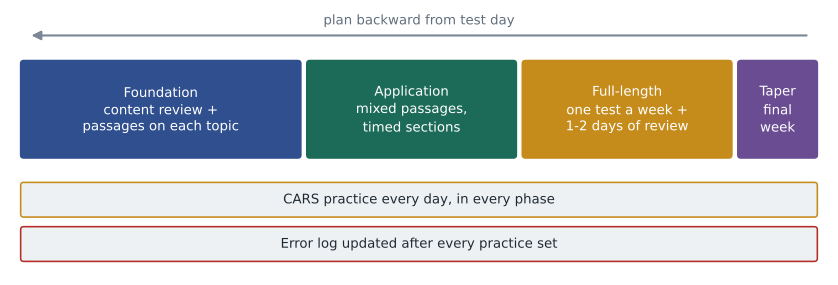
| Phase | Main activities | Typical share of time |
|---|---|---|
| Foundation | Systematic content review from the outline; daily CARS; passages on each topic soon after reviewing it | Largest share for students with major content gaps |
| Application | Mixed passage sets and timed section practice; targeted content review from the error log | Grows as content gaps shrink |
| Full-length | About one full-length test per week under real conditions, with one to two days of review; error-log fixes between tests | Usually the last six to eight weeks |
| Taper | Light review, a few passages, logistics, normal sleep; no new material | Final week |
The phases overlap. Content review never stops completely, and passage practice starts on day one. The difference between phases is emphasis, not a strict switch.
Balancing content review and practice
The most common scheduling mistake is to plan months of content review first and leave practice for the end. Because most MCAT questions are passage-based and most points come from applying knowledge, content learned without practice often fails on test day. The fix is to pair them: review a topic, then within a day or two do passages and questions that use it.
A simple rule of thumb from Thandiwe: in the foundation phase, roughly two hours of content review to one hour of practice; in the application phase, the reverse; in the full-length phase, mostly practice and review, with content work only where the error log points. CARS sits outside this balance, because it has no content. It gets a small daily slot from the first week to the last.
A sample week
Here is the week Devika built for the autumn term, when she had fifteen hours available. It assumes about two months of foundation work before she moves into application in the new year.
| Day | Session | Focus |
|---|---|---|
| Monday | 1.5 hours (evening) | Content: one physics topic from the outline; 10 practice questions on it |
| Tuesday | 1 hour (commute and lunch) | Mental math drill (15 minutes); 2 CARS passages with review |
| Wednesday | 2 hours (evening) | Content: one general chemistry topic; one Chem/Phys passage set |
| Thursday | 1 hour | 2 CARS passages; error log review |
| Friday | Rest | No MCAT work |
| Saturday | 4 hours (morning) | Content: biochemistry topic; mixed passage set; Psych/Soc vocabulary |
| Sunday | 3.5 hours (including the group session) | Sunday Session; one timed passage block; plan next week from the error log |
Notice several features. The heaviest sessions fall on days with the most free time, not evenly across the week. Short sessions on busy days are used for CARS and drills, which fit into an hour. There is a full rest day. And each week ends with planning: the error log decides what the next week covers.
Scheduling full-length tests
Full-length practice tests are the backbone of the final phase. Most students benefit from six to eight full-length tests in total, including the diagnostic, with more spaced out early and closer together near the end. The AAMC's practice exams are the most realistic, so many students save them for the final four to six weeks, using other materials for earlier full-length practice if they want it.
Each full-length test needs review time, often as much as or more than the test itself. A common pattern is to take a test on Saturday morning at the time of your real appointment, rest that afternoon, and spend Sunday and part of Monday reviewing every miss and uncertain answer. A full-length test without review is mostly a stamina exercise; with review, it is the most valuable study session of the week.
Elliot's fourteen-week calendar placed his first post-diagnostic full-length test in early December, then one each week from mid-December onward, with the last one ten days before his January 21 test. That spacing left time to review each test fully and to rest before test day.
Worked problem
Building a backward schedule
Ezequiel tests on Saturday, April 17, 2027 and starts structured study on Monday, October 19, 2026. He can study about 18 hours a week, with a lighter week over the December holidays. How should he lay out his phases?
Show solution
- Count weeks: from October 19, 2026 to April 17, 2027 is about 26 weeks.
- Mark the taper: the week of April 12 to 16.
- Mark the full-length phase: about seven weeks, roughly February 22 to April 11, with a full test most Saturdays and review on Sundays.
- Split the rest: about 11 weeks of foundation (October to early January), heavy on organic chemistry and biochemistry, then about 7 weeks of application (January to late February).
- Protect the holiday week: plan it at half load, with CARS and error-log review only.
Answer: About 11 weeks of foundation, 7 of application, 7 of full-length practice and 1 week of taper, with CARS daily throughout and organic chemistry front-loaded.
Spacing, mixing and retrieval
How you schedule review matters as much as how much. Research on learning supports three habits. Spacing means returning to a topic several times over weeks rather than studying it once in a block. Interleaving means mixing topics and question types in practice rather than doing twenty questions on one topic at a time, which better matches the real test. Retrieval practice means testing yourself, through questions, flashcards or explaining a topic from memory, rather than rereading notes.
A schedule can build these in deliberately. Each week, include a short review of topics from two and four weeks earlier. Use mixed passage sets after the first few weeks. Use the error log's re-test dates to bring old misses back. These habits feel harder than rereading, which is part of why they work.
Adjusting the plan
No schedule survives intact. Illness, exams, work schedules and family events will take weeks away. Build a buffer into the plan: one lighter week every four to six weeks, and at least two weeks of slack before your test date. When you lose time, cut lower-priority content review first, not practice and review.
Practice scores should also shape the plan. If your full-length scores have plateaued for several weeks, look at the error log for a new pattern rather than adding hours. If your rolling average is well below target two or three weeks before your test, consider whether to postpone, using the fee table in lesson 6 to make the decision as early as possible. A postponement is not a failure; testing before you are ready, when schools will see every score, is usually the more costly choice.
Thandiwe asked each member to put two checkpoint dates in their calendars: one about two months before the test and one about three weeks before. At each checkpoint, they would compare their rolling average with their target and decide, with her, whether to continue as planned, adjust the plan, or move the test.
A note on group study
Studying with others can strengthen a schedule if it has a clear purpose. A weekly session like the Sunday Session works well for accountability, for explaining concepts aloud and for debriefing practice sets together. It works less well for first-time content review, which is usually faster alone. Keep group time focused, agree in advance what each session will cover, and protect your own schedule around it.
Studying alongside school and work
Most MCAT students study alongside classes, jobs or caregiving, and their schedules need to reflect that. During heavy academic weeks, such as midterms or finals, reduce MCAT hours deliberately rather than letting them disappear. Even 20 or 30 minutes a day of CARS and a short review of flashcards keeps skills from slipping. Plan the heavier MCAT weeks for reading weeks, holidays and lighter periods.
Use small blocks of time well. Commutes and lunch breaks are good for flashcards, Psych/Soc vocabulary or a single CARS passage. Longer blocks on days off are for content review and timed passage sets, which need concentration. Full-length tests need a whole morning, so they belong on days with nothing else scheduled.
Devika's pharmacy shifts were on Thursday evenings and Saturday afternoons, so she put her long study session on Saturday morning and kept Thursday for a single CARS passage and error-log review. Ezequiel's evening courses were on Tuesdays and Thursdays, so his long sessions fell on Mondays, Wednesdays and Saturdays. Elliot, with the lightest course load, built a schedule that looked almost like a job: three to four hours most weekdays, with Saturdays at the clinic and Sundays for the group and review.
Keeping track of the plan
A plan is only useful if you can see whether you are following it. Keep a simple weekly log of hours studied, topics covered, practice sets done and their results. Compare it with the plan at the end of each week. If you are consistently falling short of the planned hours, the plan is too ambitious for your life, and it is better to adjust the plan than to keep feeling behind. If you are meeting the hours but not improving, the problem lies in how the hours are used, and the error log is the place to look.
Common mistakes
MistakeI should finish all content review before doing any practice.
InsteadPair content review with passage practice from the start.
MistakeMore hours always means a higher score.
InsteadProtected, consistent hours with good review beat long, unsustainable plans.
MistakeI should take a full-length test every few days near the end.
InsteadAbout one per week, with one to two days of review, is usually more effective.
MistakeRest days are wasted days.
InsteadRest prevents burnout and improves consolidation; plan at least one each week.
MistakeIf I lose a week, I should cut practice to catch up on content.
InsteadCut lower-priority content first; keep practice and review.
Summary and key terms
- Estimate time from the gap between diagnostic and target and from the hours you can reliably protect each week.
- Build the schedule backward from test day: taper week, full-length phase, application phase and foundation phase.
- Pair content review with practice from the start, and practice CARS daily throughout.
- Plan six to eight full-length tests in total, about one a week near the end, each with one to two days of review.
- Use spacing, interleaving and retrieval practice, build buffer weeks, and set checkpoint dates to decide whether to continue, adjust or postpone.
- Taper
- The final week before the test, with light review and rest and no new material.
- Full-length phase
- The final weeks of preparation, built around weekly full-length practice tests and review.
- Spacing
- Returning to material several times over time rather than studying it once in a block.
- Interleaving
- Mixing topics and question types within practice sessions.
- Retrieval practice
- Learning by recalling information from memory, as in practice questions or self-testing.
- Rolling average
- The average of your last few practice scores, used to judge trends.
Practice problems
Work each problem on paper first, then reveal the answer to check.
What should the final week before the MCAT include?
Show answer
Light review, a few passages, logistics and normal sleep, with no new material.
About how many full-length practice tests do most students benefit from in total?
Show answer
About six to eight, including the diagnostic.
A student loses two weeks to illness. What should she cut first?
Show answer
Lower-priority content review, not practice and review.
What is interleaving?
Show answer
Mixing topics and question types within practice instead of practicing one topic at a time.
Lesson quiz · 5 questions
Score 60% or more to complete this lesson.
Create a free account to save your progress, take quizzes and earn a certificate.