
MCAT-101 · Lesson 7 of 12 · 19 min
Testing limits, accommodations and test day
▶ Video coming soon A video version of this lesson is on the way.
Ezequiel told the story at the start of the session, because Thandiwe asked him to. In June 2025 he had registered late and taken the only seat left, at a test center two hours from home. On the morning of the test he hit road construction, missed an exit and arrived twelve minutes before his appointment, well after the recommended arrival time. The check-in line was long. He watched the clock while the person in front of him was sent back to the car park because his ID had expired the week before. Ezequiel was admitted with a few minutes to spare. 'I sat down for Chem/Phys with my heart rate at about 140,' he said, 'and I never really calmed down.'
Thandiwe used the story to introduce three topics that have nothing to do with science and everything to do with your score: testing limits, accommodations, and the rules of test day. None of them is complicated. All of them can cost you an attempt if you ignore them.
Testing limits
The AAMC limits how often anyone may take the MCAT. You may test up to three times in a single testing year, up to four times across two consecutive testing years, and up to seven times in your lifetime. The lifetime count starts with the April 2015 test dates, when the current version of the test began, so attempts before then do not count toward the seven.
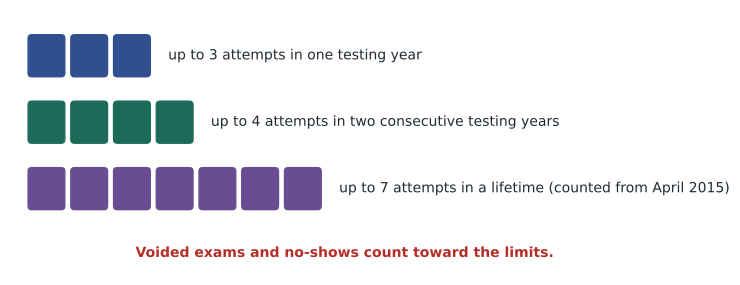
Voided exams and no-shows count toward these limits. The AAMC states plainly that a voided exam counts toward your testing limits regardless of the reason, and that voids and no-shows count toward lifetime limits. An appointment you cancel before the 10-day deadline does not count, because you never sat down to test. The AAMC may review appeals of the limits in exceptional circumstances, at its sole discretion, and will consider no more than one appeal per testing year.
The limits rarely stop anyone, but they shape strategy. The more important constraint is that schools see every scored attempt, as lesson 5 explained. Thandiwe's rule of thumb was blunt: 'Plan to take the test once, and prepare so that you only need to.'
Ezequiel had used one of his seven attempts in 2025. His plan for 2027 was one more attempt in April, with a possible third in late summer only if something went wrong. That plan kept him well within all three limits.
Testing accommodations
The AAMC offers accommodations for examinees with disabilities or medical conditions that affect test taking. Common accommodations include extra testing time, additional or longer breaks, a separate testing room, and permission to have certain items, such as medication or a medical device, in the testing room. Accommodations must be approved in advance through the AAMC's accommodations application, which serves both the MCAT and the PREview exam.
An application normally includes a personal statement describing how the condition affects you, documentation from a qualified professional, and evidence of past accommodations where available. The AAMC states that initial requests are generally reviewed within 60 days of submission, in the order received, and cannot be expedited. Requests for reconsideration, appeals or extensions are generally reviewed within 30 days.
The timing is the part applicants most often get wrong. For each test date, the AAMC publishes a recommended submission date for initial requests that is roughly three and a half months before the test. For the January 15, 2027 test, the recommended date was October 2, 2026; for May 14, 2027, it was January 29, 2027; and for the last test of the year, September 11, 2027, it was May 29, 2027. You may apply after the recommended date, but you must be approved and have a scheduling request submitted to Pearson VUE at least 15 days before the test. If approval comes later than that, you can test under standard conditions or move to a later date.
Approved accommodations carry over to future MCAT attempts, so applicants who might retake do not need to reapply for each test. Students with documented needs should apply early, ideally before registration opens, so that approval is in place when they choose a date.
| Test date (2027) | Recommended initial accommodations submission | Approval and Pearson VUE request needed by |
|---|---|---|
| January 15 | October 2, 2026 | December 31, 2026 |
| May 14 | January 29, 2027 | April 29, 2027 |
| September 11 | May 29, 2027 | August 27, 2027 |
Identification and your name
You must bring valid identification on test day. The AAMC requires an ID that is issued by a government agency, includes a photo that positively identifies you, has an expiration date printed on it (not added by sticker) and is not expired on test day, is a physical card or document in good condition with no signs of tampering, and is in English. Accepted examples include a driver's license and a passport. Digital IDs, school or employee IDs, paper receipts and birth certificates are not accepted.
Your first and last names on the ID must exactly match the names and name order in your MCAT registration. Middle names and initials do not need to appear on the registration. A nickname, a partial name or a misspelling can mean you are not admitted to the testing room. If your legal name has changed, or if your ID shows a compound surname, fix your registration well before the 10-day deadline, because that is the last day to edit registration information.
Check-in and the testing room
Arrive at least 30 minutes before your scheduled start time. The standard start time on the 2027 calendar is 8:00 a.m. If you arrive after your start time, you might not be allowed to test, and a late arrival who is turned away is treated as a no-show: there is no refund, and the attempt counts toward your lifetime limit.
Check-in involves signing in, presenting your ID, having your palms scanned digitally and having a test-day photograph taken. Each time you leave or re-enter the testing room, including during breaks, you show your ID and scan your palms again, and you may be checked with a wand and asked to turn out your pockets. Personal items, including phones, watches, bags and coats, go into a locker or storage area. You receive a noteboard booklet and a fine-point marker for notes and calculations; you cannot bring your own paper.
During the test, you must raise your hand and wait for an administrator if you need to leave the room outside a scheduled break. The exam clock keeps running during an unscheduled break. During scheduled breaks you may go to your locker for food, drink or medication. Plan simple, familiar snacks and drinks, and practice eating them during the breaks of your full-length practice tests.
The void decision
At the end of the exam, you are asked whether you want your exam scored or voided. You have one opportunity to decide, a few minutes to make the choice, and once you submit it, the decision is final. If you do not choose before time runs out, the exam is scored. A voided exam is never scored, and information from it is not included on score reports sent to schools; only you can see the void in your records. It still counts toward your testing limits.
If illness or an emergency forces you to leave during the test, you must either click through to the void question yourself or ask the administrator to file a report and submit a test center concern to the AAMC, which can then void the exam. The AAMC warns that if you do not submit a concern, your exam may be scored.
When should you void? Thandiwe's advice was conservative. Void only when something clearly went wrong that affected the whole test: you were ill, a serious disruption occurred, or you could not finish multiple sections. Do not void because a section felt hard. Almost every section feels hard, and students are poor judges of their own performance on test day. A student who voids a normal test gives up a likely acceptable score and uses an attempt anyway.
Worked problem
Deciding whether to void
During a full practice test, Elliot practices the void decision. Imagine that on the real test day, CARS felt terrible: two passages were confusing and he guessed on four questions. The other sections felt normal. Should he void?
Show solution
- Ask whether the whole test was affected: three of four sections went normally.
- Consider how little a feeling tells him: guessing on four of 53 CARS questions is common, and passages that feel confusing are often confusing for everyone.
- Consider the cost: voiding uses an attempt and discards three likely solid section scores.
- Consider the alternative: if the score is lower than hoped, he can still retake; the scored attempt is visible but the improvement will be too.
Answer: He should score the exam. Voiding is for clear disruptions that affected the whole test, not for a section that felt hard.
Planning the day before and the day of
Most test-day problems are avoidable with a little planning. In the week before, visit or look up the test center, check travel time at the hour you will be traveling, and plan parking or transit. Lay out your ID, confirmation details, snacks, drinks and a layer of clothing you can remove, since coats are not allowed in the testing room. Sleep on a normal schedule for several nights beforehand; a single late night before a test is not the main problem, but a week of short sleep is.
On the day, eat a familiar breakfast, arrive early, and use the optional tutorial only if you want a moment to settle. Use every break. Stand up, walk, eat, drink water, and do not think about the section you just finished. Thandiwe called this "closing the door". Each section is scored separately, and the only one you can still affect is the next one.
Rehearsing test-day logistics
The best preparation for test day is to rehearse it. At least once, and ideally several times, take a full-length practice test as if it were the real day: wake at the same time, eat the breakfast you plan to eat, leave the house or settle at your desk at the time you would leave for the center, start the first section at 8:00 a.m., and take the breaks exactly as scheduled with the same snacks. Some students even practice wearing earplugs or the layered clothing they plan to wear.
Rehearsals reveal small problems that cost points on the day: a snack that makes you sleepy, a break routine that runs over time, a habit of checking your phone between sections that you will not be able to do. They also reduce anxiety, because the real day feels familiar. Ezequiel, remembering his 2025 experience, drove to the Albuquerque test center on a Saturday morning in March at the time he would drive on test day, timed the trip and found the parking. 'Boring,' he reported afterward. 'Which is the point.'
Keep a short test-day checklist in your phone and on paper: ID, confirmation, directions, snacks and drinks for breaks, a layer of clothing, any approved medication, and nothing else. Lay everything out the night before.
Common mistakes
MistakeA voided exam does not count as an attempt.
InsteadVoided exams count toward testing limits regardless of the reason.
MistakeIf I miss my appointment, I can just book another free attempt.
InsteadA no-show forfeits the fee and counts toward the lifetime limit.
MistakeAny photo ID will do, and my name only has to be close.
InsteadThe ID must meet AAMC criteria, and first and last names must exactly match your registration.
MistakeI can apply for accommodations a week before the test.
InsteadInitial reviews generally take up to 60 days, and approval must be in place at least 15 days before the test.
MistakeI should void if one section felt hard.
InsteadVoid only when a clear disruption affected the whole test.
Summary and key terms
- You may test up to three times in a testing year, four times in two consecutive years and seven times in a lifetime, counted from April 2015; voids and no-shows count.
- Accommodations must be approved in advance; initial reviews generally take up to 60 days, and approval and a Pearson VUE request must be in place 15 days before the test.
- Bring a valid government-issued photo ID with an expiration date; first and last names must exactly match your registration.
- Arrive at least 30 minutes early; late arrivals may be turned away and treated as no-shows.
- At the end of the test you choose once to score or void; voids are not reported to schools but count as attempts.
- Testing limits
- The AAMC's caps on MCAT attempts per year, per two years and per lifetime.
- Void
- An end-of-test choice not to have the exam scored; it is not reported to schools but counts as an attempt.
- No-show
- Failing to test at a scheduled appointment, including being turned away for lateness; it counts toward the lifetime limit.
- Accommodations
- Approved changes to testing conditions, such as extra time or breaks, for examinees with documented needs.
- Noteboard booklet
- The erasable booklet and fine-point marker provided for notes and calculations.
Practice problems
Work each problem on paper first, then reveal the answer to check.
A student tested in May and July 2027. How many more times can she test in the 2027 testing year?
Show answer
One, because the limit is three per testing year.
Does canceling an appointment before the 10-day deadline count toward the limits?
Show answer
No. Only attempts where you test, including voids, and no-shows count.
Ezequiel's license shows a middle initial that is not in his registration. Is that a problem?
Show answer
No. Middle names and initials need not appear on the registration; first and last names must match exactly.
Why should a student with ADHD apply for accommodations before registration opens?
Show answer
Because reviews can take up to 60 days, and approval must be in place at least 15 days before the test.
Lesson quiz · 5 questions
Score 60% or more to complete this lesson.
Create a free account to save your progress, take quizzes and earn a certificate.