
MCAT-101 · Lesson 4 of 12 · 19 min
Scoring
▶ Video coming soon A video version of this lesson is on the way.
When the diagnostic results came in, the group chat lit up. Elliot posted a 506 with a row of question marks. Devika posted 503 and asked whether that was good. Ezequiel posted 497, two points below his real score from 2025, and a single word: ouch. Thandiwe asked everyone to stop comparing totals until the Sunday session. 'Before we talk about what your scores mean,' she wrote, 'we need to talk about what a score is.'
This lesson explains how MCAT scores are built: the raw score, the conversion to a scaled score, the five reported numbers, percentile ranks, and the confidence bands the AAMC uses to remind everyone that scores contain measurement error. It also explains when scores are released and what you will see on your score report.
Five numbers, not one
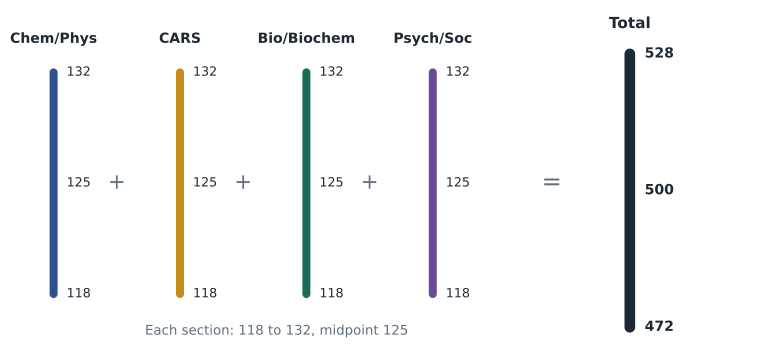
An MCAT score report contains five scores. Each of the four sections has its own scaled score, from a low of 118 to a high of 132, with a midpoint of 125. The total score is the sum of the four section scores, so it runs from 472 (four times 118) to 528 (four times 132), with a midpoint of 500.
The section scores matter as much as the total. Many schools look at them individually, and some set minimums for particular sections, as lesson 5 explains. Two applicants with a total of 508 might look quite different on paper: one with four section scores of 127, the other with 130, 122, 130 and 126. A committee might read the second applicant's CARS score of 122 as a concern even though the total is the same.
From raw score to scaled score
Within each section, your raw score is simply the number of questions you answered correctly. There is no penalty for wrong answers, and every scored question counts the same. A very hard question and a very easy one each add one point to the raw score.
The raw score is then converted to a scaled score from 118 to 132. The conversion exists because every test form is slightly different. One form might have a harder set of CARS passages than another. If the AAMC reported raw scores, a student who happened to take a harder form would be penalized. Instead, the AAMC uses a statistical process called equating to set the conversion for each form, so that a given scaled score represents the same level of performance regardless of which form you took or when.
The practical consequence is that you cannot know in advance exactly how many questions you must get right for a particular scaled score. The conversion differs from form to form. Practice tests from the AAMC give you a scaled score using a conversion for that practice form, which is a reasonable estimate, but it is not a promise about the real test.
A common rumor is that the MCAT is "curved" against the people who test on the same day, so that testing alongside strong students lowers your score. That is not how equating works. Your scaled score depends on your performance and the difficulty of your form, not on how other people performed that day. There is no advantage in choosing a date you imagine will attract weaker examinees.
The AAMC also includes some questions that do not count toward your score. These are being tried out for future forms. You cannot tell which questions they are, so treat every question as if it counts.
Percentile ranks
A scaled score tells you where you fall on the scale; a percentile rank tells you how that score compares with other examinees. The AAMC defines the percentile rank as the percentage of examinees who scored at or below a given score. The AAMC updates its percentile ranks each year on May 1. The ranks in effect from May 1, 2026 to April 30, 2027 are based on everyone who tested in 2023, 2024 and 2025.
| Total score | Approximate percentile rank (May 2026 to April 2027 table) |
|---|---|
| 490 | about 20th |
| 495 | about 33rd |
| 500 | about 48th |
| 505 | about 64th |
| 508 | about 74th |
| 510 | about 79th |
| 512 | about 84th |
| 515 | about 91st |
| 518 | about 95th |
| 520 | about 97th |
Two features of this table are worth noticing. First, the middle of the scale is crowded. Around 500, a few points of total score move you many percentile points: going from 500 to 505 moves you from about the 48th to about the 64th percentile. Near the top, the same five points matter less in percentile terms: 515 to 520 moves you from about the 91st to the 97th. Second, the 500 midpoint is close to, but not exactly at, the 50th percentile, because the scale was designed in advance and the population of examinees shifts a little over time.
Section percentiles differ by section. The same section score of 125 might correspond to a somewhat higher percentile in CARS than in Psych/Soc, for example, because the distributions are not identical. Your score report shows the percentile for each section and for the total, so you do not need to look them up.
Confidence bands
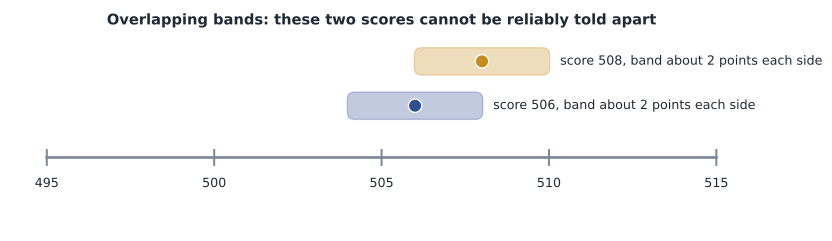
The AAMC reports a confidence band around each score. A confidence band is a range around your score that reflects the fact that any test score contains some measurement error. If you took a different form of the test on a different day with exactly the same ability, your score would probably land somewhere within the band rather than at precisely the same number. For section scores, the band typically spans a point or so on either side; for the total, a couple of points on either side.
Confidence bands carry a useful message for planning. Small differences in scores are not meaningful. An applicant with 510 and one with 511 cannot be distinguished reliably. A drop from 506 to 504 between two practice tests is not necessarily a decline. Thandiwe asked the group to stop reacting to individual practice scores and instead track a rolling average of the last three.
When scores are released
Scores are released about 30 to 35 days after the test. The AAMC publishes a calendar with a specific release date for each test date, and scores are released by 5 p.m. Eastern time on that date. For example, the AAMC calendar for 2027 shows that the January 21, 2027 test, which Elliot was registered for, has a score release date of February 23, 2027, and the April 17, 2027 test, Ezequiel's date, has a release date of May 18, 2027.
You view your scores in the AAMC's score reporting system. If you are applying through AMCAS, the scores flow into your application automatically on the release date. For other application services, such as OMSAS in Ontario or TMDSAS in Texas, you release scores to the service yourself through your AAMC account. OMSAS, for example, asks applicants to release scores through the AAMC system and match their AAMC ID and date of birth on both records.
Because of the delay, your choice of test date affects when schools can see your score. A student who wants a score in hand before an application opens, or before an application deadline, needs to work backward from the release date, not the test date. Lesson 6 and lesson 9 use this in planning.
What a good score is
There is no passing score on the MCAT. Whether a score is good depends entirely on the schools you are applying to, how they use the MCAT, and the rest of your application. Some schools publish the median scores of admitted students; the AAMC's Medical School Admission Requirements database, known as the MSAR, lists those figures for US and Canadian MD programs. Canadian schools often publish minimums or cut-offs instead.
Thandiwe gave each member a personal target based on their school lists rather than a single number for the group. For Devika, whose Ontario schools used thresholds and section minimums, the goal was a balanced profile with no section below 127. For Elliot, applying broadly to American MD programs, the target total was 512 or higher with CARS at least 126. For Ezequiel, a total of 508 or higher would put him in a strong position for several of the MD and DO programs on his list.
Worked problem
Interpreting a score report
Ezequiel's 2025 score report showed Chem/Phys 124, CARS 124, Bio/Biochem 125 and Psych/Soc 126. His diagnostic in September 2026 showed 123, 124, 124 and 126. Has he got worse?
Show solution
- Add the scores: 2025 total is 499; the 2026 diagnostic total is 497.
- Compare each section: the differences are 1 point in Chem/Phys, 0 in CARS, 1 in Bio/Biochem and 0 in Psych/Soc.
- Consider confidence bands: differences of a point or two are within normal measurement error.
- Consider context: the diagnostic was a practice form taken after more than a year away from the material, with no preparation.
Answer: No meaningful change. Both results describe roughly the same starting level. His study plan, not this two-point difference, will determine his next score.
How scores connect to preparation
Understanding scoring changes how you prepare in three ways. First, because there is no penalty for guessing, you should answer every question, and practice doing so under time pressure. Second, because each question counts equally, you should not spend five minutes on one hard question at the expense of three easier ones later. Third, because scores carry measurement error and practice forms vary, you should judge progress by trends across several practice tests, not by any single result.
Thandiwe added a fourth point. 'Every point you gain comes from questions you used to miss. So the score is not really the thing to study. The misses are.' Lesson 8 turns to how to analyze them.
Reading your score report
When scores are released, read the report slowly. Check each section score and its percentile, the total and its percentile, and the confidence bands. Compare them with the targets from your school table, not with friends' scores or forum posts. Then decide calmly, ideally after a day or two, whether the score meets your goals or whether a retake is worth considering, using the factors in lesson 5.
Practice scores and real scores
Students naturally want to know how practice scores translate into a real score. The honest answer is that no conversion is exact. AAMC practice exams use questions and scoring built by the test maker, so their scaled scores are the best available estimates, but even they are estimates for one practice form on one day. Third-party practice tests use their own scoring models, and their scores can run consistently higher or lower than official results.
Three habits make practice scores more useful. First, track a rolling average of your last three full-length scores rather than reacting to any single one. Second, compare like with like: AAMC exams with AAMC exams, and third-party exams with the same company's exams. Third, look at section scores as well as totals; a total that holds steady while one section falls and another rises is a signal to change emphasis. Devika kept a simple chart of her rolling averages by section, which made her steady CARS and slowly rising Chem/Phys visible at a glance.
On test day itself, there is one more reason not to obsess over scoring. You will not know which questions were scored, how the conversion works for your form, or how you did. Every section will feel uncertain. The only strategy that consistently helps is to answer every question as well as you can in the time available and move on.
Common mistakes
MistakeThe MCAT total runs from 0 to 528.
InsteadEach section runs from 118 to 132, so the total runs from 472 to 528.
MistakeThe MCAT is curved against people testing on the same day.
InsteadEquating adjusts for form difficulty; other examinees' performance on your date does not lower your score.
MistakeA 500 is a passing score.
InsteadThere is no passing score; what counts as good depends on your schools.
MistakeA one-point drop between practice tests means you got worse.
InsteadSmall differences fall within measurement error; track trends.
MistakeScores are available the day after the test.
InsteadScores are released about 30 to 35 days after the test on a published date.
Summary and key terms
- The MCAT reports four section scores from 118 to 132 and a total from 472 to 528, with midpoints of 125 and 500.
- Raw scores count correct answers with no guessing penalty; equating converts them to scaled scores for each form.
- Percentile ranks, updated each May 1, compare your score with recent examinees; in the 2026 to 2027 table, 500 is about the 48th percentile and 510 about the 79th.
- Confidence bands show that small differences between scores are not meaningful.
- Scores are released about 30 to 35 days after the test; AMCAS receives them automatically, while other services require you to release them.
- Raw score
- The number of scored questions answered correctly in a section.
- Scaled score
- The reported score (118 to 132 per section) after converting the raw score for the form's difficulty.
- Equating
- The statistical process that makes scaled scores comparable across test forms.
- Percentile rank
- The percentage of recent examinees who scored at or below a given score.
- Confidence band
- A range around a reported score reflecting measurement error.
- MSAR
- The AAMC's Medical School Admission Requirements database, which lists school data including MCAT medians.
Practice problems
Work each problem on paper first, then reveal the answer to check.
A student's section scores are 127, 126, 128 and 129. What is the total?
Show answer
510.
Roughly what percentile rank does a total of 515 have in the 2026 to 2027 table?
Show answer
About the 91st percentile.
Why can't you know exactly how many questions you need right for a 128?
Show answer
Because the raw-to-scaled conversion is set separately for each test form through equating.
When are scores from the May 13, 2027 test released?
Show answer
June 15, 2027, according to the AAMC calendar.
Lesson quiz · 5 questions
Score 60% or more to complete this lesson.
Create a free account to save your progress, take quizzes and earn a certificate.