
MCAT-101 · Lesson 2 of 12 · 19 min
The four sections
▶ Video coming soon A video version of this lesson is on the way.
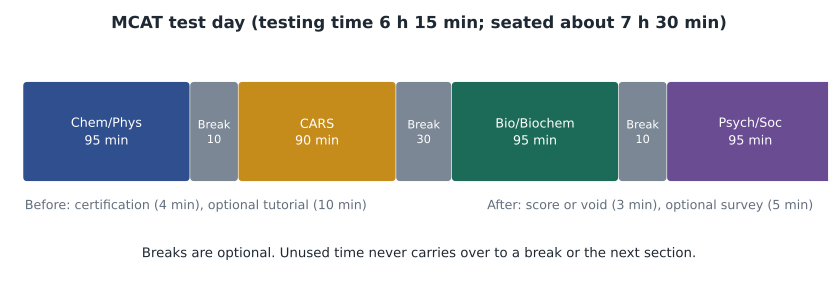
At the second half of the first session, Thandiwe shared her screen and drew four long rectangles side by side. 'This is your test day,' she said. 'Four sections, always in the same order, with breaks between them. If you understand the shape of the day, nothing on test day will surprise you. And surprises cost points.'
Ezequiel admitted that the length had surprised him in 2025. He had practiced individual passages, never a full test, and by the fourth section he was reading the same sentence three times. 'That is the most common story I hear from retakers,' Thandiwe said. 'The fix is not mysterious. You practice the whole day.'
This lesson walks through the four sections in order: what each one is called, what it covers, how many questions it has, how the questions are organized, and how much time you get. It then covers the breaks and the other timed parts of the day, and finishes with what the structure means for pacing.
The sections in order
Every MCAT presents the sections in the same sequence. The official names are long, so students and the AAMC itself use short forms. The first is Chemical and Physical Foundations of Biological Systems, usually called Chem/Phys. The second is Critical Analysis and Reasoning Skills, or CARS. The third is Biological and Biochemical Foundations of Living Systems, or Bio/Biochem. The fourth is Psychological, Social, and Biological Foundations of Behavior, or Psych/Soc.
| Order | Section | Questions | Time | Structure |
|---|---|---|---|---|
| 1 | Chemical and Physical Foundations of Biological Systems (Chem/Phys) | 59 | 95 minutes | 10 passage sets of 4 to 6 questions, plus 15 independent questions |
| 2 | Critical Analysis and Reasoning Skills (CARS) | 53 | 90 minutes | 9 passage sets of 5 to 7 questions; no independent questions |
| 3 | Biological and Biochemical Foundations of Living Systems (Bio/Biochem) | 59 | 95 minutes | 10 passage sets of 4 to 6 questions, plus 15 independent questions |
| 4 | Psychological, Social, and Biological Foundations of Behavior (Psych/Soc) | 59 | 95 minutes | 10 passage sets of 4 to 6 questions, plus 15 independent questions |
Add the numbers and you get 230 questions in 375 minutes of testing, or 6 hours and 15 minutes. With check-in steps, the optional tutorial, breaks and the end-of-day questions, the AAMC estimates the total seated time at about 7 hours and 30 minutes, not counting the time it takes to check in at the test center.
Section 1: Chemical and Physical Foundations of Biological Systems
Chem/Phys tests general chemistry, introductory physics, organic chemistry and biochemistry, with a little introductory biology, always applied to living systems. A passage might describe how blood flow changes when a vessel narrows, how an indicator changes color across a range of pH values, how light is absorbed by a molecule in a spectroscopy experiment, or how an enzyme's structure affects its function. Questions ask you to calculate, predict, explain and interpret.
You do not get a calculator. The math on the MCAT is designed to be done by hand with estimation: scientific notation, logarithms of simple numbers, unit conversions, proportional reasoning and basic algebra. Students who rely on a calculator during practice often find that Chem/Phys is the section where time disappears. Building mental math fluency early is one of the highest-value things a student can do. Devika, whose weakest area was calculations, made a note of that on the first day.
Because Chem/Phys comes first, it also sets the tone for the day. Students who start with a hard passage sometimes panic and carry that feeling forward. One of the first strategic habits Thandiwe teaches is to accept that some passages are designed to be difficult and to move on rather than fight them.
Section 2: Critical Analysis and Reasoning Skills
CARS is the only section with no science content. It contains nine passages, each roughly 500 to 600 words, drawn about equally from the humanities and the social sciences. Topics range widely: a philosopher on the nature of beauty, a historian on trade in a medieval port, an economist on the value of leisure, a critic on modernist architecture. Each passage is followed by five to seven questions, for 53 in all, and you have 90 minutes. That works out to about ten minutes per passage, including the questions.
CARS questions ask three broad kinds of things. Some ask what the passage says or means: its main idea, the meaning of a phrase in context, or the author's attitude. Some ask how the parts of the passage fit together: how a claim is supported, or what role a paragraph plays. And some ask you to go beyond the passage: to apply its ideas to a new situation, or to judge how new information would affect the author's argument. Lesson 3 gives the AAMC's names and weights for these skills.
CARS has a reputation for being impossible to study for. That reputation is wrong, but it contains a truth: CARS improves slowly and through steady practice rather than cramming. Lesson 11 describes a daily CARS routine. Elliot, whose diagnostic CARS score was his lowest, was not thrilled to hear that the fix would take months, but he liked hearing that it existed.
Section 3: Biological and Biochemical Foundations of Living Systems
Bio/Biochem is the section most premedical students expect: cells, molecular biology, genetics, metabolism, physiology of organ systems and the biochemistry that ties them together. Introductory biology makes up most of the section, first-semester biochemistry about a quarter, and general and organic chemistry a small remainder. Passages often describe real-looking research: a knockout experiment, a Western blot, a mutation that changes a protein, a hormone measured in two groups of patients.
Strong biology students sometimes underperform here because they read passages for facts they already know and skim the experimental details. The questions frequently hinge on those details: which group received the treatment, what was measured, what the control shows. Elliot, a neuroscience major, recognized himself in that description. His diagnostic Bio/Biochem score was strong, but nearly all his misses came from skimming a figure.
The third section also comes after the 30-minute mid-exam break. Students who use that break well, eating, moving and resetting, arrive at Bio/Biochem ready. Students who spend it replaying CARS questions arrive tired and distracted.
Section 4: Psychological, Social, and Biological Foundations of Behavior
Psych/Soc covers introductory psychology and sociology, with a small amount of biology. Topics include sensation and perception, learning and memory, emotion and stress, personality, psychological disorders, social influence and group behavior, identity, social structure, culture, inequality and the social determinants of health. Many passages describe studies, so research methods and statistics appear often: what a study design can and cannot show, what a correlation means, how variables are defined and measured.
Psych/Soc rewards precise vocabulary. Two answer choices might differ only in whether they describe the bystander effect or diffusion of responsibility, or classical or operant conditioning. Students who learned these terms loosely in a first-year course need to relearn them precisely. Ezequiel's strongest section was Psych/Soc, partly because years as an EMT had shown him so much of the social side of health.
Because it comes last, Psych/Soc is also where fatigue shows. A student who scores well on Psych/Soc questions in isolation but poorly at the end of a full practice test has a stamina problem, not a content problem. The diagnostic in lesson 8 is designed to reveal that difference.
Passage sets and independent questions
In the three science sections, 44 of the 59 questions come in passage sets and 15 are independent questions, also called discrete questions, which stand alone without a passage. Independent questions tend to test content knowledge more directly. Passage-based questions vary: some can be answered from the passage alone, some need outside knowledge plus the passage, and some use the passage only as a starting point.
Passage sets and independent questions are mixed within the section rather than grouped at the end, so you will move between them. You can flag questions, move back and forth within a section, and change answers until the section ends. You cannot return to a section once you leave it.
There is no penalty for wrong answers. Your score depends only on the number of questions you answer correctly. That has one firm practical consequence: never leave a question blank. If you run short of time, select an answer for every remaining question before the timer runs out.
Breaks and the other timed parts of the day
There are three optional breaks: 10 minutes after Chem/Phys, a 30-minute mid-exam break after CARS, and 10 minutes after Bio/Biochem. They are optional, but almost everyone should take them. Breaks have strict rules. You may leave the room to use the restroom, eat, drink or take medication, but time you do not use on a break does not carry over to the next section, and time left over at the end of a section does not carry over either. If you take longer than the allotted break, the next section starts without you, and the clock keeps running.
Before the first section, you complete a short test-day certification of about 4 minutes, and you may take an optional 10-minute tutorial on how the testing software works. At the end of the day, you answer a single question asking whether you want your exam scored or voided, with about 3 minutes to decide, and you may complete an optional survey. Lesson 7 explains the void decision, which is final.
Worked problem
Working out a pace
Elliot wants a simple pace target for CARS. The section has 9 passages and 90 minutes. He also wants a target for a science section with 10 passages, 15 independent questions and 95 minutes, budgeting about one minute per independent question. What targets should he use?
Show solution
- CARS: 90 minutes divided by 9 passages is 10 minutes per passage, including questions.
- Science: 15 independent questions at about 1 minute each uses about 15 minutes.
- That leaves about 80 minutes for 10 passages, or about 8 minutes per passage set.
- Checkpoints help more than per-question targets: for CARS, about 3 passages done by 30 minutes and 6 by 60 minutes.
Answer: About 10 minutes per CARS passage and about 8 minutes per science passage set, checked at regular points rather than question by question.
What the structure means for preparation
The structure of the test suggests four practical priorities. First, prepare for passages, not just facts. Most points come from passage-based questions, so content review should be paired with passage practice from early on. Second, prepare for the order. Your full practice tests should follow the real sequence and timing, with the real breaks, so your body learns what the day feels like. Third, prepare for the length. Stamina is a skill, and it is built by doing several full-length tests in the final months. Fourth, prepare for the math. No calculator means estimation and mental arithmetic must be automatic.
Thandiwe closed the session by asking each member to take the free, scored AAMC Practice Exam 1 that week, in one sitting, on a weekend morning, following the real breaks. 'Not to judge you,' she said, 'but to give us a map.' Lesson 8 explains what they found.
Practicing the real day
Knowing the structure is different from being comfortable inside it. In the first weeks, most practice will be single passages or small sets on one topic. As the test approaches, practice whole sections under section timing, and then the full sequence: four sections, the real breaks and no pauses. Thandiwe asked the group to schedule every full-length practice test for the same start time as their appointment and to treat the breaks exactly as they would on the day, with the same snacks and the same short routine.
Practice the transitions as well. Moving from Chem/Phys calculations to CARS prose requires a mental reset, and so does moving from the long mid-exam break into Bio/Biochem. A simple ritual helps: one slow breath, a glance at the clock to fix the first checkpoint, and full attention on the first passage alone. Students who carry worry about the previous section into the next one lose more points to distraction than to any single hard passage.
Common mistakes
MistakeThe sections can come in any order.
InsteadThe order is always Chem/Phys, CARS, Bio/Biochem, Psych/Soc.
MistakeYou can use a calculator in Chem/Phys.
InsteadNo calculator is provided or allowed; math is done by hand with estimation.
MistakeLeftover section time can be added to a break.
InsteadUnused time does not carry over to breaks or to the next section.
MistakeWrong answers lower your score.
InsteadThere is no penalty for wrong answers, so answer every question.
MistakeCARS questions need background knowledge in philosophy or history.
InsteadCARS needs no outside knowledge; answers must come from the passage.
Summary and key terms
- The MCAT has four sections in a fixed order: Chem/Phys, CARS, Bio/Biochem and Psych/Soc.
- Each science section has 59 questions in 95 minutes: 10 passage sets and 15 independent questions; CARS has 53 questions in 9 passages in 90 minutes.
- Testing time is 6 hours 15 minutes; total seated time is about 7 hours 30 minutes.
- Breaks of 10, 30 and 10 minutes are optional, and unused time never carries over.
- There is no penalty for wrong answers and no calculator; preparation should cover passages, order, stamina and mental math.
- Passage set
- A group of 4 to 7 questions based on one passage.
- Independent question
- A stand-alone question with no passage; also called a discrete question.
- Mid-exam break
- The optional 30-minute break after CARS.
- Seated time
- The total time at the testing station, about 7 hours 30 minutes, excluding check-in.
- Stamina
- The ability to keep reading and reasoning accurately across the whole test day.
Practice problems
Work each problem on paper first, then reveal the answer to check.
How many questions are on the MCAT in total?
Show answer
230: 59 in each of the three science sections and 53 in CARS.
Which section follows the 30-minute break?
Show answer
Bio/Biochem, the third section.
A student finishes Chem/Phys with 6 minutes left. Can she add them to her break?
Show answer
No. Unused section time does not carry over.
About how long should a CARS passage take, including its questions?
Show answer
About 10 minutes (90 minutes for 9 passages).
Lesson quiz · 5 questions
Score 60% or more to complete this lesson.
Create a free account to save your progress, take quizzes and earn a certificate.