
MCAT-101 · Lesson 10 of 12 · 20 min
Choosing resources
▶ Video coming soon A video version of this lesson is on the way.
On Sunday, November 1, 2026, Elliot confessed that he had spent part of the week reading online reviews of prep products instead of studying. He had found forum threads ranking review books, video courses, question banks and flashcard decks, and every thread contradicted the last. Devika said she had a shelf of second-hand review books from a friend and did not know whether they were current. Ezequiel had the Official Prep products from his fee assistance award and wondered whether they were enough.
'Here is my position,' Thandiwe said. 'There are only two kinds of resources: the ones written by the people who write the test, and everybody else's interpretation. You need the first kind. You may want some of the second kind. And you need far fewer resources than you think.'
This lesson describes the AAMC's official materials, the main kinds of third-party resources, how to judge any resource, and how to assemble a small, coherent set that matches your plan and budget.
Official AAMC materials
The AAMC publishes the only practice materials written by the test maker. They use retired or specially written questions in the real style, and their difficulty and wording are the closest available to the real exam. They fall into a few groups.
| Product | What it contains | Cost |
|---|---|---|
| Unscored Sample Test | A full-length, 230-question test in the real format; no scaled score | Free |
| Practice Exam 1 | A full-length, 230-question scored test with scaled scores and percentile ranks | Free |
| Practice Exams 2 to 6 | Five more full-length, scored tests | Low cost; included in fee assistance awards |
| Section Bank, volumes 1 and 2 | 300 questions each, 100 from each science section; known for difficult passages | Low cost |
| CARS Question Bank | 575 CARS questions, including those formerly in the CARS Diagnostic Tool and CARS question packs | Low cost |
| Question packs | Biology volumes 1 and 2, chemistry and physics, 120 questions each | Low cost |
| Independent Question Bank | 150 independent questions, 25 each in biochemistry, biology, chemistry, physics, psychology and sociology | Low cost |
| Official Prep Online-Only Bundle | All of the online products together, 2,876 unique questions | Discounted bundle; included in fee assistance awards |
The AAMC also publishes the content outline, discussed in lesson 3, free. And through fee assistance awards in both the United States and Canada, eligible students receive the online bundle at no cost, which for many students covers all the practice they need.
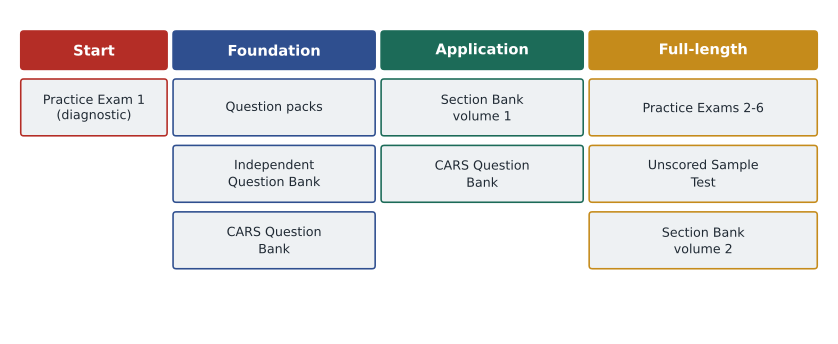
Because there are a limited number of official questions, use them deliberately. Save the practice exams for the full-length phase. Use the question packs and Independent Question Bank during content review and application to test specific areas. Save the Section Bank for the later application phase or the full-length phase, because its passages are among the most challenging. Use the CARS Question Bank steadily from early on, a passage or two at a time, alongside other CARS sources.
Third-party resources
Many companies and individuals sell MCAT preparation products. They fall into a few broad types.
Content review books and videos explain the science in each discipline. They are useful for students who need to relearn material, and they usually map their chapters to the AAMC outline. Their quality varies, and some include more detail than the outline requires.
Question banks and practice tests offer large numbers of questions with explanations. They give volume that official materials cannot, which helps during the foundation and application phases. Their questions are written to imitate the MCAT, but no third-party question is an official one, and difficulty, style and scoring can differ from the real test.
Courses and tutoring combine content, practice and a schedule, sometimes with live teaching. They can provide structure and accountability, which some students need. They are usually the most expensive option.
Flashcard decks, including spaced-repetition apps, help with memorization of facts, vocabulary and equations. They are particularly helpful for Psych/Soc terms and for amino acids, metabolic pathways and physics equations, but they cannot teach reasoning on their own.
Free resources include university course materials, open textbooks, educational videos and public-domain reading for CARS practice. Some are excellent. They require more effort to organize, because they are not built around the MCAT outline.
Judging any resource
Before buying or using a resource, ask five questions. Does it map to the current AAMC outline, or to an older version of the test? Is it current, with content updated for the format that began in April 2015? Does it explain why answers are right and wrong, not just what the answer is? Does it fit a specific gap in your plan? And can you realistically finish the part you need?
Devika's second-hand books were the right edition for the current test, but two of them covered the same subjects. She kept one set and gave the duplicates back. Thandiwe's advice was to look for one good source per job, not three overlapping ones. More resources often mean less depth in each, and an unfinished pile of books is a source of stress, not knowledge.
Be wary of claims about score predictions. Third-party practice tests often report scaled scores, but those scores come from the company's own scoring model, not the AAMC's equating, and they may run higher or lower than official results. Use them to track trends and find weaknesses, and rely on AAMC practice exams for your best estimate of readiness.
Worked problem
Assembling a resource set
Ezequiel has the AAMC Online-Only Bundle from his fee assistance award, a free open organic chemistry textbook, and a small budget. His priorities are organic chemistry, biochemistry and stamina. What set should he use?
Show solution
- Use official materials as the core: practice exams for the full-length phase, question packs and the Independent Question Bank for targeted practice, the Section Bank later.
- Add content review where the gap is largest: the open textbook for organic chemistry, matched topic by topic to the outline.
- Consider one paid product only if it fills a gap: a question bank for more organic chemistry and biochemistry passages during the foundation phase.
- Add a free spaced-repetition app for reactions, amino acids and pathways.
- Do not add a second review book series or course; he already has structure from the Sunday Session.
Answer: Official Prep as the core, the open textbook and flashcards for content, and at most one paid question bank. Everything else is optional.
Matching resources to phases
Resources make more sense when tied to phases of the plan. In the foundation phase, content review sources and topic-specific question sets dominate, with daily CARS. In the application phase, mixed passage sets and timed sections become central, including the first official Section Bank volume. In the full-length phase, official practice exams take over, supported by error-log review and occasional targeted questions. In the taper, you need almost nothing: a few passages you have seen before, your error log and a calm schedule.
Elliot, with fourteen weeks and a large CARS gap, chose the CARS Question Bank plus a daily habit of reading long-form articles from serious magazines and journals, one review book set for biochemistry refresher, and the official practice exams. Devika added a mental math workbook and kept her friend's books for physics and general chemistry. Ezequiel kept the set from the worked example. None of them bought a full course.
Cost and access
MCAT preparation can be expensive, and spending is not the same as preparing. The official materials, many of which are free or low cost, are the most important single investment. Fee assistance programs in both countries include the online bundle. Libraries and university health professions offices often lend review books and sometimes provide free practice materials or workshops. Student groups at many universities run study groups like the Sunday Session at no cost.
A paid course or tutor can help a student who needs accountability or targeted teaching, but students regularly reach strong scores with official materials, one content review source and a disciplined schedule. Spend money where your error log shows a gap, not where advertising suggests one.
Free and low-cost help near you
Before buying anything, check what is available free. Many universities have a health professions or pre-health advising office that offers MCAT workshops, practice test days under realistic conditions, lending libraries of review books and advice on school lists. Public libraries often hold recent review books, and some provide access to online learning platforms. Premedical student clubs frequently organize study groups and practice sessions, and older students who have already tested are often generous with advice and used materials.
Online, open textbooks in biology, chemistry, physics, psychology and sociology cover most introductory content, and university course websites sometimes publish lecture notes and problem sets. These sources are not built around the MCAT, so use the content outline as your map and check each topic against it. For students in Canada, the AFMC fee assistance program and some faculties publish information sessions about admission requirements, which help with the school table as well as with resources.
Whatever you use, keep a single list of your resources with what each is for and which phase it belongs to. If a new resource does not fill a gap on the list, leave it alone.
Using official materials well
Because official questions are limited, how you use them matters. Do each official question set under conditions that match its purpose: timed sections for section practice, untimed or loosely timed sets when you are learning a skill. Review every official question thoroughly, including correct answers, because the explanations show how the test makers think. Record every official miss in your error log with special care; patterns in official materials are the most reliable guide to what the real test will ask.
Avoid redoing official full-length exams too soon. Once you have seen a passage, you will remember parts of it, and a second attempt will overstate your readiness. If you do return to official materials, use them for review of method rather than for scoring. Some students redo selected passages near the end to practice their approach, which can be useful as long as the score is not taken as a measure of readiness.
Elliot planned his official materials carefully. With fourteen weeks, he used the CARS Question Bank from the first week, the biology and chemistry question packs during his content refresh, Section Bank volume 1 in early December, and Practice Exams 2 to 6 plus the Unscored Sample Test in the final six weeks, roughly one a week with review between them.
Resources for CARS reading
CARS practice benefits from reading beyond MCAT materials. Good sources are serious long-form writing in the humanities and social sciences: essays and reviews in literary and political magazines, articles in philosophy and history journals written for general readers, and books of essays. The aim is not to learn the content but to become comfortable with dense, argumentative prose on unfamiliar topics. Choose material you would not normally read, since the MCAT will not choose topics you like.
Read actively. After each article, write one sentence stating the main idea and one or two words describing the author's attitude. Notice how the author handles opposing views. Over weeks, this habit transfers directly to CARS passages. Devika, who already read widely, kept it up as maintenance; Elliot found it the hardest new habit to build and the one that helped most.
Building a budget
Write down what you plan to spend and why. A simple budget might include the registration fee, the official online bundle if you are not receiving it through fee assistance, one content review source for your weakest areas, and perhaps one question bank. Leave a small reserve for a possible reschedule fee. Anything beyond that should be justified by a specific gap in your error log, not by fear of missing out. Ezequiel's budget, with fee assistance covering registration and official materials, came to the cost of one question bank and some printing.
Common mistakes
MistakeMore resources mean better preparation.
InsteadOne good source per job, used fully, beats several overlapping sources used partly.
MistakeThird-party practice scores predict my real score.
InsteadUse them for trends and weaknesses; AAMC practice exams are the best estimate of readiness.
MistakeI should use all the official practice exams early to learn the format.
InsteadSave most of them for the full-length phase, when realism matters most.
MistakeAny MCAT book will do.
InsteadCheck that it matches the current outline and the format in place since April 2015.
MistakeFlashcards can prepare me for passages.
InsteadFlashcards help with recall; passages and practice questions build reasoning.
Summary and key terms
- AAMC Official Prep materials are the only practice written by the test maker and should form the core of preparation.
- They include two free full-length tests, five low-cost scored practice exams, the Section Bank, the CARS Question Bank, question packs and the Independent Question Bank.
- Third-party resources (review books, question banks, courses, flashcards and free materials) can add content explanation and volume.
- Judge any resource by its match to the current outline, explanation quality, fit with your gaps and whether you can finish it.
- Match resources to phases and to your error log, and spend money only where a real gap exists.
- Official Prep
- The AAMC's own MCAT practice products.
- Section Bank
- An AAMC product of challenging science-section questions in two 300-question volumes.
- Question bank
- A large collection of practice questions with explanations, often searchable by topic.
- Spaced repetition
- A flashcard method that schedules reviews at increasing intervals.
- Online-Only Bundle
- The AAMC package of all online Official Prep products, included in fee assistance awards.
Practice problems
Work each problem on paper first, then reveal the answer to check.
How many full-length scored practice exams does the AAMC offer in total?
Show answer
Six: Practice Exam 1 (free) and Practice Exams 2 to 6.
When is the Section Bank usually most useful?
Show answer
In the later application phase or the full-length phase, because its passages are among the most challenging.
Why should third-party scaled scores be treated with caution?
Show answer
They come from each company's own scoring model, not AAMC equating, and may not match official results.
Name two low-cost or free sources of MCAT help besides official materials.
Show answer
Library or university health professions office books and materials, open textbooks, free educational videos, or student-run study groups.
Lesson quiz · 5 questions
Score 60% or more to complete this lesson.
Create a free account to save your progress, take quizzes and earn a certificate.