
MBA-612 · Lesson 9 of 12 · 21 min
Climate risk: physical, transition and scenario analysis
In November 2018 the Camp Fire destroyed the town of Paradise, California, killing 85 people. The fire was started by an aging transmission line owned by Pacific Gas and Electric, California's largest utility. Facing tens of billions of dollars in wildfire claims, PG&E filed for bankruptcy protection in January 2019, an event some commentators called the first climate change bankruptcy, since years of drought and heat had turned the state's forests into fuel. For Owen Tremblay's company, Prairie Ridge Energy, whose gas plants and transmission lines run through dry forests, the case changed the board's discussions of climate. Climate risk was no longer a question about distant policy; it was about whether the company could keep operating, insure its assets and avoid causing disasters itself.
Dr. Holloway says that the hardest thing about climate risk for boards is that it does not fit their usual habits. Most risks that boards oversee are measured over a year or a few years and can be estimated from history. Climate risks unfold over decades, depend on government policies and technologies that do not yet exist, and are changing in ways that make history a poor guide. The tool boards use to think about such risks is scenario analysis, and this lesson explains it, along with the types of climate risk and the board's role in overseeing them.
Types of climate risk
The Task Force on Climate-related Financial Disclosures divided climate risks into two families, a division that the ISSB standards and most regulators have adopted. Physical risks arise from the changing climate itself. Acute physical risks are events such as floods, wildfires, hurricanes and heat waves, which are becoming more frequent or more severe in many places. Chronic physical risks are longer-term shifts, such as rising average temperatures, changing rainfall, sea-level rise and water stress, which affect agriculture, labor productivity and the demand for some products.
Transition risks arise from the move to a lower-carbon economy. Policy and legal risks include carbon pricing, emissions regulations, product standards, disclosure requirements and litigation. Technology risks arise when new technologies, such as electric vehicles, heat pumps or cheaper renewable power, displace existing products. Market risks include changes in customer preferences, input costs and the availability of capital. Reputation risks arise when customers, employees or investors judge a company's conduct harshly. Climate change also creates opportunities: for products and services that help customers reduce emissions or adapt, for resource efficiency and for new markets.
Physical and transition risks move in opposite directions across scenarios. If the world acts quickly to cut emissions, transition risks are high in the near term, as policies tighten and markets shift, but physical risks are lower in the long term. If the world acts slowly, transition risks are low for now but physical risks grow severe. A delayed and disorderly transition, in which action comes late but suddenly, may bring both. That is why scenario analysis uses several scenarios rather than a single forecast.
Scenario analysis
A scenario is not a prediction but a plausible, internally consistent description of how the future might unfold. Scenario analysis asks how a company's strategy, costs, revenues and assets would fare under several such futures, so that the board can judge the resilience of its strategy and identify actions that make sense in all of them. The approach descends from the scenario planning that Royal Dutch Shell developed in the early 1970s, which the cohort studied in MBA-514.
Most companies draw on published scenarios rather than building their own. The Network for Greening the Financial System, a group of central banks and supervisors, publishes scenarios that combine climate, energy and economic models, including an orderly Net Zero 2050 scenario, a Delayed Transition scenario in which policies are tightened only after 2030, and a Current Policies scenario in which no new policies are adopted and warming is high. The International Energy Agency publishes energy scenarios, including a net-zero pathway and scenarios based on stated and announced policies. Companies adapt these to the variables that matter to them, such as carbon prices, energy prices, demand for their products and the frequency of extreme weather at their sites.
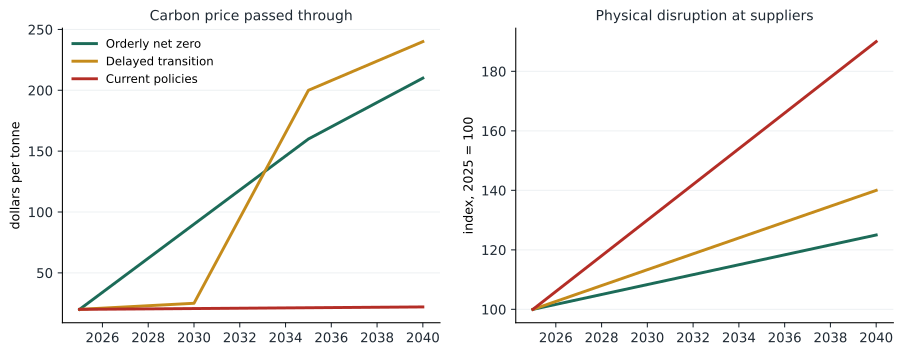
Dr. Holloway stresses three disciplines. Use a few scenarios that differ meaningfully, typically three or four, rather than many that vary slightly. Quantify what can be quantified, even roughly, but do not let precision crowd out judgment about effects that cannot be modeled. And use the results: the purpose of scenario analysis is to change decisions, such as where to source, what to invest in or how to price, not to fill a section of a report.
Climate risk at Cedarline
Cedarline's main climate exposures come from its supply chain and its markets rather than its own operations. Most of its products are made in contract factories in South and Southeast Asia, in regions exposed to flooding, cyclones and extreme heat, which can halt production and threatens the health and productivity of workers. Its cotton and wool come from regions exposed to drought. Its fabric mills use large amounts of energy for dyeing and finishing, so carbon prices or energy costs in producing countries would raise its costs. Its demand depends partly on winter weather: warmer, shorter winters reduce sales of insulated jackets, its most profitable category. On the other hand, its repair, resale and durability strategy could gain as customers and regulators pay more attention to the environmental cost of clothing.
Policy matters through several channels. The United States has no federal carbon price, and federal climate policy changed sharply after 2024, but several states, including California and the members of the Regional Greenhouse Gas Initiative in the Northeast, price carbon, and other countries continue to tighten carbon pricing. The European Union's carbon border adjustment mechanism, which entered its definitive phase in January 2026, charges importers for the emissions embedded in goods such as steel, aluminum and cement; it does not yet cover clothing, but shows where trade policy may go. The EU and several countries, and some American states, are also introducing extended producer responsibility for textiles, which makes producers pay for the collection and recycling of the clothing they sell.
The cohort builds a simple scenario model of Cedarline's operating profit in 2030 and 2035 under three scenarios. It includes four effects: the cost of carbon passed through by suppliers on the emissions in its products, the effect of warmer winters on sales of insulated products, expected losses from physical disruption at supplier factories, and the extra revenue from repair, resale and durable products as customers shift. It compares Cedarline's current strategy with the durable strategy approved in MBA-514.
# Climate scenarios for Cedarline's operating profit (millions), 2030 and 2035
base_ebit = {2030: 52.0, 2035: 60.0}           # operating profit with no climate effects
scope3_t = {"current": 68_000, "durable": 52_000}  # t in purchased goods; durable strategy sells fewer, longer-lived units
scenarios = {  # carbon price passed through (per t), pass-through share, winter demand loss, disruption loss, demand shift to durable
    "orderly net zero":    {2030: (90, 0.50, 0.010, 1.2, 0.020), 2035: (160, 0.60, 0.015, 1.6, 0.040)},
    "delayed transition":  {2030: (25, 0.30, 0.012, 1.4, 0.010), 2035: (200, 0.70, 0.020, 2.2, 0.050)},
    "current policies":    {2030: (20, 0.20, 0.015, 1.8, 0.005), 2035: (20, 0.20, 0.030, 3.4, 0.010)},
}
winter_profit = 30.0                            # operating profit from insulated products
durable_revenue = {"current": 0.0, "durable": 95.0}   # revenue from repair, resale and durable lines
for strategy in ("current", "durable"):
    print(f"strategy: {strategy}")
    for name, years in scenarios.items():
        line = []
        for year, (price, share, winter, disruption, shift) in years.items():
            carbon_cost = scope3_t[strategy] * price * share / 1e6
            winter_loss = winter_profit * winter * (year - 2025)
            upside = durable_revenue[strategy] * shift * 0.25 * (year - 2025) / 5   # 25% margin on extra sales
            loss = disruption * (0.8 if strategy == "durable" else 1.0)          # fewer, more diversified suppliers
            ebit = base_ebit[year] - carbon_cost - winter_loss - loss + upside
            line.append(f"{year}: {ebit:5.1f} ({ebit - base_ebit[year]:+5.1f})")
print(f" {name:20s} " + " ".join(line))strategy: current orderly net zero 2030: 46.2 ( -5.8) 2035: 47.4 (-12.6) delayed transition 2030: 48.3 ( -3.7) 2035: 42.3 (-17.7) current policies 2030: 47.7 ( -4.3) 2035: 47.3 (-12.7) strategy: durable orderly net zero 2030: 47.7 ( -4.3) 2035: 51.1 ( -8.9) delayed transition 2030: 48.9 ( -3.1) 2035: 47.3 (-12.7) current policies 2030: 48.2 ( -3.8) 2035: 48.5 (-11.5)
Under the current strategy, Cedarline's operating profit in 2035 falls by about 18 million dollars, almost 30 percent, in the delayed transition scenario, mainly because suppliers pass through a sudden, steep carbon price. It falls by about 13 million in both the orderly and the current policies scenarios, but for different reasons: in the orderly scenario mainly because of carbon costs, and in the current policies scenario because of warm winters and supply disruption. Under the durable strategy, every scenario is better: the 2035 loss narrows by about 4 million dollars in the orderly scenario and 5 million in the delayed one, because the strategy sells fewer, longer-lived products with lower total emissions and earns more from repair and resale, and by just over 1 million in the current policies scenario. The numbers are rough, but they support the conclusion the board needs: the durable strategy is more resilient across the scenarios, and the biggest single exposure is the carbon embedded in purchased products, which Cedarline can reduce only by working with its suppliers.
The analysis also points to actions that make sense in every scenario, which strategists call no-regret moves: diversifying production across regions with different weather risks, helping key suppliers improve energy efficiency and switch to renewable power, choosing lower-emission materials, building the repair and resale business and reducing the dependence of profit on insulated winter products. Actions that pay off only in one scenario, such as large investments in a single new material, can be staged as options and expanded if that future arrives.
Scenario results should also feed the financial plan and the board's risk appetite. If the delayed transition scenario would cut operating profit by almost a third within a decade, the board should ask whether Cedarline's debt, which is serviced from that profit, leaves enough headroom, whether its bond covenants could be breached in that scenario and whether the family and Halcyon Ridge would accept that risk. Lenders are beginning to ask the same questions. Banks subject to climate risk guidelines run their own scenario analyses of their loan books, and borrowers that can show they have analyzed their exposure and have credible responses may obtain better terms than those that cannot.
Transition plans and targets
Many companies have announced targets to reduce emissions, often including a commitment to reach net zero by 2050. Targets are credible when they cover all material scopes, set interim goals, are based on a recognized method and are supported by a transition plan: a description of the actions, investments, policies and governance through which the company will reach them. The Science Based Targets initiative validates corporate targets against pathways consistent with limiting warming, and has validated targets for thousands of companies, though the details of its standards have been debated and revised. The United Kingdom's Transition Plan Taskforce published a framework for transition plans in 2023 that the ISSB has since taken over.
Dr. Holloway warns that targets without plans have become a governance risk. A company that announces a net-zero target and then fails to make progress, or quietly drops the target, faces reputational damage, greenwashing claims and, increasingly, legal challenge. Boards should approve only targets they believe are achievable with identified actions, review progress annually and disclose honestly when circumstances change.
The board's role
Boards oversee climate risk in several ways. Most assign it to a committee, such as audit, risk or a dedicated sustainability committee, while keeping strategy and targets with the full board. They ensure that climate risks are included in the company's enterprise risk management and in major decisions, such as capital investments and acquisitions, often by requiring an internal carbon price in investment appraisals. They build directors' knowledge through education and, where the risks are large, by recruiting directors with relevant expertise. And they link some executive pay to progress on climate goals where those goals are material and measurable.
The Climate Governance Initiative, launched by the World Economic Forum, promotes a set of principles for boards on climate governance and has national chapters in many countries. Its principles emphasize that climate accountability rests with the board, that directors need sufficient knowledge, that the board's structure should support oversight, that climate should be integrated into strategy, risk and incentives, and that disclosure should be clear and decision-useful.
Worked problem
Building Cedarline's climate risk register
Prepare the main entries of a climate risk register for Cedarline's board, with the risk, its type, its time horizon and the planned response.
Show solution
- Carbon costs passed through by fabric mills and factories: transition, policy and market; medium to long term; response: supplier energy-efficiency program, lower-emission materials, internal carbon price of 80 dollars a metric ton in sourcing decisions.
- Flooding and heat at supplier factories in South and Southeast Asia: physical, acute and chronic; short to long term; response: diversify sourcing across regions, require continuity plans and worker heat protections from key suppliers.
- Warmer winters reducing sales of insulated products: physical, chronic, and market; medium to long term; response: broaden the product range toward three-season and layering products and grow repair and resale.
- Textile regulation, including extended producer responsibility and durability standards: transition, policy; short to medium term; response: design for repair and recycling, take-back through Cedarline Care.
- Opportunity: growing demand for durable, repairable gear and resale: medium term; response: invest in Cedarline Care and resale as approved.
Answer: Cedarline's register should be dominated by supply chain carbon costs and physical disruption, warm-winter demand and textile regulation, with the durable strategy as both a response to the risks and its main opportunity; the audit committee should oversee it until a sustainability committee is formed.
Common mistakes
MistakeClimate risk is a long-term issue that boards can defer.
InsteadPhysical events and policy changes are already affecting costs, insurance and operations.
MistakeScenario analysis predicts the future.
InsteadIt tests a strategy against several plausible futures to identify resilient choices.
MistakeA company's climate risk is mainly in its own operations.
InsteadFor many companies the largest risks are in the supply chain and markets.
MistakeAnnouncing a net-zero target is low-risk.
InsteadTargets without credible plans create reputational and legal risk.
Summary and key terms
- Climate risks are physical, acute or chronic, and transitional, through policy, technology, markets and reputation; climate change also creates opportunities.
- Physical and transition risks move in opposite directions across scenarios, so boards use several scenarios rather than one forecast.
- Published scenarios from the NGFS and IEA are adapted to the variables that matter to each company.
- Cedarline's main exposures are supply chain carbon costs, disruption at supplier factories and warmer winters; its durable strategy is more resilient across scenarios.
- Credible targets cover material scopes, set interim goals and are backed by transition plans.
- Boards oversee climate risk through committees, risk management, investment decisions, director education and incentives.
- Physical risk
- Risk from the effects of the changing climate, such as floods, heat and drought.
- Transition risk
- Risk from the move to a lower-carbon economy, such as carbon pricing and changing demand.
- Scenario analysis
- Assessing how a strategy performs under several plausible, consistent futures.
- No-regret move
- An action that makes sense in all scenarios.
- Transition plan
- A description of how a company will reach its climate targets.
- Internal carbon price
- A price per metric ton of emissions that a company uses in its own decisions.
Practice problems
Work each problem on paper first, then reveal the answer to check.
Why do physical and transition risks move in opposite directions across scenarios?
Show answer
Fast action raises near-term transition risk but reduces long-term warming; slow action does the reverse.
In the code example, why does the durable strategy reduce the loss in the transition scenarios?
Show answer
It sells fewer, longer-lived products with lower embedded emissions and earns more from repair and resale.
Give two no-regret moves for Cedarline.
Show answer
Diversifying production across regions and helping suppliers improve energy efficiency, among others.
What makes a climate target credible?
Show answer
Coverage of material scopes, interim goals, a recognized method and a transition plan with identified actions.
Lesson quiz · 5 questions
Score 60% or more to complete this lesson.
Create a free account to save your progress, take quizzes and earn a certificate.