
MBA-612 · Lesson 4 of 12 · 21 min
Executive compensation and say on pay
In 2018 Tesla's board granted Elon Musk a package of stock options that would vest in twelve tranches as the company's market value rose in steps from about 50 billion dollars to 650 billion and as it hit targets for revenue and operating profit. If every target was met, the options could be worth tens of billions. Shareholders approved the grant. Tesla's value then rose faster than almost anyone had imagined, and every tranche vested. In January 2024 the Delaware Court of Chancery, ruling on a lawsuit brought by a shareholder, rescinded the package, finding that the board had not been independent of Musk and that shareholders had not been fully informed when they voted. Tesla's shareholders voted again to approve it, and the company moved its incorporation from Delaware to Texas. In December 2025 the Delaware Supreme Court reversed the rescission, holding that canceling the package entirely was the wrong remedy, and the award was restored. By then Tesla's board had already proposed, and its shareholders had approved, a new package that could be worth far more if the company met still more ambitious targets.
Dr. Holloway uses the case to open the fourth session not because it is typical, but because it raises every question that matters in executive pay. How much is enough to attract and motivate a talented executive? How should pay depend on performance, and which performance? Who decides, and how independent are they? And what role should shareholders have? Executive compensation is the most visible part of corporate governance and the one on which investors vote most often.
What pay is for
Executive pay has three purposes. It must attract and retain capable executives in a competitive market. It should motivate them to make decisions that create long-term value. And it should align their interests with those of shareholders and, many would add, other stakeholders, so that executives prosper when the company does and suffer when it does not. Agency theory, which the cohort studied in lesson 1, sees pay as one of the main tools for reducing the owner-manager problem: by giving managers a share of the value they create, it encourages the effort that monitoring cannot compel.
Pay can also become an agency problem itself. Lucian Bebchuk and Jesse Fried argued in their 2004 book Pay without Performance that executives often have enough influence over the boards that set their pay to extract more than an arm's-length bargain would give them, constrained mainly by the risk of public outrage. Evidence for both views exists. Pay is clearly linked to company size and, increasingly, to share price performance. But practices such as large severance payments for executives who fail, generous pensions and the adjustment of performance targets after the fact are hard to explain as anything other than managerial influence.
The components of pay
Executive pay packages usually have five parts. Base salary is fixed and provides security. An annual incentive, or bonus, pays cash for meeting goals for the year, typically financial measures such as revenue, operating profit and cash flow, often combined with individual and strategic goals. Long-term incentives, usually the largest part for senior executives of listed companies, are paid in equity. Stock options give the right to buy shares at a fixed price, so they are valuable only if the share price rises. Restricted share units are shares delivered after a period of service, valuable even if the price falls. Performance share units are delivered only if goals over a period of usually three years are met, with the number vesting rising with performance. Retirement benefits and perquisites, such as pension plans, cars and security, form a fourth part. And severance and change-of-control arrangements set what executives receive if they are dismissed without cause or the company is sold.
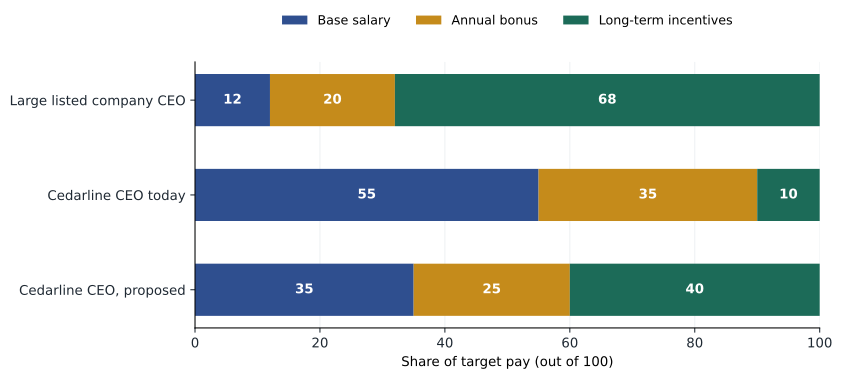
The mix matters as much as the total. A chief executive whose pay is mostly salary has little at stake in the company's results; one whose pay is mostly options has a great deal at stake but may be tempted to take large risks, since options gain from a rising price and lose nothing beyond their value from a falling one. Performance share units tied to relative total shareholder return, which compares the company's share price gain plus dividends with those of a peer group, are now the most common long-term incentive for large North American companies. They reward outperformance rather than a rising market, though critics note that they focus attention on the share price rather than on the actions that drive it.
How much, and compared with whom
Boards set pay levels by benchmarking against a peer group of similar companies, usually with the help of compensation consultants. The practice has a well-known flaw. Few boards want to pay their chief executive below the median of peers, since that seems to signal that he or she is below average, so many target the median or above. When every board does so, the median rises every year, a ratchet sometimes called the Lake Wobegon effect after a fictional town where all the children are above average. Careful boards choose peers by size and industry rather than aspiration, look at several reference points and ask whether the total is justified by the role and the results.
In the United States, public companies must disclose the pay of their principal executive officer, principal financial officer and three other most highly paid executive officers in a standard summary compensation table, together with a compensation discussion and analysis. Since 2018, rules adopted under the Dodd-Frank Act have required companies to disclose the ratio of the chief executive's total pay to that of the median employee, and since 2023 a table comparing compensation actually paid with total shareholder return and other measures. Ratios at large companies commonly run to several hundred to one, and are much higher in retail and other industries with many part-time workers.
The code below shows two calculations that often confuse readers of pay disclosures. The first compares granted pay, the value placed on awards when they are made, with realized pay, what the executive actually receives when the awards vest or are exercised. The second shows how a performance share unit plan tied to relative total shareholder return determines the number of shares that vest.
# 1. Granted versus realized pay for a chief executive over three years (thousands)
grants = [  # year, salary, bonus paid, value of share units granted, units granted
    (1, 900, 700, 2_400, 60_000),
    (2, 930, 350, 2_400, 80_000),
    (3, 960, 1_050, 2_400, 48_000),
]
price_at_vesting = 46.0        # share price when the year-1 units vest at the end of year 3
for year, salary, bonus, grant_value, units in grants:
    print(f"year {year}: granted pay {salary + bonus + grant_value:5,.0f}")
realized_units = 60_000 * price_at_vesting / 1000
print(f"year 3 realized pay: salary 960 + bonus 1,050 + vested units {realized_units:,.0f} = {960 + 1_050 + realized_units:,.0f}")

# 2. Performance share units vesting on relative total shareholder return (TSR)
def vesting_multiple(percentile):
    if percentile < 25: return 0.0                      # below the 25th percentile nothing vests
    if percentile <= 50: return 0.5 + (percentile - 25) / 25 * 0.5
    if percentile <= 75: return 1.0 + (percentile - 50) / 25 * 1.0
    return 2.0                                          # capped at twice the target
peers_tsr = [-0.22, -0.10, -0.05, 0.02, 0.06, 0.09, 0.12, 0.15, 0.21, 0.30, 0.41]
for own in (-0.15, 0.08, 0.18, 0.35):
    below = sum(1 for t in peers_tsr if t < own)
    pct = 100 * below / len(peers_tsr)
print(f"own TSR {own:+.0%}: percentile {pct:4.0f}, vesting {vesting_multiple(pct):.2f} x target")year 1: granted pay 4,000 year 2: granted pay 3,680 year 3: granted pay 4,410 year 3 realized pay: salary 960 + bonus 1,050 + vested units 2,760 = 4,770 own TSR -15%: percentile 9, vesting 0.00 x target own TSR +8%: percentile 45, vesting 0.91 x target own TSR +18%: percentile 73, vesting 1.91 x target own TSR +35%: percentile 91, vesting 2.00 x target
In year 3 the chief executive's granted pay was about 4.4 million, but her realized pay was nearly 4.8 million, because the units granted in year 1 at 40 dollars a share vested when the price had risen to 46. Granted pay shows what the board intended; realized pay shows what the executive actually received, and the two can differ by large amounts in either direction. In the second calculation, a company whose shareholders earned a negative return of 15 percent over three years, below most peers, vests nothing, while one in the top quarter vests twice the target. The design rewards performance relative to peers, so an executive cannot gain merely from a rising market, but can still be paid well in a falling one if the company falls less than its peers.
Linking pay to performance and to strategy
Michael Jensen and Kevin Murphy found in 1990 that chief executive wealth in large American companies changed by only about three dollars for every thousand dollars of change in shareholder wealth, and argued that pay was too weakly linked to performance. The growth of equity pay since then has strengthened the link considerably, but has raised new concerns: equity pay can encourage executives to manage the share price through buybacks, short-term earnings management or risky bets, especially when large awards vest on a single date.
Boards respond with several design features. Performance periods of three years or more, with shares held for further years after vesting, lengthen executives' horizons. Share ownership guidelines require executives to hold shares worth several times their salary. Bans on hedging prevent executives from insuring away the risk in their equity. Caps on payouts limit the gain from extreme results. Clawback policies allow the company to recover incentive pay that was based on results later found to be wrong. And many companies now include measures other than financial results, such as safety, customer satisfaction, employee engagement or greenhouse gas emissions, in their incentive plans.
Since December 2023, listing standards adopted under SEC Rule 10D-1 have required every listed company to have a policy to recover incentive pay that executives received on the basis of financial results later restated, whether or not the executive was at fault. Including sustainability measures in incentive plans became common among large companies in the early 2020s, but has since become politically contested, and some companies have dropped or renamed them; investors that support them ask that such measures be few, quantified, material to the business and verifiable, rather than vague goals that almost always pay out.
Say on pay
Say on pay is an advisory vote by shareholders on a company's executive pay. The Dodd-Frank Act made it mandatory for American public companies from 2011, at least once every three years, and most companies hold it annually because investors prefer that. The vote is not binding, but a failed vote, below 50 percent, is rare and damaging, and support below about 70 percent leads proxy advisers to scrutinize the board's response the following year, with recommendations against the compensation committee's members if the board does not engage with shareholders and make changes.
Research on say on pay finds that most votes pass easily, with average support around 90 percent, but that the vote has changed board behavior: companies with low support often reduce pay, change the design of their plans or improve disclosure. It has also increased the influence of proxy advisers, whose recommendations on pay sway a meaningful share of votes, and of compensation consultants, who now design plans partly to satisfy the advisers' policies. Some critics argue that this has made pay plans more uniform rather than better.
Pay in private and private equity owned companies
Private equity firms take a distinctive approach. They typically pay a modest salary and bonus but require senior managers to invest their own money in the company's equity alongside the fund, and grant them an additional stake, often called sweet equity, that becomes valuable only if the fund earns a good return when it sells. A chief executive might end up owning 2 to 5 percent of the equity, worth many millions at a successful exit. The design creates strong incentives, but they are tied to the fund's exit, which may favor decisions that raise the company's value at the sale date over those that build value afterwards.
Worked problem
Redesigning the Cedarline chief executive's pay
Cedarline's chief executive receives a salary of 850,000 dollars, a bonus of up to 540,000 dollars based on annual operating profit, and a small grant of phantom shares worth about 150,000 dollars a year. Halcyon Ridge proposes replacing the phantom shares with a stake that pays out only at its exit, worth up to 12 million if the sale price doubles the fund's investment. The family worries this will encourage cost cuts and price increases that boost profit before a sale but damage Cedarline Care and the repair promise. Propose a design.
Show solution
- Keep the salary and reduce the bonus's dependence on operating profit to half, adding measures from the strategy: return on invested capital, repair turnaround time and the share of revenue from Cedarline Care and resale.
- Grant performance share units over three-year periods, with half vesting on return on invested capital above the 9 percent cost of capital and half on strategic measures including customer retention and a verified reduction in emissions per unit sold.
- Accept an exit-linked stake, but limit it to a third of long-term pay, and require that part of any exit payment be held in the company's shares or deferred for two years after a listing.
- Adopt share ownership guidelines, a hedging ban and a clawback policy covering restatements and misconduct.
Answer: A mix of salary, a bonus tied partly to strategic measures, three-year performance shares based on returns and strategy, a capped exit stake with deferral and standard protections aligns the chief executive with both owners and with the durable strategy, rather than with the sale date alone.
Common mistakes
MistakeThe figure in the summary table is what the executive received.
InsteadIt usually reports the grant value of awards; realized pay can be much higher or lower.
MistakePaying at the median of peers is neutral.
InsteadWhen every board targets the median or above, pay ratchets upward.
MistakeRelative TSR plans pay only for good performance.
InsteadThey pay for performance relative to peers, which can be negative in absolute terms.
MistakeSay on pay gives shareholders control over pay.
InsteadThe vote is advisory; its influence comes from the pressure a low result creates.
Summary and key terms
- Pay should attract, motivate and align executives, but can itself become an agency problem when executives influence the boards that set it.
- Packages combine salary, annual incentives, long-term equity incentives, retirement benefits and perquisites, and severance and change-of-control terms.
- Peer benchmarking can ratchet pay upward; careful boards choose peers by size and industry and test totals against results.
- Granted pay and realized pay differ; relative TSR plans reward performance against peers.
- Long performance periods, holding requirements, ownership guidelines, hedging bans, caps and clawbacks strengthen the link between pay and long-term value.
- Say on pay votes are advisory but influential, and private equity firms use co-investment and exit-linked equity.
- Performance share unit
- An equity award that vests in a number depending on performance over a set period.
- Total shareholder return
- The share price gain plus dividends over a period, as a proportion of the starting price.
- Realized pay
- The pay an executive actually receives in a period, including the value of awards that vest.
- Clawback
- A policy allowing a company to recover incentive pay already paid.
- Say on pay
- An advisory shareholder vote on executive pay.
- Sweet equity
- An additional equity stake given to managers in a private equity deal that pays off only above a target return.
Practice problems
Work each problem on paper first, then reveal the answer to check.
Why might a pay package made mostly of stock options encourage excessive risk?
Show answer
Options gain from a rising price but lose no more than their value from a falling one.
In the code example, why did realized pay exceed granted pay in year 3?
Show answer
The units granted in year 1 vested at a higher share price than when they were granted.
What is the Lake Wobegon effect in pay setting?
Show answer
Upward ratcheting of pay because boards target the median or above of their peers.
Why does an exit-linked stake create risks for Cedarline's strategy?
Show answer
It may reward actions that raise value at the sale date at the expense of long-term value.
Lesson quiz · 5 questions
Score 60% or more to complete this lesson.
Create a free account to save your progress, take quizzes and earn a certificate.