
MBA-612 · Lesson 11 of 12 · 21 min
Governance in family, private and state-owned firms
Northfield Components, where Daniel Osei is controller, was founded in 1968 by Walter Brenner, who stamped brackets for farm equipment in a rented barn. His son Karl built it into a supplier to automotive and appliance makers with about 380 employees and has run it for thirty-one years. Karl is now seventy. Northfield's shares are held by fourteen members of the family across three generations: Karl and his two sisters, their children and, through a trust, several grandchildren. Only Karl and his nephew Stefan, who runs the plant, work in the business. The sisters' families want larger dividends; Karl wants to reinvest in a new press line; Stefan expects to succeed his uncle, but some relatives doubt he is ready. In MBA-511 the family considered borrowing to fund a special distribution of 20 million dollars, which Daniel helped analyze. Daniel brings the cohort one question: how should a family like this be governed so that it survives another generation?
Dr. Holloway says that most of the governance the cohort has studied so far was designed for listed companies with dispersed shareholders, but most companies in the world are not like that. They are owned by families, private equity funds, founders, governments or members, and their governance problems differ. In family firms the central problem is often between family members rather than between owners and managers; in private equity owned firms it is the fund's horizon; in state-owned firms it is the mix of commercial and political goals. This lesson examines each, and then returns to Cedarline, which combines a family and a private equity fund.
Family firms
Family firms, in which a family holds enough ownership to control the company and usually participates in its management or board, are the most common form of business in every economy, from small shops to some of the world's largest companies. Their strengths are well documented: a long horizon, patient capital, strong values, close attention to reputation and relationships of trust with employees and communities. Their weaknesses are equally familiar: conflicts among relatives, appointments based on birth rather than ability, reluctance to bring in outside capital or talent, and difficult successions.
Research on their performance is mixed in ways that are instructive. Ronald Anderson and David Reeb found in 2003 that family firms in the S&P 500 performed better than non-family firms on average. Belén Villalonga and Raphael Amit found in 2006 that the advantage came mainly from firms in which the founder was still chief executive or chair, while firms run by descendants of the founder tended to perform worse. Francisco Pérez-González found that firms in which a family heir became chief executive saw their performance fall, especially when the heir had not attended a selective university, while firms that appointed unrelated chief executives did not. The lesson for family firms is not that families should step back, but that ownership and management are separate decisions: a family can remain an excellent owner while hiring the best available managers.
The three-circle model
Renato Tagiuri and John Davis proposed in 1982 a simple model that remains the starting point for family business governance. It represents the family firm as three overlapping circles: the family, the ownership and the business. Each person occupies one of seven positions in the diagram: a family member who neither owns shares nor works in the business, an owner who is neither family nor employee, an employee who is neither, and the four overlaps. Each position brings different interests and perspectives. A family member who works in the business may want reinvestment and a career path; an owner who does not work in it may want dividends and liquidity; a non-family manager may want authority and fair treatment.
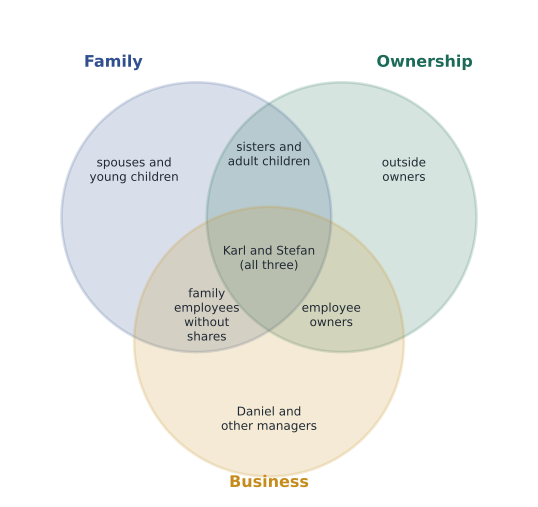
Northfield's dispute follows the circles. Karl and Stefan, in the center, see the business's needs; the sisters' families, in the family-and-ownership area, see the shares as their main financial asset but have no salary, so dividends are their only return. Neither side is selfish; they stand in different places. Good family governance creates separate forums for the different roles, so that business questions are decided as business questions and family questions as family questions.
Family governance structures
Family firms that survive across generations usually develop three sets of institutions. The board of directors governs the business, as in any company, and increasingly includes independent directors who can bring expertise, mediate between family branches and challenge family managers in ways relatives find hard. A family council, a smaller group elected or chosen by the wider family, governs the family's relationship with the business: it develops policies on employment of family members, education of the next generation, communication and family values. A family assembly or meeting brings the whole family together periodically to share information and maintain ties.
These institutions are often anchored by a family constitution, or charter, a document agreed by the family that sets out its values, its vision for the business, and policies on matters such as which family members may work in the company and under what conditions, how dividends will be set, how shares may be transferred and to whom, how disputes will be resolved and how successors will be chosen. Shareholders' agreements give the most important of these policies legal force, for example through rights of first refusal that keep shares in the family and buy-sell provisions that let family members sell shares at a fair price set by a formula or an independent valuation.
The code below shows why these institutions become more necessary with each generation. It models how the number of owners grows as shares pass to children, how the share of owners who work in the business falls, and how the dividend the owners expect compares with what the business can afford to pay while funding its investment.
# How family ownership disperses across generations
children_per_owner = 2.6
work_in_business = {1: 1.0, 2: 0.55, 3: 0.20, 4: 0.10}   # share of owners employed in the firm
owners, stake = 1.0, 1.0
equity_value = 120.0               # millions, assumed constant in real terms for simplicity
free_cash = 5.0                    # millions a year available after the investment the business needs
for gen in range(1, 5):
    if gen > 1:
        owners *= children_per_owner
        stake /= children_per_owner
    employed = owners * work_in_business[gen]
    passive = owners - employed
    # passive owners expect a 4% cash return on their stake, since they draw no salary
    demanded = passive * stake * equity_value * 0.04
    print(f"generation {gen}: {owners:5.1f} owners, each holding {stake:6.2%}; "
f"{passive:4.1f} not employed; dividend expected {demanded:4.1f} of {free_cash} available")generation 1: 1.0 owners, each holding 100.00%; 0.0 not employed; dividend expected 0.0 of 5.0 available generation 2: 2.6 owners, each holding 38.46%; 1.2 not employed; dividend expected 2.2 of 5.0 available generation 3: 6.8 owners, each holding 14.79%; 5.4 not employed; dividend expected 3.8 of 5.0 available generation 4: 17.6 owners, each holding 5.69%; 15.8 not employed; dividend expected 4.3 of 5.0 available
In the founder's generation there is one owner, who works in the business and needs no dividend. By the third generation there are almost seven owners, four-fifths of whom do not work in the business, and their expected dividend would take three-quarters of the cash available after investment. By the fourth, there are about eighteen owners, nine in ten of them passive, and their expectations would take almost nine-tenths of the free cash, leaving little margin for a bad year. Northfield is in its third generation, which is where its dispute sits. Without a dividend policy, a way for owners who want liquidity to sell to those who want to stay, and a board that can explain investment decisions to owners who are not in the business, the conflict will grow, and the common outcome is a sale of the company or a breakup of the family.
Succession
Succession is the hardest moment in a family firm's life, and many do not survive it. A good succession process separates three questions: who will lead the business, who will chair the board and how ownership will pass. It starts years in advance, with criteria for leadership agreed by the board before candidates are discussed; it considers non-family candidates alongside family ones; it expects family candidates to have worked outside the business and earned promotions on merit; and it gives the decision on the chief executive to the board, with independent directors playing a central role, rather than to the departing leader alone.
For Northfield, the cohort recommends that Karl move to the role of chair, that the board add two independent directors with manufacturing and finance experience, and that the board, not Karl, run a search for the next chief executive in which Stefan is a strong internal candidate assessed against agreed criteria and compared with external candidates. The family should develop a constitution with a dividend policy, for example paying out a set share of free cash flow after approved investment, and a share redemption program funded over several years so that relatives who want to sell can do so at a fair value without forcing a sale of the company.
Independent directors play a particular role in family firms. They can say things to a family chief executive that relatives cannot, assess family candidates for leadership without the history of childhood rivalries, and reassure owners outside the business that their interests are being considered. To do so, they must be genuinely independent: not the family's lawyer, accountant or old friends, but people chosen for their expertise, paid fairly and able to leave if they disagree. Many families start with an advisory board, whose members give advice without legal duties, before moving to a board with independent directors once they trust the process.
Private equity ownership
Private equity funds buy companies, usually with substantial borrowing, improve them over several years and sell them, returning the proceeds to the fund's investors. Michael Jensen argued in 1989, in an article titled Eclipse of the Public Corporation, that this form of ownership solves many governance problems of listed companies: concentrated owners monitor closely, managers own significant equity, debt forces discipline on spending, and boards are small and expert. Research by Steven Kaplan and Per Strömberg and others has found that private equity owned companies often improve their operations, though returns to fund investors after fees have become less exceptional as the industry has grown.
Private equity governance has characteristic risks. The fund's horizon, typically three to seven years, may encourage decisions that raise the company's value at exit at the expense of value afterwards, such as cutting investment, maintenance or research. High leverage leaves companies vulnerable in downturns, and can be increased through recapitalizations that pay dividends to the fund. And the fund's interests may differ from those of other stakeholders, such as employees and creditors. Boards of private equity owned companies are dominated by the fund's partners, which makes decisions fast but leaves little independent challenge.
State-owned enterprises
State-owned enterprises face a distinct problem: their owner is a government with both commercial and political goals, which may change with each election. The OECD's guidelines on the corporate governance of state-owned enterprises, revised in 2024, recommend that governments act as informed and active owners through a clear ownership policy, separate their ownership role from their role as regulator, give boards real authority, appoint directors on merit and disclose any non-commercial objectives they impose. The United States has relatively few federal enterprises, such as the Tennessee Valley Authority and Amtrak, though Fannie Mae and Freddie Mac have been under government conservatorship since 2008, and many cities and states own utilities and transit systems. In 2025 the federal government took unusual stakes in private companies, including about a tenth of the chipmaker Intel and a golden share giving it veto rights over certain decisions at U.S. Steel after its acquisition by Nippon Steel, raising new questions about how the government would exercise such rights.
Cedarline: a family and a fund
Cedarline combines the strengths and risks of two forms. The Rourke family offers a long horizon and a commitment to the founder's repair promise; Halcyon Ridge offers discipline, expertise and capital, and needs an exit within three years. The cohort identifies three decisions in which their interests could diverge. The first is investment in Cedarline Care and resale, which pays back slowly; the fund might prefer to defer it until after the exit. The second is dividends and leverage: a recapitalization before the exit would return cash to both owners but weaken the company. The third is the exit itself, where the family may prefer a listing that lets it keep a large stake, while the fund may prefer a sale to a buyer offering the highest price.
Worked problem
Designing a governance protocol for Cedarline's two owners
Propose arrangements that help Cedarline's board make these decisions in the company's interest rather than either owner's.
Show solution
- Add three independent directors, chosen jointly, so that the owners' representatives no longer form the whole board apart from the chief executive and Anne Dufresne, and appoint one of them as lead director.
- Agree a capital allocation policy in advance: investment in Cedarline Care and resale continues on the approved plan unless the independent directors agree otherwise; leverage stays below a set multiple of earnings; dividends are paid from free cash flow after approved investment.
- For the exit, form a committee of independent directors to evaluate a listing and a sale with independent advisers and recommend the option that maximizes long-term value for all shareholders, with the shareholders' agreement amended to give the family a right to match any sale offer.
- Hold separate family meetings, through a family council, for questions about the family's own goals, so they do not crowd the board's agenda.
Answer: With independent directors, an agreed capital allocation policy, an independent exit committee and a family council, Cedarline's board can resolve conflicts between its owners on the merits, protect the durable strategy and prepare for whichever exit serves the company best.
Common mistakes
MistakeFamily firms are poorly governed by nature.
InsteadFounder-led family firms often outperform; the risks come from succession, conflicts and appointments by birth.
MistakeFamily conflicts are caused by greedy relatives.
InsteadThey usually reflect different positions in the three circles, such as owners outside the business who rely on dividends.
MistakePrivate equity ownership always destroys value.
InsteadStudies often find operational improvements, though horizons and leverage create specific risks.
MistakeA government owner should run its companies directly.
InsteadGood practice separates ownership from regulation and gives boards real authority.
Summary and key terms
- Family, private equity, state and other owners face governance problems different from those of listed companies with dispersed shareholders.
- Family firms benefit from long horizons and trust; founder-led firms tend to outperform, while heirs as chief executives often do not.
- The three-circle model explains family conflicts through the different positions of family members, owners and employees.
- Boards with independent directors, family councils, family assemblies, constitutions and shareholders' agreements help families separate business and family questions.
- Ownership disperses with each generation, so dividend policies, liquidity mechanisms and succession processes become essential.
- Private equity offers concentrated monitoring and incentives but has horizon and leverage risks; state-owned enterprises need clear ownership policies and board authority.
- Family firm
- A company in which a family holds enough ownership to control it and usually participates in its governance.
- Three-circle model
- A model of a family firm as overlapping systems of family, ownership and business.
- Family council
- A body that governs the family's relationship with the business.
- Family constitution
- An agreed document setting out a family's values and policies regarding its business.
- Buy-sell provision
- A clause in a shareholders' agreement setting how and at what price shares may be bought and sold.
- State-owned enterprise
- A company owned or controlled by a government.
Practice problems
Work each problem on paper first, then reveal the answer to check.
Why do Northfield's sisters want higher dividends?
Show answer
They own shares but do not work in the business, so dividends are their only return.
In the code example, what happens to dividend expectations by the fourth generation?
Show answer
They would take almost nine-tenths of the cash available after investment, because nine in ten owners are passive.
What did Villalonga and Amit find about family firms?
Show answer
Founder-led firms performed better, while those run by descendants tended to perform worse.
What is the main governance risk of private equity ownership?
Show answer
Its limited horizon may encourage decisions that raise value at exit at the expense of value afterwards.
Lesson quiz · 5 questions
Score 60% or more to complete this lesson.
Create a free account to save your progress, take quizzes and earn a certificate.