
MBA-612 · Lesson 12 of 12 · 23 min
Capstone: Cedarline's board and sustainability strategy
At the end of the course, the cohort presents its recommendations to Cedarline's board. Elizabeth Rourke's brief, given in lesson 1, asked for three things: a review of Cedarline's governance, an assessment of its sustainability reporting and climate risks, and a recommended board and sustainability strategy that would serve the company whether it lists its shares, is sold or stays private when Halcyon Ridge's exit right arrives in three years. Dr. Holloway reminds the cohort that boards receive many consultants' reports and act on few. A recommendation that is to survive the meeting must start from the board's own concerns, be specific about who does what and when, and show its costs as well as its benefits.
The cohort organizes its work in five parts: a diagnosis of the governance gaps; a redesigned board and committee structure; a sustainability strategy with targets and reporting; the links to pay, culture and risk; and a three-year plan, with the decisions the board must take now. This lesson follows that structure, drawing on each of the previous lessons.
The diagnosis
The cohort's diagnosis fits on one page. Cedarline is a well-run company with a clear strategy, approved in MBA-514, but its governance has not kept pace with its ambitions. Its board of seven has one director independent of both management and the owners, so it cannot mediate between a family and a fund whose horizons differ, and it lacks the independent audit committee any listing would require. Its skills are concentrated in retail and finance, with no expertise in technology or climate and little in public company governance. Its chief executive's pay is mostly salary and annual bonus, weakly linked to the long-term strategy, and the fund's proposed exit-linked stake would tilt it toward the sale date. It has no internal audit function, a 22-year audit relationship and substantial non-audit fees. Its emissions are not measured consistently, though customers and lenders ask for them, and over nine-tenths are in its supply chain. Its speak-up data show silence in one region and fear in another. And it has no agreed process for the exit decision, which will be the most consequential decision of the next three years.
Two features of the diagnosis shape the response. First, most of the gaps would need to be closed before a listing, but almost all of them also matter if Cedarline is sold or stays private, because a buyer will pay more for a company with reliable data, independent oversight and a credible strategy, and because the family's long-term interest depends on them. Second, the gaps are connected: the board cannot oversee climate risk without the expertise, cannot rely on sustainability data without internal audit and controls, and cannot link pay to the strategy without measures it trusts.
A redesigned board
The cohort proposes a board of nine. The family keeps two seats and Halcyon Ridge two until its exit, the chief executive remains a director, and four independent directors are chosen jointly: Anne Dufresne, who stays, and three new directors, one with technology and data experience from a retailer that has completed a digital transformation, one with sustainability and supply chain human rights experience from the apparel or consumer goods industry, and one with public company audit and governance experience who could chair the audit committee after a listing. Robert Ingram, whose firm receives fees from Cedarline, steps down from the board and continues as legal adviser to the family. Elizabeth Rourke remains chair, and the independent directors choose a lead director from among themselves to chair their private sessions, lead the board's annual assessment and act as a channel for concerns about the chair.
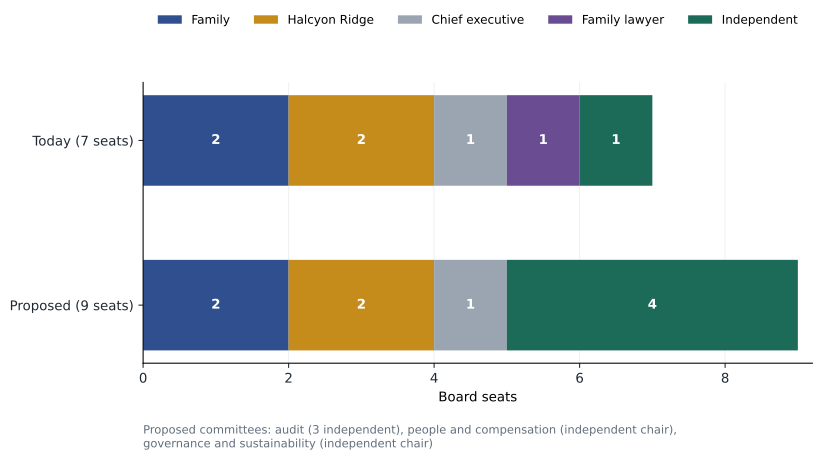
Committees follow. The audit committee consists of three independent directors, with Anne Dufresne as chair, and oversees financial and sustainability reporting, internal audit, the external auditor and the speak-up system. A people and compensation committee, chaired by an independent director with Victor Lam and Michael Rourke as members, oversees executive pay, succession and culture. A governance and sustainability committee, chaired by the new sustainability director, oversees board composition and assessment, the climate risk register, the transition plan and supply chain human rights. The full board keeps strategy, targets, major transactions and the exit decision.
The code below checks the proposal against the tests the cohort applied in lesson 2, and estimates the cost of the additional directors.
# Cedarline's board today and as proposed
today = {"E. Rourke": "family", "M. Rourke": "family", "Chief executive": "management",
         "V. Lam": "fund", "S. Feldman": "fund", "R. Ingram": "adviser", "A. Dufresne": "independent"}
proposed = {k: v for k, v in today.items() if k != "R. Ingram"}
proposed.update({"Technology director": "independent", "Sustainability director": "independent",
                 "Audit and governance director": "independent"})
skills = {"E. Rourke": {"retail", "outdoor"}, "M. Rourke": {"finance", "risk"},
          "Chief executive": {"retail", "supply", "human"}, "V. Lam": {"finance", "public"},
          "S. Feldman": {"retail", "supply"}, "R. Ingram": {"risk"},
          "A. Dufresne": {"finance", "retail", "public"},
          "Technology director": {"tech", "retail"}, "Sustainability director": {"climate", "supply", "human"},
          "Audit and governance director": {"finance", "public", "risk"}}
needed = ["retail", "finance", "tech", "climate", "human", "risk", "supply", "public", "outdoor"]
for label, board in (("today", today), ("proposed", proposed)):
    n = len(board)
    indep = sum(1 for v in board.values() if v == "independent")
    not_mgmt = sum(1 for v in board.values() if v in ("independent", "fund"))
    covered = [s for s in needed if any(s in skills[d] for d in board)]
    thin = [s for s in needed if sum(s in skills[d] for d in board) == 1]
    print(f"{label:9s} {n} directors; independent of management and owners {indep} ({indep / n:.0%}); "
          f"independent of management {not_mgmt} ({not_mgmt / n:.0%})")
    print(f"          skills covered {len(covered)} of {len(needed)}; thin: {', '.join(thin) or 'none'}; "
          f"audit committee possible: {'yes' if indep >= 3 else 'no'}")
fee, committee_fee, search = 95, 15, 60          # thousands a year per director, per committee chair; one-off per search
added = 3
print(f"added cost: about {added * fee + 2 * committee_fee} thousand a year plus {added * search} thousand of search fees")today 7 directors; independent of management and owners 1 (14%); independent of management 3 (43%)
skills covered 7 of 9; thin: human, outdoor; audit committee possible: no
proposed 9 directors; independent of management and owners 4 (44%); independent of management 6 (67%)
skills covered 9 of 9; thin: tech, climate, outdoor; audit committee possible: yes
added cost: about 315 thousand a year plus 180 thousand of search feesThe proposed board has four directors independent of both management and the owners, 44 percent of the board, and six of nine independent of management. It covers all nine skills, though technology, climate and the outdoor industry each rest on a single director, so the board should build the other directors' knowledge of the first two through education and keep them in mind when the fund's seats change. It can staff a fully independent audit committee. The cost is about 315,000 dollars a year plus about 180,000 dollars of search fees, less than a tenth of one percent of revenue. If Cedarline lists, the board would need a majority of independent directors, which it could reach when Halcyon Ridge's two directors leave and one of their seats is filled by a further independent director.
The sustainability strategy
The cohort's sustainability strategy starts from the materiality assessment in lesson 7 and the emissions inventory in lesson 8, and is designed to reinforce the business strategy rather than sit beside it. It has four commitments. On climate, Cedarline will halve its scope 1 and 2 emissions by fiscal 2031, mainly by buying renewable electricity and replacing gas heating at the distribution center as equipment is renewed, and reduce scope 3 emissions from purchased goods by 30 percent in absolute terms over the same period, through fewer and longer-lasting products, lower-emission materials and a supplier energy program at its ten largest factories. On durability, it will publish each year the share of products repaired, the average repair turnaround time and the number of items resold, and design every new product for repair. On supply chain human rights, it will audit all first-tier factories independently, map its second tier, require repayment of any recruitment fees and operate a worker helpline at every major supplier. And on reporting, it will publish a climate-first report under the ISSB-based standards for fiscal 2027, with limited assurance of scope 1 and 2 emissions, adding the other topics the following year.
The cohort tests whether the climate targets are achievable with the actions identified, using the inventory from lesson 8 and the durable strategy's plan for unit volumes.
# Can Cedarline reach its fiscal 2031 targets? (t of CO2 equivalent)
base = {"scope 1": 3_301, "scope 2": 5_362, "purchased goods": 52_920, "other scope 3": 14_945}
units_2026, units_2031 = 3_150_000, 2_650_000         # durable strategy sells fewer, longer-lived units
per_unit_2026 = base["purchased goods"] / units_2026
actions = {  # reduction in emissions per unit from each action by 2031
    "lower-emission materials (recycled and preferred materials)": 0.10,
    "supplier energy program at the ten largest factories": 0.09,
    "longer-lived designs replacing short-lived styles": 0.04,
}
per_unit = per_unit_2026
for name, cut in actions.items():
    per_unit *= (1 - cut)
goods_2031 = per_unit * units_2031
ops_2031 = base["scope 1"] * 0.75 + base["scope 2"] * 0.20   # gas replaced at the warehouse; renewable electricity
other_2031 = base["other scope 3"] * 0.90
print(f"purchased goods: {base['purchased goods']:,} -> {goods_2031:,.0f} ({goods_2031 / base['purchased goods'] - 1:+.0%}; target -30%)")
print(f"scope 1 and 2:   {base['scope 1'] + base['scope 2']:,} -> {ops_2031:,.0f} ({ops_2031 / (base['scope 1'] + base['scope 2']) - 1:+.0%}; target -50%)")
total_26 = sum(base.values()); total_31 = goods_2031 + ops_2031 + other_2031
print(f"total:           {total_26:,} -> {total_31:,.0f} ({total_31 / total_26 - 1:+.0%})")
print(f"emissions per unit of purchased goods: {per_unit_2026 * 1000:.1f} -> {per_unit * 1000:.1f} kg")purchased goods: 52,920 -> 35,003 (-34%; target -30%) scope 1 and 2: 8,663 -> 3,548 (-59%; target -50%) total: 76,528 -> 52,002 (-32%) emissions per unit of purchased goods: 16.8 -> 13.2 kg
The identified actions reduce emissions from purchased goods by about 34 percent, slightly better than the 30 percent target, but only because the durable strategy sells about 16 percent fewer units while keeping revenue roughly level through higher prices, repair and resale; without that volume effect, the actions alone would cut emissions per unit by about 21 percent. Scope 1 and 2 emissions fall by about 59 percent, better than the 50 percent target, because most of Cedarline's operational emissions come from electricity in fossil-heavy grids, which renewable power contracts can largely replace. The cohort notes that the volume effect makes the scope 3 target dependent on the strategy succeeding, and recommends disclosing that clearly, together with emissions per unit, so that readers can see how much of any reduction comes from selling less and how much from making products cleaner.
Links to pay, culture and risk
The cohort connects the governance and sustainability recommendations to the other levers the course has examined. For pay, it adopts the design developed in lesson 4: salary at about 35 percent of target pay, an annual bonus based half on operating profit and half on return on invested capital, repair turnaround and Cedarline Care revenue, and three-year performance shares based half on return on invested capital and half on strategic measures, including a verified reduction in emissions per unit of purchased goods and customer retention. The exit-linked stake that Halcyon Ridge proposed is accepted but capped at a third of long-term pay, with deferral after a listing. For culture, it adopts the speak-up improvements from lesson 10: a campaign in the western stores, an independent review of the distribution center and quarterly reporting to the audit committee. For risk, it adopts the climate risk register from lesson 9, overseen by the governance and sustainability committee, and an internal carbon price in sourcing decisions.
For purpose, it recommends the statement drafted in lesson 6: Cedarline makes outdoor gear that lasts, and keeps it in use for life, so that people can spend more time outdoors while using fewer of the world's resources. It recommends pursuing B Corporation certification as an independent test of the claim, and deferring a decision on a benefit legal form until the ownership decision is made.
The exit decision
The cohort recommends the protocol from lesson 11: a committee of the four independent directors, with independent financial and legal advisers, will evaluate a listing, a sale to a strategic buyer, a sale to another private equity fund and a recapitalization in which the family buys out Halcyon Ridge with new partners, and recommend the option that maximizes long-term value for all shareholders. The shareholders' agreement will be amended to give the family a right to match any sale offer, and to commit both owners to the capital allocation policy until the exit. If Cedarline lists, it should prefer a single class of shares, with the family as an anchor shareholder; if the family insists on control, dual-class shares should carry a sunset, a coattail and a majority of independent directors.
The three-year plan
The cohort presents its recommendations as a sequence, because the board cannot do everything at once. In the first six months, the board approves the redesign, begins searches for three independent directors, creates the governance and sustainability committee, commissions an outsourced internal audit function, adopts the capital allocation policy and the exit protocol and approves the purpose statement. By the end of the first year, the new directors have joined, the audit has been tendered, the pay design is in place for the new fiscal year, emissions data are under controls and the first climate-first report is published with limited assurance of scope 1 and 2. In the second year, the board completes its first externally facilitated assessment, extends reporting to the other material topics and expands assurance, and the exit committee begins its work. In the third year, the board decides the exit, and whichever path it chooses, Cedarline arrives with governance and data that a public market, a buyer or the family itself can trust.
The cohort closes, as the MBA-514 strategy did, with a statement short enough to fit on an index card: Cedarline will be governed by a board that is independent enough to decide on the merits, expert enough to oversee its strategy and risks, and accountable for a purpose that makes durable gear and keeps it in use for life.
Worked problem
Answering the board's objections
At the meeting, Victor Lam objects that three new directors will slow decisions and cost money for a company that may be sold within three years. Michael Rourke asks whether independent directors will weaken the family's control. How should the cohort respond?
Show solution
- To Victor: the cost is under a tenth of one percent of revenue, and buyers and public investors pay more for companies whose data, controls and oversight they can trust; the independent exit committee also protects Halcyon Ridge from accusations that the exit favored either owner.
- Also to Victor: the decisions that most need speed, such as operating matters, stay with management; the board's decisions should be careful, not fast.
- To Michael: the family keeps the chair, two seats, its veto rights under the shareholders' agreement and a right to match any sale; independent directors are chosen jointly, so the family has a say in who they are.
- Also to Michael: independent directors protect the family's long-term interest in the durable strategy against short-term pressure from any future owner, and are required by the market if the family ever wants a listing that preserves its stake.
Answer: Both objections are answered by the same point: independent, expert oversight raises the value of the company to every owner and protects each owner from the risk that the other will decide alone, at a cost that is small relative to what is at stake.
Common mistakes
MistakeA capstone recommendation should list every improvement possible.
InsteadBoards act on a few sequenced, costed decisions with clear owners.
MistakeGovernance improvements matter only if a company lists its shares.
InsteadThey raise value and reduce risk in a sale or under private ownership too.
MistakeA target is credible if it is ambitious.
InsteadIt is credible if identified actions can reach it; the plan should be tested before the target is announced.
MistakeReductions from selling fewer units are the same as making products cleaner.
InsteadBoth reduce emissions, but disclosing them separately shows what is driving progress.
Summary and key terms
- The diagnosis found a capable company whose governance lags its strategy: too few independent directors, skills gaps, weakly aligned pay, limited assurance and data, and no exit process.
- The board grows to nine with four independent directors chosen jointly, a lead director and independent audit, people and sustainability committees.
- The sustainability strategy sets tested targets for emissions, durability, supply chain human rights and reporting, connected to the business strategy.
- Pay, culture and risk recommendations link the strategy to incentives, speak-up and the climate risk register.
- An independent committee will evaluate the exit options, with protections for both owners.
- A three-year plan sequences the changes so that Cedarline reaches its exit with trustworthy governance and data.
- Lead director
- An independent director who chairs private sessions of independent directors and leads board assessment when the chair is not independent.
- Capital allocation policy
- An agreed set of rules for investment, leverage and distributions.
- Climate-first report
- A first sustainability report under ISSB-based standards that covers climate only, using transition relief.
- Absolute target
- A target for total emissions, as opposed to emissions per unit or per dollar of revenue.
- Intensity target
- A target for emissions per unit of output or revenue.
- Externally facilitated assessment
- A board evaluation led by an independent adviser.
Practice problems
Work each problem on paper first, then reveal the answer to check.
Why does the cohort recommend that Robert Ingram leave the board?
Show answer
His firm receives fees from Cedarline, so he is not independent; he can advise the family instead.
In the code example, why does Cedarline's scope 3 reduction depend on the strategy succeeding?
Show answer
Much of it comes from selling fewer units while keeping revenue through higher prices, repair and resale.
Why does the exit committee consist of independent directors?
Show answer
So that the decision is made on the merits rather than in the interest of either owner.
What happens in the first six months of the plan?
Show answer
The board approves the redesign, starts director searches, creates the new committee, commissions internal audit and adopts the capital allocation policy, exit protocol and purpose statement.
Lesson quiz · 5 questions
Score 60% or more to complete this lesson.
Create a free account to save your progress, take quizzes and earn a certificate.