
MBA-612 · Lesson 2 of 12 · 23 min
Boards of directors: duties, composition and independence
Hana Kowalski opens the second session with a confession. Lakeview Health's board has fifteen volunteer directors, including two physicians, a retired bank manager, a parish priest, the owner of a car dealership and a former mayor. Its meetings last three hours, of which two are spent on reports read aloud by managers. Last year the board learned that the hospital's emergency department had failed an accreditation review only when a local newspaper reported it. Nobody on the board had asked about accreditation, because nobody knew it was under review. Hana's question to the class is simple: what is a board actually for, and how would she know whether Lakeview's is doing it?
Dr. Holloway says that the question is the right one, because most board failures are not failures of honesty but failures of attention. A board of capable, honest people can still oversee nothing if it spends its time on the wrong things, receives the wrong information or never asks the question that matters. This lesson covers what boards are legally responsible for, what they do in practice, and how their composition, independence and culture affect whether they do it well.
What boards do
The board's authority comes from corporate law. Section 141(a) of the Delaware General Corporation Law, the statute under which most large American public companies are incorporated, provides that the business and affairs of every corporation shall be managed by or under the direction of a board of directors. In a company of any size the directors cannot manage day to day, so they direct: they appoint the officers, delegate authority to them and hold them to account. The board remains responsible for what it delegates, which is why the quality of its oversight matters so much.
In practice, boards perform five main roles. They select, evaluate, pay and, when necessary, replace the chief executive, and plan for succession, which many directors regard as their single most important job. They approve and monitor strategy, testing management's proposals rather than writing their own. They oversee financial reporting, internal control, risk and compliance. They approve major decisions, such as acquisitions, large investments, new financing and dividends. And they advise management and provide resources, such as expertise, contacts and credibility with investors, lenders and governments.
These roles pull in different directions. Monitoring requires distance from management, while advising requires closeness and trust. A board that sees itself only as a monitor may fail to help a capable chief executive; a board that sees itself only as an adviser may fail to notice when the chief executive is wrong. Good boards hold both roles at once, which is difficult and depends heavily on the relationship between the chair and the chief executive.
The duties of directors
Directors in the United States owe two principal duties under state law, as developed by the Delaware courts. The duty of care requires them to act on an informed basis, after considering all material information reasonably available. The duty of loyalty requires them to act in the good-faith belief that their actions serve the best interests of the corporation and its stockholders, rather than their own; the Delaware courts treat the obligation to act in good faith as part of the duty of loyalty. Directors who have a financial interest in a transaction must disclose it, and transactions with interested directors or controlling stockholders face closer review.
Two Delaware decisions show how the duties are applied. In Smith v. Van Gorkom in 1985, the Delaware Supreme Court held the directors of Trans Union personally liable for approving a sale of the company after a two-hour meeting, without seeing the merger agreement or asking how the price had been set; the decision so alarmed directors that Delaware added section 102(b)(7) to its statute, allowing companies to eliminate directors' personal liability for breaches of the duty of care, though not of loyalty or good faith. In Revlon v. MacAndrews and Forbes in 1986, the court held that once a company is up for sale, the board's duty becomes getting the best price reasonably available for stockholders. Delaware law is generally described as shareholder-focused: directors may consider other constituencies, but in the end must act for the benefit of the stockholders.
In both countries, courts protect directors' decisions through the business judgment rule. If directors are independent of the decision, inform themselves reasonably and act in good faith, courts will not second-guess the result, even if it turns out badly. The rule exists because business decisions involve risk, and directors who feared personal liability for every failed project would refuse to take reasonable risks. It means that the process by which a board decides matters as much as what it decides: an informed, documented and independent decision is protected, while a rushed or conflicted one is not.
Federal securities law adds disclosure duties. Companies must describe their directors' qualifications, explain how the board considers diversity in nominating candidates, and disclose their leadership structure and the board's role in risk oversight. In 2021 Nasdaq adopted a rule requiring listed companies to have, or explain why they did not have, at least two diverse directors; in December 2024 a federal appeals court struck the rule down, holding that the SEC had exceeded its authority in approving it. Many companies continue to disclose board diversity voluntarily, while others have reduced such disclosure amid political and legal pressure.
Independence
An independent director is one without relationships that could reasonably be expected to interfere with the exercise of independent judgment. The idea behind independence is that directors who depend on management, as employees, advisers, suppliers or relatives, will find it hard to challenge it. Governance rules in both countries therefore require boards of listed companies to have a majority of independent directors, either as a rule or as a recommendation, and require audit committees to be made up entirely of independent directors.
In the United States, the listing standards of the New York Stock Exchange and Nasdaq require a majority of independent directors and set bright-line tests that disqualify a director who, within the past three years, was an employee of the company, received more than a set amount in direct compensation other than director fees, was affiliated with its auditor, or was an executive of a company with significant business ties to it. Beyond those tests, the board must affirmatively determine that the director has no material relationship with the company. Controlled companies, in which one holder has more than half the voting power, are exempt from the majority-independence requirement and from the requirement for independent compensation and nominating committees, though not from the audit committee rules.
Independence is a necessary condition for some tasks but not a guarantee of good governance. Enron's board was largely independent and well credentialled. Research on whether more independent boards produce better performance has found weak and inconsistent results; Sanjai Bhagat and Bernard Black found no clear relationship in a study published in 2002. Independence seems to matter for specific decisions: Michael Weisbach found in 1988 that boards dominated by outside directors were more likely to replace a chief executive after poor performance. The lesson is that independence protects the board's ability to act in the moments that matter most, such as removing a chief executive, approving a conflicted transaction or questioning the accounts, but it does not make a board competent or engaged.
Independence also has a cost. Independent directors know less about the business than insiders and depend on management for information. A board of independent outsiders who meet eight times a year can be easily steered by a chief executive who controls the agenda and the papers. Boards address this asymmetry by meeting regularly without management, in what are called in-camera or executive sessions, by speaking directly with executives below the chief executive, by visiting operations, and by insisting on information that is concise, timely and candid.
Composition: size, skills, diversity and tenure
Large listed companies typically have boards of nine to twelve directors. Smaller boards tend to be more cohesive and decisive; larger ones bring more expertise but make it easier for individual directors to stay quiet. Boards increasingly plan their composition with a skills matrix, which lists the capabilities the company's strategy requires, such as industry experience, finance, technology, risk, human capital, sustainability and international markets, and maps each director's strengths against them. Gaps in the matrix guide recruitment.
Diversity of background, gender, ethnicity and experience is argued to improve board decisions by bringing different perspectives and reducing groupthink, though the research evidence on performance is mixed and much debated. Tenure matters too. Long-serving directors know the company well but may become too close to management to challenge it; some codes treat a director as no longer independent after a set number of years, while others rely on regular assessments. Boards also watch for overboarding, when directors sit on so many boards that they cannot give each the time it needs. Proxy advisers and many investors set limits on the number of public company boards on which a director should serve.
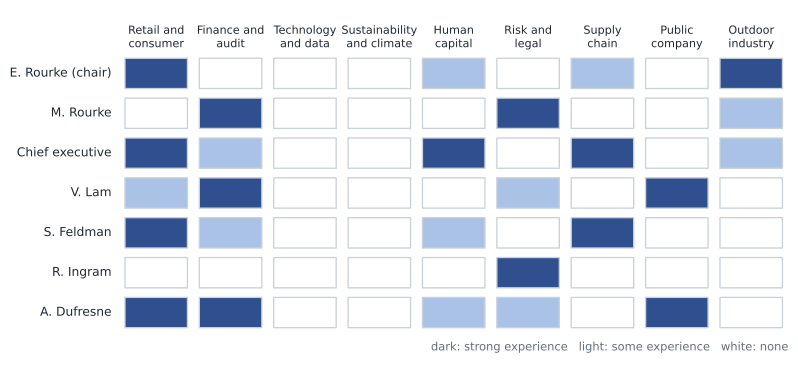
The cohort maps Cedarline's directors against the skills its strategy requires. The result shows a board strong in retail, finance and family history but weak in three areas the strategy depends on: technology and data, which the digital roadmap requires; sustainability and climate, central to a strategy built on durable products; and public company experience, which an initial public offering would demand. The code below assesses each director's independence under the usual tests and counts the gaps in the skills matrix.
# Independence and skills coverage on Cedarline's board
directors = {
 "E. Rourke (chair)": {"family": True,  "employee_3y": True,  "fees": False, "shareholder_rep": True,  "skills": {"retail", "outdoor"}},
 "M. Rourke":         {"family": True,  "employee_3y": False, "fees": False, "shareholder_rep": True,  "skills": {"finance", "risk"}},
 "Chief executive":   {"family": False, "employee_3y": True,  "fees": False, "shareholder_rep": False, "skills": {"retail", "supply", "human"}},
 "V. Lam":            {"family": False, "employee_3y": False, "fees": False, "shareholder_rep": True,  "skills": {"finance", "public"}},
 "S. Feldman":        {"family": False, "employee_3y": False, "fees": False, "shareholder_rep": True,  "skills": {"retail", "supply"}},
 "R. Ingram":         {"family": False, "employee_3y": False, "fees": True,  "shareholder_rep": False, "skills": {"risk"}},
 "A. Dufresne":       {"family": False, "employee_3y": False, "fees": False, "shareholder_rep": False, "skills": {"finance", "retail", "public"}},
}
needed = ["retail", "finance", "tech", "climate", "human", "risk", "supply", "public", "outdoor"]

def independent_of_management(d):
    return not (d["family"] or d["employee_3y"] or d["fees"])

def eligible_for_audit_committee(d):            # listed-company rules also exclude affiliates of large holders
    return independent_of_management(d) and not d["shareholder_rep"]

ind = [n for n, d in directors.items() if independent_of_management(d)]
aud = [n for n, d in directors.items() if eligible_for_audit_committee(d)]
print(f"independent of management: {len(ind)} of {len(directors)} -> {', '.join(ind)}")
print(f"eligible for a listed-company audit committee: {len(aud)} -> {', '.join(aud)}")
for skill in needed:
    holders = [n for n, d in directors.items() if skill in d["skills"]]
    flag = "  <- gap" if len(holders) == 0 else ("  <- thin" if len(holders) == 1 else "")
print(f"{skill:8s} {len(holders)}{flag}")independent of management: 3 of 7 -> V. Lam, S. Feldman, A. Dufresne eligible for a listed-company audit committee: 1 -> A. Dufresne retail 4 finance 3 tech 0 <- gap climate 0 <- gap human 1 <- thin risk 2 supply 2 public 2 outdoor 1 <- thin
Three directors are independent of management, but two of them represent Halcyon Ridge, a 45 percent shareholder. Robert Ingram is not independent because his firm receives legal fees from Cedarline. Only Anne Dufresne would qualify for the audit committee of a listed company, which requires at least three members. Technology and climate have no coverage at all, and the outdoor industry and human capital depend on a single director each. If Cedarline listed its shares, it would need at least two or three new independent directors to meet the audit committee rules alone, and more to give the board a majority of directors independent of both management and the two owners.
Board culture and dynamics
Jeffrey Sonnenfeld, writing in the Harvard Business Review in 2002 after a wave of corporate scandals, observed that the failed boards of the period looked almost identical on paper to successful ones: similar size, independence, attendance and director ownership. What distinguished good boards was their culture: a climate of respect and trust in which directors could challenge one another and management without being seen as disloyal, a willingness to dissent, accountability for individual contributions, and regular evaluation of the board's own performance.
Dr. Holloway describes the habits she looks for when she joins a board. Directors read the materials before the meeting rather than during it. The agenda leaves most of the time for discussion of a few important issues rather than for presentations. The board meets without management at every meeting, so that directors can raise concerns freely. The chair draws out quiet directors and stops dominant ones. Management brings bad news early, and the board responds by helping solve the problem rather than by punishing the messenger. And the board assesses itself every year, often with an outside facilitator, and acts on what it finds, including by asking directors who no longer contribute to step down.
Lakeview Health's problem, she tells Hana, is common in not-for-profit boards, whose directors are volunteers chosen for their community standing or fundraising rather than their skills, and whose meetings are dominated by reports. The fix is to cut the board's size over time, recruit for skills using a matrix, create a quality and patient safety committee that receives the hospital's accreditation results, safety incidents and outcome measures, and turn meetings into discussions of a few key questions. Tax-exempt hospitals in the United States must also report on their governance and community benefit in their annual filings with the Internal Revenue Service, which gives Lakeview's board information it should already be reviewing.
Leo Brandt offers a contrasting case. Kestrel's board has five members: Leo and his co-founder, two partners from its venture capital investors and one independent director chosen by both sides. Its meetings are short and intense, focused on growth, cash and the next financing. The danger in venture-backed boards, Dr. Holloway notes, is different: investors with preferred shares may favor outcomes that suit their funds, such as a quick sale, over the long-term value that common shareholders, including employees with options, would prefer. The independent director's role in such boards is often to make sure that decisions are taken for the company as a whole.
Worked problem
Restructuring Lakeview's board agenda
Lakeview's board meets six times a year for three hours. Two hours go to management reports, thirty minutes to finance and thirty minutes to other business. Propose a better use of the time.
Show solution
- Move routine reports into a consent agenda: directors read them beforehand and approve them together unless someone asks to discuss an item.
- Open every meeting with a fifteen-minute in-camera session without management and close with another, so that directors can raise concerns.
- Give the largest block of time, about ninety minutes, to one or two strategic or risk issues chosen in advance, such as emergency department quality or the capital plan, with a short paper stating the decision or advice sought.
- Receive a standing quality dashboard from the new quality committee, with accreditation status, safety incidents and outcome measures, and spend twenty minutes on it.
Answer: By moving reports to a consent agenda and dedicating most of the meeting to a few chosen issues and a quality dashboard, the board can spend its time on oversight and strategy rather than on listening to presentations, and would have learned of the accreditation problem from management, not the newspaper.
Common mistakes
MistakeDirectors are responsible for managing the business.
InsteadThey supervise or direct management; they delegate day-to-day management but remain accountable for oversight.
MistakeIndependent directors guarantee good governance.
InsteadIndependence protects key decisions, but competence, engagement and culture determine whether a board works.
MistakeThe business judgment rule protects any decision a board makes.
InsteadIt protects informed, independent and good-faith decisions, so the process matters.
MistakeA director who represents a large shareholder is independent because he is not a manager.
InsteadHe may be independent of management but is not independent of that shareholder, and is generally ineligible for a listed company's audit committee.
Summary and key terms
- Boards select and oversee the chief executive, approve and monitor strategy, oversee reporting, risk and compliance, approve major decisions and advise management.
- Directors owe a duty of loyalty and a duty of care; the business judgment rule protects informed, independent and good-faith decisions.
- Canadian law treats the duty as owed to the corporation, allowing directors to consider stakeholders; Delaware law is generally more focused on stockholders.
- Independence rules require a majority of independent directors and fully independent audit committees, with tests that disqualify employees, advisers and others with material relationships.
- Boards plan their composition with skills matrices and consider size, diversity, tenure and overboarding.
- Culture distinguishes good boards: preparation, candid information, challenge, in-camera sessions and regular self-assessment.
- Duty of loyalty
- The duty to act honestly and in good faith in the best interests of the corporation rather than oneself.
- Duty of care
- The duty to act on an informed basis with the diligence of a reasonably prudent person.
- Business judgment rule
- The principle that courts will not second-guess informed, independent and good-faith business decisions.
- Independent director
- A director with no material relationship that could interfere with independent judgment.
- Skills matrix
- A table mapping the capabilities a board needs against those its directors have.
- In-camera session
- A part of a board meeting held without management present.
Practice problems
Work each problem on paper first, then reveal the answer to check.
Why are monitoring and advising sometimes in tension?
Show answer
Monitoring requires distance from management, while advising requires closeness and trust.
Why is Robert Ingram not independent in the code example?
Show answer
His firm receives legal fees from Cedarline, a relationship that disqualifies him.
What did Weisbach find about outside directors?
Show answer
Boards dominated by outsiders were more likely to replace a chief executive after poor performance.
What is a consent agenda?
Show answer
A set of routine items that directors read in advance and approve together unless someone asks to discuss one.
Lesson quiz · 5 questions
Score 60% or more to complete this lesson.
Create a free account to save your progress, take quizzes and earn a certificate.