
MBA-502 · Lesson 7 of 12 · 20 min
Game theory: strategic interaction and Nash equilibrium
Game theory is the study of decisions in which each party's outcome depends on the choices of others. It was developed by John von Neumann and Oskar Morgenstern in their 1944 book on games and economic behavior, and transformed by John Nash, whose 1950 equilibrium concept is now used throughout economics, political science, biology and computer science. For managers, game theory is a disciplined way of putting themselves in their rivals', customers', suppliers' and employees' shoes. It explains why intelligent firms can end up in price wars that none of them wants, why cooperation sometimes survives without contracts, and how changing the rules of a game can change its outcome.
The elements of a game
A game has players, the strategies available to each player, the payoffs each player receives for every combination of strategies, and the information each player has. In a simultaneous game, players choose without seeing each other's choices, as when two airlines submit fares for the coming season or two contractors submit sealed bids. In a sequential game, players move in turn and later players see earlier moves, as when an incumbent responds to an entrant. This lesson covers simultaneous games; Lesson 8 covers sequential games and commitment. Payoffs can be profits, market shares, or any measure the players care about, and the analysis assumes that each player tries to do as well as possible given what it expects the others to do.
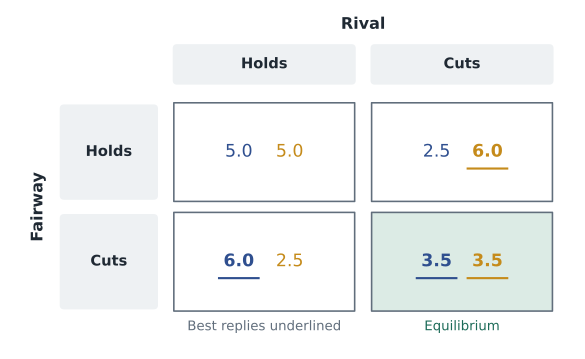
Simultaneous games with two players and a few strategies are conveniently shown as a payoff matrix. Each row is a strategy for one player, each column a strategy for the other, and each cell shows the two payoffs, conventionally with the row player's payoff first. Dr. Varga's first example is a pricing game between Fairway Grocers and its largest regional rival, each choosing whether to hold its weekly flyer prices or cut them on a basket of staples.
| Rival holds | Rival cuts | |
|---|---|---|
| Fairway holds | 5.0, 5.0 | 2.5, 6.0 |
| Fairway cuts | 6.0, 2.5 | 3.5, 3.5 |
Dominant strategies and the prisoners' dilemma
A dominant strategy is one that gives a player a higher payoff than any alternative, whatever the other player does. In the flyer game, cutting is dominant for Fairway: if the rival holds, cutting earns 6.0 rather than 5.0; if the rival cuts, cutting earns 3.5 rather than 2.5. The same is true for the rival. So both cut, and each earns 3.5, even though both would earn 5.0 if both held. This structure, in which individually rational choices produce a collectively worse outcome, is the prisoners' dilemma, named after a story about two suspects who each have an incentive to confess.
Prisoners' dilemmas are everywhere in business: advertising wars in which each firm's spending mainly cancels out its rival's, loyalty programs that each grocer must match, signing bonuses for scarce nurses that Lakeview Health and nearby hospitals keep raising, and over-investment in capacity during booms. Recognizing the structure is the first step to escaping it, either by changing the payoffs, by repeated interaction that rewards restraint, or, where the cooperation would harm customers, by accepting that competition is working as intended. Firms may not agree with competitors to hold prices; that would be illegal collusion. But they can change the game in other ways, such as differentiating the product so that price cuts move fewer customers.
Nash equilibrium
Many games have no dominant strategies. A more general concept is the Nash equilibrium: a combination of strategies in which each player's strategy is a best response to the others', so that no player can gain by changing its strategy alone. A dominant-strategy outcome is always a Nash equilibrium, but Nash equilibria exist in many games without dominant strategies. To find pure-strategy Nash equilibria in a payoff matrix, mark each player's best response to each strategy of the other; any cell in which both payoffs are marked is an equilibrium.
Some games have more than one Nash equilibrium. In a coordination game, players want to choose compatible strategies but may not know which one the other will choose: two hospitals choosing the same health records standard, two suppliers choosing compatible connector designs, or Kestrel and a partner company choosing which data format to support. Industry standards, conventions, focal points that stand out to both sides, and communication help players coordinate. Other games, such as competing for a market that can support only one entrant, have equilibria in which one firm enters and the other stays out, and the question is which one it will be.
# Finding pure and mixed Nash equilibria in 2x2 games
def pure_equilibria(A, B):
    """A[i][j]: row player's payoff, B[i][j]: column player's payoff."""
    eq = []
    for i in range(2):
        for j in range(2):
            row_best = A[i][j] >= A[1 - i][j]
            col_best = B[i][j] >= B[i][1 - j]
            if row_best and col_best:
                eq.append((i, j))
    return eq

def mixed_equilibrium(A, B):
    # row player mixes with probability p on strategy 0 to make the column player indifferent
    den_p = B[0][0] - B[0][1] - B[1][0] + B[1][1]
    den_q = A[0][0] - A[0][1] - A[1][0] + A[1][1]
    if den_p == 0 or den_q == 0:
        return None
    p = (B[1][1] - B[1][0]) / den_p
    q = (A[1][1] - A[0][1]) / den_q
    return (p, q) if 0 <= p <= 1 and 0 <= q <= 1 else None

flyer_A = [[5.0, 2.5], [6.0, 3.5]]; flyer_B = [[5.0, 6.0], [2.5, 3.5]]
print("Flyer game equilibria:", pure_equilibria(flyer_A, flyer_B), "(1 = cut)")
# Entry game: two clinics deciding whether to open in a town that supports only one
entry_A = [[-2, 6], [0, 0]]; entry_B = [[-2, 0], [6, 0]]       # strategy 0 = enter, 1 = stay out
print("Entry game pure equilibria:", pure_equilibria(entry_A, entry_B))
p, q = mixed_equilibrium(entry_A, entry_B)
print(f"Entry game mixed equilibrium: each enters with probability {p:.2f}")
# Inspection game: a supplier chooses to cut corners; Northfield chooses whether to audit
insp_A = [[ -4, 3], [-1, 0]]     # supplier: rows = cut corners, comply; columns = audit, no audit
insp_B = [[  2, -5], [-1, 0]]    # Northfield's payoffs
print("Inspection game pure equilibria:", pure_equilibria(insp_A, insp_B))
p, q = mixed_equilibrium(insp_A, insp_B)
print(f"Inspection game: supplier cuts corners with probability {p:.3f}; Northfield audits with probability {q:.2f}")Flyer game equilibria: [(1, 1)] (1 = cut) Entry game pure equilibria: [(0, 1), (1, 0)] Entry game mixed equilibrium: each enters with probability 0.75 Inspection game pure equilibria: [] Inspection game: supplier cuts corners with probability 0.125; Northfield audits with probability 0.50
Mixed strategies
Some games have no equilibrium in pure strategies. In an inspection game, a supplier decides whether to cut corners on quality and Northfield decides whether to audit. If Northfield always audits, the supplier complies, so auditing is wasteful; if Northfield never audits, the supplier cuts corners, so auditing becomes worthwhile. The equilibrium involves randomization: each player chooses its strategies with probabilities that make the other indifferent. The code finds that in this example the supplier cuts corners one time in eight, or 12.5 % of the time, and Northfield audits half the time. The insight is practical: random audits, unpredictable inspections, tax audits and drug tests work because predictability invites gaming. Penalty and audit cost levels determine the equilibrium frequencies, so raising the penalty for cutting corners lets Northfield audit less often.
Repeated games and cooperation
The prisoners' dilemma looks bleak when played once, but most business relationships are repeated. When firms expect to interact indefinitely, cooperation can be sustained by the threat that defection today will be punished by lower payoffs tomorrow. A simple strategy called tit-for-tat, which cooperates in the first round and then copies the other player's previous move, did remarkably well in computer tournaments organized by Robert Axelrod around 1980. Its virtues are that it is nice, never defecting first; retaliatory, punishing defection immediately; forgiving, returning to cooperation once the other does; and clear, so the other player can understand it.
In this condition, π_C is the per-period payoff from cooperating, π_D the one-time payoff from defecting, π_N the per-period payoff after cooperation breaks down, and δ the discount factor, which reflects both the interest rate and the probability that the relationship continues. Cooperation is easier to sustain when players are patient, when defection is detected quickly, when the gain from defecting is small and when punishment is severe. In business, legitimate cooperation includes reliable supply relationships, honest dealing with customers and joint ventures. In pricing between competitors, the same logic explains tacit coordination, which is why competition authorities worry about markets with frequent, transparent interactions among few firms.
Repeated interaction also explains the value of reputation. Northfield's long-term relationships with its customers rest on a reputation for delivering on time and absorbing small cost increases without renegotiating; that reputation is valuable precisely because it would be lost after a single opportunistic act. Lakeview's relationships with physicians, Fairway's with its local farm suppliers and Kestrel's with its early customers all depend on the shadow of the future.
Changing the game
Game theory is most useful to managers not for solving games but for changing them. Adam Brandenburger and Barry Nalebuff's framework of co-opetition suggests examining the players, the added value each brings, the rules, the tactics that shape perceptions and the scope of the game. A firm can add players, for example by encouraging a second supplier so that it is not dependent on one; change added values, for example by building switching costs or loyalty; change rules, for example with most-favored-customer clauses or meet-the-competition guarantees; or change scope, by linking one game to another. Some of these moves raise antitrust concerns when used by dominant firms or between competitors, so they must be assessed carefully.
Leo applied the framework to Kestrel's relationship with a large enterprise resource planning vendor whose platform many of Kestrel's customers use. The vendor could be a complement, distributing Kestrel through its marketplace, or a rival, building its own forecasting module. By investing in features the vendor was unlikely to build and by winning customers who used several platforms, Kestrel raised its added value to the vendor and made cooperation more attractive than competition.
Worked problem
Is cooperation sustainable?
Two specialty steel distributors in Daniel's region repeatedly bid for Northfield's quarterly coil orders. If both bid at normal margins, each earns 400,000 dollars a quarter on its share. A distributor that undercuts gains the whole order once, earning 650,000 dollars, after which both bid aggressively and earn 150,000 dollars a quarter. With a quarterly discount factor of 0.9, is restraint sustainable?
Show solution
- Cooperating forever is worth 400,000 / (1 − 0.9) = 4.0 million dollars.
- Defecting is worth 650,000 + 0.9 × 150,000 / (1 − 0.9) = 650,000 + 1,350,000 = 2.0 million dollars.
- Because 4.0 million exceeds 2.0 million, neither distributor gains by undercutting, so normal margins are sustainable without any agreement.
- From Northfield's side, the result explains why the two distributors rarely compete hard on price.
Answer: Repeated interaction sustains high margins between the two suppliers. Daniel can change the game by inviting a third distributor to bid, by using reverse auctions or by contracting for longer periods, each of which raises the gain from competing.
Common mistakes
MistakeRational players always reach the best joint outcome.
InsteadIn a prisoners' dilemma, individual rationality leads to a worse joint outcome.
MistakeEvery game has a unique equilibrium.
InsteadGames can have several equilibria or none in pure strategies.
MistakeRandomizing is irrational.
InsteadMixed strategies are optimal when predictability would be exploited, as in audits and inspections.
MistakeCooperation requires a contract.
InsteadIn repeated games, cooperation can be sustained by the prospect of future rewards and punishment.
MistakeGame theory is only about rivals.
InsteadIt applies to suppliers, customers, partners, regulators and employees, and its main value is in changing the game.
Summary and key terms
- A game has players, strategies, payoffs and information; simultaneous games can be shown as payoff matrices.
- A dominant strategy is best whatever others do; the prisoners' dilemma shows individual and joint interests in conflict.
- In a Nash equilibrium, each player's strategy is a best response to the others.
- Coordination games have several equilibria; standards, conventions and focal points help players coordinate.
- Mixed-strategy equilibria explain random audits and inspections.
- Repeated interaction and reputation can sustain cooperation when players are patient and defection is punished.
- Managers can change games by altering players, added values, rules and scope.
- Game
- A situation in which each party's payoff depends on others' choices.
- Payoff matrix
- A table showing each player's payoff for every combination of strategies.
- Dominant strategy
- A strategy that is best whatever the other players do.
- Prisoners' dilemma
- A game in which individually rational choices lead to a worse joint outcome.
- Nash equilibrium
- A set of strategies in which no player can gain by changing its own strategy alone.
- Coordination game
- A game in which players gain by choosing compatible strategies.
- Mixed strategy
- A strategy that chooses among actions with specified probabilities.
- Discount factor
- The weight placed on future payoffs relative to current ones.
- Tit-for-tat
- A strategy that cooperates first and then copies the other player's previous move.
Practice problems
Work each problem on paper first, then reveal the answer to check.
In the flyer game, what would happen if Fairway could credibly guarantee to match any lower advertised price?
Show answer
Cutting would no longer win customers from Fairway, reducing the rival's gain from cutting; such guarantees can soften competition and draw antitrust scrutiny in some settings.
Find the pure-strategy Nash equilibria of a game with payoffs (row, column): top-left (3, 3), top-right (0, 5), bottom-left (5, 0), bottom-right (1, 1).
Show answer
Bottom-right only; it is a prisoners' dilemma.
Give a business example of a coordination game.
Show answer
Choosing a common technical standard or data format.
Cooperating earns 10 per period, defecting earns 18 once and then 6 per period. For what discount factors is cooperation sustainable?
Show answer
δ ≥ 2/3: 10/(1 − δ) ≥ 18 + 6δ/(1 − δ).
Why are random audits more effective than scheduled audits?
Show answer
Scheduled audits can be anticipated, so compliance occurs only when audits are expected.
Portfolio task: map one important game your organization plays using players, added values, rules and scope, and propose one legitimate move that changes it.
Show answer
Answers vary.
Lesson quiz · 5 questions
Score 60% or more to complete this lesson.
Create a free account to save your progress, take quizzes and earn a certificate.