
MBA-502 · Lesson 12 of 12 · 25 min
Capstone: an economic analysis for a pricing and capacity decision
The final lesson brings the course together in a single decision. Cedarline Outdoor, the invented maker and retailer of outdoor clothing and equipment that the cohort met in MBA-501, is headquartered in Chicago and sells through its own stores, online and through sporting goods chains. Its product team has developed the Ridgeline, a technical insulated jacket made with a new recycled fill, and the company must decide what to charge and how to produce it. Cedarline's plant has spare capacity for about 40,000 jackets a year, which is not enough if the jacket sells as well as hoped. Dr. Varga has asked the five members of the cohort to prepare an economic analysis for Cedarline's board. Each will contribute the part of the analysis closest to their own experience, and together they will make a recommendation.
A good economic analysis for a decision like this has a clear structure. It frames the decision and the alternatives; it estimates demand, including how customers respond to price; it measures the relevant costs, distinguishing marginal, fixed and sunk; it considers how rivals will respond; it assesses risks from the macro environment; it addresses contracts and incentives where the plan depends on other parties; and it recommends a course of action with the uncertainties and the conditions that would change the answer made explicit. Lessons 1 to 11 supplied the tools; this lesson shows them working together.
Framing the decision
Lesson 1 taught that a decision should be framed as a choice among alternatives evaluated at the margin, with opportunity costs included and sunk costs ignored. The 3.4 million dollars Cedarline has spent developing the Ridgeline is sunk and irrelevant to the decision now. The relevant question is which combination of price and production plan maximizes the expected present value of future cash flows from the jacket over a five-year product life. The cohort identified three production alternatives. Cedarline could add a second shift at its existing plant, raising capacity to 70,000 jackets a year, with overtime and night premiums pushing marginal cost on the extra units from 130 to 138 dollars. It could build a new automated line with capacity for 110,000 jackets, costing 12 million dollars up front but lowering marginal cost to 121 dollars. Or it could use a contract manufacturer with ample capacity at a marginal cost of 147 dollars, including freight and quality inspection. Each option also carries different fixed costs.
| Option | Annual capacity | Marginal cost (dollars) | Annual fixed cost (millions) | Up-front investment (millions) |
|---|---|---|---|---|
| Second shift | 70,000 | 130, rising to 138 above 40,000 | 1.2 | 0 |
| New automated line | 110,000 | 121 | 3.0 | 12.0 |
| Contract manufacturer | No practical limit | 147 | 0.3 | 0 |
Estimating demand
Hana led the demand work, using the methods of Lesson 2. Cedarline had tested the Ridgeline in twelve stores over the previous autumn, varying the price between 189 and 299 dollars. The test produced weekly unit sales at each price. Hana fitted a log-log regression of units on price, whose slope is the price elasticity of demand. Combining the test with Cedarline's sales history for similar jackets and the marketing team's estimate of national demand, she calibrated a demand curve with sales of about 90,000 jackets a year at a reference price of 219 dollars.
Hana was careful about the limits of the estimate. The test stores were in larger cities, where customers may be less price-sensitive than in smaller markets; the test ran during a cold autumn; and rivals did not respond to the test prices, though they would respond to a national launch. She therefore treated the estimated elasticity as a central value and recommended testing sensitivity to a more elastic demand curve. She also noted that elasticity at the brand level is lower than at the product level, because some customers who would switch from the Ridgeline at higher prices would buy another Cedarline jacket instead, an effect that reduces the true opportunity cost of a high price.
Costs and the capacity alternatives
Daniel led the cost analysis, drawing on Lessons 4 and 5. He separated the costs that vary with output, such as fabric, fill, labor and freight, from fixed costs that depend on the option chosen but not on volume, such as supervision for the second shift, maintenance and depreciation on the new line, and contract management for the outsourcing option. He checked the marginal cost estimates against recent purchase prices and payroll data and noted that the new line would have a learning curve, with costs in the first year about 8 % above the steady-state figure, which he included in a sensitivity case.
Daniel emphasized that the right price depends on the production option, because the markup rule of Lesson 3 sets price as a multiple of marginal cost. An option with a lower marginal cost leads to a lower profit-maximizing price and a higher volume, which in turn requires the capacity to make it. Capacity constraints also matter: if demand at the optimal price exceeds capacity, the firm should raise its price until demand equals capacity, because the scarce capacity has an opportunity cost.
import math
# 1. Estimate the price elasticity from the test-market data (price, weekly units across test stores)
test = [(189, 96.6), (199, 94.4), (209, 81.4), (219, 71.9), (229, 70.5), (239, 60.2),
        (249, 53.5), (259, 55.1), (269, 43.9), (279, 38.4), (289, 35.0), (299, 34.0)]
xs = [math.log(p) for p, _ in test]; ys = [math.log(q) for _, q in test]
mx, my = sum(xs) / len(xs), sum(ys) / len(ys)
e = sum((x - mx) * (y - my) for x, y in zip(xs, ys)) / sum((x - mx) ** 2 for x in xs)
print(f"Estimated price elasticity: {e:.2f}")

# 2. National demand: 90,000 jackets a year at a price of 219 dollars, with the estimated elasticity
k = 90000 * 219 ** (-e)
def demand(price, scale):
    return scale * k * price ** e

# 3. Capacity options: annual capacity, fixed cost, up-front investment and a cost function
options = {
    'Second shift':          (70000, 1.2e6, 0.0,  lambda q: 130 * min(q, 40000) + 138 * max(q - 40000, 0)),
    'New line':              (110000, 3.0e6, 12e6, lambda q: 121 * q),
    'Contract manufacturer': (10 ** 9, 0.3e6, 0.0,  lambda q: 147 * q),
    'Contract, cost +8 %':   (10 ** 9, 0.3e6, 0.0,  lambda q: 147 * 1.08 * q),     # tariff or currency shock
}
scenarios = {'Recession': (0.80, 0.25), 'Base': (1.00, 0.50), 'Strong': (1.25, 0.25)}
annuity = sum(1 / 1.09 ** t for t in range(1, 6))         # five years at a 9 % discount rate

def best_price(cap, fixed, cost, scale):
    best = None
    for p in range(150, 331):
        q = min(demand(p, scale), cap)
        profit = p * q - cost(q) - fixed
        if best is None or profit > best[0]:
            best = (profit, p, q)
    return best

print()
print(f"{'Option':22s}{'Recession':>11s}{'Base':>9s}{'Strong':>9s}{'Expected NPV':>14s}")
for name, (cap, fixed, invest, cost) in options.items():
    npvs, ev = [], 0.0
    for scen, (scale, prob) in scenarios.items():
        profit, p, q = best_price(cap, fixed, cost, scale)
        npv = profit * annuity - invest
        npvs.append(npv); ev += prob * npv
    print(f"{name:22s}" + ''.join(f"{v / 1e6:9.1f}  " for v in npvs) + f"{ev / 1e6:10.1f}")

# 4. Prices chosen in the base case
for name, (cap, fixed, invest, cost) in options.items():
    profit, p, q = best_price(cap, fixed, cost, 1.0)
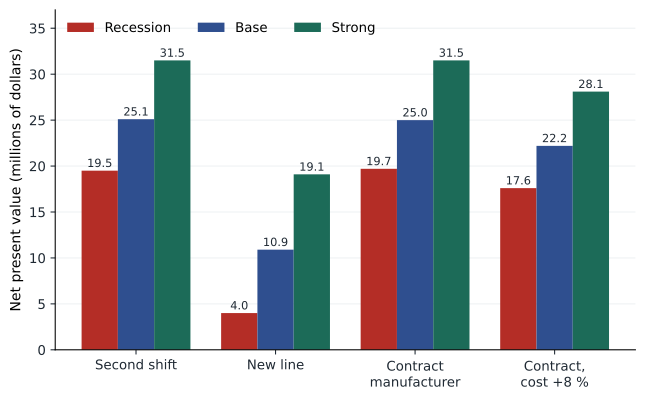
print(f"Base case, {name:22s} price {p} dollars, volume {q:7,.0f} jackets")Estimated price elasticity: -2.43 Option Recession Base Strong Expected NPV Second shift 19.5 25.1 31.5 25.3 New line 4.0 10.9 19.1 11.2 Contract manufacturer 19.7 25.0 31.5 25.3 Contract, cost +8 % 17.6 22.2 28.1 22.5 Base case, Second shift price 243 dollars, volume 69,902 jackets Base case, New line price 206 dollars, volume 104,431 jackets Base case, Contract manufacturer price 250 dollars, volume 65,241 jackets Base case, Contract, cost +8 % price 270 dollars, volume 54,112 jackets
The code reproduces the analysis. The regression recovers an elasticity of about −2.4, so the markup rule sets price at roughly 1.7 times marginal cost. For each option and each demand scenario, the code searches for the price that maximizes annual profit given capacity, converts five years of profit to present value at Cedarline's 9 % cost of capital and subtracts the up-front investment. The scenarios, discussed below, scale demand to 80 % of the base in a recession and 125 % in a strong market, with probabilities of one quarter, one half and one quarter.
Three results stand out. First, the new line is clearly the worst option, with an expected net present value of about 11 million dollars against about 25 million for the others. Its low marginal cost leads to a lower price and higher volume, but the extra margin on the additional units does not repay the 12 million dollar investment and the higher fixed costs over five years. Second, the second shift and the contract manufacturer are almost exactly tied in expected value, with the second shift doing better in the base case and the contract manufacturer slightly better in a recession, because its costs are almost entirely variable. Third, the contract option is sensitive to its cost: an 8 % increase in the contract price, which a tariff or a weaker home currency could easily cause, cuts its expected value by about 2.8 million dollars and makes the second shift the better choice.
Pricing and rival responses
Leo led the competitive analysis, using Lessons 6 to 8. Two rivals sell comparable technical insulated jackets at 229 and 249 dollars. The market is monopolistically competitive: each brand has loyal customers, but switching is easy for many buyers. Leo argued that the profit-maximizing prices from the code, 243 dollars under the second shift and 250 dollars under outsourcing, would place the Ridgeline in the middle of the rivals' range, which is unlikely to provoke a price war. A much lower launch price, such as the 206 dollars implied by the new line's lower cost, would invite a response from the rival at 229 dollars and could start a prisoners' dilemma in which both brands cut prices and both lose.
Leo also considered sequential moves. If Cedarline committed to the new line, its large capacity would be a visible commitment to high volume, which might deter a rival from launching a competing recycled-fill jacket. But the analysis of Lesson 8 showed that commitment is valuable only if it changes rivals' behavior by more than it costs, and there was no evidence that a rival was preparing such a launch. The cohort concluded that the option value of flexibility outweighed the commitment value of the new line at this stage.
For pricing tactics, Grace drew on Lesson 3 and her retail experience. She proposed a launch price of 249 dollars, a familiar price point close to the model's recommendation, with versioning: a lighter Ridgeline at 199 dollars and a premium expedition version at 329 dollars. She recommended no permanent discounts in the first season, a limited end-of-season markdown, and wholesale pricing for sporting goods chains that preserves Cedarline's own-store margin while respecting the chains' freedom to set their own retail prices, consistent with the competition law principles of Lesson 10.
The macro environment and risk
Owen led the macro analysis, using Lesson 11. The Ridgeline's fabric and fill are bought from Asian suppliers, and the contract manufacturer is located in Asia, so the contract option would expose Cedarline to tariff, shipping and currency risk on its entire cost. With energy prices pushing inflation up and the Federal Reserve holding its target range at 3.75 % to 4.00 % in October 2026, Owen expected financing costs to stay elevated, which supported using a 9 % discount rate. He built the three demand scenarios from the macro outlook: a recession, in which demand for discretionary outdoor gear would fall by about 20 %; a base case of moderate growth; and a strong case driven by the success of the recycled-fill positioning and a cold winter.
Owen also tested the discount rate. At 11 %, the expected values of the second shift and contract options fall by about 5 %, and the new line's value falls further, because its investment comes first and its benefits later. The ranking does not change, but the new line's case becomes weaker still. He concluded that the decision is robust to interest rate assumptions within a plausible range but sensitive to the contract manufacturer's cost, which depends on trade policy and exchange rates outside Cedarline's control.
Contracts and incentives
Hana, drawing on Lesson 9, raised concerns about the contract manufacturer. Cedarline would not be able to observe the manufacturer's quality control directly, creating moral hazard; the recycled fill requires careful handling, and defects would damage Cedarline's brand far more than they would cost the manufacturer. A contract could include inspection rights, penalties for defect rates above a threshold, a portion of payment deferred until warranty claims are known, and a requirement to use Cedarline-approved fill suppliers. Random audits, as the inspection game of Lesson 7 showed, are more effective than scheduled ones. But each safeguard adds cost, and some quality dimensions are hard to specify, so the contract would be incomplete.
The second shift raised different incentive questions. Night premiums and overtime could strain the workforce, and quality on night shifts is often lower. Daniel suggested a team bonus tied to both output and first-pass quality, avoiding the multitasking problem of rewarding output alone, and rotating supervisors so that the night shift benefits from experienced leadership.
The recommendation
The cohort's recommendation combined the analysis into a staged plan. Launch the Ridgeline at 249 dollars, with the lighter and expedition versions, using the existing plant and adding a second shift once orders exceed the current spare capacity. Negotiate a framework agreement with a contract manufacturer, with strong quality terms, as a flexible supplement for peak demand, but do not rely on it for the core volume until trade policy is clearer. Do not build the new line now; revisit the decision after two seasons if sales are running near the strong scenario, when the line's economics would be better and the demand risk lower. The staged plan keeps the expected value of the leading options while preserving flexibility, the real option value that Lesson 8 contrasted with commitment.
The cohort also listed the conditions that would change the recommendation: an elasticity well above the estimate, which would favor lower prices and more capacity; a sharp fall in the contract manufacturer's price or the removal of tariffs, which would favor outsourcing; evidence that a rival was preparing a competing launch, which would raise the value of committing to capacity; or sales running well above the strong scenario, which would bring forward the new line. Making these conditions explicit allows the board to monitor the decision rather than simply approve it.
Worked problem
Checking the capacity constraint
Under the second shift, the base-case optimal price is 243 dollars and volume is just under 70,000 jackets, the shift's capacity. In the strong scenario, demand at 243 dollars would be 1.25 times as high. What should Cedarline do, and what does this imply about the value of extra capacity?
Show solution
- Demand at 243 dollars in the strong case would be about 1.25 × 69,900 ≈ 87,400 jackets, well above capacity.
- With capacity fixed at 70,000, Cedarline should raise its price until demand falls to capacity; the code finds a price of about 267 dollars.
- The higher price rations the scarce capacity to the customers who value the jacket most, and the difference between price and marginal cost on the marginal jacket measures the value of extra capacity.
- At 267 dollars and a marginal cost of 138 dollars, each additional jacket of capacity would be worth about 129 dollars a year in contribution, less any cost of providing it.
Answer: Cedarline should raise prices if demand runs ahead of capacity. The high shadow value of capacity in the strong case is why the cohort recommended a contract manufacturer framework as a flexible supplement, which can supply extra jackets at 147 dollars when they are worth far more.
Common mistakes
MistakeSunk development costs should be recovered through the price.
InsteadSunk costs are irrelevant; price should be set from demand and marginal cost.
MistakeThe option with the lowest unit cost is best.
InsteadThe lowest unit cost may require investment and volume that do not pay off.
MistakeA point estimate of demand is enough.
InsteadDemand estimates are uncertain and should be tested with scenarios and sensitivity analysis.
MistakeCapacity decisions can ignore rivals.
InsteadCapacity is a commitment that can change rivals' behavior and pricing.
MistakeA recommendation is complete when it names the best option.
InsteadIt should state the conditions that would change it and how they will be monitored.
Summary and key terms
- A managerial economic analysis frames the alternatives, estimates demand, measures relevant costs, considers rivals, assesses macro risks and addresses contracts.
- Sunk costs are ignored; prices are set from demand elasticity and marginal cost.
- The profit-maximizing price depends on the production option because it depends on marginal cost.
- When capacity binds, price should rise to ration it, and the gap between price and marginal cost measures the value of capacity.
- Scenarios and sensitivity analysis show which conclusions are robust and which depend on uncertain assumptions.
- Flexibility has option value; commitment has strategic value; good plans weigh the two.
- A recommendation should state the conditions that would change it.
- Economic analysis
- A structured evaluation of a decision using demand, cost, competition and risk.
- Shadow value of capacity
- The increase in profit from one more unit of capacity when capacity is binding.
- Sensitivity analysis
- Testing how results change when one assumption changes.
- Scenario analysis
- Testing a decision under several consistent sets of assumptions.
- Staged investment
- Committing resources in steps as uncertainty is resolved.
- Versioning
- Offering several versions of a product at different prices to serve different customers.
- Expected net present value
- The probability-weighted average of net present values across scenarios.
Practice problems
Work each problem on paper first, then reveal the answer to check.
Why is the 3.4 million dollars of development cost irrelevant to the pricing decision?
Show answer
It is sunk and does not change with the price or production choice.
With marginal cost of 147 dollars and an elasticity of −2.43, what price does the markup rule give?
Show answer
About 147 / (1 − 1/2.43) ≈ 250 dollars.
Why does the new line lead to a lower optimal price?
Show answer
Its lower marginal cost lowers the profit-maximizing price under the markup rule.
What would happen to the ranking of options if demand were much more elastic?
Show answer
Prices would be lower and volumes higher, which would favor the low-cost, high-capacity new line.
Name two safeguards in a contract with an outside manufacturer and the problem each addresses.
Show answer
Random audits for moral hazard; deferred payment tied to warranty claims for hidden quality.
Portfolio task: prepare a two-page economic analysis of a pricing or capacity decision in your organization using the structure of this lesson.
Show answer
Answers vary.
Lesson quiz · 5 questions
Score 60% or more to complete this lesson.
Create a free account to save your progress, take quizzes and earn a certificate.