
MBA-502 · Lesson 1 of 12 · 23 min
Economics for managers: marginal thinking and opportunity cost
Managerial economics applies the tools of microeconomics and macroeconomics to the decisions managers actually face: what to charge, how much to produce, whether to build a plant, how to respond to a rival, how to write a contract that motivates people, and how to read the economy that surrounds the business. This course is taught in the weekend executive MBA at the Lakeshore School of Business in Chicago by Dr. Elena Varga, an economist who spent eight years in the research department of a Federal Reserve bank and another six as chief economist of a national grocery and pharmacy chain before joining the faculty. Her first slide in the first session carries a single sentence: economics is the study of choices under scarcity, and management is the art of making those choices well.
The same five managers who worked through financial and managerial accounting together in MBA-501 continue into this course. Daniel Osei is the plant controller at Northfield Components, a private maker of metal stampings and welded assemblies for auto and equipment makers. Hana Kowalski runs operations for Lakeview Health, a not-for-profit network of clinics and a community hospital. Leo Brandt is co-founder and chief financial officer of Kestrel Analytics, a venture-funded software company that sells inventory forecasting by subscription. Grace Mwangi is a category manager at Fairway Grocers, a regional supermarket chain. Owen Tremblay is a finance manager at Prairie Ridge Energy, which processes natural gas and owns wind and solar farms. Their businesses will supply most of the examples in this course, because the point of the course is to change how each of them decides.
Scarcity, choice and the economic way of thinking
Every organization faces scarcity: of money, time, plant capacity, management attention, skilled staff, shelf space or operating-room hours. Because resources are limited, choosing one thing means giving up another. Economists organize their thinking around a few ideas that apply to all such choices. People and organizations respond to incentives. Decisions are made at the margin, by comparing a little more of something with a little less. The cost of anything is what you give up to get it. Voluntary exchange creates value for both sides. Markets coordinate the plans of millions of people through prices, usually well and sometimes badly. None of these ideas is complicated, but applying them consistently is surprisingly hard, because accounting reports, organizational habits and human psychology all push managers to think in other ways.
Dr. Varga asks each manager to describe one decision they made in the past year that they would now make differently. Daniel describes keeping an old press running because it was fully depreciated and therefore looked free. Grace describes defending shelf space for a brand that had already lost the category. Leo describes hiring sales staff in proportion to last year's revenue rather than to the revenue each new hire could actually generate. Owen describes delaying a turbine overhaul to protect the quarter's operating budget. Hana describes refusing to close a weekend clinic because of the money already spent on renovating it. Each of these, she says, is a failure of one of the ideas in this lesson.
Opportunity cost
The opportunity cost of a choice is the value of the best alternative given up. It is the most important cost concept in economics and the one most often missing from accounting reports, because accounting records transactions with outsiders, and an opportunity cost is a transaction that did not happen. When Northfield uses its own warehouse to store finished goods, the accounts show no rent, but the opportunity cost is the rent it could earn by leasing the space to someone else or the cost it avoids by not leasing space elsewhere. When an owner-manager works in her own business without a salary, the accounting profit overstates the economic profit by the salary she could have earned working for someone else. When Prairie Ridge holds cash rather than repaying debt, the opportunity cost is the interest it could have saved.
Economists distinguish between explicit costs, which involve payments to others, and implicit costs, which are the opportunity costs of resources the business already owns. Accounting profit is revenue minus explicit costs. Economic profit is revenue minus both explicit and implicit costs, including a normal return on the capital invested by the owners. A business earning an accounting profit can still be destroying value if that profit is less than the owners could earn by investing the same capital elsewhere at similar risk. This is the same idea as economic profit, or economic value added, which MBA-501 calculated by subtracting a capital charge from operating profit after tax.
Time is also a resource with an opportunity cost. An hour that a senior surgeon at Lakeview spends on paperwork has an opportunity cost measured in procedures not performed; an hour that Leo spends on a minor customer support issue is an hour not spent raising capital or closing a large account. Delegation decisions, and much of the design of jobs inside organizations, are really decisions about the opportunity cost of different people's time.
Sunk costs and why they should be ignored
A sunk cost is a cost that has already been incurred and cannot be recovered whatever you decide. Because it is the same under every option, it cannot affect which option is best, and rational decisions ignore it. Hana's renovation of the weekend clinic was a sunk cost by the time she had to decide whether to keep the clinic open; the relevant question was whether the future revenue and community benefit from keeping it open exceeded the future cost, not whether the clinic had earned back the renovation. Daniel's old press was fully depreciated, but its book value was irrelevant in the other direction too: running it had a real opportunity cost, because a newer press would have used less energy, produced fewer defective parts and freed floor space.
People find sunk costs hard to ignore. Psychologists call the tendency to continue a project because of past investment the sunk cost fallacy, and it shows up in failing information technology projects, in drug development programs that should have been stopped after poor trial results and in acquisitions that managers keep funding to avoid admitting a mistake. Organizations can protect themselves by separating the people who approve a project from the people who review whether to continue it, by setting stopping rules in advance, and by asking the question in a forward-looking form: if we were starting today, knowing what we know, would we begin this project?
Marginal thinking
Most business decisions are not all-or-nothing. They are decisions about how much: how many units to produce, how many staff to schedule, how much to spend on advertising, how far to extend a delivery network. The right way to make such decisions is to compare the marginal benefit of one more unit of the activity with its marginal cost. Expand the activity as long as the marginal benefit exceeds the marginal cost, and stop when they are equal. This rule sounds abstract, but it is the logic behind every optimization in this course, from setting a profit-maximizing price to choosing the level of output in a competitive market.
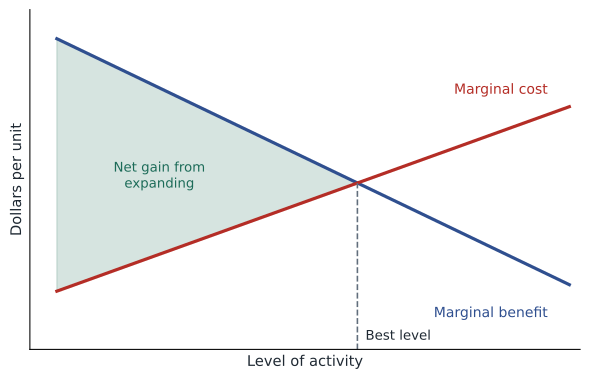
Marginal values differ from averages, and confusing the two is a classic error. The average cost of a nurse's hour at Lakeview includes a share of fixed hospital costs that do not change when one more shift is added; the marginal cost of an additional evening shift is mainly the wage premium and the extra supplies. A product line can have a high average profit and still be overextended, because the last dollars of advertising spent on it brought in very little. Conversely, a line with a low average profit may deserve more investment if its marginal return is high. Throughout the course we will repeatedly convert totals and averages into marginal changes.
# Marginal analysis: how many evening clinic shifts should Lakeview schedule each week?
# Each extra shift sees fewer additional patients because demand is met first on the busiest evenings.
extra_patients = [64, 52, 41, 30, 21, 13, 7]   # additional patients seen by shift 1, 2, 3, ...
net_revenue_per_patient = 62.0                 # dollars of funding or fees per visit, net of supplies
cost_per_shift = 2150.0                        # dollars of staff and opening costs per shift
total = 0.0
for shift, patients in enumerate(extra_patients, start=1):
    mb = patients * net_revenue_per_patient
    mc = cost_per_shift
    total += mb - mc
    decision = "add" if mb > mc else "stop"
print(f"shift {shift}: marginal benefit {mb:7.0f} marginal cost {mc:6.0f} -> {decision:4} cumulative net {total:8.0f}")shift 1: marginal benefit 3968 marginal cost 2150 -> add cumulative net 1818 shift 2: marginal benefit 3224 marginal cost 2150 -> add cumulative net 2892 shift 3: marginal benefit 2542 marginal cost 2150 -> add cumulative net 3284 shift 4: marginal benefit 1860 marginal cost 2150 -> stop cumulative net 2994 shift 5: marginal benefit 1302 marginal cost 2150 -> stop cumulative net 2146 shift 6: marginal benefit 806 marginal cost 2150 -> stop cumulative net 802 shift 7: marginal benefit 434 marginal cost 2150 -> stop cumulative net -914
The code shows that the first three evening shifts each bring in more than they cost, the fourth roughly breaks even and the later ones lose money. If Hana looked only at averages she might be misled: across all seven shifts the average shift sees about 33 patients, which looks close to the break-even of about 35, so she might keep or drop all of them together. The marginal view says to keep three or four and drop the rest. Of course a not-for-profit health provider also cares about outcomes that do not appear in the revenue column, such as fewer emergency visits and better access for people who work during the day, and Hana adds an estimate of those benefits to the marginal benefit before deciding.
Incentives and unintended consequences
People respond to incentives, and they often respond in ways that the designer of the incentive did not intend. When Leo paid Kestrel's sales team a commission based on contract value signed, they signed large multi-year contracts with generous early termination clauses that many customers later used. When a hospital is paid per procedure, it tends to do more procedures; when it is paid a fixed amount per patient per year, it tends to do fewer. When Fairway rewarded store managers for shrink reduction alone, some managers cut fresh-food orders so far that sales fell. Lesson 9 returns to these problems with the tools of contract theory, but the habit of asking how each party will respond to a rule, a price or a bonus is one of the most valuable that managers can develop.
Markets, prices and the role of the manager
Markets bring together buyers and sellers, and prices carry information about scarcity. When the price of steel rises, Northfield's purchasing staff look for substitutes, its engineers redesign parts to use less metal, and its customers face higher prices for the equipment they buy, all without anyone directing them. When demand for heat pumps grows, the rising price encourages manufacturers to expand capacity. This coordinating function of prices is why economists generally favor market solutions, but markets can also fail: when one firm has market power, when actions impose costs on others who are not paid (pollution is the standard example), when one side knows much more than the other, or when goods are public in the sense that one person's use does not reduce another's. Lessons 5, 6 and 9 explore these failures, and Lesson 10 examines how governments respond.
Inside a firm, prices do not coordinate activity; managers do. The economist Ronald Coase asked in 1937 why firms exist at all if markets are so efficient, and his answer was that using markets has costs: searching for suppliers, negotiating contracts and enforcing them. Firms exist where organizing an activity internally is cheaper than buying it. This idea, developed later by Oliver Williamson, explains many make-or-buy decisions, including Northfield's choice to keep tool and die making in-house while buying its fasteners and powder coating from specialists.
Worked problem
Accounting profit versus economic profit
Leo and his co-founder each left jobs paying 160,000 dollars a year to start Kestrel. Last year the company had revenue of 4.8 million dollars and explicit costs of 4.5 million dollars. The founders and early investors have 6 million dollars of equity in the business, and Dr. Varga suggests that investors in early-stage software expect a return of about 25 % a year. What were the accounting profit and the economic profit?
Show solution
- Accounting profit is 4.8 − 4.5 = 0.3 million dollars.
- The founders draw salaries of only 90,000 dollars each, so their implicit cost is the 70,000 dollars each forgoes, or 140,000 dollars in total.
- The normal return on equity capital is 25 % × 6 million = 1.5 million dollars.
- Economic profit is 0.3 − 0.14 − 1.5 = −1.34 million dollars.
Answer: Kestrel is profitable in accounting terms but is not yet earning a normal return on the resources committed to it. Its investors are betting that growth will turn economic profit positive later, which is why its strategy must focus on scale.
Common mistakes
MistakeA fully depreciated machine is free to use.
InsteadIts book value is irrelevant, but using it has an opportunity cost: the output a better machine would produce and the value of the space it occupies.
MistakeWe should continue the project because we have already spent so much.
InsteadMoney already spent is sunk; only future costs and benefits matter.
MistakeIf the average return is positive, we should expand.
InsteadExpand only while the marginal return exceeds the marginal cost.
MistakeAccounting profit shows whether a business creates value.
InsteadEconomic profit, which charges for the opportunity cost of capital and owners' time, is the right test.
MistakeIncentives work exactly as designed.
InsteadPeople respond to what is measured and rewarded, often in unintended ways.
Summary and key terms
- Managerial economics applies economic tools to decisions about prices, output, investment, strategy, contracts and the economic environment.
- Opportunity cost is the value of the best alternative given up and is often missing from accounting reports.
- Economic profit subtracts implicit costs, including a normal return on capital, from accounting profit.
- Sunk costs cannot be recovered and should not affect decisions.
- Optimal decisions equate marginal benefit and marginal cost; averages can mislead.
- People respond to incentives, often in ways the designer did not intend.
- Prices coordinate markets; firms exist where internal organization is cheaper than market transactions.
- Opportunity cost
- The value of the best alternative given up when a choice is made.
- Explicit cost
- A cost involving a payment to another party.
- Implicit cost
- The opportunity cost of using resources the business already owns.
- Economic profit
- Revenue minus explicit and implicit costs, including a normal return on capital.
- Sunk cost
- A cost already incurred that cannot be recovered.
- Marginal benefit
- The additional benefit from one more unit of an activity.
- Marginal cost
- The additional cost of one more unit of an activity.
- Incentive
- A reward or penalty that influences behavior.
- Transaction cost
- The cost of using a market: searching, negotiating and enforcing agreements.
Practice problems
Work each problem on paper first, then reveal the answer to check.
A manager uses a company-owned truck that could be leased to another firm for 2,400 dollars a month. What is the monthly opportunity cost of using it?
Show answer
2,400 dollars, the lease income forgone.
A project has absorbed 3 million dollars. Completing it costs 1 million more and will produce benefits worth 1.5 million. Should it be completed?
Show answer
Yes: the 3 million is sunk, and the future benefit of 1.5 million exceeds the future cost of 1 million.
Revenue is 2 million dollars, explicit costs 1.7 million, the owner could earn 120,000 dollars elsewhere and the owner's capital of 1 million could earn 10 % elsewhere. What is economic profit?
Show answer
2 − 1.7 − 0.12 − 0.10 = 0.08 million dollars.
The fifth sales representative would add 260,000 dollars of contribution and cost 190,000 dollars a year. The sixth would add 170,000 dollars. How many should be hired?
Show answer
Five: the fifth adds more than she costs; the sixth adds less.
Give an example of an incentive in your own organization that produced an unintended response.
Show answer
Answers vary.
Portfolio task: identify one recurring decision in your organization that is distorted by sunk costs or by average rather than marginal thinking, and describe how you would reframe it.
Show answer
Answers vary.
Lesson quiz · 5 questions
Score 60% or more to complete this lesson.
Create a free account to save your progress, take quizzes and earn a certificate.