
MBA-501 · Lesson 4 of 12 · 21 min
The cash flow statement and cash conversion
Businesses rarely fail because they report a loss; they fail because they run out of cash. The cash flow statement explains how cash moved during a period and connects the income statement to the balance sheet. For managers it answers practical questions: did operations generate cash, how much went into new assets, how was any shortfall financed, and is the business funding its growth from its own operations or from lenders and investors? This lesson explains the structure of the statement, the indirect method, free cash flow and the cash conversion cycle.
Three kinds of cash flow
The statement classifies cash flows into three groups. Operating activities are the principal revenue-producing activities: cash received from customers and paid to suppliers and employees. Investing activities are purchases and sales of long-term assets and investments, such as equipment, acquisitions and the sale of a division. Financing activities are flows with lenders and owners: borrowing and repaying debt, issuing and buying back shares, paying dividends and paying the principal portion of lease liabilities.
Under US GAAP, interest paid, interest received and dividends received are all operating cash flows, while dividends paid are financing. Operating lease payments are operating cash flows; finance lease principal payments are financing. These fixed rules make US statements comparable with one another, but when you compare a US company with one reporting under IFRS, check where interest and lease payments sit, because they can move hundreds of millions of dollars between operating and financing cash flow.
| Activity | Typical inflows | Typical outflows |
|---|---|---|
| Operating | Collections from customers | Payments to suppliers, employees, taxes |
| Investing | Sale of equipment or businesses, maturities of investments | Capital expenditure, acquisitions, purchases of investments |
| Financing | New borrowing, share issues | Debt repayments, lease principal, dividends, buybacks |
The indirect method
Most companies present operating cash flow using the indirect method, which starts from net income and adjusts it. First, add back non-cash expenses such as depreciation, amortization, impairments and share-based compensation, and remove non-cash gains. Then adjust for changes in operating working capital: an increase in receivables or inventory uses cash and is deducted; an increase in payables or unearned revenue provides cash and is added. The direct method instead lists cash received from customers and paid to suppliers, which is easier to understand but less common in practice.
The indirect method is valuable precisely because it shows the bridge between profit and cash. When Daniel presented Northfield's year, the bridge showed net income of 6.8 million dollars, depreciation of 7.9 million added back, and then a 9.4 million drain from higher receivables and inventory. Operating cash flow was barely 5 million, and after capital spending of 8.6 million the company had to draw on its credit line. The board had celebrated record sales; the cash flow statement explained why the bank was calling.
# Indirect method: from net income to operating cash flow, then free cash flow (millions of dollars)
net_income = 6.8
depreciation = 7.9
share_based_pay = 0.3
gain_on_sale = 0.4                      # gain on selling an old press (cash is in investing)
change = {"receivables": +5.6, "inventory": +3.8, "payables": +1.2, "accrued wages": +0.2}
cfo = net_income + depreciation + share_based_pay - gain_on_sale
cfo -= change["receivables"] + change["inventory"]       # increases in assets use cash
cfo += change["payables"] + change["accrued wages"]       # increases in liabilities provide cash
capex = 8.6
proceeds_from_sale = 1.1
print("Cash from operations:", round(cfo, 1))
print("Free cash flow (CFO - capex):", round(cfo - capex, 1))
print("Free cash flow after asset sale proceeds:", round(cfo - capex + proceeds_from_sale, 1))Cash from operations: 6.6 Free cash flow (CFO - capex): -2.0 Free cash flow after asset sale proceeds: -0.9
Note that the gain on selling the old press is removed from operating cash flow: the cash proceeds of 1.1 million appear in investing activities instead. Leaving the gain in would count it twice.
Free cash flow
Free cash flow is the cash a business generates after the investment needed to sustain and grow it. The simplest version is operating cash flow minus capital expenditure. Analysts who value companies use free cash flow to the firm, which is calculated before any payments to lenders or shareholders, typically as operating profit after tax plus depreciation minus capital expenditure minus the increase in operating working capital. Free cash flow to equity subtracts interest and net debt repayments as well. Lessons in MBA-511 Corporate Finance will discount these cash flows to value a business; here the aim is to read them.
Different companies define free cash flow differently in their presentations, so always check the definition. Some exclude acquisitions, some deduct lease payments and some do not, and some subtract only maintenance capital spending, arguing that growth spending is optional. Dr. Achterberg's rule is to calculate it yourself from the statement.
Cash flow patterns over the life of a business
The signs of the three cash flows often reveal the stage and health of a business. A start-up like Kestrel usually shows negative operating cash flow, negative investing cash flow and positive financing cash flow, as investors fund the losses. A mature, healthy business like Fairway generates positive operating cash flow, invests part of it and returns the rest to owners through dividends and buybacks, so financing cash flow is negative. A business in decline may show positive investing cash flow as it sells assets to cover operating shortfalls.
| Pattern (operating, investing, financing) | Typical situation |
|---|---|
| - , - , + | Start-up or rapid growth funded by investors |
| + , - , + | Growing company investing more than it earns, borrowing the rest |
| + , - , - | Mature company funding investment and paying owners from operations |
| - , + , - | Distress: selling assets to repay lenders |
| + , + , - | Restructuring or harvesting: selling assets and returning cash |
Kestrel's pattern has started to change. Annual prepayments from customers have turned operating cash flow slightly positive, even though the income statement still shows a loss, because unearned revenue grows as the customer base expands. Software investors watch this closely: a subscription business that collects in advance can fund much of its growth from customers.
The cash conversion cycle
The cash conversion cycle measures how many days pass between paying for inputs and collecting from customers. It combines three measures. Days inventory outstanding is how long goods sit before sale; days sales outstanding is how long customers take to pay; and days payables outstanding is how long the business takes to pay suppliers.
# Cash conversion cycle for three course companies (one year = 365 days); millions of dollars
companies = {
    "Northfield": {"sales": 214.0, "cogs": 173.3, "inventory": 21.5, "receivables": 18.4, "payables": 14.1},
    "Fairway":    {"sales": 3150.0, "cogs": 2315.0, "inventory": 158.0, "receivables": 21.0, "payables": 261.0},
    "Lakeview":   {"sales": 410.0, "cogs": 120.0, "inventory": 4.1, "receivables": 52.0, "payables": 18.0},
}
for name, c in companies.items():
    dio = 365 * c["inventory"] / c["cogs"]
    dso = 365 * c["receivables"] / c["sales"]
    dpo = 365 * c["payables"] / c["cogs"]
    ccc = dio + dso - dpo
    funding = ccc * c["sales"] / 365
    print(f"{name:<11} DIO {dio:5.1f}  DSO {dso:5.1f}  DPO {dpo:5.1f}  CCC {ccc:6.1f} days"
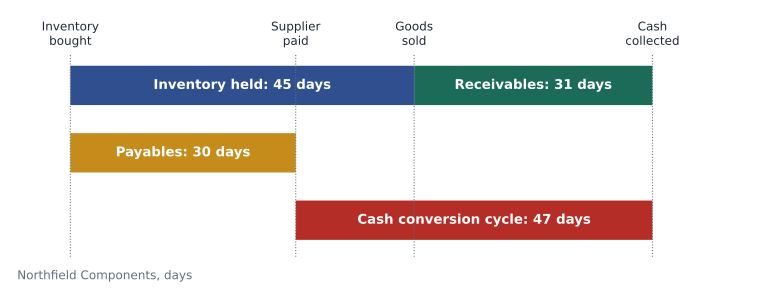
f" working capital tied up about {funding:7.1f}")Northfield DIO 45.3 DSO 31.4 DPO 29.7 CCC 47.0 days working capital tied up about 27.5 Fairway DIO 24.9 DSO 2.4 DPO 41.2 CCC -13.8 days working capital tied up about -119.2 Lakeview DIO 12.5 DSO 46.3 DPO 54.8 CCC 4.0 days working capital tied up about 4.5
Northfield's cycle is about 47 days: its money is tied up in steel and parts for over six weeks, then in receivables for a month. Fairway's cycle is negative, at about minus 14 days, because suppliers wait longer to be paid than goods sit on shelves and customers pay at the till. Lakeview Health's cycle is dominated by receivables from insurers and government payers. For each company, a reduction of one day in the cycle frees roughly one day's sales of cash. Hana calculated that cutting Lakeview's billing delays by five days would release more than 5 million dollars.
Managing cash conversion
Managers can shorten the cycle in several ways. They can reduce inventory through better forecasting, smaller batches and supplier-managed stock; collect faster by invoicing promptly, offering early-payment discounts and following up on overdue accounts; and pay suppliers on agreed terms rather than early. Each lever has costs. Very low inventory risks stock-outs, aggressive collection can damage customer relationships, and stretching payables beyond agreed terms harms suppliers and may raise prices. Supply chain finance programs, in which a bank pays suppliers early and the buyer pays the bank later, can lengthen payables, but standard setters now require disclosure of these arrangements because they can make operating cash flow look better than it is.
Daniel's plan at Northfield combined a review of slow-moving parts, tighter enforcement of 45-day terms with two large customers and a vendor-managed inventory agreement with the steel service center. The plan aimed to free 6 million dollars over a year, enough to fund the next press without additional borrowing.
Cash flow warning signs
Because cash flow is harder to manipulate than accrual profit, analysts compare the two over several years. A company whose operating cash flow consistently trails net income needs a good explanation, such as rapid growth that legitimately absorbs working capital. Without one, the gap may mean that revenue is being recognized before customers can or will pay, or that costs are being capitalized that should have been expensed. Capitalized costs never pass through operating cash flow; they appear as investing outflows, which flatters both profit and operating cash flow at the same time.
Classification choices matter as well. Under IFRS a company may present interest paid as an operating or a financing cash flow, so two otherwise identical companies can report different operating cash flow. Supplier finance arrangements, in which a bank pays suppliers early and the company repays the bank later, can make payables look stretched and operating cash flow look strong, while the real obligation is closer to debt. Newer disclosure requirements under both IFRS and US GAAP now ask companies to describe these programs and their size. Selling receivables to a factor speeds up operating cash flow in the same way.
Owen Tremblay keeps a short checklist for Prairie Ridge Energy's peers: operating cash flow against net income over three to five years; capital spending against depreciation, to see whether assets are being renewed; changes in receivables, inventory and payables against sales growth; and any new financing arrangements in the notes. None of these is proof of a problem, but each is a question to ask management before trusting the reported numbers.
Worked problem
Reading a cash flow statement
A retailer reports net income of 40 million dollars, operating cash flow of 95 million, capital expenditure of 70 million, acquisitions of 30 million, new borrowing of 20 million and dividends of 18 million. What does this tell you?
Show solution
- Operating cash flow far exceeds net income, which is typical for a retailer with large depreciation and favorable working capital.
- Free cash flow before acquisitions is 95 − 70 = 25 million.
- The company spent 30 million on acquisitions and 18 million on dividends, more than its free cash flow, and borrowed 20 million to close part of the gap.
- If this continues, debt will rise. Check whether the acquisitions are expected to raise future operating cash flow.
Answer: The business generates cash from operations but is spending more than that on growth and dividends, funding the difference with debt.
Common mistakes
MistakeDepreciation is a source of cash.
InsteadDepreciation is added back because it is a non-cash expense; it does not generate cash.
MistakeAn increase in receivables increases operating cash flow.
InsteadHigher receivables mean sales not yet collected, so they reduce operating cash flow.
MistakeNegative operating cash flow always means a business is failing.
InsteadStart-ups and fast-growing firms often have negative operating cash flow funded by investors.
MistakeFree cash flow has one standard definition.
InsteadDefinitions vary; calculate it yourself from the statement.
MistakeStretching payables is always good cash management.
InsteadPaying later than agreed damages suppliers and can raise prices; supply chain finance must be disclosed.
Summary and key terms
- The cash flow statement classifies flows into operating, investing and financing activities.
- US GAAP puts interest paid and received in operating cash flow; IFRS classifications can differ.
- The indirect method reconciles net income to operating cash flow through non-cash items and working capital changes.
- Free cash flow is operating cash flow after the capital spending needed to sustain and grow the business.
- The signs of the three cash flows reveal a business's stage and financial health.
- The cash conversion cycle equals days inventory plus days sales outstanding minus days payables.
- Shortening the cycle frees cash, but each lever has costs to customers, suppliers or service.
- Operating activities
- The principal revenue-producing activities of a business.
- Investing activities
- Purchases and sales of long-term assets and investments.
- Financing activities
- Transactions with lenders and owners.
- Indirect method
- Presenting operating cash flow by adjusting net income for non-cash items and working capital.
- Free cash flow
- Operating cash flow minus capital expenditure, or a related measure.
- Capital expenditure
- Spending on property, plant and equipment and similar long-term assets.
- Days sales outstanding
- Average receivables divided by sales, times 365.
- Days inventory outstanding
- Average inventory divided by cost of goods sold, times 365.
- Days payables outstanding
- Average payables divided by cost of goods sold, times 365.
- Cash conversion cycle
- The days between paying suppliers and collecting from customers.
Practice problems
Work each problem on paper first, then reveal the answer to check.
Net income 10, depreciation 4, receivables up 3, payables up 1 (millions). What is operating cash flow?
Show answer
10 + 4 − 3 + 1 = 12 million.
Operating cash flow 12, capital expenditure 9. What is free cash flow?
Show answer
3 million dollars.
DIO 50, DSO 40, DPO 35. What is the cash conversion cycle?
Show answer
55 days.
Sales are 730 million dollars a year. How much cash is released by cutting the cycle by 4 days?
Show answer
About 8 million dollars (730 / 365 × 4).
A company shows negative operating, positive investing and negative financing cash flows. What might be happening?
Show answer
It may be selling assets to fund operating losses and repay debt, a sign of distress.
Portfolio task: find a company's cash flow statement and classify its pattern of signs.
Show answer
Answers vary.
Lesson quiz · 5 questions
Score 60% or more to complete this lesson.
Create a free account to save your progress, take quizzes and earn a certificate.