
MBA-501 · Lesson 11 of 12 · 21 min
Relevant costs, pricing and decision making
Managers face a constant stream of choices: make a part or buy it, accept a special order at a low price, drop a product line, add a shift, close a clinic on weekends, set the price of a new service. Each decision needs cost information, but not the full product costs from Lesson 9 and not the totals in the financial statements. It needs the costs and revenues that will change because of the decision. This lesson develops the relevant cost approach, applies it to the most common decisions, and then turns to pricing, where accounting meets strategy and customer value.
What makes a cost relevant
A relevant cost or revenue has two properties: it lies in the future, and it differs between the alternatives being considered. Past costs, called sunk costs, are never relevant, because no decision can change them. Future costs that are the same under every alternative are also irrelevant, because they cancel out. What remains are the incremental, or differential, costs and revenues: the amounts by which one alternative is better or worse than another. Opportunity costs, the benefit given up by not using a resource in its best alternative use, are relevant even though they never appear in the accounts.
Sunk costs cause the most trouble, because people find it hard to ignore money already spent. Northfield had spent 1.6 million dollars developing a new hinge design that a customer then dropped. Some managers wanted to keep investing because "we have already spent so much". The money was gone whatever they decided; the only question was whether the future cash flows from continuing exceeded the future costs. Economists call the urge to continue the sunk cost fallacy.
| Cost | Relevant? | Why |
|---|---|---|
| Materials to be bought for the order | Yes | Future and incurred only if the order is accepted |
| Depreciation on an existing machine | No | Allocation of a past cost; unchanged by the decision |
| Overtime premium required by the order | Yes | Future and caused by the decision |
| Allocated head-office costs | Usually no | Unchanged in total unless the decision alters them |
| Profit lost on work displaced by the order | Yes | An opportunity cost of using scarce capacity |
| Research already spent on the product | No | Sunk |
Make or buy
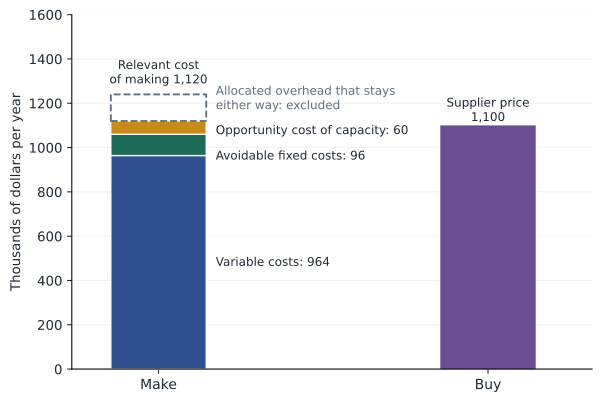
The make-or-buy, or outsourcing, decision compares the cost of producing a part or service internally with the price of buying it. The relevant costs of making are those that would be avoided by buying: direct materials, direct labor, variable overhead and any fixed costs that would actually disappear, such as a supervisor's salary or equipment leases that could be canceled. Allocated fixed costs that would remain are irrelevant. If the freed capacity could be used for something else, the contribution from that alternative use is an opportunity cost of making.
# Make or buy: Northfield's welded subassembly, 40,000 units a year (dollars)
units = 40_000
make_cost_per_unit = {"materials": 14.20, "direct work": 6.80, "variable overhead": 3.10}
allocated_fixed_per_unit = 5.40          # plant overhead allocated at the standard rate
avoidable_fixed = 96_000                 # line supervisor and equipment lease, avoided if we buy
supplier_price = 27.50
freed_capacity_contribution = 60_000    # contribution from bracket work that could use the cell
relevant_make = sum(make_cost_per_unit.values()) * units + avoidable_fixed + freed_capacity_contribution
relevant_buy = supplier_price * units
full_cost_make = (sum(make_cost_per_unit.values()) + allocated_fixed_per_unit) * units
print(f"Full cost of making (misleading):  {full_cost_make:>11,.0f}")
print(f"Relevant cost of making:          {relevant_make:>11,.0f}")
print(f"Cost of buying:                   {relevant_buy:>11,.0f}")
best = "buy" if relevant_buy < relevant_make else "make"
print(f"Decision on cost alone: {best}, by {abs(relevant_make - relevant_buy):,.0f} a year")Full cost of making (misleading): 1,180,000 Relevant cost of making: 1,120,000 Cost of buying: 1,100,000 Decision on cost alone: buy, by 20,000 a year
On a full-cost basis, making looks 80,000 dollars more expensive than buying, but the full cost includes allocated overhead that would stay whether Northfield makes or buys. Counting only the avoidable costs, making is cheaper by about 40,000 dollars, until the opportunity cost of the freed welding cell is included. With the bracket work that could use the cell, buying comes out ahead by about 20,000 dollars a year. The decision also involves qualitative factors: the supplier's quality and reliability, the risk of losing a skill the company might need later, the strength of the supplier's position once Northfield depends on it, and the effect on employees. MBA-513 and MBA-514 develop these strategic considerations.
Special orders
A special order is a one-time request, often at a price below normal, from a customer outside the regular market. If the company has idle capacity and the order will not affect regular sales, it should be accepted if its price exceeds the incremental cost, even if that price is below full cost. The order contributes to fixed costs that would be incurred anyway. If capacity is tight, the order must also cover the contribution of regular work it would displace. And managers must ask whether accepting a low price will spill over: regular customers who hear about it may demand the same price, and some jurisdictions restrict selling the same product to competing buyers at different prices.
Keeping or dropping a product, service or segment
When a product line or segment shows a loss after allocated costs, managers often want to drop it. The right test compares the contribution margin the line provides with the fixed costs that would actually be avoided by dropping it, and adds any effect on other lines. A line that covers its variable costs and its own avoidable fixed costs contributes to shared costs; dropping it shifts those costs to the remaining lines and lowers total profit. Effects on other products cut both ways: dropping a loss-leader may cost sales of complementary products, while dropping a line that cannibalizes a more profitable one may raise profit.
Hana faced this at Lakeview, where the weekend urgent care service showed a loss of 380,000 dollars a year after allocated hospital overhead. On examination, about 520,000 dollars of the allocated overhead would remain if the service closed, and closing would send about 2,100 patients a year to the emergency department, where their care cost more and waits were already long. Keeping the service was the better choice, and the analysis focused attention on its staffing pattern instead.
Constrained resources
When a resource is scarce, such as machine hours, operating-room time, shelf space or skilled engineers, the goal is to maximize contribution per unit of the constrained resource, not per unit of product. A product with a high contribution per unit can be a poor use of a bottleneck if it takes a lot of the bottleneck's time. Fairway allocates shelf space by contribution per meter of shelf per week, not by margin per item. When more than one resource is constrained, linear programming finds the best mix, a technique MBA-513 covers.
# Best use of a bottleneck: Northfield's laser cutter has 1,800 hours available next month
products = {             # contribution per unit (dollars), cutter minutes per unit, maximum demand
    "Bracket A": (6.50, 1.2, 40_000),
    "Hinge B":   (11.00, 3.0, 15_000),
    "Panel C":   (24.00, 9.0, 6_000),
}
hours_left = 1_800 * 60          # in minutes
ranked = sorted(products.items(), key=lambda kv: kv[1][0] / kv[1][1], reverse=True)
total = 0.0
for name, (cm, minutes, demand) in ranked:
    per_minute = cm / minutes
    make = min(demand, int(hours_left // minutes))
    hours_left -= make * minutes
    total += make * cm
    print(f"{name:<10} contribution per cutter minute {per_minute:5.2f}  make {make:>6,}")
print(f"Total contribution {total:,.0f} dollars; unused cutter minutes {hours_left:,.0f}")Bracket A contribution per cutter minute 5.42 make 40,000 Hinge B contribution per cutter minute 3.67 make 15,000 Panel C contribution per cutter minute 2.67 make 1,666 Total contribution 464,984 dollars; unused cutter minutes 6
Panel C has the highest contribution per unit, 24 dollars, but the lowest per cutter minute, about 2.67 dollars, so it is made last. Bracket A, with the lowest contribution per unit, earns the most per minute of the bottleneck. Ranking by contribution per unit would have filled the cutter with panels and given up thousands of dollars of contribution.
Pricing
Prices can be set from three directions. Cost-based pricing adds a markup to a cost base, such as full cost plus 20 %. It is simple and common in contracting, but it ignores what customers will pay, and if the cost base includes allocated fixed costs it leads to raising prices when volume falls, which can drive volume down further. Competition-based pricing follows market prices, appropriate for commodities and for products with close substitutes. Value-based pricing starts from the value the product creates for the customer, such as the savings from less downtime or the extra revenue from better forecasts, and sets the price to capture part of it. Kestrel prices its forecasting tool on the inventory reductions it delivers, not on its cost, which is close to zero per extra customer.
Target costing reverses cost-plus pricing. It starts from the price customers will pay and the profit the company requires, subtracts to find the allowable cost, and then designs the product and process to meet it. Japanese manufacturers developed the approach in the 1960s and 1970s, and it is widely used for new products where most costs are locked in at the design stage. Northfield's vehicle customers effectively impose target costing: they announce the price they will pay for a part and expect annual price reductions, so the company must engineer costs down to stay profitable.
Short run and long run
Relevant costing is a short-run tool: it treats capacity as given and asks how best to use it. In the long run, prices must cover all costs, including fixed costs and a return on capital, or the business will not survive. A company that repeatedly accepts special orders at incremental cost may find that its regular prices erode and that it never earns enough to replace its equipment. Full costs and ROIC, from Lessons 7 and 9, are the long-run checks. Good managers use incremental analysis for the decision in front of them and full-cost analysis to make sure the pattern of decisions keeps the whole business healthy.
Worked problem
A special order at Fairway's bakery
A hotel chain asks Fairway's central bakery for 20,000 dinner rolls a month for six months at 0.32 dollars each. Full cost is 0.38 dollars per roll, of which 0.24 dollars is variable. The bakery runs at 70 % of capacity, and the order would need one extra delivery run a week costing 450 dollars. Should Fairway accept?
Show solution
- Incremental revenue: 20,000 × 0.32 = 6,400 dollars a month.
- Incremental variable cost: 20,000 × 0.24 = 4,800 dollars; extra deliveries about 4.3 × 450 ≈ 1,950 dollars a month.
- Incremental profit: 6,400 − 4,800 − 1,950 = about −350 dollars a month, so the order loses money as priced.
- Fairway could counter-offer at a price of about 0.35 dollars or ask the hotel to collect from the bakery, which would make the order profitable with idle capacity.
Answer: With idle capacity the full cost is irrelevant, but every incremental cost must be included. Here the delivery cost turns a seemingly attractive order into a small loss.
Common mistakes
MistakeSunk costs should be recovered before a project is abandoned.
InsteadSunk costs cannot be changed and are irrelevant to the decision.
MistakeA product that shows a loss after allocated overhead should be dropped.
InsteadCompare its contribution with the fixed costs that would actually be avoided and the effects on other lines.
MistakeThe cheapest supplier price is the best make-or-buy choice.
InsteadInclude avoidable fixed costs, opportunity costs of capacity and qualitative factors.
MistakeWith a bottleneck, make the products with the highest contribution per unit first.
InsteadRank by contribution per unit of the constrained resource.
MistakeCost-plus pricing guarantees profit.
InsteadIf volume falls, allocated costs per unit rise, prices rise and volume can fall further; prices also need to reflect customer value.
Summary and key terms
- Relevant costs and revenues are future amounts that differ between alternatives; sunk costs are never relevant.
- Opportunity costs of scarce resources are relevant even though they are not recorded in the accounts.
- Make-or-buy compares avoidable costs and opportunity costs of making with the cost of buying, plus qualitative factors.
- Special orders with idle capacity should cover incremental cost; with full capacity they must also cover displaced contribution.
- Keep-or-drop decisions compare contribution with avoidable fixed costs and effects on other products.
- With a constrained resource, maximize contribution per unit of the constraint.
- Prices can be cost-based, competition-based or value-based; target costing works back from the market price.
- Relevant cost
- A future cost that differs between alternatives.
- Sunk cost
- A cost already incurred that cannot be changed by any decision.
- Opportunity cost
- The benefit forgone by choosing one alternative over the next best.
- Incremental analysis
- Comparing alternatives by the revenues and costs that differ between them.
- Avoidable cost
- A cost that would be eliminated by choosing a particular alternative.
- Special order
- A one-time order, often at a price below normal.
- Constrained resource
- A resource whose limited capacity restricts output.
- Cost-plus pricing
- Setting price by adding a markup to a cost base.
- Value-based pricing
- Setting price according to the value created for the customer.
- Target costing
- Designing a product to meet an allowable cost derived from the target price and required profit.
Practice problems
Work each problem on paper first, then reveal the answer to check.
A machine bought for 200,000 dollars could be sold for 30,000 dollars or used for a project. Which amount is relevant?
Show answer
The 30,000 dollar resale value, an opportunity cost; the original price is sunk.
Variable cost 8 dollars, avoidable fixed cost 20,000 dollars for 10,000 units; supplier price 9.50 dollars. Make or buy on cost alone?
Show answer
Buy: making costs 100,000 dollars against 95,000 to buy, so buying is cheaper by 5,000 dollars.
A special order offers 15 dollars a unit; variable cost is 11 dollars; capacity is idle. Accept?
Show answer
Yes on financial grounds; it adds 4 dollars of contribution per unit, provided regular prices are not affected.
Product X earns 12 dollars of contribution and needs 4 machine minutes; product Y earns 9 dollars and needs 2. Which should get the machine first?
Show answer
Y, at 4.50 dollars per minute against 3.00 for X.
A market price is 80 dollars and the company requires a 15 % margin on price. What is the target cost?
Show answer
68 dollars.
Portfolio task: identify a recent decision in your organization and list its relevant and irrelevant costs.
Show answer
Answers vary.
Lesson quiz · 5 questions
Score 60% or more to complete this lesson.
Create a free account to save your progress, take quizzes and earn a certificate.