
LVT-340 · Lesson 4 of 12 · 25 min
Safety and fundamentals review
The review lessons in this course work through the program in the order Maya learned it, and each one does three things: it restates the core ideas briefly, works the kinds of problems that appear on exams, and points out the traps that catch candidates. Each review also names the lesson where the topic was first taught, so a candidate who finds a gap knows where to go back to. This lesson covers the first course, LVT-110: safety, electrical basics, power supplies and batteries, and the drawings that every job starts from.
Safety questions are often the easiest marks on an installer exam and the most often lost through overconfidence. They usually ask what to do first, or what is required, and the answers are those of the reference and the regulations, not of a busy job site.
Job site safety essentials
LVT-110 lessons 7 and 8 covered the hazards. The points most often examined are these.
- Electrical hazards: treat every conductor as live until it is proven dead with a tested meter. Low-voltage technicians work near power, not on it; if a task needs power circuits opened or moved, the electrician does it under lockout.
- Arc flash: the approach boundaries in CSA Z462 and NFPA 70E keep unqualified people out of the space near exposed energized equipment. A low-voltage technician working in an electrical room stays outside the limited approach boundary unless escorted and trained.
- Ladders: set a straight or extension ladder at a 4 to 1 slope, one unit out for every four up; extend it 3 ft above the landing; keep three points of contact; never stand on the top step of a stepladder.
- Lifts: only trained, authorized operators use scissor and boom lifts; inspect before use; use the fall protection the lift requires.
- Ceilings: never stand on ceiling grid; watch for asbestos-containing materials in older buildings and stop work if suspect material is disturbed.
- Confined spaces: vaults, manholes and some crawl spaces may be confined spaces; entry requires the employer's program, testing of the atmosphere and an attendant. The exam answer is never just go in quickly.
- Eye protection: wear it when cleaving or splicing fiber, drilling, and working overhead; fiber shards are hard to see and hard to remove.
- Silica and dust: drilling concrete and masonry creates respirable silica; use tools with dust extraction or water and follow the employer's exposure control plan.
Electrical fundamentals
LVT-110 lessons 3 and 4 introduced the four quantities and the rules that link them. Exams test them with short calculations, and the traps are units and round trips.
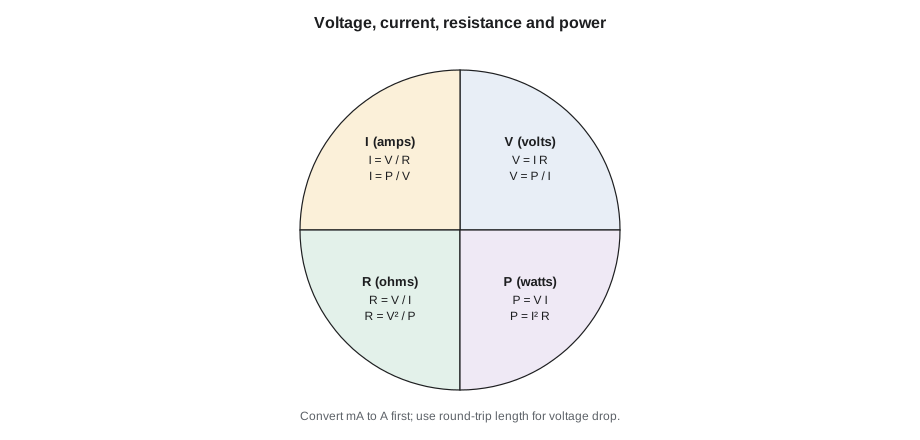
Three reminders cover most exam errors. Convert milliamps to amps before multiplying: 350 mA is 0.35 A. A cable carrying current to a device and back has two conductors in the circuit, so the round-trip length is twice the run. And in a series circuit the current is the same everywhere while the voltages add, while in a parallel circuit the voltage is the same across each branch while the currents add.
Worked problem
Voltage drop on a 24 V camera heater
A 24 V DC supply feeds an outdoor camera housing heater drawing 0.8 A through a 150 ft run of 18 AWG cable. The conductor resistance is 0.0064 ohm per foot. The device needs at least 21.6 V. Is the run acceptable?
Show solution
- Round-trip length: 2 × 150 = 300 ft.
- Loop resistance: 300 × 0.0064 = 1.92 ohm.
- Voltage drop: 0.8 × 1.92 = 1.54 V.
- Voltage at the device: 24 − 1.54 = 22.5 V, above 21.6 V.
Answer: Acceptable, with about 0.9 V to spare. The common wrong answer forgets the return conductor and finds half the drop, which hides the problem on a longer run.
Power-limited circuits
LVT-110 lesson 2 explained what counts as low voltage. In the NEC, Class 2 and Class 3 circuits are supplied by sources listed and marked for the class, and their power and voltage are limited by NEC Chapter 9 Tables 11(A) and 11(B), broadly to 100 VA, with 30 V an important dividing line in the tables. Class 3 allows higher voltages than Class 2, with more protection against shock. A circuit is Class 2 or 3 because of its source: replace a listed Class 2 supply with an ordinary one and the wiring becomes a Class 1 circuit with different rules.
Exam trap: a question may describe a circuit's voltage and ask whether it is Class 2, without mentioning the source. The safe answer is that the class depends on the source's listing or certification, not on the voltage alone.
Power supplies and batteries
LVT-110 lessons 5 and 6 covered supplies and standby batteries. A power supply has a rated output current; the connected load, plus a margin, must not exceed it. Many manufacturers and specifications ask for a 20 percent margin, so a supply rated 4 A should carry no more than about 3.2 A of continuous load. Standby battery sizing multiplies the standby current by the standby hours, adds the alarm or active current times its duration, and then applies a derating factor for battery aging and temperature.
Worked problem
Sizing a standby battery
An access control panel draws 0.65 A in standby and 1.40 A when all locks are energized for egress. The specification requires 4 hours of standby followed by 15 minutes of full load. Use a derating factor of 0.8.
Show solution
- Standby: 0.65 A × 4 h = 2.60 Ah.
- Active: 1.40 A × 0.25 h = 0.35 Ah.
- Total before derating: 2.95 Ah.
- Divide by 0.8: 3.69 Ah.
Answer: Choose the next standard size above 3.69 Ah, which is often a 7 Ah battery in this kind of panel. The trap is forgetting to convert 15 minutes to 0.25 hours.
# Formula review: Ohm's law, voltage drop on a two-conductor run, supply margin and battery size
def drop(current_a, run, ohm_per_unit):
    loop = 2 * run * ohm_per_unit                 # out and back
    return current_a * loop, loop

V_SUPPLY, V_MIN = 24.0, 21.6
I, RUN, R_UNIT = 0.8, 150, 0.0064
vd, loop = drop(I, RUN, R_UNIT)
print(f"Heater run: loop {loop:.2f} ohm, drop {vd:.2f} V, at device {V_SUPPLY - vd:.1f} V,",
      "OK" if V_SUPPLY - vd >= V_MIN else "TOO LOW")

# longest run that still leaves V_MIN at the device
max_run = (V_SUPPLY - V_MIN) / (I * 2 * R_UNIT)
print(f"Longest run for this load: {max_run:.0f} ft")

rating, margin = 4.0, 0.20
print(f"Supply rated {rating} A carries at most {rating * (1 - margin):.1f} A with a {margin:.0%} margin")

def battery_ah(i_standby, h_standby, i_alarm, min_alarm, derate=0.8):
    return (i_standby * h_standby + i_alarm * min_alarm / 60) / derate

print(f"Access panel battery: {battery_ah(0.65, 4, 1.40, 15):.2f} Ah minimum")
print(f"Alarm panel battery: {battery_ah(0.50, 24, 2.00, 5):.2f} Ah minimum")Heater run: loop 1.92 ohm, drop 1.54 V, at device 22.5 V, OK Longest run for this load: 234 ft Supply rated 4.0 A carries at most 3.2 A with a 20% margin Access panel battery: 3.69 Ah minimum Alarm panel battery: 15.21 Ah minimum
The calculator puts the formulas Maya will need on the exam in one place, so she can check her hand calculations while studying. On the day there is no code, only a basic calculator, so the point is to know the steps well enough to do them by hand and to recognize a wrong answer by its size.
Drawings and specifications
LVT-110 lesson 10 introduced the documents. The exam asks a candidate to read symbols, scales and schedules, and to know which document governs. Common points:
- A floor plan shows outlet locations with symbols defined in the legend; the legend for this project governs, not a symbol remembered from another job.
- A riser diagram shows the vertical relationship between rooms and floors; it is not to scale.
- Specifications are organized by division and section; communications work is usually in Division 27 and electronic safety and security in Division 28.
- When a drawing and a specification disagree, the contract documents say which governs; the installer asks the designer through a request for information rather than choosing.
- To use a scale, measure on the drawing and multiply by the scale ratio; at 1:100 a 1 in line represents 100 in, and on an imperial drawing at 1/8 in = 1 ft, 1 inch represents 8 feet.
Traps in fundamentals questions
| Trap | How it appears | Defense |
|---|---|---|
| Units | Current in mA, length in feet with resistance per meter | Convert everything first; write units in every step |
| Round trip | Voltage drop on a two-conductor run | Double the run length |
| Source decides class | A low voltage described without its source | Class depends on the listed or certified source |
| Margin | A supply loaded to exactly its rating | Apply the specified margin, often 20 percent |
| First action | What to do on finding damaged suspect material | Stop, do not disturb, report |
| Ladder angle | Height given, base distance asked | One out for four up |
Worked problem
A ladder question
An extension ladder must reach a landing 16 ft above the floor. How far from the wall should its base be, and how long must the ladder be at least?
Show solution
- Base distance at 4 to 1: 16 ÷ 4 = 4 ft.
- Length to the landing along the ladder: square root of (16² + 4²) = 16.5 ft.
- Add the extension above the landing: 16.5 + 3 = 19.5 ft.
Answer: Set the base 4 ft out and use a ladder that gives at least 19.5 ft of working length after its overlap. Candidates often forget the extension above the landing.
More fundamentals worth reviewing
Three more topics from LVT-110 appear often enough to deserve a short review.
Series and parallel resistance. Resistors in series add: 100 ohm and 220 ohm in series make 320 ohm. For two resistors in parallel, the total is their product divided by their sum: 100 and 220 in parallel make 22,000 ÷ 320 = 68.75 ohm, always less than the smaller one. Exam questions use these rules for end-of-line resistor circuits, speaker loads and sensor loops, and the quick check is that a parallel result must be below the smallest branch.
AC and DC. Most low-voltage devices run on DC from a power supply that converts the building's AC. Some, such as certain door strikes, transformers for older systems and some heaters, run on low-voltage AC, commonly 24 V AC. A meter must be set to the right kind of voltage, and a reading of a DC supply on the AC range, or the reverse, gives a meaningless number. An AC supply's rating is in volt-amperes (VA); for resistive loads, VA and watts are about the same, but for transformers and motors they are not.
Wire size. American Wire Gauge numbers run backwards: a smaller number is a larger conductor. Every three steps down roughly doubles the cross-section and halves the resistance per unit length, so 18 AWG has about twice the resistance of 15 AWG, and about four times that of 12 AWG. When a voltage drop is too large, the fixes are a larger conductor, a shorter run, a higher supply voltage where the device allows it, or a local power supply near the load.
Worked problem
Choosing a fix for voltage drop
A 12 V DC device draws 1.2 A at the end of a 200 ft run of 18 AWG cable and needs at least 10.8 V. The loop resistance is 2.56 ohm. What is wrong, and what are the options?
Show solution
- Drop: 1.2 × 2.56 = 3.1 V, leaving about 9 V at the device, below 10.8 V.
- Halving the resistance means three gauge steps larger: 15 AWG would roughly halve the drop to about 1.5 V, leaving about 10.5 V, still short.
- Six steps larger, 12 AWG, cuts the drop to about a quarter, about 0.75 V, leaving about 11.2 V.
- Alternatives: a 24 V device with its own regulator, or a local supply near the device.
Answer: The run needs 12 AWG, or a different powering approach. Candidates often pick 16 AWG as the obvious one-step fix; working the numbers shows it is not enough.
Exam trap: VA and watts. A transformer rated 40 VA can supply about 40 W to a resistive heater but less real power to a motor or a magnetic lock coil, so the rating is compared with the load's VA, not its wattage, whenever the load data gives VA.
Common mistakes
MistakeTreating a conductor as dead because the circuit is labeled off.
InsteadProve it dead with a tested meter, or leave power work to the electrician.
MistakeForgetting the return conductor in a voltage drop calculation.
InsteadUse the round-trip length.
MistakeLoading a supply to its full rating.
InsteadLeave the specified margin.
MistakeDeciding a circuit's class from its voltage.
InsteadThe listed or certified source decides it.
MistakeChoosing the drawing or the specification when they conflict.
InsteadAsk the designer with a request for information.
Summary and key terms
- Safety answers follow the reference and the regulations: prove dead, respect approach boundaries, 4 to 1 ladders, no entry without a confined space program.
- V = IR and P = VI; convert units first and use round-trip length for voltage drop.
- A circuit is Class 2 because of its source, not its voltage.
- Load supplies with a margin; size batteries for standby plus active time, then derate.
- Read drawings with the project legend and scale; ask when documents conflict.
- Round-trip length
- Twice the cable run, used for the two conductors carrying current out and back.
- Derating factor
- A factor below 1 that allows for battery aging and temperature in sizing.
- Limited approach boundary
- The distance from exposed energized parts inside which only qualified people may go unescorted.
- Riser diagram
- A drawing showing the vertical relationship of rooms and backbone cabling, not to scale.
- Request for information
- A formal question to the designer when documents are unclear or in conflict.
Practice problems
Work each problem on paper first, then reveal the answer to check.
What is the base distance for a ladder reaching 12 ft?
Show answer
3 ft, at 4 to 1.
Convert 450 mA to amps.
Show answer
0.45 A.
A 24 V supply is rated 5 A. With a 20 percent margin, what is the maximum load?
Show answer
4 A.
What decides whether a circuit is Class 2?
Show answer
Its listed or certified Class 2 source.
Lesson quiz · 5 questions
Score 60% or more to complete this lesson.
Create a free account to save your progress, take quizzes and earn a certificate.