
LVT-340 · Lesson 2 of 12 · 20 min
How BICSI and other certification exams work
An exam is a measuring instrument, and like a cable tester it has a known way of working. A technician who understands how a tester measures can read its results and avoid fooling herself; a candidate who understands how an exam is built can prepare for what it actually measures and avoid losing marks to the format. This lesson describes how the common low-voltage exams are organized, using BICSI's installer exams as the main example, and then turns to the skills of answering multiple-choice questions well. The details in this lesson are those in recent candidate handbooks; every program publishes a current handbook, and a candidate reads it before booking.
Written and practical parts
Most installer credentials have two parts. The written part is a computer-based, multiple-choice exam that checks knowledge: the standards, the codes, the reasons behind practices, the calculations. The practical part, often called the hands-on exam, checks skill: the candidate terminates, tests, splices or builds something while an evaluator watches and scores it against a checklist. Passing one part does not make up for failing the other, because a technician who knows the theory but cannot terminate a jack is no more use on a job than one who terminates well but routes cable through a plenum in the wrong jacket.
| Credential | Written part (recent handbooks) | Practical part | Experience |
|---|---|---|---|
| Installer 1 | 75 questions, 2 hours | 6 timed tasks, pass or fail, before the written part | None required |
| Installer 2 Copper | 100 questions, 2 hours | 6 copper tasks | Field experience, by one of several routes |
| Installer 2 Optical Fiber | 100 questions, 2 hours | 6 fiber tasks | Field experience, by one of several routes |
| Technician | 100 questions, 2 hours | 12 tasks across copper and fiber | Broader experience, or both Installer 2 credentials |
The experience routes are worth knowing because they decide when a technician may sit. For Installer 2 Copper, recent handbooks list three: Installer 1 plus about six months of structured cabling experience; about one year of experience plus BICSI's own copper hands-on training; or about two years of experience plus a set number of documented continuing education hours. Maya qualifies by the first route, with Installer 1 from her second term and years of copper work since. Technician has similar routes with longer experience, and holding both Installer 2 credentials is one of them.
Where the questions come from
A good exam is built from a published outline, called the blueprint or the job task analysis. The certifying body surveys working technicians about what tasks they do and how important each one is, groups the tasks into domains and decides how many questions each domain gets. Each question is written to test one task, checked by a panel of practitioners, tried out on candidates as an unscored item and kept only if it separates candidates who know the material from those who do not. The questions are drawn from named reference books. For BICSI's installer exams, the main reference is BICSI's installation methods manual, supported by the standards it cites.
Two consequences follow. First, the exam rewards the reference's way of doing things. If the manual says a bend radius during pulling is a certain multiple of the cable diameter, that is the answer, even if a crew on one job did something different. Second, the blueprint tells the candidate where the marks are. A domain that carries a quarter of the questions deserves a quarter of the study time, not the hour left over at the end. Lesson 3 turns the blueprint into a study plan.
Other exams in the trade
Texas has several exams that touch low-voltage work. The Department of Public Safety requires an exam for the person who qualifies an alarm or access control company, a 50-question test with a two-hour limit and a 70 percent pass mark, and entry-level alarm training for installers. The State Fire Marshal's Office tests fire alarm technicians and planning superintendents on the statutes and rules. NICET, which many fire alarm and security employers use, certifies technicians at four levels in fire alarm systems through written exams plus documented experience. ETA International's Fiber Optics Installer certification has a written exam and is often taken alongside a hands-on course. Manufacturer programs usually end with a short online test after the course.
Every one of these exams is multiple choice in its written part. The skills in the rest of this lesson apply to all of them.
Reading a multiple-choice question
A multiple-choice question has a stem, which asks the question, and options, one of which is correct; the others are called distractors. Good distractors are not silly. Each one is a mistake that a partly prepared candidate is likely to make: the right number in the wrong unit, a rule from the wrong standard, the answer to a similar but different question. This is why candidates who know the material roughly but not exactly do worse on a well-written exam than they expect.
Dev's method, which he has taught to every apprentice who has sat an exam at Cobalt Line, has five steps.
- Read the stem twice, slowly. Underline the key words in your head: the subject, the condition, and any word like not, except, maximum, minimum, first or best.
- Answer it in your head before looking at the options. If the question asks for the maximum horizontal cable length, say 90 meters to yourself first. Then look for your answer among the options.
- Read every option, even if the first one looks right. The best answer may be further down, or the first one may be a distractor that is almost right.
- Eliminate. Cross out options that are certainly wrong. If two remain, look for the difference between them and go back to the stem to see which one it asks for.
- Answer, flag if unsure and move on. A question that takes four minutes costs time that two easier questions needed.
Some question types need special care. An except question, such as which of the following is not a requirement, reverses the usual logic, and a tired candidate answers the opposite question. Read the options as true or false statements and pick the false one. A best answer question may have more than one defensible option; the best is the one that the reference supports most directly, or the one that is safest or most complete. A calculation question offers the correct result and the results of common errors: the wrong formula, a missed conversion, a rounding step in the wrong place. Working the calculation fully, not estimating, is the defense.
Worked problem
Working an except question
A practice question reads: all of the following are part of a permanent link test configuration except: (a) the horizontal cable, (b) the telecommunications outlet, (c) the patch panel termination, (d) the equipment cord at the switch.
Show solution
- The stem asks for the one item that is not in a permanent link.
- Recall from LVT-130 lesson 10: the permanent link is the fixed cabling from the patch panel to the outlet, tested with special adapters.
- Test each option as true or false: horizontal cable is in it (true); outlet is in it (true); patch panel termination is in it (true); equipment cord is not (false).
- The false statement is the answer.
Answer: Answer (d). Equipment cords belong to the channel, not the permanent link. The distractors are all genuine parts of the link, which is why a hurried candidate who reads part of a link as is part of a link picks the first familiar option.
Time
Exams are timed, and time is a resource to plan like any other. A 100-question exam in two hours gives 72 seconds per question on average. Most questions take less; calculations and long scenario questions take more. Dev's rule is to make three passes: on the first pass, answer every question that can be answered in under a minute and flag the rest; on the second, work the flagged questions; on the third, review flagged answers and any that felt uncertain. Most computer-based exams allow flagging and returning, and most do not penalize wrong answers, so a question should never be left blank. A guess among two remaining options is a 50 percent chance; a blank is zero.
# Exam pacing: average time per question and checkpoints for a three-pass plan
def pacing(questions, minutes, review_share=0.15, checkpoints=4):
    review = minutes * review_share            # time kept back for the final review pass
    working = minutes - review
    per_q = working * 60 / questions
    print(f"{questions} questions in {minutes} min: {minutes * 60 / questions:.0f} s each on average")
    print(f"Keep {review:.0f} min for review, so work at {per_q:.0f} s per question")
    for k in range(1, checkpoints + 1):
        q = round(questions * k / checkpoints)
        t = working * k / checkpoints
        print(f"  checkpoint {k}: question {q:3d} by {t:5.1f} min")

print("Maya, Installer 2 Copper:")
pacing(100, 120)
print("Teo, Installer 1:")
pacing(75, 120)Maya, Installer 2 Copper: 100 questions in 120 min: 72 s each on average Keep 18 min for review, so work at 61 s per question checkpoint 1: question 25 by 25.5 min checkpoint 2: question 50 by 51.0 min checkpoint 3: question 75 by 76.5 min checkpoint 4: question 100 by 102.0 min Teo, Installer 1: 75 questions in 120 min: 96 s each on average Keep 18 min for review, so work at 82 s per question checkpoint 1: question 19 by 25.5 min checkpoint 2: question 38 by 51.0 min checkpoint 3: question 56 by 76.5 min checkpoint 4: question 75 by 102.0 min
The pacing table gives Maya checkpoints to glance at during the exam: if she is past question 50 with less than half the time used, she is on track. Teo's Installer 1 written part is shorter, 75 questions, so his checkpoints come at different times, which the same code produces by changing two numbers.
The practical part
Practical exams are scored against a checklist, and the checklist usually has two kinds of item. Some are critical: a wrong wiremap, an untwist beyond the limit, a fiber end face that fails inspection, a safety violation such as not wearing eye protection when cleaving. Missing a critical item fails the task. Others are workmanship items, such as a neat dress, correct labeling and a clean work area, that add to or take from the score. Each task has a time limit, often around 20 minutes for a single task on the entry exams.
The best preparation is to do the tasks repeatedly under the same conditions as the exam, with someone checking against a written checklist and a clock running. Lesson 11 builds those checklists. Two habits help on the day: lay out the tools and materials in the same order every time, so the hands know where things are under pressure, and finish every task by checking it against the checklist before calling the evaluator, because a two-minute check catches most critical errors.
Before the exam
Practical arrangements matter more than candidates think. Exams are booked through the certifying body or its testing provider, usually weeks ahead. The candidate needs government-issued identification that matches the name on the booking exactly, an understanding of the rules about what may be brought into the room, and, for many computer-based exams, a short tutorial on the testing software. Most programs allow a retake after a waiting period and a fee, and most limit the number of attempts within a year. Knowing those rules in advance takes some pressure off the day: a failed first attempt is a setback with a known way back, not a disaster.
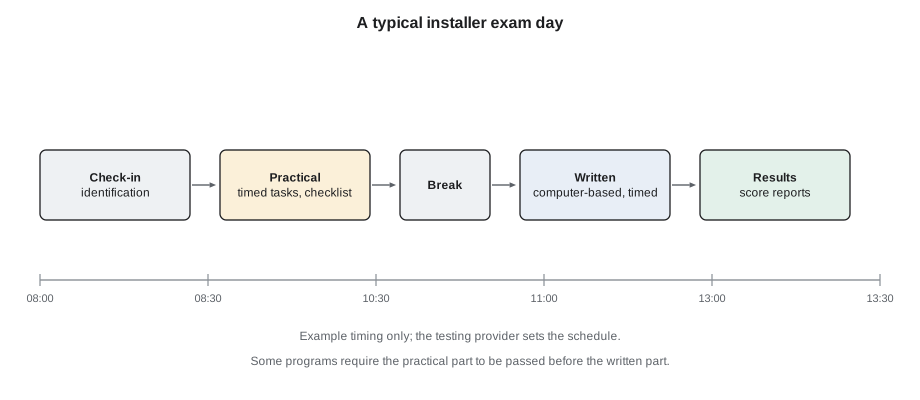
Maya booked her Installer 2 Copper exam for the second-last week of her tenth term, leaving four weeks after the booking for study and practice. Teo booked Installer 1 at a testing center that runs the practical part on the same day, so he will do his hands-on tasks in the morning and, if he passes them, the written part in the afternoon.
After the result
Score reports for written exams usually show a pass or fail and, for a fail, the candidate's performance by domain. That breakdown is the most useful document a failed candidate has: it is a ready-made study plan for the retake. A pass is not the end of the record either. The candidate receives a certificate and a credential number, which goes into the employer's register and, for BICSI and many others, into an online directory that clients can check. The renewal date starts counting from the issue date.
Common mistakes
MistakeStudying from memory of how one crew did things.
InsteadStudy the reference the exam is built from; it decides the answers.
MistakeChoosing the first option that looks right.
InsteadRead every option; the best answer may come later.
MistakeMisreading an except or not question.
InsteadTreat each option as true or false and pick the false one.
MistakeSpending five minutes on one hard question.
InsteadFlag it and return; easier questions need the time.
MistakeLeaving questions blank.
InsteadUnless the rules penalize guessing, answer every question.
MistakeSkipping the final checklist on a practical task.
InsteadCheck against the list before calling the evaluator.
Summary and key terms
- Most credentials have a written, multiple-choice part and a practical part scored against a checklist; both must be passed.
- Exams are built from a published blueprint and named references; the reference's way is the right answer.
- Distractors represent likely mistakes, so exact knowledge beats rough knowledge.
- Read the stem twice, answer before looking, read every option, eliminate, answer and flag.
- Plan time in passes and use checkpoints; never leave a question blank unless guessing is penalized.
- Practical tasks have critical items that fail the task; check before calling the evaluator.
- Blueprint
- The published outline of an exam, with domains and the share of questions in each.
- Stem
- The part of a multiple-choice question that asks the question.
- Distractor
- A wrong option written to attract candidates who have a likely misunderstanding.
- Critical item
- A checklist item on a practical exam that fails the task if missed.
- Job task analysis
- A survey of practitioners used to decide what an exam should cover.
Practice problems
Work each problem on paper first, then reveal the answer to check.
How many seconds per question does a 100-question, two-hour exam allow on average?
Show answer
72 seconds.
What is the safest way to handle an except question?
Show answer
Treat each option as a true or false statement and choose the false one.
What decides the correct answer when field practice and the reference differ?
Show answer
The reference the exam is built from.
What usually fails a practical task outright?
Show answer
Missing a critical item, such as a wrong wiremap or a safety violation.
Lesson quiz · 5 questions
Score 60% or more to complete this lesson.
Create a free account to save your progress, take quizzes and earn a certificate.