
LVT-340 · Lesson 3 of 12 · 19 min
Study strategy and the exam blueprint
Most candidates who fail a trade exam do not fail for lack of ability. They fail because they studied the wrong things, studied the right things in a way that does not stick, or ran out of time because they started too late. Each of those is a planning problem, and planning is something a technician already knows how to do. A study plan is a project schedule: a scope (the blueprint), a set of tasks (topics and practice), a duration (the weeks before the exam) and a way to measure progress (practice scores). This lesson builds Maya's plan for Installer 2 Copper and Teo's for Installer 1, and explains the few study methods that research and experience agree on.
Start from the blueprint
Lesson 2 described the blueprint: the list of domains on the exam and the share of questions each carries. The first job is to put it beside an honest rating of one's own knowledge. Maya and Dev sat down with the handbook's domain list and grouped it into the headings Cobalt Line's study group uses, then gave each heading a weight and a self-rating from 1 (weak) to 5 (strong). The weights below are the study group's working estimates from the handbook outline, not official percentages; the handbook is the authority for the real ones.
| Domain (study group headings) | Weight | Maya's self-rating | Teo's self-rating |
|---|---|---|---|
| Safety and job site practice | 10% | 4 | 3 |
| Standards, codes and documentation | 20% | 3 | 2 |
| Pathways, spaces and cable installation | 20% | 4 | 3 |
| Termination | 20% | 5 | 3 |
| Testing and troubleshooting | 20% | 3 | 1 |
| Fiber basics, bonding and other systems | 10% | 3 | 2 |
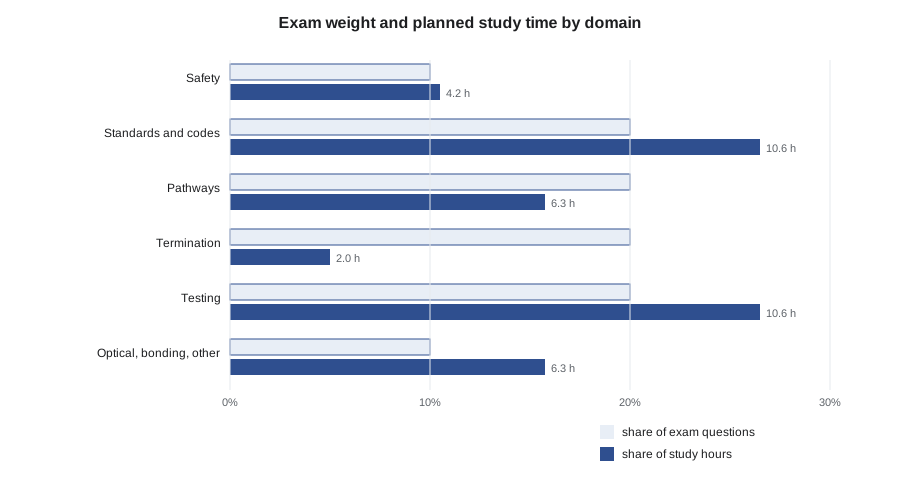
Two domains stand out for Maya: standards and testing, both heavily weighted and both rated 3. Termination is her strongest area, and it is tempting to keep practicing what she already does well, because it feels like progress. The plan has to push the hours toward the weak, heavy domains instead.
Turning weights into hours
A simple rule works well: hours for a domain are proportional to its weight times the gap between the self-rating and full marks. A heavy domain where the candidate is weak gets the most time; a light domain where she is strong gets the least, but never zero, because every domain needs at least a review. The code below does this for Maya's 40 hours over four weeks and Teo's 30 hours, keeping a floor of two hours for each domain.
# Share study hours by exam weight x knowledge gap, with a floor for every domain
domains = ["Safety", "Standards and codes", "Pathways and installation", "Termination", "Testing", "Fiber, bonding, other"]
weight = [0.10, 0.20, 0.20, 0.20, 0.20, 0.10]

def plan(name, ratings, hours, floor=2.0):
    gap = [(5 - r) / 4 for r in ratings]          # rating 5 means no gap
    prod = [w * g for w, g in zip(weight, gap)]
    spare = hours - floor * len(domains)
    total = sum(prod)
    print(f"{name}: {hours} h")
    for d, p in zip(domains, prod):
        h = floor + (spare * p / total if total else 0)
        print(f"  {d:26s} {h:5.1f} h  " + "#" * round(h))

plan("Maya", [4, 3, 4, 5, 3, 3], 40)
plan("Teo", [3, 2, 3, 3, 1, 2], 30)Maya: 40 h Safety 4.2 h #### Standards and codes 10.6 h ########### Pathways and installation 6.3 h ###### Termination 2.0 h ## Testing 10.6 h ########### Fiber, bonding, other 6.3 h ###### Teo: 30 h Safety 3.3 h ### Standards and codes 6.0 h ###### Pathways and installation 4.7 h ##### Termination 4.7 h ##### Testing 7.3 h ####### Fiber, bonding, other 4.0 h ####
Maya's plan sends more than half her hours to standards and testing. Teo's spreads more evenly, because he is weaker everywhere, with testing at the top. Neither plan is fixed: after each practice test, the self-ratings are replaced by the practice scores for each domain and the hours are recalculated. That turns the plan from a guess into a feedback loop.
Methods that work
Some study methods feel productive and are not; others feel hard and work. The evidence on learning is clear on a few points, and they match what experienced trainers see.
- Retrieval practice. Testing yourself, by answering questions or explaining a topic from memory, builds memory far better than rereading notes. Rereading feels easy because the material is familiar on the page, but familiarity is not recall. Every study session should end with a few minutes of questions answered without looking.
- Spacing. Studying a topic in several short sessions spread over days beats one long session, even if the total time is the same. Forgetting between sessions is part of the process: each time a fact is recalled after some forgetting, it is stored more firmly.
- Interleaving. Mixing topics in a practice session, for example a fill calculation, then a code rule, then a test result, is harder than doing ten fill calculations in a row, but it trains the skill the exam needs: recognizing which kind of problem is in front of you.
- Worked examples, then problems. For calculations, study a worked example step by step, then do a similar problem without looking, then check. The review lessons in this course follow that pattern.
- Explaining. Explaining a topic aloud, to a study partner or an empty truck cab, shows quickly where understanding stops. Maya explains testing parameters to Teo; it helps him, and it shows her what she does not yet know.
Highlighting, rewriting notes neatly and watching long videos without pausing to answer anything are the common low-value methods. They are not useless, but they should take a small share of the time.
Spaced repetition with flashcards
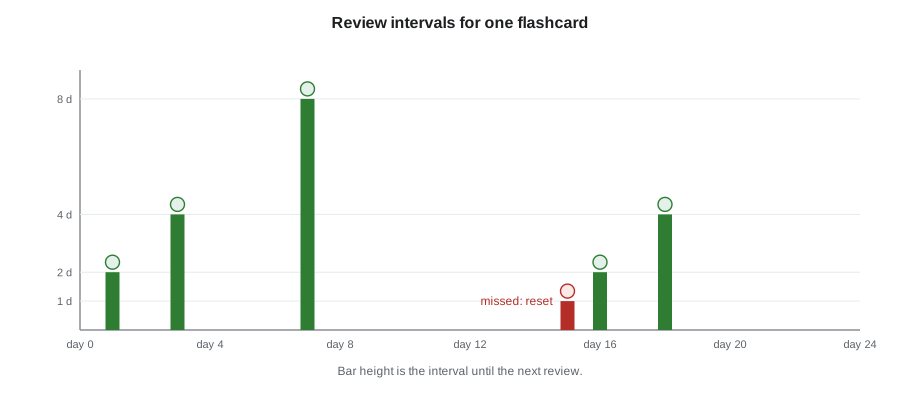
Facts that must be recalled exactly, such as limits, distances, color codes and code section numbers, suit flashcards. A spaced repetition system schedules each card based on how well it was remembered last time: a card answered correctly comes back after a longer interval; a card answered wrongly comes back the next day. Over a few weeks, easy cards appear rarely and hard cards often, so time goes where it is needed. Paper cards in boxes work, and so do the many free apps. The scheduling rule is simple enough to write in a few lines.
# A simple spaced repetition schedule: double the interval after a correct recall, reset to 1 day after a miss
def schedule(card, results, start_day=1):
    day, interval = start_day, 1
    for ok in results:
        mark = "right" if ok else "MISS"
        print(f"  day {day:2d}: {mark:5s}", end="")
        interval = interval * 2 if ok else 1
        day += interval
        print(f"  next review in {interval} day(s), on day {day}")

print("Card: maximum untwist at a Category 6A termination")
schedule("untwist", [True, True, True, False, True, True])Card: maximum untwist at a Category 6A termination day 1: right next review in 2 day(s), on day 3 day 3: right next review in 4 day(s), on day 7 day 7: right next review in 8 day(s), on day 15 day 15: MISS next review in 1 day(s), on day 16 day 16: right next review in 2 day(s), on day 18 day 18: right next review in 4 day(s), on day 22
The doubling rule in the code is the simplest version; apps use more refined formulas but the same idea. For an exam four weeks away, a card that keeps doubling from one day will be seen five or six times, which is enough for most facts if each review is a real attempt to recall before looking.
Building the schedule
A plan needs to fit around work. Maya works full days and has a family; long weekend sessions do not happen. Her plan uses short weekday sessions and one longer session on Saturday mornings.
| Day | Session | What |
|---|---|---|
| Mon to Thu | 45 minutes after supper | One domain from the plan; end with 10 questions without notes |
| Lunch breaks | 15 minutes | Flashcards due that day |
| Saturday | 2.5 hours | Mixed practice test of 40 to 50 questions, then review of every wrong answer |
| Sunday | Off | Rest; memory consolidates during sleep and breaks |
| Week 4 | Lighter | Mixed practice, flashcards, no new material in the last three days |
Teo, who is younger and has more evenings free, overloads his plan at first and burns out in week one. Dev's advice to him is the same as for a long pull: steady tension beats jerking the rope. Two focused 45-minute sessions are worth more than an exhausted three-hour one.
Reviewing wrong answers
The most valuable part of a practice test is the review of wrong answers, and most candidates skip it. For every miss, Maya writes one line in a mistake log: the topic, why she got it wrong, and what the right answer rests on. Her reasons fall into a handful of categories, and the categories tell her what to change.
- Did not know it: add the fact to flashcards and study the topic.
- Knew it but misread the question: slow down on the stem, watch for except and maximum.
- Calculation error: redo the calculation fully and find the step that went wrong.
- Confused two similar rules: make a comparison card with both rules side by side.
- Changed a right answer to a wrong one: trust the first answer unless there is a clear reason to change it.
After two weekends, Maya's log shows that a third of her misses were misreadings, mostly in long scenario questions. That is good news: it is the easiest kind of miss to fix, by technique rather than more study.
Worked problem
Recalculating the plan after a practice test
After week one, Maya scores the following on a 45-question mixed practice test: safety 4 of 5, standards 5 of 9, pathways 7 of 9, termination 9 of 9, testing 5 of 9, other systems 2 of 4. She has 30 hours left.
Show solution
- Convert to percentages: safety 80, standards 56, pathways 78, termination 100, testing 56, other 50.
- Use 1 minus the score as the gap: safety 0.20, standards 0.44, pathways 0.22, termination 0.00, testing 0.44, other 0.50.
- Multiply by weight: safety 0.02, standards 0.089, pathways 0.044, termination 0, testing 0.089, other 0.05.
- Give each domain the 2-hour floor (12 hours), then share the other 18 hours in proportion to those products (total 0.292).
Answer: Standards and testing each get about 7.5 hours, other systems about 5, pathways about 4.7, safety about 3.2 and termination the 2-hour floor. Other systems rose because the practice test showed a gap she had underrated.
Looking after the candidate
Memory and judgment depend on sleep, food and stress. In the last week Maya stops learning new material, keeps up flashcards and one practice test, and goes to bed at her usual time the night before. On exam day she eats before she goes, arrives early enough to find parking and the room, and does not cram in the hallway. None of this is mysterious, but candidates under pressure forget it, and a tired candidate misreads questions she would otherwise get right.
Anxiety is normal, and some is useful. If it becomes a problem, the practical fixes are rehearsal, such as doing full timed practice tests in conditions like the exam, so the real exam feels familiar, and a plan for the moment of panic: put the pencil down, take three slow breaths, skip to an easy question and come back.
Studying with others
Cobalt Line's study group meets for an hour every second Thursday during exam season. Its rules are simple. Every member brings two original practice questions on the evening's domain, written with four options and a short explanation, and the group answers them without notes before discussing. Members take turns explaining one topic in five minutes, which is the explaining method from earlier in this lesson with an audience. Wrong answers are discussed without embarrassment, because the point is to find gaps before the exam does. Writing questions turns out to be one of the best ways to learn: to write good distractors, a candidate has to understand exactly how a topic is misunderstood.
The group also keeps its question bank honest. Each question is tagged with the reference section it comes from, and when a standard changes, the questions on that section are checked and rewritten. A question bank that teaches an old limit does more harm than good.
Common mistakes
MistakeSpending most study time on strong topics because it feels good.
InsteadSend hours to heavy domains where the score is low.
MistakeRereading notes as the main method.
InsteadUse retrieval practice: answer questions and explain from memory.
MistakeCramming in one long session before the exam.
InsteadSpace short sessions over weeks.
MistakeTaking practice tests without reviewing wrong answers.
InsteadLog every miss with its cause and fix the cause.
MistakeLearning new material the night before.
InsteadStop new material a few days out; review and rest.
Summary and key terms
- A study plan is a project schedule: scope from the blueprint, tasks, duration and progress measures.
- Share hours by domain weight times the knowledge gap, with a floor for every domain.
- Retrieval practice, spacing, interleaving and worked examples are the methods that work.
- Spaced repetition schedules each fact by how well it was recalled; missed cards come back soon.
- Review every wrong answer and classify the cause; misreadings are fixed by technique.
- Sleep, food and rehearsal under exam conditions protect performance.
- Retrieval practice
- Recalling information from memory, for example by answering questions, to strengthen learning.
- Spacing
- Spreading study of a topic over several sessions separated by time.
- Interleaving
- Mixing different kinds of problems in one practice session.
- Spaced repetition
- A flashcard schedule in which review intervals grow after each successful recall.
- Mistake log
- A record of wrong practice answers with their causes.
Practice problems
Work each problem on paper first, then reveal the answer to check.
Why does rereading notes feel more effective than it is?
Show answer
Familiarity on the page is mistaken for the ability to recall.
In a simple spaced repetition scheme, what happens to a card answered wrongly?
Show answer
Its interval resets to one day.
How should study hours be shared between domains?
Show answer
In proportion to the domain's weight times the knowledge gap, with a floor for each.
What should a candidate do in the last three days before an exam?
Show answer
Review and practice, but learn no new material, and rest.
Lesson quiz · 5 questions
Score 60% or more to complete this lesson.
Create a free account to save your progress, take quizzes and earn a certificate.