
LES-214 · Lesson 8 of 12 · 20 min
Major events and mass gatherings
▶ Video coming soon A video version of this lesson is on the way.
At 22:17 on Saturday, August 1, 2026, five minutes after the last Harbourfest fireworks burst over the water, about twelve thousand people began moving toward Pier Street, the shortest route from the waterfront to the downtown parking garages and the bus loop. Pier Street is six meters wide between the old warehouses. By 22:24, a police observer on the roof of the harbourmaster's building reported over the radio that the crowd at the top of Pier Street was 'packed shoulder to shoulder and not moving', and that people near the front were pushing back against the people behind them.
Captain Ruth Abara, the police lead in the event's unified command post, made two decisions in the next three minutes. She asked the event's crowd manager to open the Harbor Lane gates, a second exit that had been kept closed to reduce the number of security staff needed, and she asked the public address announcer to tell people at the back of the crowd that Pier Street was full and to use Harbor Lane or wait at the waterfront for twenty minutes. By 22:31 the density at the top of Pier Street had begun to fall. Nobody was hurt. Desjardins tells the class that Harbourfest went well, and that it came closer to going badly than most people who were there ever knew.
What makes major events different
A major event is a planned gathering large enough to strain the normal resources of the community: a festival, a concert, a sports championship, a parade, a large public celebration. Unlike most emergencies, major events are known about in advance, which means there is time to plan. That is both an advantage and a responsibility. When something goes wrong at a planned event, the question afterward is usually not whether it could have been foreseen, but why it was not prevented.
Responsibility for safety at an event is shared. The organizer is responsible for running a safe event, including the site, stewards and private security, first aid, and the crowd management plan, and usually needs permits from the municipality. The municipality controls roads, parks, permits and bylaws. Fire, paramedic and public health services set requirements in their areas. Police are responsible for public safety and order in public places, traffic beyond the site, criminal matters, and supporting the organizer and other agencies. Many services also provide officers paid by the organizer for duties on the site. Clear agreements about who does what are the foundation of the plan.
Planning a major event
Planning for Harbourfest started in January. An event planning committee chaired by the city's special events office met monthly and included the organizer, police, fire, paramedics, public health, transit, public works, the harbor authority and the main private security company. The plan they produced covered the site layout and capacity; entrances, exits and emergency routes; crowd management and stewarding; medical services and first aid posts; lost and found children; traffic, road closures, parking and transit; weather monitoring and the triggers for delaying or stopping the event; alcohol service and the licensed areas; communications, including radio channels and the public address system; public information; and the command structure on the day.
Like emergency response, event management uses incident command. Harbourfest had a unified command post in a trailer behind the main stage, with the event's own operations manager, a police inspector, a fire captain, a paramedic supervisor and a public works lead. Each had radio contact with their own people. A city representative linked the command post to the emergency operations center, which was on monitoring status all weekend in case the event turned into an emergency.
Desjardins stresses the value of tabletop exercises before the event. In June the planning committee spent an afternoon working through scenarios: a lost child, a medical emergency in the densest part of the crowd, a severe thunderstorm warning at 20:00, a suspicious package, a power failure during the fireworks. 'The storm scenario changed the plan,' Kowal says. 'We realized we had no way to tell thirty thousand people to leave the waterfront quickly. We added prerecorded announcements and a rule that the fireworks would be canceled if lightning was within ten miles at 21:30.'
How crowds behave
Popular accounts of crowd disasters often describe panic and stampedes. Research on crowds tells a different story. Most people in crowds behave sensibly and cooperatively, even in emergencies, and many help others. Deadly crowd incidents are usually caused not by panic but by density: too many people in too little space, often because more people are entering an area than can leave it. At very high densities, people cannot move independently. Pressure is transmitted through the crowd in waves, and people can be crushed or asphyxiated while standing, or fall and be unable to get up. The people at the front often have no idea why they are being pushed, and the people at the back have no idea that anyone is in danger.
Crowd crushes are rare but deadly, and recent history has many examples. Ninety-seven people died at Hillsborough stadium in Sheffield in 1989. Ten people died in a crowd crush at the Astroworld music festival in Houston in 2021. One hundred and fifty-nine people died in narrow streets in the Itaewon district of Seoul during Halloween celebrations in 2022, an event with no organizer and no ticketing. In each case, investigations pointed to failures in planning, monitoring and communication, not to the behavior of the crowd.
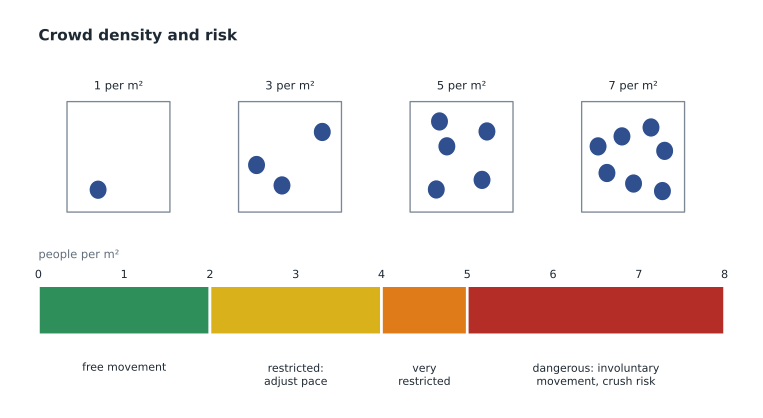
Crowd safety specialists commonly describe density in people per square meter. At about one or two people per square meter, people can walk freely. At about four, movement is restricted and people must adjust their pace. At around five and above, people have little control over their own movement, and the risk of crushing rises sharply, particularly if the crowd is moving or pushing. Officers do not need to count people; they need to recognize the signs. People touching on all sides. People unable to move in the direction they want. Faces showing distress, people being lifted or swayed, people shouting that they cannot breathe, people climbing barriers or walls to get out. These are signs that immediate action is needed.
Ingress and egress
The most dangerous moments at most events are when people arrive and when they leave, because large numbers move in the same direction at the same time. Exits must be wide enough for everyone to leave in a reasonable time, and routes must not narrow without warning. Planners estimate exit times using flow rates, the number of people who can pass through a meter of exit width in a minute. Guidance commonly used for planning gives figures of roughly eighty people per meter of width per minute on level ground in good conditions, and lower figures on stairs and slopes. Real flows are often lower, especially at night, with alcohol, or with families and strollers.
# Estimating how long a crowd takes to pass through an exit route
flow_per_m_per_min = 80     # rough planning figure for level ground
def minutes_to_clear(people, width_m, flow=flow_per_m_per_min):
    return people / (width_m * flow)

routes = {
    "Pier Street only (6 m)":            (12000, 6),
    "Pier Street + Harbour Lane (6+8 m)": (12000, 14),
    "Whole site, all exits (48 m)":       (38000, 48),
}
for name, (people, width) in routes.items():
print(f"{name:36} about {minutes_to_clear(people, width):4.1f} minutes")Pier Street only (6 m) about 25.0 minutes Pier Street + Harbor Lane (6+8 m) about 10.7 minutes Whole site, all exits (48 m) about 9.9 minutes
With only Pier Street open, twelve thousand people needed at least twenty-five minutes to pass through, even at the planning flow rate, and during that time the people still arriving at the top of the street were pressing against those who could not yet leave. Opening Harbor Lane cut the time by more than half. The plan had counted the total width of all exits correctly, but it had assumed that people would spread across them. They did not. They took the route they knew. Kowal says the after-action review led to two changes: all exits are now open from the start of the fireworks, and stewards with signs are posted at the waterfront end of each exit route to direct people before they reach the bottleneck.
Common problems at events
Most calls for service at major events are not about crowds or crime but about health and lost people. At Harbourfest, the first aid posts saw two hundred and twelve people over the weekend, mostly for minor injuries, heat illness and intoxication. Forty-seven were treated for heat-related illness on the Saturday alone, when the heat index reached 106 degrees Fahrenheit. Three were taken to hospital. The event had added extra water stations and shaded rest areas after public health issued a heat advisory on the Thursday.
Lost children are a near-certainty at a large family event. Harbourfest had a lost children post staffed by trained volunteers and a police officer, wristbands for young children with a parent's phone number, and a procedure that sent a description to all staff radios within minutes of a report. Nine children were reported lost; all nine were reunited with their families, the longest after thirty-five minutes. Desjardins notes that the procedure deliberately avoided broadcasting the child's description over the public address system, which can attract the wrong attention and frighten the child, and instead used staff radios.
Other common issues include alcohol-related disturbances, disputes at entrances, pickpocketing, people climbing onto structures for a better view, medical emergencies in places ambulances cannot reach, drones flown without permission, and weather. Police at events should be visible and approachable, should patrol in a way that lets them see crowd conditions, and should report concerns about density, structures or weather as soon as they notice them, even if they are not sure. The officer who reported 'packed shoulder to shoulder and not moving' at 22:24 was doing exactly that.
Weather and outdoor events
Weather is one of the biggest hazards at outdoor events, and it can change faster than a crowd can move. Lightning, high winds, heat and sudden heavy rain have all caused deaths and injuries at events, including the collapse of temporary stages in strong winds. Event plans should name the person who monitors the weather, the sources used, and the triggers for actions such as warning the crowd, delaying a performance, clearing a stage or a temporary structure, or stopping the event. Triggers should be set in advance and written down, because the pressure to keep a show going is strong once it has started.
At Harbourfest, the weather monitor was a city staff member in the command post with access to the National Weather Service's radar and a commercial lightning detection service. The decision to cancel or delay the fireworks belonged to unified command, but the trigger was not negotiable: if lightning was detected inside the set distance at 21:30, the fireworks would not go ahead. On August 1 the sky stayed clear, but on the Sunday afternoon a line of thunderstorms forced a forty-minute pause, during which the crowd was directed to the parking garages and the covered market. The prerecorded announcement written after the tabletop exercise was used for the first time.
Paid duty officers and private security
Many major events use a mix of on-duty police, officers working special duty for the organizer, and private security staff. Officers working special duty remain police officers with full powers and duties, and they remain bound by their service's policies; the organizer pays for their time but does not direct how they use their police authority. Private security staff have only the powers of the property owner they work for and of ordinary citizens. Good plans make the relationship clear: security staff and stewards handle ticket checks, bag checks, crowd direction and ejections from the site under the organizer's rules, while police deal with offenses, public safety in public spaces and anything requiring police powers.
Worked problem
Recognizing and reporting a dangerous crowd
You are on foot patrol at a concert in a park. As the headline act begins, you notice the crowd near the stage barrier becoming very dense. People are swaying together, a few are trying to climb out over the barrier, and you hear someone shouting that they cannot breathe. What should you do?
Show solution
- Treat it as an emergency: the signs indicate dangerous density.
- Report it immediately on the radio to the event command post, giving the exact location, what you see and hear, and asking for the show to be paused.
- Do not try to push into the crowd yourself; you will add to the pressure.
- Help stewards pull people out over the barrier from the front if that is safe, and direct people at the back of the crowd away from the stage.
- Support announcements from the stage or public address system telling people to step back, and keep reporting until the density falls.
Answer: Report immediately and ask for the show to be paused, avoid adding pressure, help relieve the front, and move people away at the back.
Common mistakes
MistakeCrowd disasters are caused by panic.
InsteadThey are usually caused by dangerous density from too many people in too little space.
MistakePeople at the front of a crowd can just move back.
InsteadAt high density they cannot move independently; the pressure comes from behind.
MistakeIf total exit width is enough, the crowd will leave safely.
InsteadPeople use the routes they know; plans must direct people to all exits.
MistakeLost child descriptions should be announced to the whole crowd.
InsteadStaff radios are often preferred, to protect the child.
Summary and key terms
- Major events are planned, so planning and prevention are expected; responsibility is shared between the organizer, the municipality and emergency services.
- Event plans cover site capacity, exits, crowd management, medical services, lost children, traffic, weather triggers, communications and command.
- Events use unified command, linked to the operations center, and benefit from tabletop exercises.
- Crowd disasters are usually caused by density, not panic; above about five people per square meter the risk rises sharply.
- Arrival and departure are the most dangerous moments; exit times can be estimated from flow rates, but people take familiar routes.
- Most event calls concern health and lost people; officers should report crowd, structure and weather concerns immediately.
- Heat index
- A measure combining temperature and humidity to describe how hot it feels.
- Crowd density
- The number of people per square meter in a crowd.
- Crowd crush
- An incident in which people are injured or killed by pressure in a very dense crowd.
- Flow rate
- The number of people passing through a unit width of exit per minute.
- Ingress and egress
- The arrival and departure of a crowd.
- Crowd manager
- The person responsible for crowd safety for the event organizer.
Practice problems
Work each problem on paper first, then reveal the answer to check.
What two decisions did Abara make at 22:24?
Show answer
She opened the Harbor Lane gates and had announcements direct people to Harbor Lane or to wait.
In the code example, how long would 12,000 people take to pass through Pier Street alone?
Show answer
About 25 minutes.
What change to the fireworks plan came from the June tabletop exercise?
Show answer
Prerecorded announcements and a rule canceling the fireworks if lightning was within 10 miles at 21:30.
How were lost child descriptions shared?
Show answer
By staff radios rather than the public address system.
Lesson quiz · 5 questions
Score 60% or more to complete this lesson.
Create a free account to save your progress, take quizzes and earn a certificate.