
LES-214 · Lesson 5 of 12 · 20 min
Public alerting and crisis communication
▶ Video coming soon A video version of this lesson is on the way.
At 00:22 on June 23, every mobile phone connected to a cell tower near Riverside Flats made a sound that most of their owners had only heard during tests. Desjardins puts the message on the screen. 'Emergency alert. Port Ardent: Kettle Creek is flooding. Leave Riverside Flats now, south of Front Street and east of Ridge Road. Go to Lakeview Community Center, 400 Lakeview Drive. Do not drive through water on any road. Information: portardent.gov/flood.'
Within ten minutes, Kowal says, the city's information line had taken more than three hundred calls, the communications team had answered two hundred messages on social media, and officers going door to door were finding many residents already packing. 'The alert did not replace knocking on doors,' she says. 'Some people sleep through it, some have no phone, some don't believe it. But it meant that when an officer knocked, the person who answered often already knew why.' This lesson covers how emergency warnings work, why they sometimes fail, and how police fit into the wider job of keeping the public informed during an emergency.
Why warnings fail
Decades of research on how people respond to warnings point to a consistent pattern. When people receive a warning, they do not usually act at once. They first try to make sense of it: Is it real? Does it apply to me? How bad is it? What are others doing? They look for confirmation from other sources, from neighbors, from the news, from looking out the window. This search for confirmation is sometimes called milling. It is a normal human response, and messages that anticipate it work better than messages that ignore it.
There are predictable reasons why warnings fail. They are too vague about where the danger is, so people outside the area worry and people inside it assume it means somebody else. They tell people about the hazard but not what to do. They come from a source people do not trust or recognize. They arrive through only one channel, so people who missed it never hear it again. They are only in one language. They are not accessible to people who are deaf, blind or have cognitive disabilities. Or they come too late to act on.
A widely used model of an effective warning says it should contain five things: the source of the message, the nature of the hazard, the location affected, the action people should take, and the time by which they should act or when the danger will arrive. Messages should be specific, consistent across channels, confident in tone, and repeated. If something is uncertain, say so, but say what people should do anyway.
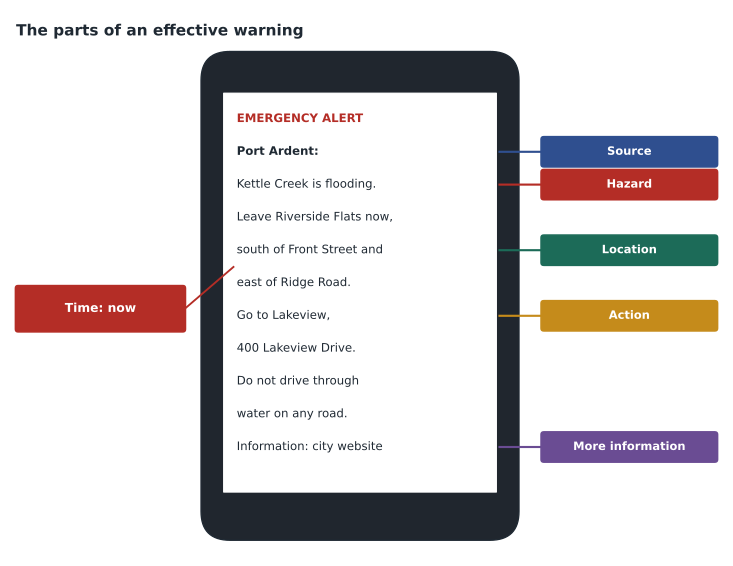
IPAWS, Wireless Emergency Alerts and the Emergency Alert System
FEMA's integrated public alert and warning system, known as IPAWS, is FEMA's national system for sending alerts through several channels at once. Authorized alerting authorities, which can include state and county emergency management agencies and some cities, send a message once through IPAWS, and it can go out as a Wireless Emergency Alert to phones in the targeted area, through the Emergency Alert System on radio and television, through NOAA Weather Radio and to other systems. Wireless Emergency Alerts were established by a federal law passed in 2006, the WARN Act. Under FCC rules adopted in 2016, messages on modern networks can be up to 360 characters, and alerts can include links and be sent in Spanish. The National Weather Service sends alerts directly for the most dangerous weather, such as tornado warnings and flash flood emergencies.
Port Ardent is not itself an alerting authority, so the alert was sent by the county emergency management agency. The city's plan contained pre-written templates for floods, chemical releases and boil-water advisories, with blanks for the location and instructions. At 00:12 Kowal filled in the flood template and sent it to the county duty officer, who issued the alert at 00:22. The ten minutes were spent checking the boundaries of the area and the wording.
# Checking a draft alert: length and the five essential parts
alert = ("Emergency alert. Port Ardent: Kettle Creek is flooding. Leave Riverside Flats now, "
         "south of Front Street and east of Ridge Road. Go to Lakeview Community Center, "
         "400 Lakeview Drive. Do not drive through water on any road. Information: portardent.gov/flood.")
print("characters:", len(alert))
print("words:", len(alert.split()))
parts = {
    "source":   "Port Ardent",
    "hazard":   "flooding",
    "location": "Riverside Flats",
    "action":   "Leave",
    "more information": "Information:",
}
for part, phrase in parts.items():
print(f"{part:17} {'present' if phrase in alert else 'MISSING'}")characters: 256 words: 39 source present hazard present location present action present more information present
The draft passes the checklist and is under 300 characters, short enough to read in a few seconds. Kowal points out one thing the checklist cannot test: whether people will understand the boundaries. 'South of Front and east of Ridge works for people who live there,' she says, 'but a lot of people don't know which way is east at midnight. In the next version of the template we're adding a landmark, like "the Riverside Flats neighborhood around the arena".'
Other ways to reach people
No single channel reaches everyone. Port Ardent used at least eight during the flood: the wireless alert, radio and television, the city's website and social media, a recorded message on the information line, local radio interviews with the mayor, door-to-door notification by police and firefighters, loudspeakers on patrol cars and fire trucks driving slowly through the streets, and phone calls to facilities such as the seniors' residence and a group home on Elm Street. Volunteers from a local mosque and a Vietnamese community association helped share messages in other languages.
Door-to-door notification is slow and labor-intensive, but it is the most reliable method for people who have not heard or believed other warnings, and it lets officers see who needs help. During the flood, evacuation teams worked in pairs, knocked loudly, waited, and marked each house with chalk on the sidewalk: a line for contacted and leaving, a cross for no answer, and a circle for refused, with the address written in their notebooks. The planning section collected the results every hour.
Loudspeaker announcements should be short, repeated and spoken slowly: what is happening, what to do, where to go. Officers should stop periodically, because messages from a moving car are easy to miss. Desjardins reminds the class that sirens and horns tell people something is wrong but not what to do; they need to be followed by spoken or written instructions.
Public information during an emergency
Issuing warnings is only part of the communication job. Once an emergency is under way, the public, the media and elected officials all want information, and if official sources do not provide it, rumors will. The ICS public information officer coordinates messaging, and when several agencies are involved, they may form a joint information center so that the public hears one consistent story. Police have their own communications staff, but in a community emergency, police messages should be coordinated with the overall message so that agencies do not contradict each other.
Some information should never be released casually. Names of people killed or seriously injured should not be released until next of kin have been notified. Unconfirmed casualty numbers should be described as preliminary. Details of an evacuated area that would help thieves should be kept general. And officers at a scene should refer media questions to the designated spokesperson rather than speculating.
Rumors spread fastest when people are frightened and information is scarce. At about 01:30 a post began circulating that the dam upstream on Kettle Creek had failed. There is no dam on Kettle Creek; the post seems to have mixed up an older story about another town. Within twenty minutes the city posted a correction, the mayor mentioned it in a radio interview, and officers at the reception center were told so they could answer questions. Kowal says the speed of the correction mattered more than its wording. 'Fill the gap before someone else does,' she says.
The media at the scene
The media have no special right of access to dangerous areas, but the First Amendment protects newsgathering in public places, including filming police. Officers may keep reporters and photographers out of a hazard area or an active perimeter for safety and to protect evidence, but should not use a perimeter to stop lawful reporting, seize cameras without lawful authority, or demand that images be deleted. Many services designate a media area with a good view and a regular briefing schedule, which serves safety and good relations at the same time.
Accessible and multilingual warnings
Alerts must reach people who cannot hear a siren, read a text message or understand the language it is written in. Port Ardent's plan keeps a voluntary register of residents who need extra help in an emergency, such as people who use oxygen or wheelchairs, are deaf or have low vision, and shares it with police and fire during an activation. During the flood, officers used it to prioritize eleven homes in the evacuation zone. Messages on the city's website were posted in plain language and in the five languages most spoken in the city after English, and the information line offered interpretation. Desjardins tells the class that officers going door to door should be ready to communicate with a notepad or a phone screen, to speak slowly and face the person, and to check that their instructions have been understood rather than assuming they have.
False alarms and warning fatigue
Alerting systems depend on trust, and trust is damaged when alerts are wrong. On January 13, 2018, a false ballistic missile alert was sent to phones across Hawaii during a shift change at the state emergency management agency; it took about 38 minutes for a correction to go out, and the event led to changes in how alerts are authorized and canceled. Two years later, in January 2020, an alert was sent in error to phones across Ontario about the Pickering nuclear station. Both events led to changes in procedures, including second-person checks before an alert is sent and pre-written corrections.
So-called warning fatigue is a related problem. If people receive frequent alerts for things that do not affect them, they start ignoring all alerts. That is one reason alerting authorities target alerts geographically, reserve the most intrusive alerts for imminent threats to life, and use other channels for less urgent information. Kowal says that the Riverside Flats alert was the first non-test emergency alert ever sent for Port Ardent. 'We want it to stay rare,' she says. 'When it goes off, we want people to act.'
Desjardins adds one practical point for officers. When a resident asks an officer whether an alert is real, the officer's answer carries weight. Officers should know what alerts have been issued for their area, which dispatch can tell them, and should confirm or correct quickly and consistently. An officer who shrugs and says 'I don't know anything about that' can undo the work of the whole alerting system for that household.
Finally, communication does not end when the danger passes. People need to know when it is safe to return, what to do about damaged property, where to get help and how to avoid scams. In the weeks after the flood, Port Ardent posted daily updates for the first week, then weekly ones, and held two public meetings in Riverside Flats where residents could ask questions of city staff, the police and the utility. Lesson 12 returns to recovery.
Worked problem
Correcting a rumor quickly
During a chemical release, a resident at a reception center tells you that people on social media are saying the water supply has been poisoned and that everyone should stop drinking tap water. You have heard nothing about the water supply. What should you do?
Show solution
- Do not confirm or deny on your own authority; you do not know.
- Tell the person that you have not heard that from officials and that you will find out, and suggest they wait for official information before acting on it.
- Report the rumor immediately to your supervisor so it reaches the public information officer and the operations center.
- The information team checks with the water utility and public health and, if the rumor is false, issues a correction quickly through all channels.
- Pass the official answer back to staff at the reception center so they can repeat it consistently.
Answer: Report the rumor quickly through the chain so officials can check it and issue a correction, and avoid speculating yourself.
Common mistakes
MistakeSending one alert is enough.
InsteadPeople need confirmation from several channels; repeat the message in different ways.
MistakeA siren tells people what to do.
InsteadSirens get attention; spoken or written instructions must follow.
MistakeOfficers should answer every media question at a scene.
InsteadRefer questions to the designated spokesperson and avoid speculation.
MistakeOfficers can keep the media away from any scene.
InsteadSafety perimeters are lawful, but they should not be used to stop lawful reporting.
Summary and key terms
- People who receive warnings look for confirmation before acting; good warnings anticipate this.
- An effective warning names the source, the hazard, the location, the action to take and the time.
- IPAWS sends alerts through Wireless Emergency Alerts, the Emergency Alert System and other channels; alerts can be up to 360 characters on modern networks.
- No single channel reaches everyone; door-to-door notification remains essential for people who have not heard or believed other warnings.
- Public messages should be coordinated, names withheld until next of kin are notified, and rumors corrected quickly.
- Perimeters can keep media out of danger but should not be used to stop lawful reporting.
- IPAWS
- FEMA's integrated public alert and warning system.
- Joint information center
- A location where agencies work together on public information.
- Milling
- The search for confirmation and meaning that people undertake after receiving a warning.
- Alerting authority
- An agency authorized to issue public alerts.
- Public information officer
- The person responsible for coordinating public messages for an incident.
- Common message
- A single, consistent message used by all agencies.
Practice problems
Work each problem on paper first, then reveal the answer to check.
What were the five essential parts of the Riverside Flats alert?
Show answer
Source, hazard, location, action and where to find more information, with the time being now.
In the code example, how many characters did the alert have?
Show answer
Fewer than 300 (the output gives the exact count).
What did the chalk circle mean on a sidewalk during the flood?
Show answer
The resident refused to leave.
How did the city handle the rumor about a dam failure?
Show answer
It posted a correction within twenty minutes, the mayor mentioned it on radio, and staff were told.
Lesson quiz · 5 questions
Score 60% or more to complete this lesson.
Create a free account to save your progress, take quizzes and earn a certificate.