
LES-214 · Lesson 4 of 12 · 20 min
Emergency operations centers and interagency coordination
▶ Video coming soon A video version of this lesson is on the way.
While Sergeant Haddad and Captain Moreno ran Willow command on the street, a different kind of response was taking shape three kilometers away in a windowless room on the second floor of Port Ardent Fire Headquarters. Kowal had opened the city's emergency operations center at 23:50 on June 22, on a partial activation, and called it to full activation at 00:30. By one o'clock there were nineteen people in the room: the mayor and the city manager, the fire chief, a police representative, public works, social services, public health, the transit authority, the electric utility, the county engineer, the school board, the county EMS coordinator, the communications team and Kowal's own staff.
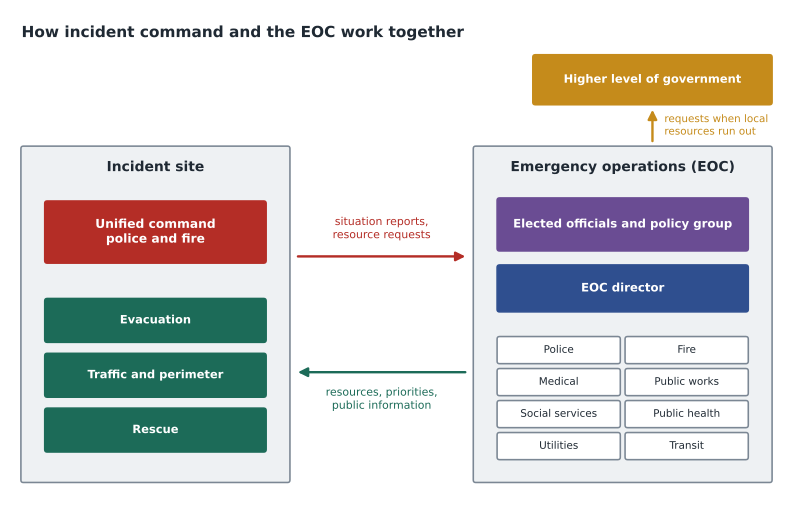
'The command post runs the incident,' Kowal tells the class. 'The operations center supports it and runs everything else. Haddad could see Willow Lane. She could not see that the utility was about to cut power to the whole east side, that the school board had three buses and drivers ready, that the hospital wanted to know how many patients were coming, or that the mayor was being asked by the media whether the city was going to declare an emergency. That is our job.'
What an emergency operations center does
An emergency operations center is a location where officials from different agencies gather to coordinate the response to an emergency and support those working at the scene. It does not usually direct tactical operations; that remains with incident command at the site. Instead it handles the wider picture: setting overall priorities when there are several incidents, finding and allocating scarce resources, making policy decisions, managing public information for the community as a whole, maintaining essential services, and keeping senior officials informed. Where there is one site, the center supports it; where there are several, it sets priorities between them.
In Ohio, emergency operations centers are often run by the county emergency management agency, with cities either joining the county center or running their own. Many are organized using ICS functions, with a center director and sections that mirror the site, while others use an emergency support function model in which each agency group covers a function such as transportation, communications or mass care.
Activation levels
Most operations centers have several levels of activation, so they can scale up and down like the incident command structure. A typical scheme has monitoring, in which the coordinator watches a developing situation such as a storm forecast and keeps partners informed; partial activation, in which a few key agencies staff the center; and full activation, in which all agencies with roles in the plan are present. Kowal had been monitoring since 16:00 on June 22, when the weather service upgraded its rainfall alert and the creek forecast called for rising levels overnight. She sent a heads-up message to the duty inspector, the fire chief and public works at 18:00 and moved to partial activation when Okeke's report came in.
Desjardins points out that this early monitoring was a form of preparedness. Because Kowal had warned partners in the afternoon, public works had barricades loaded on trucks, the duty inspector had kept two extra officers on after the evening shift, and the reception center at Lakeview had been told it might be needed. Nothing was certain at 18:00, but readiness cost little and saved a great deal of time later.
The police representative
Lieutenant Omar Siddiqui was the police representative in the operations center that night. Desjardins invites him to describe the role. 'I'm the link between the police service and everybody else in the room,' Siddiqui says. 'I need to know what police are doing everywhere in the city, not just at the flood, because we still had to answer every other 911 call. I need to be able to commit police resources, or get the decision quickly from someone who can. And I need to understand what the other agencies need from us, because often they don't know what police can do.'
Siddiqui lists the tasks he handled between midnight and seven in the morning. He arranged for six more officers to be called in from home. He asked the neighboring Bay Township police department for four officers under the mutual aid agreement to staff closures, so city officers could join the evacuation. He arranged police escorts for the buses carrying seniors' residence residents. He passed the list of residents who refused to evacuate to fire. He kept the duty inspector informed about calls elsewhere in the city. And he worked with the communications team on every public message that mentioned police, such as the warning that anyone driving around a barricade could be charged.
- Know the plan and the police role in it before the activation.
- Have the authority to commit police resources, or a fast way to get decisions.
- Keep a log of every request, decision and commitment, with times.
- Maintain the picture of police activity across the whole jurisdiction, not just the incident.
- Explain police capabilities and limits to other agencies.
- Coordinate public messages that involve police with the information team.
A common operating picture
The most valuable thing an operations center produces is a shared understanding of the situation, often called a common operating picture. Without it, each agency works from its own partial view, and decisions are made on different facts. In Port Ardent the picture was built from situation reports from the command post every hour, the utility's outage map, the county engineer's creek gauge readings, the social services count of people at the reception center, and the map of closures maintained by public works. All of it went onto a single screen at the front of the room and into a situation report that was sent to every partner and to the state.
Situation reports have a standard structure so they can be read quickly: the current situation, actions taken, current priorities, resources committed and needed, issues requiring decisions, and the time of the next report. They are short. The 03:00 report on June 23 was one page.
# Tracking resource requests from the command post to the EOC
requests = [
    # (time requested, item, quantity, time filled or None)
    ("23:58", "Buses able to carry wheelchairs", 3, "00:41"),
    ("00:05", "Officers for road closures",      4, "00:52"),
    ("00:20", "Rescue boats with crews",         2, "00:58"),
    ("00:35", "Portable lighting towers",        2, "01:46"),
    ("01:10", "Sandbags (pallets)",              6, None),
]
def minutes(t):
    h, m = t.split(":")
    return int(h) * 60 + int(m)
for asked, item, qty, filled in requests:
    if filled is None:
        print(f"{asked} {item} x{qty}: still open")
        continue
    wait = minutes(filled) - minutes(asked)
    if wait < 0:
        wait += 24 * 60
print(f"{asked} {item} x{qty}: filled after {wait} minutes")23:58 Buses able to carry wheelchairs x3: filled after 43 minutes 00:05 Officers for road closures x4: filled after 47 minutes 00:20 Rescue boats with crews x2: filled after 38 minutes 00:35 Portable lighting towers x2: filled after 71 minutes 01:10 Sandbags (pallets) x6: still open
The tracking table shows something every operations center learns: some requests take much longer than others, and some are never filled. The sandbag request at 01:10 was overtaken by events; by the time sandbags could have arrived, the water had already peaked. The planning section marked it canceled at 02:30. Tracking requests in this way lets everyone see what is outstanding and prevents the same request being made twice through different channels.
Working with partners
An emergency brings police into contact with organizations they rarely deal with on an ordinary shift. Kowal describes some of the most important.
Utilities decide when to cut power or gas to protect the public and when it is safe to restore them. Police often need to know because a power cut can disable traffic signals and affect the people sheltering in place. The National Weather Service issues forecasts, watches and warnings, and river forecasts for gauged streams; local engineers and floodplain managers know how high the water will go and where. School districts control buses and buildings that can be used for evacuation and shelter. Hospitals need warning of casualties and may need their own access routes protected. Volunteer organizations such as the American Red Cross and the Salvation Army run or support shelters, registration and family reunification, often under agreements with the county.
Desjardins adds that the police service itself must keep functioning during an emergency. That means continuity planning: knowing how to staff the patrol schedule when many officers are committed to the incident, how to keep the communications center running if the building loses power, and how to look after officers' families so officers can stay at work. Port Ardent's dispatch center ran on its generator from 01:12 to 05:40 on June 23. The generator had been tested monthly.
Policy decisions
Some decisions in an emergency are not operational but political, and they belong to elected officials. Whether to declare an emergency, whether to order an evacuation of a whole neighborhood, whether to close schools the next day, whether to spend money outside the approved budget: these are policy decisions, and the operations center exists partly to give elected leaders the information and advice they need to make them quickly.
At 00:05 on June 23, Kowal briefed the mayor on three options: continue the response without a declaration, declare an emergency for Riverside Flats only, or declare for the whole city. The fire chief, the police representative and public works each gave a view. Siddiqui told the mayor that police could enforce road closures under existing traffic powers but that an evacuation order would make door-to-door work clearer and give officers a firmer footing with residents who resisted. The mayor declared an emergency for the city at 00:15, with the order focused on Riverside Flats and the closures. Kowal says the decision took ten minutes because the options had been written into the plan and practiced in the spring exercise. 'Nobody in that room was seeing those choices for the first time,' she says.
Logs and records
Everyone with a role in the operations center keeps a log: a running record of information received, decisions made, requests sent and actions taken, each with the time. Logs serve three purposes. During the emergency they let people check what was decided and when. Afterwards they support the review of the response. And they provide the record needed for cost recovery and for any inquiry, lawsuit or coroner's investigation that follows. Officers should treat an emergency log with the same care as their notebook: written at the time, complete, and never altered after the fact except by a dated addition.
Siddiqui's log for the night ran to six pages. At 01:40 it records that the electric utility told him it intended to cut power to the east side at 02:15 to protect substations. He passed that to the command post and to dispatch, and asked public works to put portable signals at the two busiest intersections that would go dark. Without the log, he says, he would not have been able to explain the next week why officers had been directing traffic at Ridge and Front at half past two in the morning.
Standing down
Operations centers scale down as deliberately as they scale up. Agencies leave when their role is finished, the center drops to partial activation and then to monitoring, and the final situation report records what remains to be done and who is responsible. Port Ardent's center went to partial activation at 14:00 on June 23 and to monitoring on June 25. The mayor terminated the declaration on Monday, June 29, after the reception center had closed and the last residents had been able to return or find other accommodation. The recovery work, as later lessons show, went on for months.
Worked problem
Sending a resource request through the right channel
At a flood scene, a team leader tells you, the officer acting as the evacuation group supervisor, that they need two more boats. A firefighter nearby says he will just call his own station and get one sent. What should happen?
Show solution
- The request should go through the incident structure: from the team leader to you, from you to operations, and from operations to logistics or the command post.
- If the incident cannot fill it, the command post sends the request to the operations center.
- Direct calls to home stations bypass tracking: nobody knows the boat is coming, where it should go, or that the request has been filled, and two boats might arrive for one need.
- Ask the firefighter to send the request through the fire branch so it is tracked, or let the command post know immediately if it has already been made.
Answer: Send the request up through the incident structure so it is tracked and filled once, with the operations center taking it if the scene cannot fill it.
Common mistakes
MistakeThe operations center runs the scene.
InsteadIncident command runs the scene; the operations center supports it and coordinates the wider response.
MistakeOnly the incident matters during an emergency.
InsteadThe rest of the community still needs police; the representative must track the whole jurisdiction.
MistakeAgencies can call their own people directly for help.
InsteadRequests go through the incident structure so they are tracked and not duplicated.
MistakeThe operations center is only opened once a disaster is obvious.
InsteadMonitoring and early partial activation give partners time to get ready.
Summary and key terms
- An emergency operations center coordinates the wider response and supports incident command, which runs the scene.
- Centers activate at levels from monitoring to full activation, and early monitoring is a form of preparedness.
- The police representative links the service to other agencies, commits resources, keeps a log and tracks police activity everywhere.
- A common operating picture and short, structured situation reports keep everyone working from the same facts.
- Resource requests should be tracked from the scene to the center so they are filled once.
- Utilities, weather and water experts, schools, hospitals and volunteer agencies are key partners, and police must keep their own service running.
- Emergency support function
- A grouping of agencies responsible for one function, such as transportation or mass care.
- Emergency operations center
- A location where agencies coordinate the response and support the scene.
- Common operating picture
- A shared understanding of the situation among all agencies.
- Situation report
- A short, structured summary of the current situation, actions and needs.
- Activation level
- The degree to which an operations center is staffed, from monitoring to full.
- Continuity planning
- Planning to keep an organization's essential services running during an emergency.
Practice problems
Work each problem on paper first, then reveal the answer to check.
Why did Kowal send a heads-up message at 18:00?
Show answer
So partners could get ready: barricades loaded, extra officers kept on, the reception center warned.
In the code example, how long did the boat request take to fill?
Show answer
38 minutes.
What happened to the sandbag request?
Show answer
It was overtaken by events and canceled.
Name two things the police representative did during the flood.
Show answer
Arranged mutual aid officers and bus escorts, among others.
Lesson quiz · 5 questions
Score 60% or more to complete this lesson.
Create a free account to save your progress, take quizzes and earn a certificate.