
LES-214 · Lesson 12 of 12 · 20 min
Recovery, after-action review and responder wellness
▶ Video coming soon A video version of this lesson is on the way.
Three weeks after the flood, Officer Femi Okeke stopped sleeping well. He told Desjardins later that it was not the night itself that stayed with him, but one moment: the pickup's headlights swinging around the barricade at Mill Road, close enough to touch, and the thought, a second later, that he had nearly been killed and that the driver probably would be. The driver survived. Okeke went back to patrol the next night and worked normally for weeks. Then the dreams started. He talked to a peer support officer in August, saw a psychologist through the service's program in September, and by October he says he is sleeping again. He agreed to tell his story to the class because, he says, 'nobody told me this could happen after a call where everyone lived.'
The final lesson covers what happens after the response ends: recovery, which can take months or years; the review of what went well and what did not; and the wellness of the people who responded. It ends with the class's own review of Port Ardent's year.
Recovery
Recovery begins during the response and continues long after the last responder has gone home. In the short term it means restoring essential services, clearing debris, inspecting buildings, letting people return home safely and meeting the immediate needs of those who cannot. In the longer term it means repairing and rebuilding, supporting the local economy, helping people with the financial and emotional costs, and, ideally, rebuilding in ways that reduce the risk of the next event.
In Riverside Flats, one hundred and eighty-six homes had water in their basements, and fourteen had water on the main floor. Building inspectors checked every home on the main-floor list before residents moved back. The city ran free waste pickup for flood-damaged belongings for three weeks. Public health issued advice on cleaning up safely, including the risk of mold and contaminated water. The damage did not reach the thresholds for a federal major disaster declaration, so residents depended mainly on insurance, including flood insurance for those who had it, help from volunteer organizations, and low-interest disaster loans, which the federal Small Business Administration can offer to homeowners and businesses after some smaller disasters. The Riverside Seniors Residence reopened on August 18.
Kowal says recovery is where communities most often lose interest. 'On the night, everybody wants to help,' she says. 'Three months later, the man whose basement flooded is still fighting with his insurance company and living with his daughter, and nobody is calling him.' The city's recovery committee met every two weeks through the fall, tracking households still displaced and pushing for repairs to the culverts at Mill Road, which engineers found had been undersized for decades.
The police role in recovery
Police remain involved in recovery longer than people expect. They patrol areas where homes are empty or damaged. They manage traffic around repair work. They investigate crimes that follow disasters, which include thefts from damaged homes, fraud, and violence in households under severe stress. Fraud is a particular concern. After disasters, people posing as contractors take deposits for repairs they never do, scammers pretend to be government officials or insurance adjusters, and fake charities collect donations. Police can warn the public early, take reports seriously, and work with consumer protection agencies.
When an emergency causes deaths, police support the coroner and are responsible for notifying next of kin, in a way that is accurate, timely and humane. Where there are many deaths, identifying the victims can take time and involves specialists such as forensic pathologists, odontologists and DNA analysts working through a disaster victim identification process. Police also run the family assistance or inquiry process that collects information from relatives and reunites families, and they may lead or support investigations into whether the deaths involved any criminal or regulatory offense.
After-action reviews
Every significant response should be reviewed, so that what was learned is not lost. Reviews usually happen at two levels. A hot wash is a short, informal debrief held soon after the response, while memories are fresh, in which participants say what went well, what did not and what should change. An after-action review is a more structured process that gathers records, logs, recordings and interviews, compares what happened with what the plan said should happen, identifies strengths and areas for improvement, and produces an improvement plan with specific actions, owners and dates. In the United States, the Homeland Security Exercise and Evaluation Program provides a widely used method and templates for after-action reports and improvement plans, for both exercises and real incidents.
A good review focuses on the system, not on blaming individuals. The question is not 'who made the mistake?' but 'what about the way we were organized, trained, equipped or informed made that mistake likely, and what can we change?' People are more honest when they know the review is meant to improve the system, and honesty is what makes reviews useful. That does not mean misconduct is ignored; it is dealt with separately, through the usual processes.
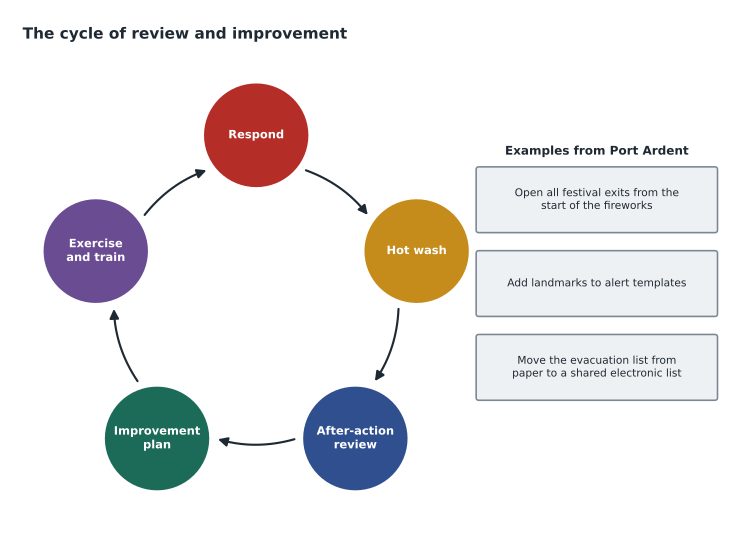
The Port Ardent reviews produced thirty-one improvement actions across the year's events. Kowal lists some of them. The culverts at Mill Road will be replaced, and the crossing will have automatic flood gates that lower when the water reaches the road. Alert templates now include a landmark. The evacuation tracking list is electronic. All Harbourfest exits open at the start of the fireworks, with stewards and signs at each one. The police service has added a struck-by awareness module to its annual training and bought more advance warning signs for patrol vehicles. And the plan now requires that the operations center confirm with the utility before any planned power cut during an emergency, after the east-side cut on June 23 surprised the command post.
Responder wellness
Emergency work exposes responders to danger, distressing scenes, long hours, disrupted sleep and the weight of decisions made under pressure. Most responders cope well with most events, especially with support from colleagues, family and their organization. But some develop lasting problems, including post-traumatic stress injuries, depression, anxiety and substance misuse, and the risk rises with repeated exposure over a career. Okeke's experience is common: a delayed reaction, weeks after an event, to a moment of personal danger rather than to the event as a whole.
Responders' organizations have learned a great deal about what helps. Before an event, training that explains normal stress reactions, and leaders who talk openly about mental health, make it easier for people to ask for help. During an event, rotating people out of the most demanding jobs, making sure they eat, drink and rest, and keeping shifts to manageable lengths reduce strain. After an event, checking in with everyone who was involved, offering confidential peer support and professional help, and watching for changes in behavior in the weeks that follow matter more than any single debriefing session. Research has found that compulsory, one-time psychological debriefings soon after an event do not reliably prevent later problems and may not suit everyone; voluntary support, offered over time, is generally preferred.
Since 2021, Ohio law has provided a fund that pays benefits to first responders disabled by post-traumatic stress disorder arising from their employment, even without a physical injury, which was previously required. Most police services now have peer support teams, employee assistance programs and access to clinicians who understand police work. Desjardins tells the class that using them is a sign of professionalism, not weakness. 'We expect officers to maintain their equipment,' he says. 'Your mind is the most important piece of equipment you carry.'
# Scoring Port Ardent's year against ten review areas (0 = poor, 1 = adequate, 2 = strong)
areas = {
    "Early warning and monitoring":          2,
    "Public alerting":                        2,
    "Incident command and span of control":   2,
    "EOC coordination":                       2,
    "Evacuation and accountability":          1,
    "Traffic and perimeter safety":           1,
    "Crowd management at Harbourfest":        1,
    "Hazardous materials awareness":          2,
    "Mass-casualty response and families":    2,
    "Responder wellness follow-up":           1,
}
total = sum(areas.values())
print(f"total: {total} out of {2 * len(areas)}")
for name, score in areas.items():
    if score < 2:
print("improve:", name)total: 16 out of 20 improve: Evacuation and accountability improve: Traffic and perimeter safety improve: Crowd management at Harbourfest improve: Responder wellness follow-up
The class review
For their final assignment, the students used the ten review areas above to score Port Ardent's year. They gave it sixteen out of twenty. The strongest areas were early warning, alerting, incident command and coordination, the hazardous materials response at Industrial Road, and the response to the school bus collision. The weaker areas were the paper-based accountability system during the evacuation, the danger to officers at traffic points shown by the Mill Road video, the Pier Street bottleneck at Harbourfest, and follow-up with responders: Okeke's experience showed that the service had checked on the firefighters and officers involved in rescues, but not on officers who had been at the closures.
Linh Tran presented the group's conclusion. 'Most of what went right was decided months before,' she said. 'The flood levels in the plan, the bus agreements, the alert templates, the tabletop exercise for Harbourfest, the guidebook in the glovebox. Most of what went wrong was something nobody had thought about yet, like where people would actually walk after the fireworks, or the officer at a closure who was nearly hit. So the job isn't just to respond well. It's to keep finding the things nobody has thought about yet.' Desjardins tells the class that this is as good a summary of emergency management as he has heard.
Exercises: closing the loop
Improvement plans matter only if the changes are tested. Exercises are how communities find out whether a new procedure works before they need it for real. They range from discussion-based exercises, such as seminars and tabletop exercises, in which participants talk through a scenario, to operations-based exercises, such as drills that test one function, functional exercises that test an operations center without moving people and equipment, and full-scale exercises with real responders on the ground. Ohio local programs must exercise their emergency operations plan at least once a year.
Port Ardent's exercise for 2027 is already planned. It will test the new electronic evacuation list and the revised alert templates in a scenario based on an ice storm, with a functional exercise of the operations center in February and a door-to-door drill in one neighborhood in April. Kowal has asked the police service to take part with real officers, not just a representative in the center. 'The best exercise I ever ran found that the radio channel we had assigned to evacuation teams didn't reach the bottom of Riverside Drive,' she says. 'We found that in an exercise. Imagine finding it on the night.'
Officers as part of the system
Desjardins ends the course where it began, with the idea that emergency management is mostly invisible work done in advance. Officers rarely write emergency plans or run operations centers, but they carry the plan onto the street. They are the ones who notice that a culvert is blocked, that a barricade keeps getting moved, that a care home's exit is chained, that a crowd at a regular event is getting denser every year. Reporting those things, through the right channel, is emergency management too. So is knowing the plan, taking training seriously, keeping a guidebook in the car, and looking after one another after a hard night.
Worked problem
Running a hot wash after a closure-heavy shift
You are the sergeant who supervised the traffic and perimeter group during an overnight flood response. It is 08:00, the next shift has taken over, and your eleven officers are tired. You have twenty minutes before they go home. How should you run a hot wash?
Show solution
- Bring the group together somewhere quiet, thank them, and explain that the purpose is to learn, not to find fault.
- Ask three questions: what went well, what did not go well, and what we should change next time. Let everyone speak.
- Record specific points, such as the barricade that was driven around and the near miss, and who raised them.
- Check on each officer individually, especially anyone involved in a close call, and remind everyone of peer support and the employee assistance program.
- Pass the notes to the after-action review team and follow up with officers in the following days.
Answer: A short, blame-free debrief focused on what went well, what did not and what to change, with individual check-ins and follow-up.
Common mistakes
MistakeRecovery ends when the water goes down.
InsteadRecovery can take months or years and needs continued attention.
MistakeReviews are for finding who made mistakes.
InsteadGood reviews focus on the system and produce specific improvements.
MistakeIf everyone survived, responders will be fine.
InsteadClose calls and personal danger can cause delayed stress reactions.
MistakeA single compulsory debriefing prevents stress injuries.
InsteadVoluntary support offered over time is generally preferred.
Summary and key terms
- Recovery runs from restoring services to rebuilding and reducing future risk, and often loses attention after the response.
- Federal assistance depends on declarations; after smaller events residents rely on insurance, volunteers and disaster loans.
- Police roles in recovery include patrols, traffic, investigating crimes and fraud, supporting death investigations and notifying families.
- Hot washes and structured after-action reviews should focus on the system and produce improvement plans with owners and dates.
- Responder wellness depends on preparation, support during the event and voluntary help offered over time.
- Ohio has provided a fund for first responders disabled by PTSD since 2021.
- HSEEP
- The Homeland Security Exercise and Evaluation Program.
- Recovery
- Restoring and rebuilding a community after an emergency.
- Hot wash
- A short, informal debrief held soon after a response.
- After-action review
- A structured review that compares what happened with the plan and identifies improvements.
- Improvement plan
- A list of specific actions, with owners and dates, arising from a review.
- Peer support
- Confidential support for responders from trained colleagues.
Practice problems
Work each problem on paper first, then reveal the answer to check.
What happened to Okeke after the flood?
Show answer
He developed delayed sleep problems and got help through peer support and a psychologist.
In the code example, what was the total score?
Show answer
16 out of 20.
Name two improvement actions from the Port Ardent reviews.
Show answer
Replacing the Mill Road culverts with flood gates, and adding landmarks to alert templates, among others.
What did the class find about responder follow-up?
Show answer
The service checked on rescuers but not on officers at the closures.
Lesson quiz · 5 questions
Score 60% or more to complete this lesson.
Create a free account to save your progress, take quizzes and earn a certificate.