
LES-214 · Lesson 3 of 12 · 21 min
Incident command: NIMS and the Incident Command System
▶ Video coming soon A video version of this lesson is on the way.
At 23:31 on June 22, eleven minutes after Officer Okeke's first report from Mill Road, Sergeant Haddad arrived at the corner of Willow Lane and Front Street. Fire Captain Luis Moreno pulled up behind her two minutes later. Desjardins plays the radio recording for the class. Haddad's voice is calm: 'Dispatch, Sergeant Haddad. I'm establishing Willow command at Willow and Front. Fire Captain Moreno is with me; we'll be unified command. Water is over Mill Road and rising on Willow Lane. Request public works for closures at Mill and Front, Mill and Ridge, and Willow and Elm. Notify the duty inspector and the emergency management coordinator.'
'In about forty seconds,' Desjardins says, 'she named the incident, said where the command post was, said who was in charge, gave a situation report and made three resource requests. Everybody listening knew who to talk to. That is what an incident management system is for.' This lesson explains the system Haddad was using, why it exists, and how it scaled up that night from two people on a street corner to an organization of more than a hundred and sixty responders.
Why incident management systems exist
Large emergencies have always strained the way agencies work together. In the 1970s, a series of major wildfires in California exposed recurring problems: agencies used different terms for the same things, radios could not talk to each other, nobody was sure who was in charge, plans changed without everyone knowing, and too many people reported to one supervisor while others had nobody to report to. Fire agencies developed the Incident Command System to fix those problems. It spread across emergency services, and today it or a close relative is the standard way to organize the response to almost any incident, from a single-vehicle crash to a disaster lasting weeks.
In the United States, the Incident Command System is part of the National Incident Management System, known as NIMS. NIMS, first issued after the September 2001 attacks and updated in 2017, gives all levels of government, non-governmental organizations and the private sector a common approach to managing incidents. Adopting NIMS is a condition of many federal preparedness grants, so Ohio state agencies, counties and cities have adopted it, and police officers receive basic ICS training as part of their preparation.
Core principles
The details vary between versions, but the core principles are consistent. Officers should know them well enough to use them without thinking.
- Common terminology: everyone uses the same names for roles, facilities and resources, and speaks in plain language on the radio rather than agency codes.
- Modular organization: the structure grows from the top down as the incident grows, and shrinks as it winds down. Only the parts that are needed are filled.
- Management by objectives: the people in charge set clear, measurable objectives for each period of the response, and every assignment supports them.
- An action plan: objectives, strategies and assignments are written down for each operational period, at first informally and later as a formal plan.
- Manageable span of control: each supervisor oversees a manageable number of people or units, usually three to seven, with five often treated as ideal.
- Unity of command: each person reports to one supervisor and only one.
- Unified command: when several agencies have responsibility, their leaders share command and agree on one set of objectives.
- Designated facilities: the command post, staging areas and other facilities have standard names and are announced so everyone can find them.
- Accountability: everyone who arrives checks in, and the incident knows who is on scene, where they are and what they are doing.
Kowal says the principle most often broken is accountability. 'Self-dispatching is the enemy,' she says. 'On a big night, off-duty officers, neighboring departments, volunteers and members of the public all want to help. If they show up and go to work without checking in, nobody knows where they are, and if something goes wrong you might not even know they are missing. Everyone checks in, every time.'
The structure
The command function is responsible for the whole incident. On a small incident one person holds it; on a larger one, the commander builds an organization beneath them. In ICS, the incident commander is supported by a command staff and a general staff. The command staff includes a public information officer, a safety officer and a liaison officer. The general staff includes four section chiefs: operations, planning, logistics, and finance and administration. Intelligence and investigations can be added as a separate function when needed.
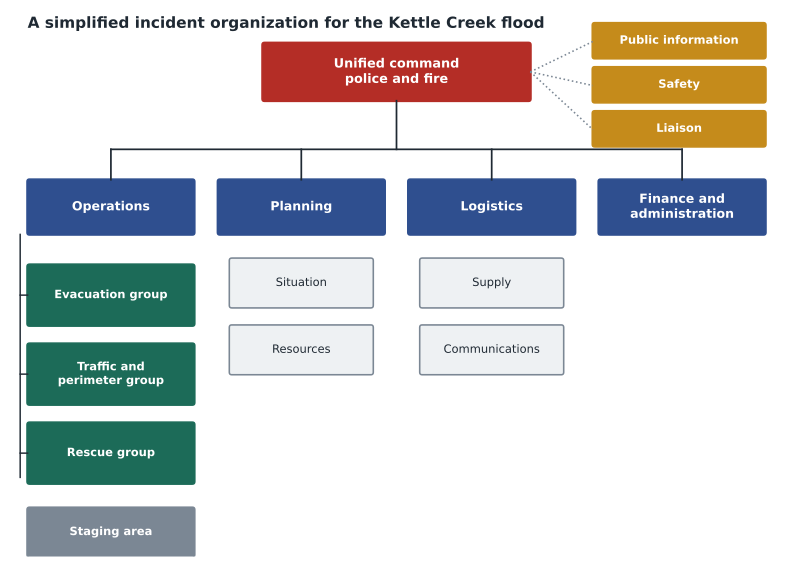
Operations carries out the work: evacuating, rescuing, closing roads, staffing perimeters. Planning collects and analyzes information, tracks resources, and prepares the action plan for the next period. Logistics finds and supplies what is needed: people, equipment, food, fuel, radios, toilets. Finance and administration tracks costs, time, purchases and claims, which matters later when the community seeks reimbursement or assistance. Public information prepares and releases information to the public and media. Safety watches for hazards to responders and has authority to stop unsafe actions. Liaison is the contact point for agencies that are helping but not part of the command.
As operations grows, it is divided further. Groups are organized by function, such as an evacuation group or a traffic group. Divisions are organized by geography, such as Division A for the streets north of the creek. Branches combine several groups or divisions when the span of control would otherwise be too large. Single resources, such as one patrol car with one officer, can be combined into task forces of different kinds or strike teams of the same kind, each with a leader.
By 01:30 on June 23, Willow command had grown to more than a hundred and sixty people. Haddad and Moreno remained in unified command. A police staff sergeant led an evacuation group of twenty-four officers and a dozen firefighters working door to door in four divisions. A traffic and perimeter group of eleven officers and public works crews staffed nine closures. A rescue group under a fire captain ran two boat teams. A staging area at the Front Street plaza held ambulances, buses and spare units. A safety officer from the fire service watched the water. Kowal, at the emergency operations center, handled everything the scene needed from outside it.
Span of control in practice
Span of control is easy to state and easy to break. A sergeant directing twenty officers spread across a neighborhood cannot track them all, answer their questions and still think about what comes next. The fix is to add a layer: put the twenty officers into four teams of five, each with a leader, so the sergeant supervises four people instead of twenty. The cost is a little more structure; the benefit is control.
# How many supervisors does a group need for a given span of control?
import math
def supervisors_needed(people, span):
    return math.ceil(people / span)

for people in (6, 12, 24, 60):
    for span in (5, 7):
        leaders = supervisors_needed(people, span)
        print(f"{people:3} responders, span {span}: {leaders} team leaders", end="")
        if leaders > 7:
            print(f", which needs {supervisors_needed(leaders, span)} more supervisors above them")
        else:
print()6 responders, span 5: 2 team leaders 6 responders, span 7: 1 team leaders 12 responders, span 5: 3 team leaders 12 responders, span 7: 2 team leaders 24 responders, span 5: 5 team leaders 24 responders, span 7: 4 team leaders 60 responders, span 5: 12 team leaders, which needs 3 more supervisors above them 60 responders, span 7: 9 team leaders, which needs 2 more supervisors above them
The output shows how quickly the structure has to grow. Twenty-four officers need five team leaders at a span of five; sixty need twelve, which is itself more than one person can supervise, so a further layer of supervision is needed. That is why large incidents have branches and why the incident organization chart can look complicated. Each layer exists to keep every supervisor's span manageable.
Objectives and the action plan
Management by objectives means deciding what the response must achieve, not just what everyone is doing. At 23:40, Haddad and Moreno agreed on three objectives for the first operational period, which they wrote on a whiteboard on the hood of the command vehicle: first, keep everyone out of moving water by closing the low crossings; second, evacuate Riverside Flats, starting with the seniors' residence and the streets nearest the creek, by 03:00; third, account for every household in the evacuation zone. Every assignment that night supported one of the three.
Good objectives are specific, measurable, achievable, realistic and time-bound, a standard often remembered by the acronym SMART. 'Deal with the flood' is not an objective. 'Evacuate the 64 residents of Riverside Seniors Residence to Lakeview by 01:30' is. The action plan for the next operational period, which began at 07:00, was written by the planning section overnight and set new objectives: complete accountability checks, maintain closures, begin damage assessment, and support the reception center.
Transfer of command
Command often changes hands as an incident grows. The first officer on scene is the incident commander until someone else takes over; at Mill Road, that was briefly Okeke. Haddad took command from him when she arrived, and at 00:20 the duty inspector, Ruth Abara, arrived. Abara chose not to take command from Haddad, who was managing well, but stayed at the command post as a senior adviser and the link to the police chief. Desjardins says that was a sound decision: rank alone is not a reason to change command, and every transfer costs time and information.
When command does transfer, it should be done face to face if possible and should cover the situation, the objectives, the resources on scene and on the way, the hazards, and any outstanding requests. The transfer is then announced on the radio so everyone knows who is in charge.
Incident facilities
Incident management systems give standard names to the places an incident uses, so that everyone arriving knows where to go. The incident command post is where command operates; it should be close enough to see or understand the scene but outside the hazard, and it should be easy to find. Haddad chose the corner of Willow and Front because it was on higher ground, on a main road, and visible to arriving units. A staging area is where resources wait until they are assigned, so that ambulances and buses do not clog the scene. A base or camp may be set up on longer incidents for rest, food and equipment. Other facilities, such as a helicopter landing zone, a decontamination area or a casualty collection point, are named as needed.
Each facility is announced on the radio and recorded on the incident map. Okeke remembers that one of the boat teams was sent to the wrong end of Willow Lane at about 00:40 because the staging area had moved from Front Street to the plaza without a radio announcement. The team lost about six minutes. Nobody was hurt, but the planning section added a rule for the rest of the night: any facility that moves is announced on every channel the incident is using.
Resources and check-in
Resources are described by kind and type so that requests are precise. Asking for 'some help' produces whatever is available; asking for 'two buses able to carry wheelchairs, to staging at Front Street plaza, for the seniors' residence' produces the right thing in the right place. Many jurisdictions use standard resource typing, so that a request for a particular type of boat team or patrol unit means the same thing across agencies.
When a resource arrives it checks in at the command post, the staging area or another check-in point, reporting who it is, what it can do, how many people it has and how it can be reached. The planning section tracks each resource as assigned, available or out of service. At 02:15, when a resident reported that her neighbor, an 82-year-old man named Arthur Penner, had not answered his door, the resources unit knew exactly which evacuation team had covered his street and when, and could send it back within minutes. Penner was found safe at a friend's house two streets away.
Common problems
Desjardins lists the problems that most often weaken incident command in practice. Command posts are set up too close to the hazard and have to move. Leaders get drawn into doing tasks themselves and stop managing. Different agencies set up separate command posts a block apart and run parallel incidents. Radio channels are overloaded because nobody assigns separate channels to different groups. Objectives are never written down, so people work from memory and assumption. And nobody plans for the next operational period, so the night shift arrives at dawn to find no plan and an exhausted first shift that has been on duty for twelve hours. Each problem has a simple fix in the system; the hard part is remembering to use it under pressure.
Worked problem
Transferring command at a growing incident
You are the first officer at a three-vehicle collision on a highway in heavy rain. You have closed the lanes, called for fire and paramedics and begun traffic control. A sergeant arrives and tells you she will take command. What should you tell her?
Show solution
- Situation: three vehicles, number of people involved and their condition, lanes closed, road conditions.
- Actions taken: closures, resources requested and their estimated arrival, any first aid given.
- Hazards: fuel leaking, traffic speed, poor visibility, power lines.
- Resources on scene and what each is doing, and anything still needed.
- Then confirm the transfer on the radio and take the assignment she gives you.
Answer: A short, structured briefing of the situation, actions, hazards and resources, followed by a radio announcement of the new commander.
Common mistakes
MistakeThe highest-ranking person on scene is automatically in command.
InsteadCommand transfers deliberately, with a briefing; rank alone is not a reason to change command.
MistakeIncident command is only for big disasters.
InsteadIt is modular and works for incidents of any size; it starts the moment the first unit arrives.
MistakeUnified command means nobody is really in charge.
InsteadAgency leaders share command and agree on one set of objectives, so there is one plan.
MistakeHelpful people can just start working.
InsteadEveryone checks in so the incident knows who is on scene and where.
Summary and key terms
- NIMS includes the Incident Command System, which local agencies must adopt for many federal grants.
- Core principles include common terminology, modular organization, management by objectives, an action plan, manageable span of control, unity of command, unified command and accountability.
- The main functions are command, operations, planning, logistics, finance and administration, and public information, with safety and liaison roles.
- Operations can be divided into groups by function, divisions by geography and branches above them.
- Span of control is usually three to seven; adding a layer of team leaders keeps it manageable.
- Objectives should be specific and measurable, and command transfers should be deliberate and announced.
- NIMS
- The National Incident Management System.
- Command staff
- The public information, safety and liaison officers who support the incident commander.
- Incident commander
- The person responsible for the whole incident until command is transferred.
- Unified command
- Shared command by the leaders of agencies with responsibility for the incident.
- Span of control
- The number of people or units one supervisor oversees.
- Operational period
- The time for which a set of objectives and assignments applies.
- Staging area
- A location where resources wait until they are assigned.
Practice problems
Work each problem on paper first, then reveal the answer to check.
What three objectives did Haddad and Moreno set at 23:40?
Show answer
Keep everyone out of moving water, evacuate Riverside Flats by 03:00, and account for every household.
In the code example, how many team leaders do 60 responders need at a span of five?
Show answer
Twelve, which in turn needs more supervisors above them.
Why did Inspector Abara not take command from Haddad?
Show answer
Haddad was managing well and a transfer would have cost time and information.
What is the difference between a group and a division?
Show answer
A group is organized by function; a division by geography.
Lesson quiz · 5 questions
Score 60% or more to complete this lesson.
Create a free account to save your progress, take quizzes and earn a certificate.