
LES-212 · Lesson 7 of 12 · 23 min
Trauma, memory and trauma-informed interviewing
▶ Video coming soon A video version of this lesson is on the way.
Brooks begins with two short transcripts on the screen, side by side, both from real interviews with names and details changed. In the first, an officer asks, 'Okay, start from the beginning. What time did you get to the party? Who drove? How many drinks did you have? Why did you go into the bedroom? Why didn't you just leave?' The answers get shorter and shorter until the woman says, 'I don't know. Maybe I'm wrong. Can I go?' In the second, the officer says, 'Tell me whatever you remember, in whatever order it comes to you. Take your time.' After a long pause the woman says, 'There was a fan on the ceiling. I kept looking at it. I couldn't move my arms.' The account that follows is longer, more detailed and more useful as evidence. 'Same kind of event,' Brooks says. 'Same kind of person. Very different interviews. The difference is not kindness, although kindness matters. The difference is that the second officer understood how memory works after trauma.'
This lesson covers what research tells us about how people respond to traumatic events and how they remember them, and how investigators can use that knowledge to interview victims in a way that is fair, humane and more likely to produce accurate and complete evidence. Desjardins adds a caution at the start. Trauma-informed interviewing is not about believing every account without question or giving up on testing evidence. It is about removing obstacles that prevent accurate accounts from being given, and about avoiding false judgments about credibility based on how a traumatized person behaves.
How people respond to threat
When a person faces a sudden, overwhelming threat, the brain's defense systems activate automatically, before conscious thought. Most people know about fight and flight. Fewer know that the most common responses to sexual assault are often freezing and a state researchers call tonic immobility, an involuntary paralysis in which a person cannot move or speak despite being conscious. A Swedish study published in 2017, led by Anna Möller, examined women who came to an emergency clinic after sexual assault and found that about seven in ten reported significant tonic immobility during the assault. The same study found that women who experienced it were more likely to develop post-traumatic stress disorder and severe depression in the following months.
Victims who froze often blame themselves afterward for not resisting, and they may be ashamed to tell investigators that they did not fight, scream or run. Investigators who do not understand freezing may wrongly read it as consent or as a sign the account is false. Other responses are also common: some victims try to placate or appease the abuser, some talk or act in ways that seem calm in order to survive, and some dissociate, feeling detached from their body or as if the event were happening to someone else. In intimate partner violence, victims may have learned over years that resisting makes things worse. None of these responses is evidence that the person consented or was not afraid.
How traumatic memories are formed and recalled
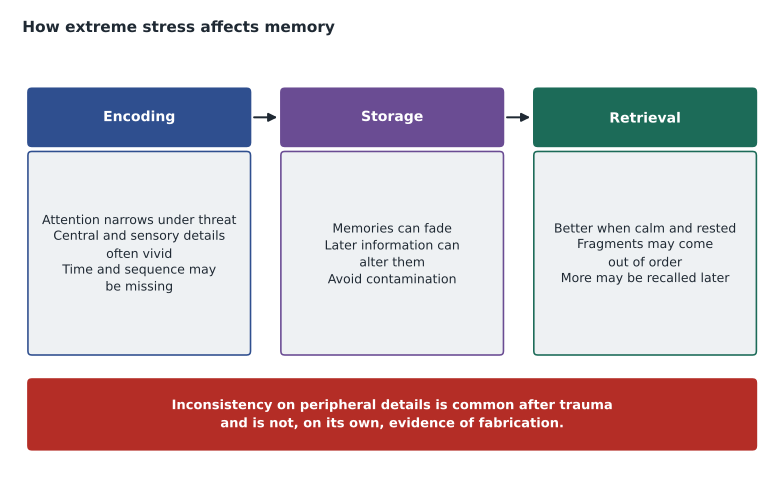
Memory is not a video recording. Every memory is built from what a person paid attention to at the time, stored imperfectly, and reconstructed when recalled. Extreme stress changes all three stages. During a traumatic event, attention narrows to what seems most important for survival, which may be the threat itself, or something the person fixes their eyes on while trying to endure it, such as a ceiling fan. These central details are often remembered vividly and for a long time. Peripheral details, such as what time it was, the order of events, what other people were wearing or what was said before and after, may be poorly encoded or not encoded at all. Sensory details, such as smells, sounds and physical sensations, are often remembered especially well.
As a result, survivors of trauma often give accounts that are fragmented, out of sequence, and incomplete on peripheral matters, and they may remember more over time, particularly after sleep and in a calm setting. These features are normal and are not, on their own, signs of fabrication. At the same time, Desjardins warns against overstatement. Memory after trauma is not uniquely unreliable or uniquely reliable; it is subject to the same processes as other memories, including forgetting and the influence of later information. Central details remembered from the start tend to be accurate. Details that emerge only after suggestive questioning, or that come from conversations with others, can be contaminated. Good interviewing protects the memory from contamination as much as it helps the person recall.
Alcohol and drugs add a further complication. At high levels, alcohol can prevent memories from being formed at all, a condition known as a blackout. A fragmentary blackout leaves islands of memory with gaps between them; a complete, or en bloc, blackout leaves no memory for a period. A person in a blackout may still be awake and able to walk and talk, so other people may not realize how impaired they are. A blackout does not by itself prove a person was incapable of consenting, but it is evidence of very heavy intoxication, and the inability to remember means that the investigation must rely on other evidence: witnesses, messages, video, toxicology and the accused's own statements. Victims who cannot remember often feel they cannot report. Investigators should reassure them that an investigation does not depend on a complete memory.
Principles of trauma-informed interviewing
Trauma-informed interviewing draws on decades of research on investigative interviewing, including the PEACE model developed by police in England and Wales in the early 1990s and widely used in Canada, and the cognitive interview developed by psychologists Ronald Fisher and Edward Geiselman, as well as more recent trauma-focused approaches such as the Forensic Experiential Trauma Interview. The approaches differ in detail, and some trauma-focused techniques have been criticized for limited research support, but they share common principles.
The first principle is preparation and timing. A victim who has just been assaulted may need medical care, rest, food and the support of a trusted person before a full interview. The first officer should gather only the information needed for immediate safety and evidence preservation, and a full interview should be arranged when the victim is ready, ideally within a few days, in a comfortable, private setting. The second principle is rapport and explanation. The interviewer should introduce themselves, explain what will happen, how the interview will be recorded and why, and that the victim can take breaks, decline to answer and ask questions. Giving the victim choices restores some of the control that was taken from them, and people who feel safe remember and say more.
The third principle is free recall first. The interviewer invites the victim to describe what happened in their own words and in their own order, without interruption, using open prompts such as 'Tell me everything you remember, even things that seem small' or 'What are you able to tell me about that night?' Silence is allowed. The interviewer listens and notes topics to return to later. The fourth principle is careful questioning. After free recall, the interviewer asks open questions to explore each topic: 'You said you couldn't move your arms. Tell me more about that.' Questions about sensory experience, such as what the person saw, heard, smelled or felt, often help recall. Specific closed questions are used only when needed, and leading questions, which suggest an answer, should be avoided. Questions that begin with 'why,' such as 'Why didn't you leave?', sound like blame and should be rephrased: 'What was going through your mind then?'
The fifth principle is to separate credibility from demeanour. Victims may be tearful, numb, angry, joking or calm, and none of these says whether the account is true. Inconsistencies in peripheral details are common, and an interviewer should explore them neutrally rather than treat them as lies. Credibility is judged at the end, against the whole of the evidence, not in the interview room. The sixth principle is closure. The interviewer should explain what happens next, give contact information, tell the victim that it is normal to remember more later and how to share it, and connect them with support. A follow-up interview a few days later often produces additional, accurate information.
Recording, interpreters and support
Interviews with victims of sexual and intimate partner violence should be video-recorded wherever possible. A recording preserves the account exactly, including the questions asked, which protects both the victim and the investigator from later disputes about what was said, and it can reduce the number of times the victim has to repeat their account. In the United States, recorded interviews with victims are used to preserve accounts and refresh memory, and recorded forensic interviews of children at child advocacy centers are used under each state's rules. Ohio courts have admitted some recorded child interviews under the hearsay exceptions and Rule 807, subject to the Confrontation Clause. Victims who are not fluent in English should be interviewed through a qualified, independent interpreter, never through a family member, a friend or, above all, the suspect.
A support person can help a victim feel safe, but the support person should not be someone who is a witness in the case, and they should not take part in the interview itself, because anything they say or suggest could affect the account. In the Reyes case, Maya Desai was a witness, so she waited outside while a victim services volunteer sat with Sofia before and after the interview.
The Reyes interview
Detective Sergeant Mendes interviewed Sofia on the afternoon of March 10 in the unit's soft interview room, which has couches, soft lighting and a recording system that is visible but not intrusive. Mendes told Sofia how the interview would work, that it was being recorded, that she could stop at any time, and that it was fine to say she did not remember something. Then she said, 'Tell me whatever you remember about Saturday night, in whatever order it comes. I won't interrupt.' Sofia spoke for eleven minutes, with long pauses. She described arriving at the party, drinking, dancing with Maya, and then a gap. She described the ceiling fan, the smell of laundry soap on the pillow, a song playing in another room, and not being able to move her arms or say anything. She said she did not know whether she had said no. Then she said, 'I don't know how I got in that room.'
Mendes followed up with open questions about each fragment, never suggesting details. When Sofia said she did not know whether she had said no, Mendes did not tell her it did not matter, which might have seemed to signal what the law required, but noted the point for the investigation and moved on. At the end, Mendes told Sofia that it was normal to remember more over the next few days, that she should write down anything that came back without trying to force it, and that she could call any time. Sofia called on March 15 to say she had remembered trying to text Maya. When Mendes examined Sofia's phone, with her consent, she found an unsent draft message to Maya, created at 2:14 a.m., that read 'cn u cme bak.' Mendes conducted a short second interview on March 17.
# Organizing fragments from two interviews into a working timeline, with sources and confidence
fragments = [
    ("00:30", "arrives at party with Maya", "interview 1", "high"),
    ("01:30", "Maya sees Sofia unable to stand", "Maya's statement", "high"),
    ("02:00", "Maya leaves; Brandon says he will keep an eye on her", "Maya's statement", "high"),
    ("02:14", "unsent draft 'cn u cme bak' created", "phone extraction", "high"),
    (None,    "ceiling fan, smell of laundry soap, cannot move arms", "interview 1", "central detail"),
    ("06:00", "wakes, leaves house", "interview 1", "high"),
    ("11:42", "Brandon's message: 'you were pretty out of it'", "phone", "high"),
]
timed = sorted([f for f in fragments if f[0]], key=lambda f: f[0])
for t, what, src, conf in timed:
    print(f"{t}  {what:58} [{src}; {conf}]")
print("untimed:", [f[1] for f in fragments if not f[0]])00:30 arrives at party with Maya [interview 1; high] 01:30 Maya sees Sofia unable to stand [Maya's statement; high] 02:00 Maya leaves; Brandon says he will keep an eye on her [Maya's statement; high] 02:14 unsent draft 'cn u cme bak' created [phone extraction; high] 06:00 wakes, leaves house [interview 1; high] 11:42 Brandon's message: 'you were pretty out of it' [phone; high] untimed: ['ceiling fan, smell of laundry soap, cannot move arms']
The timeline shows how other evidence can anchor a fragmented memory. Sofia could not say when she lost the ability to move or speak, but Maya's statement placed her severe intoxication at half past one, the draft message showed she was awake but barely able to type at 2:14, and Brandon's message showed what he observed. Desjardins points out that every item on the list came from a different source, which is exactly what a strong investigation looks like. 'Her memory is one piece of evidence,' he says. 'It is not the whole case, and it should never have to be.'
Interviewing in intimate partner violence cases
The same principles apply to victims of intimate partner violence, with some additional considerations. Victims may have experienced many incidents over years and may struggle to separate them or to date them; a calendar, a list of significant life events or the dates of messages can help. They may minimize, because the abuse has become normal or because they fear the consequences of disclosure. They may still love the abuser and feel conflicted about the investigation. They may fear losing their children. Interviewers should ask about the whole pattern, not only the latest incident, and about coercive and controlling behavior as well as violence. Detective Sergeant Mendes's second interview with Megan Hollis, on February 24, focused on the history. Using a calendar, Megan dated the first neck grab to February 2024 by remembering it had happened the week of Ava's fourth birthday, which matched the date of her quiet call to police.
Worked problem
Rephrasing questions
An officer's notes show these questions from an interview with a woman who says her partner assaulted her: 'Why didn't you call earlier?' 'Were you drinking?' 'Did you provoke him?' 'You're sure it was his hand and not something else?' How could the questions be rephrased?
Show solution
- 'Why didn't you call earlier?' sounds like blame. A better question is, 'What was happening for you between when it happened and when you called?'
- 'Were you drinking?' may be relevant, but it should be asked neutrally, at the right time, with an explanation: 'I ask everyone this so I have a full picture: had you or he had anything to drink or any drugs?'
- 'Did you provoke him?' implies she is responsible and should not be asked. If the lead-up matters, ask, 'What happened just before?'
- 'You're sure it was his hand and not something else?' is leading and suggests doubt. Ask, 'Tell me about what touched your neck,' and follow up on what she says.
- Each rephrased question invites a fuller, more accurate account without suggesting answers or implying blame.
Answer: Replace why-questions and suggestive questions with open, neutral prompts that invite her own account.
Common mistakes
MistakeA victim who froze must have consented.
InsteadFreezing and tonic immobility are common, involuntary responses to threat and are not consent.
MistakeFragmented or out-of-order accounts are signs of lying.
InsteadFragmentation and gaps in peripheral details are normal after trauma; explore them neutrally.
MistakeTrauma-informed means accepting every account without testing it.
InsteadIt means removing obstacles to accurate accounts and judging credibility against all the evidence.
MistakeA friend who was at the party should sit in on the interview for support.
InsteadA witness should not attend the interview; a neutral support person can help before and after.
Summary and key terms
- Freezing, tonic immobility, appeasement and dissociation are common, involuntary responses to threat.
- Under extreme stress, central and sensory details are often remembered well while peripheral details, timing and sequence may be missing.
- Alcohol blackouts can prevent memory formation while a person is still awake; investigations must then rely on other evidence.
- Trauma-informed interviews prepare carefully, build rapport, start with free recall, use open and sensory questions, avoid why-questions and leading questions, and close with support.
- Credibility should be judged against the whole of the evidence, not by demeanour or by inconsistencies in peripheral details.
- Interviews should be recorded, use independent interpreters, and be followed up, because victims often remember more later.
- Tonic immobility
- An involuntary paralysis in response to extreme threat, in which a person cannot move or speak.
- Dissociation
- A feeling of detachment from one's body or surroundings during or after trauma.
- Free recall
- The part of an interview in which the person describes events in their own words and order without interruption.
- Leading question
- A question that suggests the answer the interviewer expects.
- Blackout
- A period for which alcohol or drugs prevented memories from being formed, though the person may have been awake.
Practice problems
Work each problem on paper first, then reveal the answer to check.
What did the Möller study find?
Show answer
About seven in ten women seen after sexual assault reported significant tonic immobility, which was linked to later PTSD and depression.
Why did Maya Desai wait outside the interview room?
Show answer
Because she was a witness, and her presence could affect Sofia's account.
In the code example, what time was the unsent draft message created?
Show answer
2:14 a.m.
How did Megan date the first neck grab?
Show answer
By remembering it happened the week of Ava's fourth birthday, which matched her February 2024 call.
Lesson quiz · 5 questions
Score 60% or more to complete this lesson.
Create a free account to save your progress, take quizzes and earn a certificate.