
LES-212 · Lesson 1 of 12 · 24 min
Understanding intimate partner violence: dynamics, coercive control and impact
▶ Video coming soon A video version of this lesson is on the way.
Professor Desjardins begins the course with a short audio clip, played with the caller's permission and with identifying details removed. It is eleven seconds long. A woman's voice, low and quick, says, 'He's in the other room. I can't talk long. He took my phone again and he said if I call anyone he'll know.' The line goes quiet, then the call ends. Desjardins lets the silence sit for a moment. 'That call came in to Port Ardent dispatch two years ago,' he says. 'The officers who went to the house found no injuries, no damage and a calm man who said his partner had been drinking. They left after ten minutes. Nothing in that call was a crime by itself. Everything in it was a warning.'
This course is about the kinds of calls that police officers attend more often than almost any other violent call, and the kinds of crimes that are least likely to be reported: intimate partner violence and sexual assault. Desjardins tells the class that the course has two aims. The first is legal and practical: to know the offenses, the powers and the procedures well enough to act correctly at two in the morning in someone's kitchen. The second is harder. It is to understand how these crimes work, why victims behave the way they do, and how an officer's response can make the next call more or less likely to come in. 'Most of the mistakes I have seen in this area,' he says, 'were not mistakes of law. They were mistakes of understanding.'
He introduces his co-instructor for the course. Nadia Brooks has spent sixteen years in victim services and is now coordinator of the Port Ardent Police Department's victim advocate unit. The students know her from the victimology course. She will join every class, and she will bring in other guests: a detective sergeant from the department's intimate partner violence and sexual assault unit, a sexual assault nurse examiner (SANE), a shelter worker and a prosecutor. Brooks tells the students she has one request. 'Some of you will have lived through what we are going to talk about, at home or somewhere else. You do not have to tell anyone. Take a break when you need one. The supports are on the course page, and they are there for you as well as for the people you will serve.'
If anything in this course raises something for you, you can call or text 988 at any time to reach the 988 Suicide and Crisis Lifeline, call the National Domestic Violence Hotline at 1-800-799-7233, or call the National Sexual Assault Hotline run by RAINN at 1-800-656-4673. In an emergency, call 911.
What we mean by intimate partner violence
Intimate partner violence is abuse by a current or former partner: a spouse, a common-law partner, a dating partner or someone with whom the victim has had a sexual or romantic relationship, whether or not they live together. It includes physical violence, sexual violence, threats, stalking and harassment, and psychological, emotional and financial abuse. Family violence is a broader term that also covers abuse by parents, children, siblings and other relatives, and domestic violence is used in different ways in different places, sometimes to mean intimate partner violence and sometimes to mean all violence within a household. In Ohio, the domestic violence statute protects family or household members, a definition that includes spouses, former spouses, people living or who have lived together as spouses, parents and children, and other relatives who have lived with the offender, and Ohio protection order law also covers people in dating relationships.
Brooks asks the class who they picture when they hear the words. Most of the students describe a man hitting a woman in a home. That picture is accurate for a large share of the cases that reach police, and the most severe and lethal violence is overwhelmingly committed by men against women. But it is not the whole picture. Men are also victimized, sometimes by women and sometimes by male partners. Violence occurs in same-sex relationships at rates similar to or higher than in opposite-sex relationships. Older adults are abused by partners as well as by adult children. Teenagers experience dating violence. And the abuse that does the most lasting damage is often not the punch but the pattern around it.
Patterns, not incidents
The criminal law is built around incidents: a particular act, on a particular date, by a particular person. Intimate partner violence usually does not work that way. It is a pattern of behavior over time in which one partner seeks to dominate and control the other. A single assault may be the only part of that pattern that the law has traditionally recognized, but it is often not the most important part. The researcher Evan Stark described this pattern as coercive control in his 2007 book of that name: a strategic course of conduct in which an abuser uses some combination of violence, intimidation, isolation, degradation and control to take away a partner's liberty and sense of self. Many victims describe the control as worse than the violence.
Desjardins writes a list on the board and asks the students to imagine each item happening every day for a year. Checking a partner's phone and messages. Tracking her location through a shared account. Controlling all the money and requiring receipts for every purchase. Deciding which friends she may see and turning up when she sees them. Criticizing her in front of others until she stops going out. Threatening to leave with the children or to report her to child protection. Threatening suicide if she leaves. Damaging things she values. Hurting a pet. Pushing or grabbing, rarely enough that each time can be explained away. 'None of these, on its own, is necessarily a crime,' he says. 'Together they are a cage.'
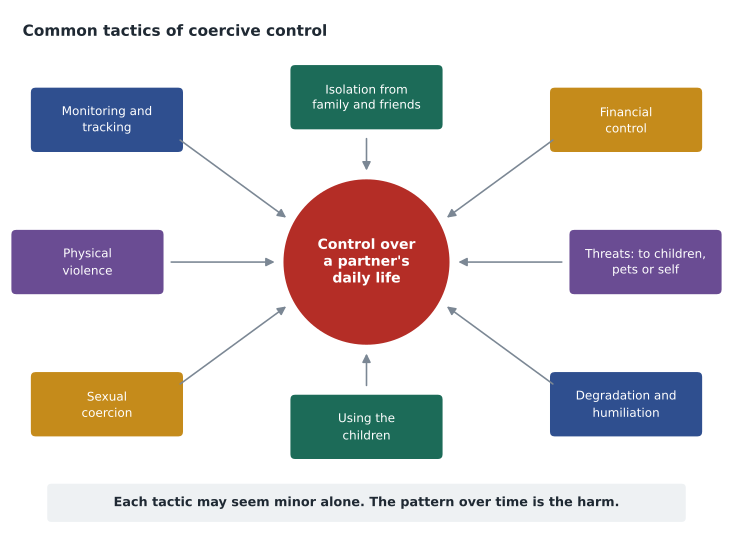
Most American states, including Ohio, do not have a criminal offense of coercive control, although a few states have added coercive control to the definitions used in their civil protection order or family law statutes. In Ohio, the pattern is still central. It supports charges such as menacing by stalking, telecommunications harassment and domestic violence by threat, it is evidence in protection order hearings, and it is the foundation of risk assessment. Whatever the law says about the pattern, an officer who only looks at the incident in front of them will consistently underestimate the danger.
Why it happens and why it continues
Students often want a single explanation for why people abuse their partners. There is not one. Research points to a combination of factors at several levels: individual factors such as exposure to violence in childhood, substance misuse and attitudes that justify control; relationship factors such as conflict, jealousy and separation; community factors such as poverty, isolation and weak sanctions; and social factors such as norms that excuse men's control of women. Alcohol and drugs are present in many incidents and increase the severity of violence, but they do not cause it: many people drink heavily without abusing partners, and many abusers are violent when sober. Desjardins warns the students against two explanations they will hear on calls. The first is that the abuser 'just lost his temper.' Most abusers control their temper perfectly well at work and with strangers. The second is that the victim 'provoked' the violence. Nothing a partner says or does makes violence their fault.
The question students ask most is the one Brooks asks them to stop asking: why doesn't she just leave? The question puts the responsibility on the victim, and it misunderstands the situation. Victims stay, or return, for many reasons: fear of what the abuser will do, which is often realistic; financial dependence; children, and the fear of losing custody or of the children losing a parent; housing; immigration status; shame and isolation; love and hope that the person will change; family, religious or community pressure; and the effect of trauma itself, which can make planning and decision-making very hard. Leaving is also the most dangerous time. Separation is one of the strongest risk factors for homicide in intimate relationships. 'Leaving is not an event,' Brooks says. 'It is a process, and it often takes several attempts. Each time a victim reaches out and gets a good response, the next attempt is more likely to succeed.'
How common it is
The Centers for Disease Control and Prevention's National Intimate Partner and Sexual Violence Survey estimates that about two in five women and a similar share of men in the United States have experienced contact sexual violence, physical violence or stalking by an intimate partner in their lifetime, with women far more likely to be injured, to fear for their safety and to experience severe physical violence. The National Crime Victimization Survey finds that only about half of domestic violence victimizations are reported to police, and fewer for sexual violence. Brooks points out that every figure on the slide undercounts. People who are being monitored by an abuser do not answer surveys freely, and many victims do not define what happened to them as abuse.
Intimate partner violence is also one of the leading causes of homicide of women. In the United States, roughly half of women who are murdered are killed by a current or former intimate partner, and firearms are used in a large share of those killings. Many states, including Ohio, review domestic violence deaths to learn how they might have been prevented, and the risk factors they find are remarkably consistent.
# A simple model of why reported calls undercount: each incident has a chance of being reported
incidents_per_year = 40      # pattern incidents in one abusive relationship (illustrative)
report_chance = 0.05         # chance any one incident leads to a call (illustrative)
years = [1, 2, 3, 5]
for y in years:
    n = incidents_per_year * y
    p_no_call = (1 - report_chance) ** n
    expected_calls = n * report_chance
print(f"{y} year(s): {n} incidents, expected calls {expected_calls:.0f}, chance of no call at all {p_no_call:.3f}")1 year(s): 40 incidents, expected calls 2, chance of no call at all 0.129 2 year(s): 80 incidents, expected calls 4, chance of no call at all 0.017 3 year(s): 120 incidents, expected calls 6, chance of no call at all 0.002 5 year(s): 200 incidents, expected calls 10, chance of no call at all 0.000
The numbers in the example are illustrative, but the shape is real. By the time police receive a first call, the victim has usually experienced many earlier incidents. A call that looks like a single argument is often the visible tip of a long pattern. Desjardins tells the class that this is why the questions officers ask at a scene matter so much: 'Has this happened before? Has it been getting worse? Has he ever threatened to kill you?' Those questions are how the pattern becomes visible.
The impact on victims and children
The effects of intimate partner violence go far beyond physical injury. Victims experience higher rates of depression, anxiety, post-traumatic stress, substance misuse and suicidal thoughts. Chronic stress affects physical health, including sleep, digestion, heart health and the immune system. Repeated head injuries and strangulation can cause brain injury that is often missed, with symptoms such as memory problems, headaches and difficulty concentrating that can be mistaken for intoxication or evasiveness. Abuse affects employment and finances, sometimes for years after the relationship ends. Many victims lose housing when they leave.
Children are affected whether or not they are physically hurt. Children who live with intimate partner violence see it, hear it from another room, see the injuries and damage afterwards, and live with the tension and fear in between. Exposure is associated with anxiety, behavior problems, difficulties at school and, over the long term, a higher risk of experiencing or using violence in their own relationships. Abusers also use children as part of the pattern: threatening to take them, using visits and custody exchanges to harass, or turning children against the other parent. In Ohio, police officers are among the professionals required by Ohio Revised Code 2151.421 to report known or suspected child abuse or neglect to the public children services agency or to law enforcement, and many agencies' policies treat a child's presence during domestic violence as a reason to make that referral.
Brooks tells the class about a boy of eight she met at a shelter years ago who had drawn a picture of his house with every door closed and a small figure hiding under a table. 'When officers came,' he told her, 'they were nice to my mom.' She says that was the most important thing about the call for him. Children remember how the police behaved. They remember whether anyone spoke to them, whether anyone told them it was not their fault, and whether the adults who were supposed to help seemed to take it seriously.
What this means for police
Desjardins finishes the lesson with the principles that will run through the course. First, look for the pattern, not only the incident. Ask about history, document it, and check records. Second, assume that the danger is real until proven otherwise; most homicides in intimate relationships were preceded by warning signs that someone knew about. Third, do not make the case depend on the victim. Victims may minimize, recant or refuse to cooperate for reasons that have nothing to do with whether the violence happened. Good investigations gather evidence that stands on its own. Fourth, connect the victim with support every time, even when no charge is laid. Fifth, remember the children. And finally, take care of yourself and your partners. These calls are difficult, repetitive and sometimes dangerous, and officers who attend many of them are at risk of burnout and of cynicism, which is the enemy of good work.
He returns to the eleven-second call from the start of the lesson. 'Two years after that call, the same address came in again, and this time the officers knew the history. They asked the questions, they took the victim's account seriously, they found the evidence, and they made an arrest. That case is the one we will follow through this course. You will see what went well, what did not, and what the people involved needed from us.' The class does not know it yet, but the address belongs to Megan Hollis.
Worked problem
Seeing the pattern in a call history
A records check on an address shows three earlier calls involving the same couple. Fourteen months ago, a neighbor reported shouting; officers found no offense and cleared the call. Seven months ago, the woman called and said her partner had taken her car keys and would not let her leave, then said she was fine when officers arrived. Two months ago, the man called to report that the woman had 'gone crazy' and thrown a mug, and officers noted a small cut on his hand. Tonight, the woman has called to say he grabbed her by the arm and pushed her into a wall. What might the history mean?
Show solution
- Each earlier call, on its own, looked minor, and none led to a charge.
- Taken together, they show a relationship in which control and conflict have been ongoing for over a year, which is consistent with a pattern of abuse.
- The call about the car keys suggests controlling behavior that restricted the woman's freedom, which is a recognized tactic of coercive control.
- The man's earlier call does not by itself show who the abuser is; officers will need to look at the history, injuries, fear and context to identify the primary aggressor, which Lesson 3 covers.
- Tonight's officers should ask directly about the history, whether things have been getting worse and whether there have been threats, and should record the earlier calls in their report.
Answer: The history suggests an escalating pattern of control; tonight's officers should treat the call as part of that pattern and ask about it.
Common mistakes
MistakeIntimate partner violence is a series of separate fights.
InsteadIt is usually a pattern of control over time, and single incidents are often the visible part of it.
MistakeIf there is no injury, it is not serious.
InsteadMany of the most dangerous situations involve threats, control and strangulation that leave little visible injury.
MistakeA victim who stays must not be in real danger.
InsteadVictims stay or return for many reasons, and separation is one of the most dangerous times.
MistakeChildren who did not see the violence are not affected.
InsteadChildren who live with intimate partner violence are affected whether or not they see it directly.
Summary and key terms
- Intimate partner violence is abuse by a current or former partner, including physical, sexual, psychological and financial abuse, threats and stalking.
- It is usually a pattern of coercive control rather than a series of separate incidents.
- Ohio has no coercive control offense, but the pattern supports charges such as menacing by stalking and is central to protection orders and risk assessment.
- Most incidents are never reported, and separation is one of the most dangerous times for victims.
- Children are harmed by living with intimate partner violence and are protected by mandatory reporting duties.
- Officers should look for the pattern, take danger seriously, build cases that do not depend on the victim, and always connect victims with support.
- Intimate partner
- A current or former spouse, partner or dating partner; Ohio uses the term family or household member in its domestic violence statute.
- Coercive control
- A pattern of behavior that uses intimidation, isolation, degradation, control and sometimes violence to dominate a partner.
- Family violence
- Abuse within a family, including by partners, parents, children and other relatives.
- Separation
- The period when a relationship is ending or has ended, associated with increased risk of serious violence.
- Exposure
- A child seeing, hearing or living with the effects of violence in the home.
Practice problems
Work each problem on paper first, then reveal the answer to check.
Why does Desjardins say the eleven-second call was 'a warning' even though it described no crime?
Show answer
Because it described monitoring, control of the phone and threats, which are tactics of coercive control and signs of danger.
Name three reasons a victim might stay in or return to an abusive relationship.
Show answer
Any three of: fear, financial dependence, children, housing, immigration status, isolation, hope, family or community pressure, or the effects of trauma.
In the code example, what happens to the expected number of calls as the years go by?
Show answer
It rises, but stays far below the number of incidents, showing how police see only a small fraction of the pattern.
What duty does an officer have when a child lives in a home where partner violence is occurring?
Show answer
To report suspected abuse or neglect under Ohio Revised Code 2151.421, which applies to police officers.
Lesson quiz · 5 questions
Score 60% or more to complete this lesson.
Create a free account to save your progress, take quizzes and earn a certificate.