
LES-212 · Lesson 10 of 12 · 20 min
Victims with particular needs: children, older adults, newcomers and other communities
▶ Video coming soon A video version of this lesson is on the way.
Brooks opens with three short case notes from the Port Ardent unit's files, details changed. The first is about Agnes, seventy-eight, whose husband of fifty-five years has started locking her in the bedroom when he goes out, saying it is for her own good. The second is about Amina, twenty-nine, who arrived in the country fourteen months ago with her husband; he keeps her passport and tells her she will be deported if she calls the police. The third is about Chris, thirty-four, whose male partner has told him that if he leaves, the partner will tell Chris's employer and his parents that he is gay. 'Three different people,' Brooks says. 'One pattern. Control, isolation and fear. But each of them faces barriers to help that the standard response was not built for. If you treat them all the same, you will fail at least two of them.'
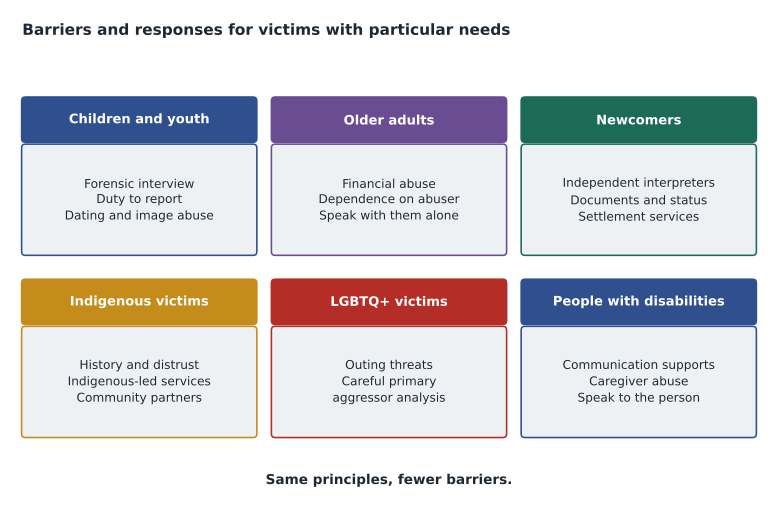
This lesson looks at groups of victims whose circumstances create particular risks or particular barriers to safety and justice. Desjardins cautions against treating any group as a stereotype. Each person is an individual, and the purpose of knowing about these barriers is to ask better questions and remove obstacles, not to make assumptions. The same principles from earlier lessons apply to everyone: take the report seriously, look for the pattern, assess risk, gather evidence that stands on its own and connect the victim with support.
Children and youth
Lesson 1 described the harm to children who live with intimate partner violence and the duty to report. Children are also victims of physical and sexual abuse in their own right, most often by someone they know. Children rarely disclose abuse all at once. They may hint, test the reaction of a trusted adult, disclose part of what happened, or take it back if the response frightens them. Officers who receive a disclosure from a child should listen calmly, avoid leading questions, write down exactly what the child said, and arrange a forensic interview by a trained interviewer as soon as possible, rather than conducting a detailed interview themselves. In Ohio, children services agencies and law enforcement investigate together under county protocols, often through child advocacy centers, and interviews are recorded so that the child does not have to repeat the account many times.
Teenagers experience dating violence at high rates, including controlling behavior through phones and social media, sexual coercion and the sharing of intimate images. Many do not recognize it as abuse, or fear that telling an adult will mean losing their phone or their privacy. Officers who respond to youth should take the relationship seriously, be aware of the laws on intimate images and on the age of consent described in Lesson 6, and involve parents or guardians with care, since a parent may not be safe or may be part of the problem.
Older adults
Abuse of older adults includes intimate partner violence that has continued for decades or begun late in life, and abuse by adult children, other relatives and caregivers. It takes physical, sexual, psychological and financial forms, and neglect. Financial abuse, such as misusing a power of attorney, taking pensions or pressuring the person to sign over property, is especially common. Older victims may be dependent on the abuser for care, may have cognitive impairment that makes disclosure difficult, may feel shame, or may fear being moved into a care home. Officers should speak with the older person alone, at a pace that suits them, with hearing aids or glasses if needed, and should not assume that confusion means the person cannot give an account. Ohio law requires certain professionals, including law enforcement officers, to report suspected abuse, neglect or exploitation of adults aged sixty and older to the county's adult protective services, under Revised Code 5101.63. Agnes's case was handled with her consent through a referral to an elder abuse response team, a safety plan with her daughter, and charges of forcible confinement after a second incident.
Newcomers and immigrants
Immigrant and refugee victims face distinct barriers. They may not speak English or French fluently, may not know their rights or the law, may have had frightening experiences with police in other countries, and may depend on the abuser for their status, income and housing. Abusers often exploit these vulnerabilities, for example by holding passports and documents or by threatening deportation or the loss of the children. Officers should use qualified, independent interpreters, never the abuser or a child, explain the process simply, and make clear that police are there to help.
Federal immigration law includes protections for victims. The U visa, created in 2000, is available to victims of qualifying crimes, including domestic violence, sexual assault and stalking, who have suffered substantial abuse and who have been, are being or are likely to be helpful to law enforcement; it requires a certification from a law enforcement agency, prosecutor or judge on Form I-918 Supplement B. The T visa protects victims of human trafficking. Under the Violence Against Women Act, spouses and children of citizens and permanent residents who are abused can petition for status themselves, without the abuser's involvement. Officers should know who in their agency signs U visa certifications and should refer victims to immigration legal services for advice; officers should not ask about immigration status unless it is relevant to the investigation. Amina's officer arranged an Arabic interpreter through the language line, referred her to a settlement agency and a legal clinic, and recovered her passport from her husband during the execution of a warrant.
Native American and Alaska Native victims
Native American and Alaska Native women experience violence at much higher rates than other women in the United States, and murder is among the leading causes of death for young Native women. Jurisdiction in Indian country is complex, divided among tribal, federal and sometimes state authorities, and Congress expanded tribal criminal jurisdiction over non-Native offenders in domestic violence and some other cases in the Violence Against Women Act reauthorizations of 2013 and 2022. Savanna's Act and the Not Invisible Act, both enacted in 2020, address missing and murdered Indigenous people. Ohio has no reservations, but many Native people live in Ohio's cities, and officers should be aware of urban Native organizations, the history that shapes distrust of police, and the importance of thorough missing person investigations.
LGBTQ+ victims
Intimate partner violence occurs in same-sex and other LGBTQ+ relationships at rates similar to or higher than in heterosexual relationships, and transgender people face especially high rates of violence. Abusers may use tactics specific to these relationships, such as threatening to out a partner to family, employers or immigration authorities, or telling a partner that police and services will not help people like them. Victims may fear homophobic or transphobic responses, may find that shelters are not designed for them, and may be isolated if their community is small. Officers should not assume that the larger or more masculine partner is the primary aggressor, should use the names and pronouns the person uses, and should refer to services that are welcoming to LGBTQ+ people. Chris's officer documented the outing threats as part of a pattern supporting menacing by stalking, and connected him with an LGBTQ+ community agency that runs a partner violence program.
Men as victims
Men are victims of intimate partner violence and sexual assault, by female and male partners and others. They report much less often than women, because of shame, the belief that men cannot be victims, fear of not being believed, and fear of being arrested themselves. When men do report, they sometimes meet disbelief or ridicule. Officers should take men's reports seriously and apply the same careful primary aggressor analysis described in Lesson 3. Services for male victims are fewer, but they exist, and the crisis lines listed in Lesson 1 serve everyone.
People with disabilities
People with disabilities are victimized at substantially higher rates than people without disabilities, and the abuser is often a partner, family member or caregiver on whom the victim depends. Abuse may include withholding medication, mobility aids or care, and the victim may have difficulty communicating, leaving or being believed. Officers should ask the person how they communicate and what support they need, use communication supports or sign language interpreters, speak directly to the person rather than to a caregiver, and never use the suspected abuser as an interpreter or helper. Ohio's adult protective services law and agency policies provide for referrals, and courts can allow accommodations for witnesses with disabilities.
Rural and remote communities
Victims in rural and remote areas face long distances to services, limited public transportation, poor phone and internet coverage, a lack of anonymity in small communities, and longer police response times. Firearms are often more common in rural homes. Officers in these areas should plan for longer waits for backup, make sure victims have a way to reach help, use phone and video supports where in-person services are far away, and be especially careful about firearms seizure.
# Matching a victim's needs to referrals (illustrative; use your agency's current directory)
referrals = {
    "interpreter": "professional language line (never family or the suspect)",
    "immigration": "settlement agency and immigration legal clinic",
    "older adult": "elder abuse response team or adult protective services",
    "lgbtq": "LGBTQ+ community agency partner violence program",
    "disability": "communication supports and disability advocacy service",
    "indigenous": "Indigenous-led victim service",
    "children": "child protection agency and child advocacy program",
}
cases = {"Agnes": ["older adult"], "Amina": ["interpreter", "immigration"], "Chris": ["lgbtq"]}
for name, needs in cases.items():
    print(name)
    for n in needs:
print(" ->", referrals[n])Agnes -> elder abuse response team or adult protective services Amina -> professional language line (never family or the suspect) -> settlement agency and immigration legal clinic Chris -> LGBTQ+ community agency partner violence program
The example is a reminder that the right referral depends on what the person needs, and that officers should know their local services before they need them. Brooks suggests that every new officer spend a shift visiting the local shelter, the sexual assault center and the victim services office. 'You will make better referrals if you have met the people you are referring to.'
When the abuser is a police officer
Desjardins ends the lesson with a subject that police services have often avoided. Police officers commit intimate partner violence too, and their victims face unique barriers: the abuser knows the system, knows the officers who will respond, may have access to service weapons and databases, and may be believed over the victim. Victims may fear that reporting will lead colleagues to protect the officer or will cost the family its income. Police leaders and organizations, including the International Association of Chiefs of Police, which published a model policy on police-perpetrated domestic violence in 2003, have called for clear policies: calls involving officers must be handled like any other, by supervisors from another unit where possible; weapons must be addressed immediately; investigations must be independent; and victims must be given an advocate outside the police service. Federal firearms law has no exception for police officers convicted of misdemeanor domestic violence, so a conviction ends an officer's ability to carry a firearm and usually the officer's career. 'The test of whether a service takes this seriously,' Desjardins says, 'is what it does when the suspect wears its uniform.'
Worked problem
Responding to an older victim
Officers attend a call from a home care nurse, who says an eighty-four-year-old woman she visits told her that her son, who lives with her, takes her pension check each month and shouts at her until she signs blank checks. The woman has mild memory problems. When officers arrive, the son answers the door and says his mother is confused and he manages her money under a power of attorney. How should officers proceed?
Show solution
- Ask to speak with the woman alone, in a quiet room, at her pace, making sure she has her hearing aids or glasses.
- Do not assume that mild memory problems mean she cannot describe what is happening; ask open questions and record her words.
- Ask about the power of attorney, which gives authority to act in her interest, not to take her money for himself; misuse can be theft or fraud.
- Make the required report to adult protective services under 5101.63 and consider charges such as theft from a person in a protected class if the evidence supports them.
- Assess her safety and risk, consider whether she needs another place to stay or other care, and connect her with support.
Answer: Speak to her alone, take her account seriously, examine the power of attorney, refer or report, and assess risk.
Common mistakes
MistakeAn older person with memory problems cannot give a reliable account.
InsteadMany people with mild impairment can describe what is happening to them; ask carefully and record their words.
MistakeA family member is the easiest interpreter.
InsteadUse a qualified, independent interpreter; family members and the suspect may distort or intimidate.
MistakeAsking every victim about immigration status shows thoroughness.
InsteadAsk only when relevant; fear of immigration consequences keeps many victims from calling.
MistakeIn a same-sex relationship, the bigger partner is the aggressor.
InsteadApply the same evidence-based primary aggressor analysis to every relationship.
Summary and key terms
- Children disclose gradually; listen, record their words and arrange a forensic interview rather than interviewing in detail.
- Older adults face dependence and financial abuse; Ohio requires officers to report suspected abuse of adults sixty and older to adult protective services.
- Immigrant victims may be eligible for U visas, which need a law enforcement certification, T visas and VAWA self-petitions; use independent interpreters.
- Native women face very high rates of violence; Savanna's Act and the Not Invisible Act address missing and murdered Indigenous people.
- LGBTQ+ victims, male victims and victims with disabilities face distinct tactics and barriers; apply careful primary aggressor analysis and use appropriate supports.
- Calls involving police officers as suspects must be handled independently, with weapons addressed and an outside advocate for the victim.
- U visa
- A federal visa for victims of qualifying crimes who help law enforcement, requiring a certification on Form I-918 Supplement B.
- Adult protective services
- The county agency that investigates reports of abuse, neglect or exploitation of older adults in Ohio.
- Forensic interview
- A recorded interview of a child conducted by a trained interviewer to obtain an accurate account.
- Financial abuse
- Misuse or theft of a person's money or property, including misuse of a power of attorney.
- Outing
- Revealing a person's sexual orientation or gender identity without their consent, sometimes threatened as a form of control.
- Independent interpreter
- A qualified interpreter with no personal connection to the parties.
Practice problems
Work each problem on paper first, then reveal the answer to check.
What pattern did Brooks say linked Agnes, Amina and Chris?
Show answer
Control, isolation and fear, each with different barriers to help.
Why should the abuser or a child never act as interpreter?
Show answer
They may distort the account or intimidate the victim, and it exposes the child to harm.
In the code example, what referrals were matched to Amina?
Show answer
A professional language line, and a settlement agency and immigration legal clinic.
Name two features of a good policy on police-perpetrated domestic violence.
Show answer
Any two of: handle calls like any other, supervisors from another unit, immediate attention to weapons, independent investigation, an outside advocate for the victim.
Lesson quiz · 5 questions
Score 60% or more to complete this lesson.
Create a free account to save your progress, take quizzes and earn a certificate.