
LES-212 · Lesson 6 of 12 · 21 min
Sexual offenses and consent under Ohio law
▶ Video coming soon A video version of this lesson is on the way.
Desjardins begins the second part of the course with a case that has not yet gone to trial. On Tuesday, March 10, 2026, a twenty-year-old student named Sofia Reyes walked into the Port Ardent police department's front office with her friend Maya Desai and said she wanted to report a sexual assault. It had happened three nights earlier, after a party. She remembered some things clearly and others not at all. She was not sure she wanted to go through with a report, but Maya had told her that talking to someone could not hurt. 'What the officer at the front desk said in the next two minutes,' Desjardins tells the class, 'decided whether this case would exist. We will come back to what he said. First, the law.'
Brooks adds a note about language before they begin. Police and courts use the word complainant for the person who reports a sexual offense, because the law has not yet decided what happened. Victim services and many survivors prefer victim or survivor. The course will use all three, depending on context, and the students should be ready to explain why the legal word does not mean the officer doubts the person. She also reminds them that the supports listed on the course page are there for them. 'This part of the course is hard for many people. Look after yourselves.'
The sexual offenses in Ohio
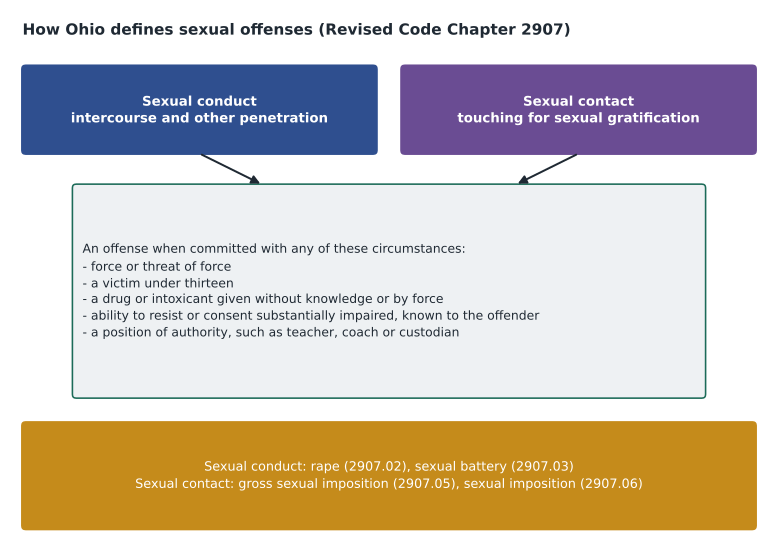
Ohio's sexual offenses are in Revised Code Chapter 2907, and they distinguish between sexual conduct, which includes intercourse and other forms of penetration, and sexual contact, which is touching of an erogenous zone for the purpose of sexual arousal or gratification. Rape under 2907.02 is engaging in sexual conduct in any of several circumstances, including when the offender purposely compels the other person to submit by force or threat of force; when the other person is under thirteen; when the offender substantially impairs the other person's judgment or control by administering a drug or intoxicant without their knowledge or by force; and when the other person's ability to resist or consent is substantially impaired because of a mental or physical condition, and the offender knows or has reasonable cause to believe that. Rape is a felony of the first degree. Sexual battery under 2907.03 covers sexual conduct in other coercive circumstances, including when the offender knows the other person's ability to appraise the nature of or control their own conduct is substantially impaired, or when the offender holds a position of authority such as a teacher, coach or custodian. Gross sexual imposition under 2907.05 and sexual imposition under 2907.06 cover sexual contact in similar circumstances.
Consent, force and impairment
Ohio's criminal law does not have a general statutory definition of consent of the kind found in some other jurisdictions, and most Ohio sexual offenses are defined by force, threat, the victim's age or the victim's impairment, rather than by the absence of affirmative agreement. Force means any violence, compulsion or constraint exerted by any means upon or against a person or thing, and Ohio courts have held that the force needed can be subtle, particularly where the offender holds power over the victim, such as a parent over a child. Impairment does not require unconsciousness: a person whose ability to resist or consent is substantially impaired by intoxication, sleep, a disability or a medical condition is protected, but the prosecution must also prove that the offender knew or had reasonable cause to believe the person was impaired. Many colleges and universities, including in Ohio, use an affirmative consent standard in their own student conduct policies, which is separate from the criminal law.
United States law on consent varies widely among the states. Some states define consent as affirmative, freely given agreement, and some, like Ohio, focus on force, threats and impairment. Federal law on sexual abuse, which applies in federal jurisdictions such as military bases and national parks, uses a similar structure. Officers working in Ohio must know the elements of the specific Ohio offenses, and should not assume that a definition they have seen on a college website or in another state's law applies. Desjardins tells the class that whatever the formal definition, the evidence questions are the same: what the complainant agreed to, whether they were capable of agreeing, what force or pressure was used, and what the accused knew.
What the accused knew
Several Ohio offenses depend on what the offender knew or had reasonable cause to believe. For rape and sexual battery based on impairment, the prosecution must prove that the offender knew, or had reasonable cause to believe, that the victim's ability to resist or consent, or to appraise or control their own conduct, was substantially impaired. That makes evidence of the victim's condition, and of what the accused saw, said and did, central to the investigation. A message the next morning such as 'you were really out of it' can be important evidence of what the accused knew. Investigators should therefore gather evidence about what the accused saw, heard and did: whether the complainant was slurring, stumbling, vomiting or falling asleep; whether others warned the accused; and what the accused said afterward.
# Age-based rules, simplified for illustration (always check the full statute and exceptions)
def ca_age_rule(complainant_age, partner_age, position_of_trust=False):
    if complainant_age >= 16 and not position_of_trust:
        return "age not a bar (consent still required)"
    if position_of_trust and complainant_age < 18:
        return "no valid consent: position of trust, authority or dependency"
    gap = partner_age - complainant_age
    if complainant_age in (14, 15) and gap < 5:
        return "close-in-age exception may apply"
    if complainant_age in (12, 13) and gap < 2:
        return "close-in-age exception may apply"
    return "no valid consent: under the age of consent"

def oh_age_rule(victim_age, offender_age):
    if victim_age < 13:
        return "rape 2907.02(A)(1)(b) if sexual conduct"
    if 13 <= victim_age <= 15 and offender_age >= 18:
        gap = offender_age - victim_age
        return "unlawful sexual conduct with a minor 2907.04" + (" (misdemeanor: gap under four years)" if gap < 4 else " (felony)")
    return "age not a bar (other elements still apply)"

for a, b in ((15, 19), (15, 22), (13, 14), (17, 30)):
    print("ca", a, b, "->", ca_age_rule(a, b))
for a, b in ((15, 18), (15, 24), (12, 15)):
print("oh", a, b, "->", oh_age_rule(a, b))ca 15 19 -> close-in-age exception may apply ca 15 22 -> no valid consent: under the age of consent ca 13 14 -> close-in-age exception may apply ca 17 30 -> age not a bar (consent still required) oh 15 18 -> unlawful sexual conduct with a minor 2907.04 (misdemeanor: gap under four years) oh 15 24 -> unlawful sexual conduct with a minor 2907.04 (felony) oh 12 15 -> rape 2907.02(A)(1)(b) if sexual conduct
The example simplifies the rules, which have more exceptions and conditions than a few lines of code can show. Desjardins uses it to make one point: in Ohio a person under thirteen cannot consent to sexual conduct, and an adult who engages in sexual conduct with a thirteen-, fourteen- or fifteen-year-old commits unlawful sexual conduct with a minor under 2907.04, a lesser offense where the age gap is small. Officers should check the statute every time.
Myths and stereotypes
Sexual assault cases are especially vulnerable to myths and stereotypes about how a real victim behaves. Some of the most persistent are that real victims report immediately; that they fight back and are injured; that they are visibly distressed afterward; that they are assaulted by strangers; that they do not have further contact with the accused; that they remember events clearly and in order; that intoxication means they share responsibility; and that their clothing, past sexual history or relationship with the accused makes consent more likely. Research and experience show that none of these is reliable. Most sexual assaults are committed by someone the victim knows. Most victims do not report at all, and those who do often delay. Many freeze rather than fight, and most have no visible physical injury. Many continue some contact with the accused, especially when they share friends, classes or a workplace. Memory of a traumatic event is often fragmented, as Lesson 7 explains.
Ohio's rape shield law, in 2907.02(D) and 2907.05(E), generally prohibits evidence of the victim's other sexual activity, with narrow exceptions such as evidence of the origin of semen, pregnancy or disease, or the victim's past sexual activity with the offender, and only to the extent the court finds it material and not unduly prejudicial. Ohio courts have also held that a delay in reporting is not in itself a reason to doubt a victim. Brooks tells the class that the myths are not only a problem in courtrooms. They shape what officers notice, which questions they ask, and whether they believe the person in front of them. 'If you catch yourself thinking that she did not act like a real victim, stop. There is no such thing.'
Reporting and the first response
Sexual assault is one of the most underreported crimes. The National Crime Victimization Survey finds that only about one in four or one in five rapes and sexual assaults are reported to police. Victims give many reasons for not reporting: shame and self-blame; fear of not being believed; fear of the accused or of consequences for relationships, school or work; not being sure what happened was a crime; wanting to forget; and distrust of the police and courts. How the first officer responds has a large effect on whether a victim continues with a report, and on whether they ever report anything again.
At the front desk, Officer Ryan Teague listened to Sofia's first few sentences, then said, 'Thank you for coming in. I'm sorry this happened. You can take as much time as you need, and you're in control of what happens next. I'd like to get you somewhere private and have a detective from our sexual assault unit speak with you, if that's all right.' He took her and Maya to the soft interview room, offered water, and asked only for the basic information he needed: whether she was safe now, whether she needed medical care, roughly when and where it happened, and whether the person who did it knew where she lived. He did not ask for details. He told her that a forensic examination might still be possible, that it was her choice, and that the hospital could hold evidence even if she had not decided whether to proceed. Desjardins says Teague did everything right. 'His job was not to investigate. His job was to make sure there could be an investigation.'
The facts of the Reyes case
Sofia told Detective Sergeant Mendes, in an interview later that afternoon, that she went to a party on Saturday, March 7, at a house on Lakeview Avenue rented by four students, including Brandon Lowe, twenty-two, whom she knew from a class. She drank more than she usually did. By about half past one, Maya saw that Sofia could barely stand and wanted to take her home, but Brandon said Sofia could sleep it off in his room and he would 'keep an eye on her.' Maya left at about two. Sofia's next memory was of waking, unable to move properly, with Brandon on top of her, and then nothing until she woke at about six with her clothing disarranged. She left the house without speaking to anyone. At 11:42 that morning, Brandon sent her a message: 'hey sorry about last night, you were pretty out of it lol. we good?' She did not reply.
Sofia's account, if accepted, describes sexual conduct with a person whose ability to resist or consent was substantially impaired, and Brandon's message is evidence that he knew or had reasonable cause to believe it was. A Lucas County grand jury indicted him on April 21, 2026, for rape under 2907.02(A)(1)(c) and, in the alternative, sexual battery under 2907.03(A)(2). The trial is scheduled for January 2027 in the Court of Common Pleas. Lessons 7 through 10 follow the investigation and the pretrial process. The trial has not yet taken place, and Desjardins reminds the class that Brandon Lowe is presumed innocent.
Worked problem
Applying the law to a scenario
A woman tells an officer that she and her boyfriend began to have sex, but partway through she said 'stop, I don't want to' and tried to push him away. He continued for a short time, saying 'just a minute,' then stopped. She is upset but unsure whether this 'counts' because she agreed at first. How should the officer think about this?
Show solution
- In Ohio the question is whether the continued sexual conduct was compelled by force or threat of force, or involved another listed circumstance; pushing him away and his continuing despite it may support force, depending on the facts.
- Her words 'stop, I don't want to' and the attempt to push him away are clear expressions that she did not agree to continue.
- Earlier agreement does not authorize sexual activity after it has been withdrawn, and a relationship with the person does not change that.
- The officer should not tell her whether it 'counts,' but should listen, explain that what she describes may be an offense, and explain her options without pressure.
- The officer should arrange a trauma-informed interview with the specialized unit, offer medical care and connect her with victim services.
Answer: Withdrawn consent is no consent; the officer should take the report seriously, explain options and refer her for a specialized interview and support.
Common mistakes
MistakeA victim who did not fight back must have consented.
InsteadMany victims freeze; Ohio law looks at force, threats and impairment, and a lack of resistance does not prove consent.
MistakeConsent given at the start covers everything that follows.
InsteadConsent must be present throughout and can be withdrawn at any time.
MistakeDelayed reports are less credible.
InsteadDelay is common and is not, by itself, a reason to doubt a complainant.
MistakeMost sexual assaults involve strangers and injuries.
InsteadMost are committed by someone the victim knows, and most leave no visible injury.
Summary and key terms
- Ohio's offenses in Chapter 2907 distinguish sexual conduct from sexual contact and are defined by force, threats, age, impairment and positions of authority.
- Impairment-based offenses require proof that the victim's ability to resist or consent was substantially impaired and that the offender knew or had reasonable cause to believe it.
- Consent definitions vary among states; officers must know the elements of the Ohio offenses.
- Evidence of what the accused saw, said and knew is central in impairment cases.
- Myths about delayed reporting, injuries, resistance, demeanour and strangers are unreliable and must not shape investigations.
- The first response decides whether there can be an investigation: listen, reassure, ensure safety and medical care, and refer to specialists.
- Sexual conduct
- Under Ohio law, intercourse and other forms of penetration.
- Sexual contact
- Under Ohio law, touching of an erogenous zone for the purpose of sexual arousal or gratification.
- Substantially impaired
- A condition, such as intoxication or sleep, that significantly reduces a person's ability to resist, consent or control their own conduct.
- Complainant
- The person who reports a sexual offense; the legal term does not imply doubt.
- Rape shield
- Rules that restrict evidence of a complainant's other sexual activity.
- Myths and stereotypes
- Unfounded beliefs about how victims behave that can distort investigations and trials.
Practice problems
Work each problem on paper first, then reveal the answer to check.
What did Constable or Officer Teague do that made the Reyes investigation possible?
Show answer
He listened, reassured her, ensured safety and medical options, avoided asking for details and referred her to a specialist detective.
Why is Brandon Lowe's message important evidence?
Show answer
It suggests he knew she was severely intoxicated, which bears on her capacity and on what he knew.
What does Ohio's rape shield law generally prohibit?
Show answer
Evidence of the victim's other sexual activity, with narrow exceptions decided by the court.
Name three myths about sexual assault victims.
Show answer
Any three of: they report immediately, they fight back, they are injured, they are visibly upset, they are attacked by strangers, they avoid the accused afterward, they remember clearly.
Lesson quiz · 5 questions
Score 60% or more to complete this lesson.
Create a free account to save your progress, take quizzes and earn a certificate.