
LES-212 · Lesson 12 of 12 · 21 min
Capstone: reviewing the Hollis and Reyes cases
▶ Video coming soon A video version of this lesson is on the way.
For the last class, Desjardins and Brooks rearrange the room into a single long table, the way the high-risk table at the hospital is set up. On it are two binders. The first holds the Hollis file: the 2024 call records, the February 22 dispatch log, the body-worn camera index, the photographs, the nurse examiner's report, the risk assessments, the bail and court records, the forty-three messages, the plea and the sentence. The second holds the Reyes file as it stands today: the front-desk notes, the interviews, the examination report, the witness statements, the doorbell video, the phone extractions, the warrants and the pretrial ruling. 'One case is finished,' Desjardins says. 'One is not. Today we review both the way a death review committee or an external case review would: not to blame anyone, but to learn what worked, what did not, and what we would change.'
The class will score each case in ten areas, each worth up to two points: two for practice that met the standard, one for practice that partly met it, and zero for practice that fell short. The scoring is a tool for discussion, not a verdict on any officer. Brooks reminds the students that the people in these files are real to the officers who worked them, and that the point of the exercise is the next victim. She also reminds them that Brandon Lowe has not been tried and is presumed innocent, so the review of the Reyes case is a review of the investigation, not of his guilt.
The Hollis case: from the first call to the sentence
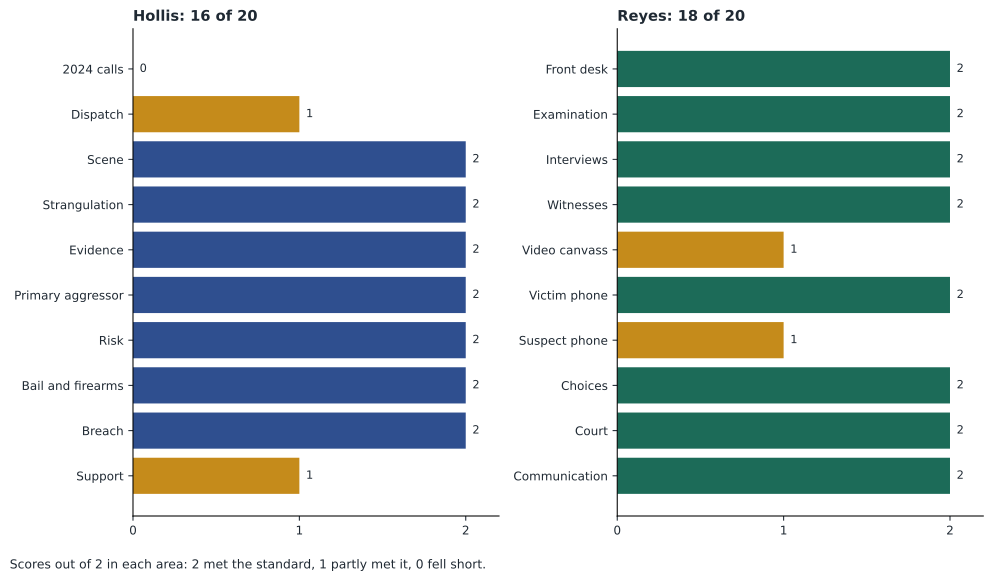
The class begins with the 2024 calls. In February 2024, Megan called and said quietly that Tyler had taken her phone, then hung up. Officers attended, found Tyler calm and Megan saying she was fine, and cleared the call as 'no offense' after ten minutes. They did not separate the couple, ask about history or threats, give Megan any information, or record the call in a way that would flag it for the future. In October 2024, a neighbor reported shouting; officers spoke to the couple together at the door and left. Megan later told Mendes that the first neck grab had happened the week of the February call, and that if the officers had asked her alone she might have told them. Linh Tran says the area should score zero. Nobody disagrees.
The February 22, 2026 response is a different story. The call-taker asked about weapons and children and stayed on the line. Dispatch checked records and firearms. Okeke and Malhotra separated the parties, asked the strangulation questions, called paramedics and persuaded Megan to be examined. They captured Megan's first account on camera, photographed Kerr's knuckle, found Doreen Pike, preserved the 911 call and seized the firearms. Mendes arranged follow-up photographs and a detailed recorded interview. The risk assessment was completed and shared, bail conditions were specific, the school was informed, and the high-risk table met within nine days. When Kerr breached, Mendes preserved the messages, identified the account and arrested him the same day. Brooks's office called Megan weekly. The class scores most of these areas at two.
There are two partial scores. The first is dispatch information. Doreen told the call-taker she had heard Megan shout 'stop,' but the call-taker did not relay that detail to the responding officers, who learned it only from Doreen at the scene. Marco DiSanto points out that it did not change the outcome, but in a different call it might have changed how the officers approached the door. The second is follow-up with Ava. The children services agency was notified the next morning, but nobody arranged support for Ava herself until Brooks's office raised it at the high-risk table nine days later. Brooks says children are still too often treated as witnesses or as part of the victim's file, rather than as victims in their own right.
# Capstone scoring (0 = fell short, 1 = partly met, 2 = met the standard)
hollis = {
    "2024 calls: separation, questions, records": 0,
    "dispatch and call-taking": 1,
    "scene safety and separation": 2,
    "strangulation assessment and medical care": 2,
    "evidence that stands without the victim": 2,
    "primary aggressor and arrest decision": 2,
    "risk assessment and sharing": 2,
    "bail conditions and firearms": 2,
    "breach response": 2,
    "support for victim and child": 1,
}
reyes = {
    "first response at the front desk": 2,
    "forensic examination and advocate": 2,
    "trauma-informed interviews": 2,
    "witness identification and interviews": 2,
    "video canvass": 1,
    "victim phone: focused, consent-based extraction": 2,
    "suspect phone: warrant and timing": 1,
    "respect for the victim's choices": 2,
    "court protections and support": 2,
    "communication with the victim": 2,
}
for name, case in (("Hollis", hollis), ("Reyes", reyes)):
    total = sum(case.values())
    weak = [k for k, v in case.items() if v < 2]
print(f"{name}: {total}/{2 * len(case)}; areas to improve: {weak}")Hollis: 16/20; areas to improve: ['2024 calls: separation, questions, records', 'dispatch and call-taking', 'support for victim and child'] Reyes: 18/20; areas to improve: ['video canvass', 'suspect phone: warrant and timing']
The Hollis case scores sixteen of twenty. Desjardins notes that the score is low not because the 2026 response was weak, which it was not, but because the 2024 response was. 'The best officers in this case were the ones in February 2026,' he says. 'The most important officers were the ones in February 2024, because they had the first chance. Every death review I have read has a February 2024 in it somewhere.'
The Reyes case: the investigation so far
The class turns to the Reyes file. Officer Teague's front-desk response scores two; the students quote his words back to each other. The examination at the hospital, with the advocate present throughout and Sofia's consent sought at every step, scores two. Mendes's interviews, with free recall, open questions, no why-questions, no suggestion of details, and a follow-up interview that recovered the draft message, score two. The eleven witness interviews, done separately within ten days, score two. The focused extraction of Sofia's phone, limited by date and type of data with her consent documented, scores two. Mendes's response when Sofia declined to make a pretext call, accepting the decision and never raising it again, scores two. The protections at the pretrial hearing, where Sofia had her own lawyer and the defense application was refused, and the advocate's steady contact with Sofia, both score two.
Two areas score one. The first is the video canvass. The doorbell camera across the street was found only on March 19, nine days after the report, when Mendes went back to the street; the owner said the system kept footage for fourteen days, so the crucial clips were saved with five days to spare. Amara Okafor says a canvass for cameras on the day of the report should be standard. The second is the timing of the warrant for Brandon's phone, which was not sought until his arrest on April 21, six weeks after the report. Mendes tells the class she had grounds earlier, and that her reason for waiting, to avoid alerting him before the DNA result, was defensible but carried a risk that he would delete data. In the end the search history survived. 'I would probably do it the same way again,' she says, 'but I would write down why, at the time, so that someone reviewing the file could see it was a decision and not an oversight.' The Reyes investigation scores eighteen of twenty.
Root causes and recommendations
A review is only useful if it identifies causes and leads to change. The class works in two groups to write recommendations, then compares them. For the Hollis case, the group identifies the root cause of the 2024 failures as a culture in which calls without visible injury were treated as low priority, combined with a records system that let 'no offense' calls disappear. Its recommendations are that every intimate partner call, whether or not an offense is found, should include separation of the parties, a short set of risk questions asked privately, information for the victim about services, and a report that flags the address; that dispatch should read back key details to responding officers; and that every intimate partner call involving a child should trigger a referral for the child's own support, not only a notification. Brooks adds that the service has since adopted the first two recommendations.
For the Reyes case, the group recommends that a camera canvass be completed within forty-eight hours of every sexual assault report, and that investigators record the reasons for the timing of key steps such as warrants. Jesse Morningstar adds a recommendation about classification: the unit should continue its participation in external case review, and should review how many reports in which the victim chose not to proceed were closed as 'victim declined' rather than investigated as far as possible without her, so that choices made by victims are respected without becoming a reason to stop looking at evidence that already exists.
Where things stand
Megan's civil protection order under 3113.31, granted in April 2026 after a full hearing, remains in force until 2031, and the domestic relations court has ordered supervised parenting time between Ava and her father at a visitation center. Megan and Ava live in a new apartment with a security system. Ava sees a counselor through a children's program at Juniper Place. Megan has returned to work. She agreed to let the course use her story, with names and details changed, because, she told Brooks, 'someone should learn something from it.' Kerr remains in custody and will be supervised when he is released.
Sofia's case is set for trial in January 2027. She has decided to testify, with a screen and a support person, and her advocate will be in the courtroom. She has also started a peer support group at her college for students who have experienced sexual violence. Desjardins reminds the class once more that the trial has not happened, that Brandon Lowe is entitled to the presumption of innocence and a fair trial, and that the purpose of the investigation was not to secure a conviction but to gather every piece of evidence fairly, so that the court can decide on the truth.
What this course has been about
Desjardins closes with the principles from the first class, now with the cases attached. Look for the pattern, not only the incident: the February 2024 call was the pattern, and the officers who saw only an incident missed it. Assume the danger is real until proven otherwise: the eight risk factors in the Hollis file were real, and the people at the table treated them that way. Build cases that do not depend on the victim: Kerr pleaded guilty because the evidence stood on its own, and Megan never had to testify. Understand trauma: Sofia's fragmented memory was not a weakness in her account but a feature of what happened to her, and an interview built around that fact produced the evidence that anchored the case. Respect victims' choices without abandoning them: Megan's request to drop the charges and Sofia's refusal of a pretext call were both respected, and neither ended the support or the investigation. Work with others: no single officer or agency protected Megan; a table did. And look after yourselves, because this work will be with you for a career.
Brooks has the last word. She tells the class about a call she received the previous week from a woman whose case she had worked on twelve years earlier. The woman had seen a news story and wanted Brooks to know that she was safe, that her children were grown, and that she still remembered the name of the officer who sat on the floor with her in her hallway and said, 'This is not your fault.' 'You will forget most of the calls you go to,' Brooks says. 'The people you go to will not forget you. Be someone they are glad to remember.'
Worked problem
Writing a root-cause recommendation
A review finds that in three domestic homicides in one region, the victims had each made earlier calls to police that were cleared as 'verbal disputes' with no report. In each case, officers had spoken to the couple together. How should a recommendation be written?
Show solution
- Identify the pattern across cases rather than blaming individual officers: three separate calls handled the same way suggests a systemic cause.
- Name the root cause: a practice of treating calls without visible injury as low priority, and of speaking to couples together.
- Make the recommendation specific and checkable: every intimate partner call must include separation, private risk questions, victim information and a report that flags the address, whether or not an offense is found.
- Say who is responsible for putting it in place and how it will be monitored, for example through a quarterly audit of a sample of cleared calls.
- Explain the reason in terms of victims: earlier calls are opportunities to see the pattern and offer help before violence escalates.
Answer: Identify the systemic cause, then make a specific, assigned and monitored recommendation tied to victim safety.
Common mistakes
MistakeA review exists to find who was to blame.
InsteadReviews look for systemic causes and practical changes so the next victim is better protected.
MistakeA high score on the night of the arrest means the case was handled well.
InsteadThe earlier calls are part of the case; missed chances at the start matter most.
MistakeA victim's choice not to take part ends the investigation.
InsteadRespect the choice, but continue to gather and preserve evidence that already exists, and keep offering support.
MistakeRecommendations should be general reminders to do better.
InsteadGood recommendations are specific, assigned to someone and monitored.
Summary and key terms
- Reviews of completed and ongoing cases should look for what worked, what did not, and why, without blaming individuals.
- In the Hollis case, the 2026 response met the standard in most areas, but the 2024 calls were missed opportunities, and support for the child came late.
- In the Reyes case, the first response, examination, interviews and respect for the victim's choices were strong; the video canvass and the documentation of warrant timing could have been better.
- Root causes are often systemic: low priority for calls without injury, records that let calls disappear, and no standard for camera canvasses.
- Recommendations should be specific, assigned and monitored, and tied to victim safety.
- The principles of the course: see the pattern, take danger seriously, build cases that stand alone, understand trauma, respect choices, work with others and look after yourself.
- Case review
- A structured examination of how a case was handled, to learn and improve.
- Root cause
- The underlying reason a problem occurred, often a system or practice rather than one person.
- Missed opportunity
- An earlier contact in which the risk could have been identified and acted on.
- Recommendation
- A specific, assigned and monitored change that responds to a root cause.
Practice problems
Work each problem on paper first, then reveal the answer to check.
Why did the 2024 calls score zero?
Show answer
Officers did not separate the couple, ask about history or threats, give Megan information or flag the address.
In the code example, what was the Hollis total?
Show answer
Sixteen of twenty.
Why did the video canvass in the Reyes case score one?
Show answer
The doorbell camera was found nine days after the report, with only five days left before the footage would be overwritten.
What did Mendes say she would do differently about the phone warrant?
Show answer
Record her reasons for the timing at the time, so a reviewer could see it was a decision.
Lesson quiz · 5 questions
Score 60% or more to complete this lesson.
Create a free account to save your progress, take quizzes and earn a certificate.