
LES-207 · Lesson 6 of 12 · 22 min
Marksmanship fundamentals: principles
▶ Video coming soon A video version of this lesson is on the way.
Ferris starts the sixth class by asking a question that surprises the students. 'Why does a police officer need to shoot accurately?' Marco DiSanto says that it is so they can stop a threat. Ferris says that is part of it. Amara Okafor says that it is so they do not hit the wrong person. 'That is the bigger part,' Ferris says. 'Every round an officer fires goes somewhere. If it does not go where the officer intended, it may go through a window, into a car or into a person who had nothing to do with anything. Accuracy is not about scores. It is about responsibility for every bullet.'
This lesson describes the fundamentals of marksmanship as general principles, the same principles taught in hunter education, sport shooting and military basic training. They apply to every firearm and every shooter. The lesson explains what each fundamental is and why it matters. It does not replace range training, where instructors teach the fundamentals with the service's own firearms, watch each shooter and correct what they see. Nobody learns to shoot from a textbook, and nobody should try.
Why fundamentals matter
Shooting accurately means firing so that the bullet strikes where the shooter intended. Four things have to come together for that to happen: the firearm has to be held steadily, it has to be pointed precisely at the intended spot, it has to fire without being disturbed, and the shooter has to stay steady until the bullet has left the barrel. The fundamentals are the habits that make each of these happen. Instructors usually list them as stance, grip, sight alignment, sight picture, breathing, trigger control and follow-through. Different courses group them a little differently, but the ideas are the same.
The fundamentals matter most because they are the part of shooting that has to work without conscious thought. Under stress, people lose fine motor control, their vision narrows and they stop thinking about technique. Whatever they have practiced correctly, thousands of times, is what remains. That is why instructors spend so much time on basics that seem obvious, and why they correct small faults even in experienced shooters.
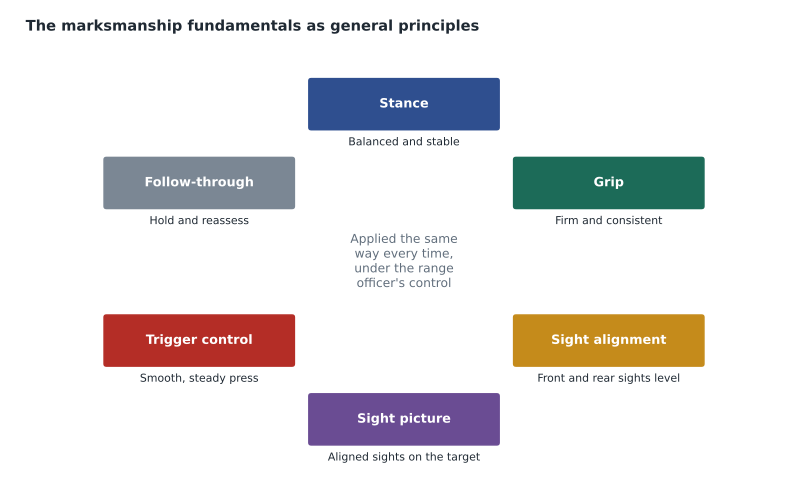
Stance
Stance is how the shooter stands. A good stance is balanced and stable, so that the shooter's body supports the firearm and is not knocked off balance when it fires. Instructors teach a stance that is natural and repeatable, with the feet comfortably apart and the body relaxed rather than rigid. Police training also expects officers to be able to shoot safely from positions other than standing still, because real situations rarely allow a perfect stance, but those positions are taught on the range, step by step, under an instructor's control.
Grip
Grip is how the shooter holds the firearm. A good grip is firm, consistent and high on the firearm, so that the firearm moves the same way each time it fires and returns to the same place. With a pistol, both hands usually work together. The grip is one of the fundamentals most affected by hand size, which is one reason services offer interchangeable grip panels or different frame sizes within their approved model. Ferris says that a shooter who cannot reach the trigger properly while holding the firearm correctly will struggle with every other fundamental. 'Fit comes first,' she says. 'Then grip. Then everything else.'
Sight alignment and sight picture
Most police pistols have two sights: a front sight near the muzzle and a rear sight near the back of the slide. Sight alignment means lining up the front sight in the notch of the rear sight, so that the top of the front sight is level with the top of the rear sight and centered in the notch. Sight picture means placing those aligned sights on the target. The human eye cannot focus sharply on three things at different distances at once, so shooters are traditionally taught to focus on the front sight, letting the rear sight and the target appear slightly blurred. Optic sights, which project a small illuminated dot, simplify this by letting the shooter focus on the target with the dot superimposed on it, which is one reason many services have adopted them.
Sight alignment matters more than most new shooters expect. A small error in alignment at the firearm becomes a large error at the target, and the error grows with distance. That is one reason the fourth safety rule is so important: the further away the target, the more chance that a bullet will not strike where intended.
Breathing
Breathing moves the chest and shoulders, which moves the firearm slightly. Shooters in precise target disciplines are taught to fire during the natural pause at the end of a breath, when the body is most still. In police work, where officers may be breathing hard after running or struggling, this is less about a precise technique and more about awareness: the body is less steady when breathing is fast, and accuracy suffers. Training that raises officers' heart rates before they shoot, under close supervision, helps them understand that effect.
Trigger control
Trigger control means pressing the trigger smoothly and steadily straight back until the firearm fires, without moving the rest of the firearm. It is widely considered the most important and the most difficult fundamental. When a shooter anticipates the noise and recoil, they often push or jerk the firearm just as the trigger breaks, and the shot goes low or to one side. Instructors watch for these errors and coach shooters to keep the sights aligned throughout the press.
Trigger control and trigger discipline are different ideas. Trigger discipline, the third safety rule, is about where the finger is when the shooter has not decided to fire. Trigger control is about how the finger moves once the decision to fire has been made. Both matter, and both are practiced until they are automatic.
Follow-through
Follow-through means maintaining the fundamentals for a moment after the shot, so that nothing disturbs the firearm while the bullet is still in the barrel and so that the shooter is ready to reassess. In police training, follow-through has a second meaning that matters more than any score: after firing, the officer reassesses the situation. Has the threat ended? Is anyone else in danger? Is it safe to approach? Do I need to call for help? Lesson 9 returns to this when it discusses decision-making, and Lesson 11 when it discusses what happens after a shooting.
How the fundamentals are trained
Range training builds the fundamentals in stages. New shooters start with explanations and demonstrations, then practice with training replicas or with firearms that have been proven unloaded, in designated areas and under an instructor's control, before firing live rounds at short distances on the range. Instructors watch where shots strike and how the shooter moves, and they correct one fault at a time. As skills develop, training adds distance, time limits, movement, low light and decision-making, always on the range and always under supervision.
Practice without live ammunition, often called dry practice, is an important part of training, and it is also a known cause of unintended discharges when it is done carelessly. Police services that allow it set strict rules: it is done only where policy permits, with the firearm proven unloaded by two checks, with all ammunition removed from the room, with the muzzle pointed at a surface that would stop a bullet and with a deliberate routine for ending the session before reloading. Many services allow it only on the range or with dedicated training firearms that cannot fire live ammunition. 'Most people who shoot their television did it during dry practice,' Ferris says. 'The firearm was loaded because they reloaded it and then did one more practice press.'
| Fundamental | What it means | Common error an instructor watches for |
|---|---|---|
| Stance | Balanced, stable, natural position | Leaning back or standing rigid |
| Grip | Firm, consistent, high hold | Loose or inconsistent hold, poor fit for hand size |
| Sight alignment | Front sight level and centered in the rear notch | Front sight high, low or off to one side |
| Sight picture | Aligned sights placed on the target | Focusing on the target instead of the sight, or the reverse with an optic |
| Trigger control | Smooth, steady press straight back | Jerking or pushing the firearm as the shot breaks |
| Follow-through | Holding steady after the shot and reassessing | Dropping the firearm or looking up too soon |
Measuring accuracy on the range
On the range, accuracy is measured on paper or cardboard targets with scoring zones. Instructors look at two things: whether shots land in the scoring zone, and how close together they are, which shows consistency. A tight group that is off-center often means the fundamentals are being applied consistently but something, often sight alignment or the sights themselves, is slightly off. A wide scatter often means the fundamentals are not being applied consistently, with trigger control a common cause. Instructors use these patterns to coach, not to judge.
| Shot | Right (+) or left (−) | Up (+) or down (−) | Distance from aiming point | In zone |
|---|---|---|---|---|
| 1 | +1.2 | −0.8 | 1.4 | Yes |
| 2 | +0.4 | +0.3 | 0.5 | Yes |
| 3 | −0.6 | +1.1 | 1.3 | Yes |
| 4 | +2.9 | −3.4 | 4.5 | No |
| 5 | +0.1 | −0.2 | 0.2 | Yes |
| 6 | −1.0 | +0.6 | 1.2 | Yes |
| 7 | +0.8 | +1.4 | 1.6 | Yes |
| 8 | −0.3 | −1.1 | 1.1 | Yes |
| 9 | +1.6 | +0.2 | 1.6 | Yes |
| 10 | −0.9 | −0.4 | 1.0 | Yes |
Worked problem
Scoring the target
Using the table, find the number of hits, the middle of the group and the widest distance between two shots.
Show solution
- A shot is a hit if its distance from the aiming point is 3.0 inches or less. Only shot 4, at 4.5 inches, is outside, so 9 of 10 are hits.
- The middle of the group is the average of the right–left values and the average of the up–down values.
- \[\bar{x}=\frac{4.2}{10}=+0.42,\qquad \bar{y}=\frac{-2.3}{10}=-0.23\]
- The widest pair is shot 4 and shot 3: 3.5 inches apart sideways and 4.5 inches apart vertically.
- \[\sqrt{3.5^2+4.5^2}\approx 5.7 \text{ inches}\]
Answer: 9 of 10 hits, a group centered about 0.42 inches right and 0.23 inches low, and a widest spread of 5.7 inches, caused almost entirely by shot 4.
In the invented target, nine of ten shots were in the scoring zone, and the group was roughly centered on the aiming point, which suggests good sight alignment. One shot landed well low and to the right, the kind of flyer that instructors often trace to a single moment of poor trigger control. An instructor would ask the shooter what happened on that shot and watch the next few closely.
From range scores to real situations
Desjardins warns the class not to confuse range scores with performance in real incidents. Research on police shootings, which Lesson 9 examines, consistently finds that officers strike their intended target far less often in real confrontations than on the range. Real incidents involve stress, movement, poor light, short time, unexpected distances and people who are moving and may be shooting back. The fundamentals are necessary but not sufficient. Good judgment about when to fire, and when not to, matters more than any score, and officers who know that their accuracy will fall under stress have one more reason to use cover, distance and time to avoid having to fire at all.
Ferris adds that this is also why she trains officers to think about what is behind the target every time they fire on the range, even though the range has a backstop. 'I want it to be a habit to see the background,' she says. 'On the street, nobody builds you a backstop.'
Worked problem
Reading a target with an instructor
A recruit fires ten rounds at a target. Eight shots form a tight group about two inches low and to the left of the aiming point; two shots are scattered further away. What might an instructor consider, and what should the recruit not do?
Show solution
- The tight group suggests the fundamentals are being applied consistently, so the cause may be a small, repeated error or a sight issue.
- The two scattered shots suggest occasional lapses, often in trigger control.
- The instructor watches the next shots and may check the sights or ask an armorer to check the firearm.
- The recruit should not adjust the sights or modify the firearm; only an armorer does that, and only if the firearm is at fault.
Answer: The instructor diagnoses and coaches one fault at a time. The recruit reports what they felt and follows instructions, but does not change the firearm.
Common mistakes
MistakeAccuracy is about getting good scores.
InsteadAccuracy is about being responsible for where every bullet goes, including bullets that miss.
MistakeTrigger control and trigger discipline are the same thing.
InsteadTrigger discipline is keeping the finger off the trigger until the decision to fire; trigger control is how the trigger is pressed once that decision is made.
MistakeDry practice is always safe because no ammunition is used.
InsteadDry practice causes unintended discharges when done carelessly; it is done only under strict rules where policy permits.
MistakeHigh range scores mean an officer will be accurate in a real incident.
InsteadAccuracy falls sharply under stress; judgment, cover, distance and time matter more than scores.
Summary and key terms
- The fundamentals are stance, grip, sight alignment, sight picture, breathing, trigger control and follow-through.
- They are taught as general principles but learned only through supervised range training.
- Trigger control is often the hardest fundamental; trigger discipline is a separate safety rule.
- In police work, follow-through includes reassessing whether the threat has ended.
- Dry practice is valuable but dangerous when careless, and services set strict rules for it.
- Range accuracy does not carry over fully to real incidents, so judgment and the background always matter.
- Sight alignment
- Lining up the front sight in the rear sight notch.
- Sight picture
- Placing the aligned sights on the target.
- Trigger control
- Pressing the trigger smoothly without disturbing the firearm.
- Follow-through
- Maintaining the fundamentals after the shot and reassessing the situation.
- Dry practice
- Practice without ammunition, under strict safety rules.
- Group
- The pattern made by several shots on a target, which shows consistency.
Practice problems
Work each problem on paper first, then reveal the answer to check.
Why does a small sight alignment error matter more at a distance?
Show answer
The error at the firearm grows larger the further the bullet travels.
What is the difference between trigger control and trigger discipline?
Show answer
Discipline is keeping the finger off the trigger until deciding to fire; control is pressing it smoothly once the decision is made.
What does follow-through mean in police training, beyond technique?
Show answer
Reassessing whether the threat has ended and whether anyone needs help.
Why do many unintended discharges happen during dry practice?
Show answer
The firearm is reloaded and the shooter does one more practice press.
Lesson quiz · 5 questions
Score 60% or more to complete this lesson.
Create a free account to save your progress, take quizzes and earn a certificate.