
LES-207 · Lesson 12 of 12 · 20 min
Capstone: reviewing a firearms incident
▶ Video coming soon A video version of this lesson is on the way.
The last class of the course is a review. Desjardins divides the students into four teams and gives each team the same file: the radio recordings and both camera videos from Kettle Creek Road, the timeline, the scene diagram, the forensic summary, Okeke's training and qualification records, Coutu's and Haddad's accounts, the Bureau of Criminal Investigation's summary, the prosecutor's summary of the grand jury presentation and the service's own review. Ferris and Haddad sit at the back of the room. 'You are not deciding whether Okeke committed a crime,' Desjardins says. 'The grand jury has already done that. You are doing what a good service does after every serious incident: asking what went well, what could have gone better and what should change.'
The review method is the one the program has used in earlier capstones. The teams score the incident in ten areas, from 0 to 2 in each, using a shared rubric: 2 means the action met the standard expected of a well-trained officer, 1 means it met the standard only partly, and 0 means it fell clearly short. They must base every score on evidence in the file, and they must keep four questions separate throughout: was the force lawful, was it within policy, was medical care adequate, and was the incident properly recorded?
The facts the teams agreed on
The teams start by agreeing on the facts, a step Desjardins insists on before any judgment. Okeke was dispatched at 2:44 a.m. to a report that a man who had been drinking had pointed a rifle at his brother-in-law and driven off. At 2:58 he found the pickup at the Kettle Creek Road boat launch. He stopped well back on the road, behind his engine block, and called for backup. In that first radio call he gave his location as Kettle Creek Road without saying that he was at the boat launch, and Coutu drove first to the trail access about half a mile away, arriving at the boat launch at 3:06 instead of about three minutes earlier. For about five minutes Okeke tried to talk Vossberg out of the pickup without the rifle. At about 3:09 Vossberg got out holding the rifle. At 3:11:02 he raised it and fired one round, which struck the front of Okeke's car. Okeke fired three rounds; one struck Vossberg, who fell and dropped the rifle. Okeke stopped firing, radioed for an ambulance within about twenty seconds, and the officers gave first aid when the scene was safe. Vossberg survived.
Behind Vossberg, from Okeke's position, were the boat ramp, the creek and an empty field. The nearest house was about 2,000 feet away and was not in the line of fire. Forensic investigators recovered two of Okeke's three projectiles; the third was not found and was believed to have entered the creek. Okeke's body-worn camera began recording about forty seconds after he stopped his car. Coutu's camera recorded throughout.
The scores
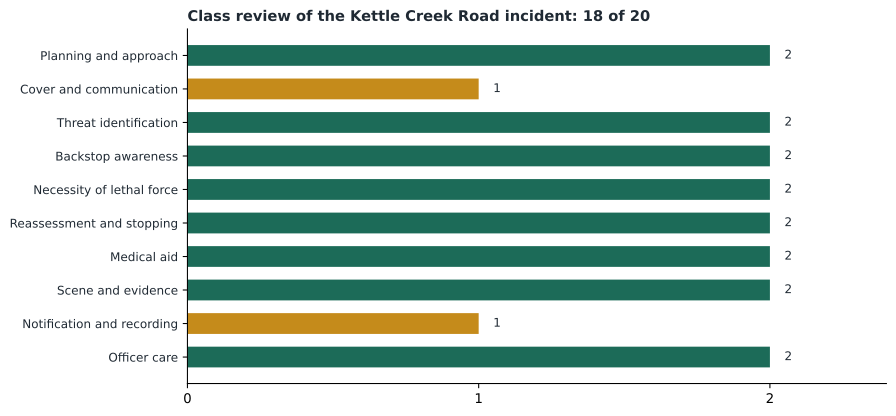
| Area | Score | Evidence and reasoning |
|---|---|---|
| Planning and approach | 2 | Stopped well back behind the engine block, waited for backup and did not approach a man reported to have a rifle |
| Cover and communication | 1 | Good use of cover and a calm attempt at dialogue, but the imprecise first location broadcast delayed backup by about three minutes |
| Threat identification | 2 | Vossberg was visibly holding a rifle and had just fired it toward the officers; there was no doubt about the threat |
| Backstop awareness | 2 | The creek and an empty field lay behind Vossberg, with no homes in the line of fire; one projectile went into the creek |
| Necessity of lethal force | 2 | A rifle had just been fired at the officers and was still in Vossberg's hands; the force met the Graham and Barnes standard and the grand jury declined to indict |
| Reassessment and stopping | 2 | Okeke stopped firing when Vossberg fell and dropped the rifle, about two seconds after the first shot |
| Medical aid | 2 | Ambulance requested within twenty seconds; tourniquet applied and timed within five minutes; clear handover to paramedics |
| Scene and evidence | 2 | Scene taped and logged, rifle location noted before it was moved, officers separated, pistol left holstered for investigators |
| Notification and recording | 1 | Oversight and supervisors notified promptly, but Okeke's camera started about forty seconds late, contrary to policy |
| Officer care | 2 | Relief from duty, psychologist within seventy-two hours, peer support for Okeke and Coutu, gradual return |
The teams disagree on one score. Two teams first give planning and approach a 1, arguing that Okeke could have stayed even further back, waited for more officers and asked for a crisis negotiator before speaking to Vossberg at all. Haddad answers that question from the back of the room. A negotiator was about forty minutes away at that hour, Vossberg's pickup was at a public boat launch that early-morning fishermen use, and Okeke's position was already well beyond the range at which he could clearly see Vossberg's hands without the spotlight. After discussion, the teams agree on a 2, but they record the question about negotiators as a point for the service to consider in its planning for rural calls. Desjardins tells them that this is exactly how a review should work: disagreements are resolved by evidence and recorded when they reveal a real question.
| Area | Score |
|---|---|
| Planning and approach | 2 |
| Cover and communication | 1 |
| Threat identification | 2 |
| Backstop awareness | 2 |
| Necessity of deadly force | 2 |
| Reassessment and stopping | 2 |
| Medical aid | 2 |
| Scene and evidence | 2 |
| Notification and recording | 1 |
| Officer care | 2 |
The total is 18 of a possible 20. The two areas that scored 1, cover and communication and notification and recording, are the ones the service's improvements must be tied to, each with the evidence that cost the point.
What the service changed
The class compares its review with the service's own. Port Ardent's administrative review, completed on November 6, found the shooting within policy and reached conclusions close to the class's. The service identified the same two improvement points and made three changes.
First, dispatch software was changed so that when an officer requests backup, the system automatically sends the officer's GPS location to the responding units, which would have taken Coutu straight to the boat launch. Second, the service will test holster sensors that automatically start body-worn cameras nearby when a firearm is drawn, in a pilot planned for spring 2027; until then, supervisors are auditing camera start times on every call involving a weapon. Third, Ferris added a scenario to the 2027 requalification in which officers respond to a report of a person with a long gun in a rural setting, with points awarded for location broadcasts, positioning and identifying the background before any decision to fire. The question about negotiators for rural calls was referred to the service's emergency response planning committee.
Looking back across the course
Desjardins asks each team to compare Kettle Creek Road with the two other incidents in the course. The clearing station discharge in March 2025 was caused by routine handling going wrong: fatigue, distraction and two broken safety rules, caught by the third. Riverside Park in April 2026 showed what time, distance, cover and light can do: a call that could have ended in a tragic shooting of a young man with a replica ended with a conversation. Kettle Creek Road showed an officer facing a real threat to his life, using lethal force lawfully and within policy, stopping when the threat ended and then working to save the life of the man he had shot. The teams notice that every incident involved the same four safety rules, the same habits of reassessment and the same need to record and review honestly.
Jesse Morningstar says that what surprised him most was how much of the course was about not shooting. Ferris agrees. 'A firearm is the one piece of equipment on your belt that you hope never to use on a person,' she says. 'Everything we do on the range, everything in this course, is about two things: making sure that if you ever have to fire, you do it lawfully, accurately and only as long as necessary, and making it as unlikely as possible that you ever have to.'
What a good review looks like
Desjardins closes with the features of a good firearms review, which apply to every serious incident the students will ever be part of. It begins with the facts, gathered from every available source, and agreed before anyone judges them. It keeps legal, policy, medical and recording questions separate, because an incident can be lawful but still reveal policy or training gaps. It scores against a known standard so that reviews are consistent. It ties every improvement to a specific piece of evidence. It looks for system causes, such as dispatch software or camera design, as well as individual decisions. It records disagreements honestly. And it treats the people involved fairly, recognizing that the officers made decisions in seconds that reviewers can study for weeks.
Vossberg's case is still before the courts. He has pleaded not guilty and is presumed innocent, and his trial is scheduled for 2027. The class review, like the service's, looked only at the officers' actions. 'Whatever happens at that trial,' Desjardins says, 'the service has already learned what it needed to learn from that night. That is what accountability looks like when it works.'
Writing up the review
Each team's final task is to write a two-page review report, the kind a service would keep on file and use in training. Desjardins gives them a structure. The report begins with a short, neutral summary of the facts. It then sets out the score for each area with the evidence behind it, in a table. It lists what went well, because practices that worked deserve to be repeated and taught. It lists the improvement points, each tied to evidence and each with a specific recommendation and an owner, such as the dispatch manager or the range master. It records any disagreements and how they were resolved. And it ends with a note on how the officers involved were consulted, since reviews are fairer and more accurate when the people involved can comment on the facts before the report is final.
Haddad tells the class that Okeke read the service's review in draft and corrected one detail: the time he first saw the rifle, which he remembered later than the camera showed. The review kept the camera's time and recorded his recollection, with a note about the memory effects studied in Lesson 9. 'He was not trying to change the story,' Haddad says. 'He was telling us what he remembered. The record should show both.'
Ferris adds one practical point. The best review reports are short enough to be read. A report that runs to fifty pages may be thorough, but if nobody on patrol reads it, nothing changes. The range now uses a one-page summary of each review in its briefings, so that officers learn from incidents across the service, not only their own.
Worked problem
Scoring one area
A team proposes scoring backstop awareness at 1, because one of Okeke's rounds was never recovered. Using the evidence in the file, is that score justified?
Show solution
- The rubric asks whether the officer was aware of the background and fired only where a miss would not endanger anyone.
- Behind Vossberg were the boat ramp, the creek and an empty field, with the nearest house about 2,000 feet away and not in the line of fire.
- A projectile entering the creek is consistent with a safe background, not evidence of carelessness.
- Missing a target under stress is expected; the question is whether the miss endangered anyone.
Answer: A score of 2 is justified. An unrecovered round is not in itself a failure; what matters is that the background was safe. The team should record its reasoning so that later readers see why the score was given.
Common mistakes
MistakeA review's job is to decide whether the officer committed a crime.
InsteadThat decision belongs to the oversight body, prosecutor or court; a review asks what went well, what could improve and what should change.
MistakeIf the force was lawful, there is nothing to learn.
InsteadLawful incidents often reveal gaps in communication, recording, equipment or training.
MistakeReviewers should judge with the benefit of hindsight.
InsteadReviewers must consider what the officers knew and how much time they had, while still learning from what is now known.
MistakeImprovements should focus only on the officer's individual decisions.
InsteadGood reviews also find system causes, such as dispatch software or camera design.
Summary and key terms
- A good review starts by agreeing the facts from every source.
- Legal, policy, medical and recording questions are kept separate.
- Kettle Creek Road scored 18 of 20; points were lost for an imprecise location broadcast and a late camera activation.
- The service changed dispatch software, planned a camera-activation pilot and added a rural long-gun scenario to requalification.
- Across the course, the four safety rules, reassessment and honest recording appear in every incident.
- The aim of firearms training is lawful, accurate and limited force when it is unavoidable, and avoiding it whenever possible.
- After-action review
- A structured review of an incident to learn what went well and what should change.
- Rubric
- A shared scoring guide that makes reviews consistent.
- System cause
- A cause rooted in equipment, procedures or organization rather than one person's decision.
- Line of fire
- The path a bullet would take, including beyond the target.
Practice problems
Work each problem on paper first, then reveal the answer to check.
Which two areas lost a point in the Kettle Creek Road review?
Show answer
Cover and communication, for the imprecise location broadcast, and notification and recording, for the late camera activation.
Why was the negotiator question recorded rather than scored?
Show answer
It revealed a real planning question for rural calls, and the evidence supported Okeke's approach on the night.
Name the three changes the service made.
Show answer
Automatic GPS location sharing on backup requests, a camera-activation pilot with interim audits, and a rural long-gun requalification scenario.
What does Ferris say firearms training is ultimately about?
Show answer
Firing lawfully, accurately and only as long as necessary if it is ever unavoidable, and making it as unlikely as possible that it is ever needed.
Lesson quiz · 5 questions
Score 60% or more to complete this lesson.
Create a free account to save your progress, take quizzes and earn a certificate.